A few years ago, we became familiar with a French publisher named Shakos and they make some very interesting games. At that time, we played a few smaller games, one called Saladin and the other Border States, and very much enjoyed the experience. We interviewed the designer of Border States named Stéphane Brachet and recently we caught wind of his new upcoming game from Shakos called Rex Britannorum and reached out to him to discuss it further. It is currently on Gamefound.
If you are interested in Rex Britannorum, you can back the project on the Gamefound page at the following link: https://gamefound.com/en/projects/shakos/rex-britannorum
Grant: Welcome back to the blog Stéphane. How have you felt about your Border States design and its reception?
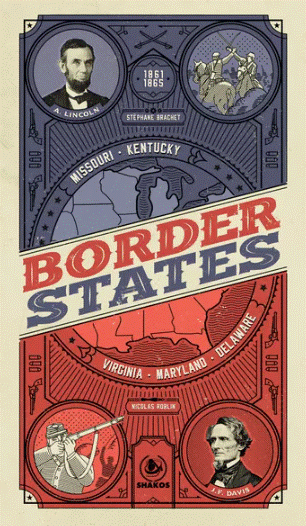
Stéphane: Thank you for the invitation; I’m very happy to be back to talk about Rex Britannorum. As for Border States, I’m truly pleased with the feedback the game received at the conventions and festivals where I presented it. Players had the opportunity to explore the role of the border states in the American Civil War. The placement and bluff mechanics with only 10 blocks per player were a big hit and have inspired me with ideas for future games.
Grant: What have you learned from that process that will help you with other future designs?
Stéphane: Border States wasn’t my first game, but it was my first collaboration with Shakos. Even more than for Border States, we worked hard with Shakos early on to introduce and playtest Rex Britannorum at different gaming conventions. This allowed us to fine-tune every detail and to deliver an optimal gaming experience right from the launch of the Gamefound campaign. This process was very rewarding and served as a good lesson for future projects.
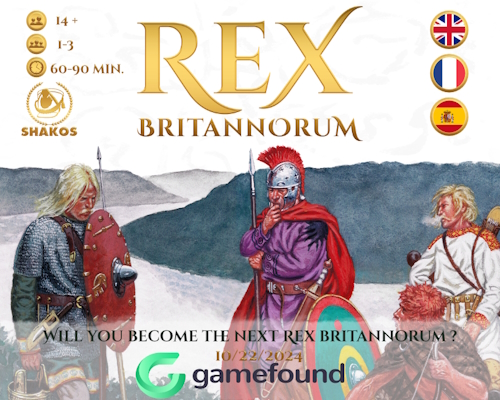
Grant: What is your newest design Rex Britannorum about?
Stéphane: Rex Britannorum immerses players in the first century, following the Roman invasion of the island of Britain and the creation of the province of Britannia. Players take on the roles of client kingdoms allied with Rome, competing for control of territory in the hopes of being named “Rex Britannorum” by the Romans. Rex Britannorum is a strategic level game focused on battles, territory conquest and secret objectives and is designed for 1 to 3 players.
Grant: What was your inspiration for the design?
Stéphane: The idea for Rex Britannorum was born a few years ago after listening to a podcast about the British client kingdoms and their allegiance to Rome. This theme intrigued me, and I delved into the history of Britannia and the conflicts among the British tribes of that era. At the same time, I was working on a prototype I had created for three-player confrontations. I combined the two ideas, and that became the starting point for Rex Britannorum.
Grant: What is your design goal with the game?
Stéphane: As with Border States, my goal was to create an accessible conflict game with battle resolutions that allows players to discover and explore a specific historical period. This time, I also wanted the game to be playable with more than two players.
Grant: What sources did you consult to get the historical details correct? What one must read source would you recommend?
Stéphane: I explored numerous sources to cross-reference information, including the websites of various museums, which offer a wealth of historical details. The goal was to stay true to the historical context without impacting the playability of the game. I didn’t rely on any single, essential source; there’s a lot of material on the topic, and British museums also offer many useful online resources to explore this period of Roman occupation.
Grant: What elements did you need to model from the Roman occupation of Britain?
Stéphane: First and foremost, the three kingdoms played by the players were significant client kingdoms of Rome at that time.
The roads, cities, and regions at the heart of the game are inspired by Roman-occupied Britannia. The division of the board into regions reflects the period’s divisions, though exact boundaries are open to interpretation. While the roads draw inspiration from major routes of the time, such as Ermine Street or Dere Street, the cities along these routes represent emblematic locations of this era.
Grant: What is the layout of the game board? What do the different colored regions represent?
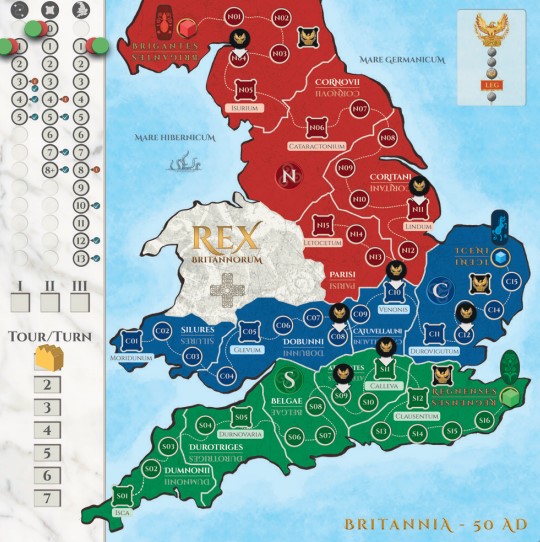
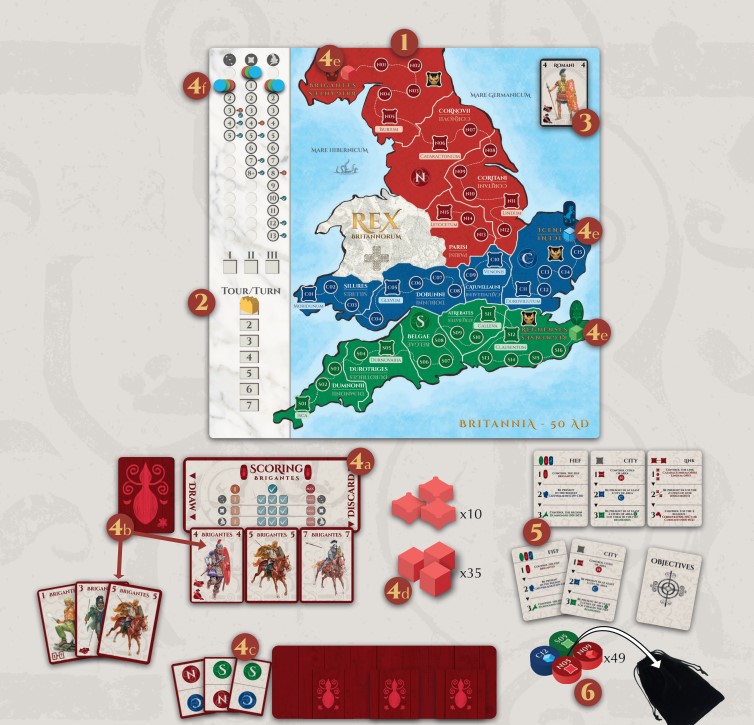
Stéphane: The game board represents the Roman province of Britannia in the first century, covering a large part of the island of Britain. The board is divided into three colored areas: the North, the Center, and the South. Each of these areas serves as a theater of combat, where players will fight for control of the roads, cities, and regions.
Grant: What is the purpose of the 3 Stake Tracks? What does each represent?
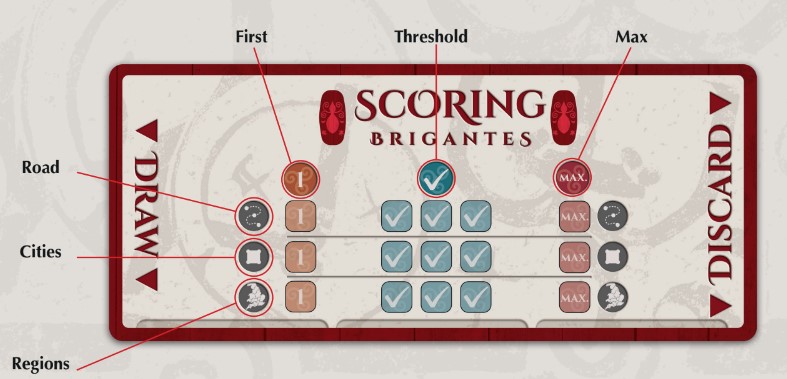
Stéphane: The three Stake Tracks are each associated with a stake of the game: roads, regions, and cities, allowing players to score victory points based on their progress in each track. Each track has strategic thresholds that, once crossed, award victory points. Some of these thresholds are only marked by the first players to reach them, creating a race for certain stakes. Additionally, extra victory points are awarded to players who advance the furthest on each of these tracks.
Grant: What purpose do roads serve? Connections?
Stéphane: In Rex Britannorum, the roads of Britannia are divided into locations connected by links (connections). One of the main objectives, represented by one of the Stake Tracks, is to control the longest chain of connected locations on the board. The roads and connections also play a crucial strategic role in achieving the secret objectives assigned to each player at the beginning of the game.
Grant: What different factions are represented? What asymmetry is included?
Stéphane: The game highlights three factions: the Iceni, the Brigantes, and the Regnenses, representing three significant client kingdoms of this era. There’s no asymmetry between the factions when played by players, all have the same Troops Cards. However, when a faction is in automatic mode, for two-player or solo games, it adopts a specific behavior that reflects the behavior of the simulated king or queen.

Grant: What is the role of the Troops and Reinforcements Cards? How does the design use these cards?
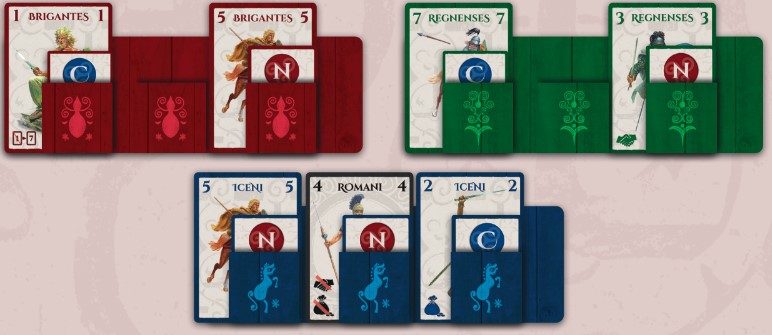
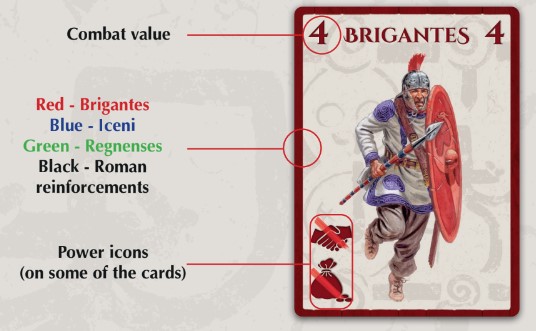
Stéphane: In Rex Britannorum, the Troops and Reinforcements Cards are central to military strategy. Each Kingdom has 14 Troops Cards, with values ranging from 1 to 7, and each card appears twice. The card with a value of 7 is the most powerful for winning battles, but the cards with values from 1 to 4 have powers that players must use wisely.
Each turn, players will play two Troops Cards, and once the battles are resolved, the cards are discarded. Since the game lasts 7 turns, all cards will be played! Players must therefore find the best time to play their highest cards while optimizing the use of weaker ones to take advantage of their powers. Managing the deck of Troops Cards is a key strategic element in Rex Britannorum.
Reinforcements Cards can come to the players’ aid. If a player finishes a turn without any gains, they can call upon Rome’s help and select a Reinforcements Card from those available. These cards function as additional Troops Cards, but are limited to values of 3, 4, and 5. They allow players to add a third card in an upcoming battle, increasing their chances of success.
Grant: How are the Deployment Mini-Cards used?
Stéphane: The Deployment Mini-Cards are associated to the three areas of the board: North (N), Center (C), and South (S). Each turn, players place two Troops Cards in their cardholder combined with two of their Mini-Cards to indicate the areas where their troops will engage in battle. Players can send both Troops Cards to the same area or to two different areas.
Grant: What purpose does the draw bag serve? How do players utilize the Location Tokens when drawn?
Stéphane: At the beginning of the game, the draw bag contains the 49 Location Tokens, each token corresponding to a specific location on the board. Each turn, players draw 7 tokens from the bag and place them on their respective locations on the board. This draw determines the locations for which players will fight during the turn. When a player wins a location, they replace the token with one of their Control Cubes or Oppidum, indicating their control over the territory.
Grant: How do players earn Victory Points?
Stéphane: Players earn Victory Points in two ways in the game. During the game, they score points by advancing on the Stake Tracks and completing achievements. Then, at the end of the game, players score additional points based on the conditions of the Objective Cards they have successfully fulfilled.
Grant: What is the role of Objective Cards? How many of these cards are there?
Stéphane: As mentioned in the previous question, the Objective Cards is a way to earn additional Victory Points at the end of the game. There are three types of Objective Cards: Link, Fief, and City, with six cards of each type.
At the start of the game, players receive two Objective Cards. Each card has three conditions numbered 1 to 3 and, at the end of the game, each fulfilled condition awards one Victory Point. However, to score the point for condition No. 2, condition No. 1 must be fulfilled, and similarly, condition No. 3 will only score if condition No. 2 has been achieved.
In addition to providing Victory Points, the Objective Cards direct players toward specific areas of the map and guide their strategy to win key battles.
Grant: What different Achievements are available to each faction?
Stéphane: There are three types of Achievements in the game: First, Threshold, and Max. Each type is associated with special spaces on the three Stake Tracks:
- First: Only the first players to reach this space on the Track will score 1 Victory Point.
- Threshold: All players who reach these spaces will score 1 Victory Point for each space reached.
- Max: On each Track, players who have progressed the furthest will score 1 additional Victory Point.
The Victory Points earned from these achievements are recorded on each player’s individual Scoring Board.
Grant: How do Battles work?
Stéphane: In each turn, Battles take place in the three areas of the board. Each player sends 2 Troops Cards into these different areas using their Deployment Mini-Cards to try to control the locations designated by the Location Tokens placed in each area.
Each battle rewards the player who played the highest combat strength in the area by adding the values of their Troops Cards. The winner of an area gains up to 3 locations; if there are more than 3 tokens available, they must choose only 3. Then, they place a Control Cube on a Road Location or one of their Oppidum on a City. The remaining locations are assigned to other players who also deployed Troops Cards in that area but lost the battle, or to Rome if they cannot be assigned to any player.
Each battle offers different potential gain, providing players with strategic choices based on their targeted Achievements and Objectives.
Grant: What are the special powers of the different Troops Cards?
Stéphane: Troops Cards with values 5 to 7 have no special powers, as they represent significant combat strength. However, cards with values 1 to 4 have special abilities:
- Value 1 Card: In a battle in an area, if a card with a value 7 is played by a kingdom, the value 1 cards of the other kingdoms have a combat value of 7. With clever understanding of opponents, this can turn the tide of a battle.
- Value 2 Card: In a defeated battle, this card allows the player to steal one of the cards played by the winner in that battle to make it a Mercenary. This stolen card can be played as a third Troops Card in a future battle, similar to Reinforcements Cards. Not all battles can be won during the game, and sometimes it’s necessary to lose one to prepare for the next.
- Value 3 Card: Like the value 2 card, in the case of a defeat, this card allows the player to place a Control Cube on one of the locations won by the winner. This card enables the player to aim for a specific location even in defeat.
- Value 4 Card: When played by the winner in a battle, this card neutralizes the powers of value 2 and 3 cards played in that battle! This card allows players to counter their opponents’ strategies if they can guess their plans.
Since each Troops Card is played only once in the game, it’s important to remember the cards that have already been used! These powers offer interesting tactical choices for players who have a good grasp of the stakes and their opponents.
Grant: What is the concept of Evaluation and what does it represent?
Stéphane: The Evaluation is an essential phase in the sequence of the game. After the resolution of battles and the allocation of the gains, each player assesses their progress on the three Stake Tracks: what is their longest route on the board? In how many cities is the player present? In how many regions is the player present? Players adjust their markers on the three Tracks based on this evaluation and record the Achievements they have reached on their scoring board.
Grant: To summarize, what is the general sequence of play?
Stéphane: To summarize, a turn in Rex Britannorum:
- Determining Turn Order
- Determining Locations to Conquer: The first player draws 7 Location Tokens from the bag and places them on the board in their corresponding locations.
- Recruitment: In turn order, each player adds 2 Troops Cards to their hand by choosing from their recruitment queue or drawing from their card deck.
- Planning: Each player secretly associates 2 Troops Cards from their hand with 2 Deployment Mini-Cards indicating the areas on the board where they will battle. A player may select 1 Reinforcements or Mercenary Card in addition if they have one.
- Resolving Battles: In each area, Battles are resolved by adding the values of the Troops Cards played by each player. The winner is the player with the highest combat value.
- Assigning Gains: The winner chooses up to 3 drawn locations. Other players can obtain a maximum of 2 remaining locations. Unassigned locations go to Rome.
- Applying Card Powers: Powers from played cards are resolved.
- Evaluation on Tracks: On each Track (Routes, Cities, Regions), players update their totals and note their Achievements on their scoring board.
- End of Turn: All played cards are discarded, and players get back their Deployment Mini-Cards. The turn marker is advanced by one.
At the end of the 7th turn, the winner of the game is determined.
Grant: How does the solitaire mode work?
Stéphane: On the back of each individual Scoring Board there is a description of a Non-Player Kingdom (NPK), each with unique and automated behavior. In a solo game, the player chooses the kingdom they want to play and faces the two others NPK’s throughout the game.
The player’s objective is to score as many points as possible out of a total of 24 Victory Points. Their performance is evaluated on a scale ranging from “ A junk Rex who will end up devoured by lions in the Colosseum” to “More than a Rex, a legend.”
Grant: How does the solitaire make decisions? What are its priorities?
Stéphane: Each Non-Player Kingdom (NPK) has a distinct behavior reflecting the character of its king or queen:
- Cogidubnus: Impulsive and unpredictable. He deploys both of his Troops Cards randomly across different areas, making his moves challenging for the player to anticipate.
- Prasutagos: Greedy. His first Troops Card always targets the area with the most locations to win, while his second card is deployed randomly in one of the three areas.
- Cartimandua: Always prepared but can surprise. Her deployment areas are partially revealed to the player before each battle, allowing the player to anticipate her actions and adapt accordingly.
Grant: What type of experience does the solo mode create?
Stéphane: Solo mode provides a direct challenge against the game itself, pushing players to aim for the highest score! Facing off against Non-Player Kingdoms, with unpredictable or goal-driven behaviors, demands close attention. Players need to carefully track and memorize the cards played by the two NPK’s, adapting their strategy accordingly.
Grant: What are you most pleased with about the design?
Stéphane: I believe we’ve succeeded, with Shakos, in creating a game that is both simple, with easy-to-learn rules, and compact, around 60 minutes for a game, yet far from being simplistic. There’s a great deal of strategy involved in managing your Troops Cards, reading your opponents to make the best choices, and analyzing each battle to achieve your Accomplishments and Secret Objectives.
Grant: What has been the experience of your playtesters?
Stéphane:This has been a long journey, as the project started five years ago. There were several versions of the game before reaching this one, and I want to thank my most loyal and dedicated testers for their invaluable help. For about a year now, the game has been tested at various conventions in France, and the feedback has been very positive. Players appreciate the combination of territory conquest with « luck-free » combat and the strong interaction between players.
Grant: What other designs are you mulling over?
Stéphane: I have many projects underway, but regarding historical games, I am currently working on a particularly advanced project about the Battle of Verdun which took place in World War I. It will once again be a game for 2 players, with a format of about 60 minutes similar to Rex Britannorum.
If you are interested in Rex Britannorum, you can back the project on the Gamefound page at the following link: https://gamefound.com/en/projects/shakos/rex-britannorum
-Grant


I have been meaning to grab Border States, so this interview was great to “meet” the designer. Now I’ll probably back both Breizh 1341 and Rex Britannorum.
That is the “problem” with your blog — your interviews and reviews leave little chance not to purchase these games during this great age of gaming! I am going to be busy once I hit retirement, playing through my shelves of shame. LOL Cheers!
LikeLiked by 1 person