I think that every single wargamer knows the name Volko Ruhnke. He has designed several great series including the COIN Series, that has now stretched to a full 15 volumes (not all designed by Volko), and then more recently the Levy & Campaign Series, which has an astounding 4 released volumes (once again not all designed by Volko) with 3 others that are announced and about a dozen more in design.

He can make a good game for sure! One of our first experiences in wargaming and the first Volko design we played was Wilderness War. He is now at it again with a new design that uses hide and seek elements to tell the story of the Allied intelligence teams versus the Japanese in the Pacific during WWII. The game is called Coast Watchers: Allied Field Intelligence in the South Pacific, 1942-1943 and looks to be very interesting. We reached out to Volko and as usual he was very accommodating of our interview request.
*Please keep in mind that the artwork and layout of the various components shown in this interview are not yet finalized and are only for playtest purposes at this point. Also, as this game is still in development, rules and scenario details may still change prior to publication.
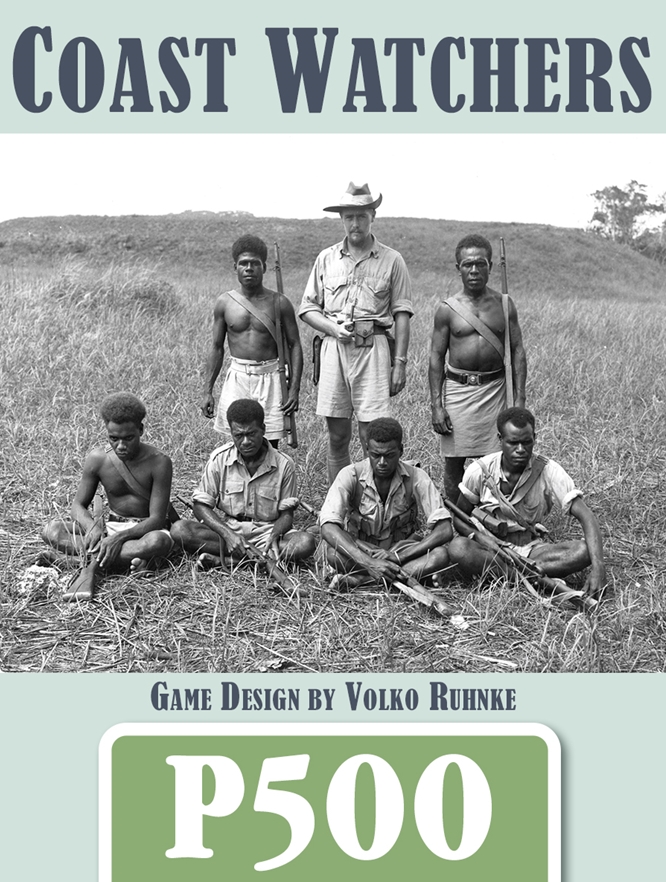
Grant: Welcome back as always Volko! What is your new design Coast Watchers about?
Volko: In Coast Watchers, players run a WWII network of intelligence operatives on Japanese-held jungle islands or the Japanese security forces hunting those spies.
Grant: What has been your attraction and interest in this topic?
Volko: I’m a retired intelligence analyst and am fascinated by the simulation of intelligence and deception in wargames. C3i Magazine Nr37 recently ran a survey that I wrote about denial and deception in wargames. I wanted to design an examination of the intelligence struggle in war, and I chose one of my favorite historical settings, the South Pacific campaigns of 1942-1943 during World War II.
Grant: How do you go about visualizing and creating these new and innovative systems? How does your design process work?
Volko: I start with historical dynamics that seem under-covered in games, then consider how adapted or invented game mechanics could represent them. So—similar to most wargame designers, I expect—my process goes from history to game play, rather than first building a play experience and then dressing it with a theme.
Grant: Why did you feel this topic could have a system built around it to meaningfully tell this story?
Volko: The exploits of the Allied coastwatchers are somewhat famous, but they have enjoyed only a cameo role (such as an event card) in previous boardgames. The cat and mouse between the Japanese and the coastwatching teams was not only complex and consequential but also involved dynamics of denial and deception that well-known game mechanics seemed not quite adequate to play out. So exploration via some new hidden-information techniques seemed well warranted.
Grant: What other designs did you use as inspiration for the system?
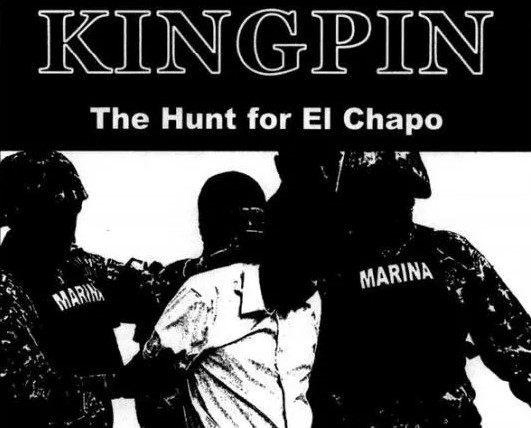
Volko: Coast Watchers draws on a short lineage back to an intelligence training game that I co-designed back in my day job, called Kingpin—The Hunt for El Chapo. I applied lessons learned in that law enforcement design to Hunt for Blackbeard, currently in production with Fort Circle Games. Coast Watchers inherits from that design a simple new way to enable secret actions on a shared board.
Grant: What were some of the major elements of this type of observation and early warning that needed to be included and modeled?
Volko: The precise makeup of the coastwatching network needed to be hidden from the Japanese player but discoverable. The coastwatchers needed Japanese military activity to observe and warn against, and that military activity similarly needed to be secret. And both sides—especially the coastwatchers—needed the ability to find out about the other side’s secrets without the opponent necessarily knowing that they knew.

Grant: What sources did you consult to get the historical details correct? What one must-read source would you recommend?
Volko: There is an ample range of histories written about the Allied side of this intelligence work, including from the view of indigenous personnel. The foundation source is the memoir of the commander of the Coastwatching Program, Eric Feldt’s The Coast Watchers.
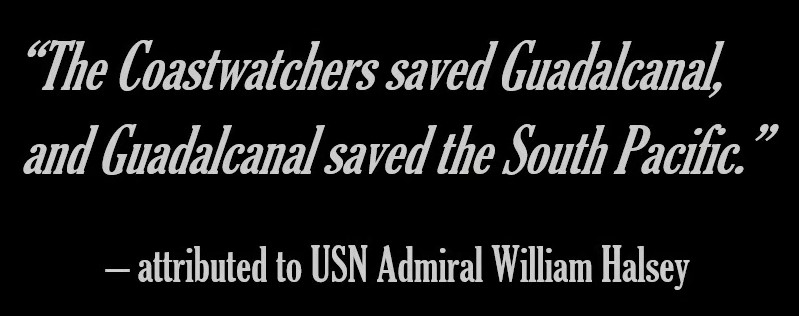
Grant: What does this quote mean to your vision of the game –“The Coastwatchers saved Guadalcanal, and Guadalcanal saved the South Pacific.”?
Volko: That statement attributed to USN Admiral Halsey shows the pivotal impact that this tiny number of daring individuals had on the outcome of the Pacific War. That is true for a range of achievements—from spying on Japanese buildup of forces to rescuing refugees and downed airmen. Halsey here specifically refers to tactical warning that coastwatchers along the Solomons provided to the US defense of Henderson Field. So the game needed to separately capture all these intelligence activities.
Grant: What role did the indigenous peoples of the South Pacific play in the Coastwatchers?
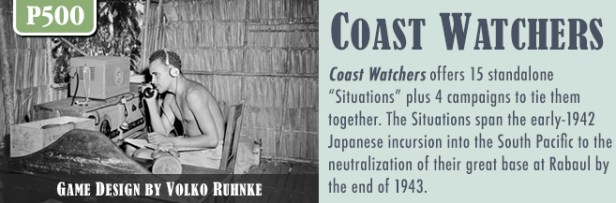
Volko: Solomon Islanders, Papuans, and other Melanesian inhabitants of Japanese-occupied territory were the make-or-break element to the coastwatchers’ success. Coastwatching stations were almost entirely reliant on local cooperation to keep them hidden. Natives to the region provided a cocoon of security around the mostly Australian coastwatching officers and served as coastwatchers themselves. Differing regional sympathies across the South Pacific are key to the players in Coast Watchers, via powerful cards for either side and far more effective Japanese search patrols when aided by pro-Japanese locals.

Grant: How are blocks used in the game? What do these blocks represent?
Volko: Blocks on the map show 32 historical coastwatching stations—typically a couple Australians with a bulky but transportable tele-radio, plus local scouts, spies, guards, carriers, and canoemen. Instead of unit blocks moving across the map, as in typical block games, the blocks represent the status of each station—manned by coastwatchers and/or guerrillas or inactive, or perhaps hosting Allied crew or refugees. The Allied player switches blocks out secretly. Japanese searches can reveal blocks face up, and Allied actions can stand them up again. If the Japanese player succeeds in capturing a block, that station becomes deactivated—known to the Japanese as clear of spies.

Grant: How are face down counters used to represent forces buildup?
Volko: Markers at each station space record the waxing and waning Japanese occupation. The control markers’ backs hide either “quiet”—nothing special happening for the coastwatchers to report—or various military buildups such as aircraft, warships, supplies, and so on. The Japanese player secretly switches these markers out to build up forces for victory points according to hidden mission cards.
Grant: What happens when forces build up beyond a certain point?
Volko: The Japanese build up forces for either static missions or air and sea “Operations”. The latter specify launch windows from Turn II through Turn V. If the Japanese player decides to launch any Operations, coastwatchers along flight paths or naval routes will score for warning. Launching an Operation ends the game, so games last just two to five turns. The Japanese need not launch any Operation, as they also can score for static missions plus taking Allied personnel captive.
Grant: How are blind draw chit cups used? What does this represent?
Volko: Coast Watchers uses chit pull instead of dice to represent opposed actions. The Japanese player searches for coastwatchers via a “Patrol cup” with a shifting number of “Patrol” and “Evasion” chits in it. The Allied player runs deliveries of supplies and personnel in and out of Japanese territory via a “Delivery cup” with “Sighting” and “Nothing Sighted” chits. The ability to adjust the number of each type of chit in the cups yields subtle simulation effects without specialized dice, die-roll modifiers, or much rules burden.
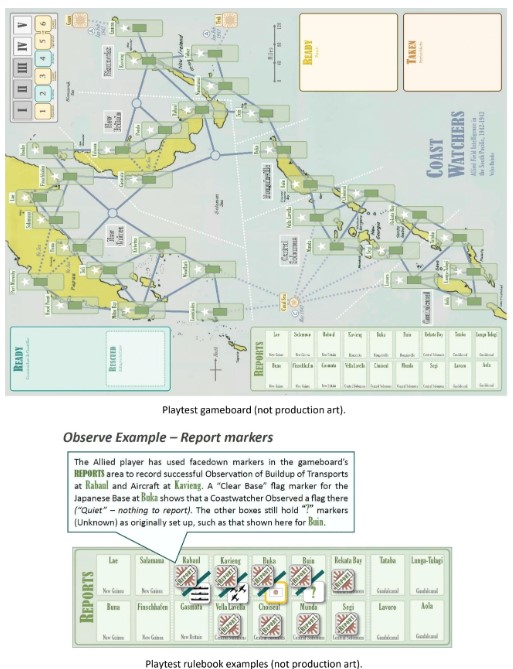
Grant: What is the layout of the board and the purpose of the different boxes such as Ready, Rescued and Reports?
Volko: A map of the South Pacific theater shows a network of coastwatching stations—one block at each. A Japanese “Ready” box holds Patrol markers awaiting deployment to the map or the Patrol cup—troops standing by to get out of their facilities and beat the bushes for spies. An Allied “Ready” box holds trained coastwatching teams waiting in Australia for insertion across enemy lines, plus civilian and military personnel (more blocks) that coastwatchers have rescued. Allies boxes also include “Reports”—hidden markers tracking the enemy’s military buildups that they have observed, typically without the Japanese player’s precise knowledge.
Grant: What are Mission cards? How do each side’s Mission Cards differ?
Volko: Japanese Mission Cards—whether air and sea Operations like “Torpedo Attack” or static such as “Airstrip Grading”—guide the buildups that the Japanese player can place to score—their main source of VP. The hitch is, the more buildups that the Japanese invest in, the more information there is out there for the coastwatchers to discover and report—a main source of VP for the Allied player. The Allied Mission Cards mostly add smaller scoring opportunities for the Allied player, bonuses for presence in enemy territory or for rescues, or open the door to run guerrilla resistance to Japanese patrols.
Grant: Can you show us a few examples of the Mission Cards and explain their use?
Volko: Above, we looked at Operations Missions, so here is a static Japanese “Fortification” Mission. Each Japanese Mission card shows the “Buildup” types that can score, where they need to go, and how many VP they earn. A key to play is that each Situation features a unique combination of cards that the Japanese might draw. The Allied player wants to figure out what the Japanese are up to and focus spying against that.
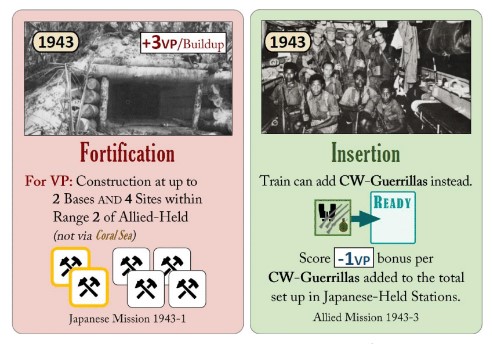
This Allied Mission Card shows both of the aspects of this deck—adding an ability helpful to scoring points, and adding small bonus scores. The Japanese player similarly can try to discern the coastwatchers’ priorities and focus their security measures accordingly.
Grant: What are Asset cards? What type of special abilities do they provide?
Volko: Decks of 22 cards for each side provide a wide range of added abilities that players only reveal at the first instant they use them. Key for the Allies are “Delivery” Assets that keep coastwatching stations supplied so they can continue to evade capture and that move personnel in and out of dangerous spots. Allied Assets also include helpful boosts to spying and other actions and to staying hidden. Japanese Assets include air and sea patrols to better spot Allied deliveries, aids to the execution of Operations with minimum Allied warning, and especially help in searching for coastwatchers.
Grant: Can you show us a few examples of the Asset cards and explain their use?
Volko: Here are two Allied Asset samples, the first a Delivery Asset and the second helpful to Observe actions. The use of Assets in the game is quite simple: whenever you use a card, you must show it (place it face up on the table) if still hidden your hand, or declare its use if already showing. Some cards get discarded when used, however stated on the card. For Deliveries, the Asset used sets up how many of each kind of chit goes in the Delivery cup—the base chance that the enemy will spot the delivery. A Submarine is particularly stealthy and high capacity, for really hazardous jobs; but you only get it for a time before the US Navy needs it for other duties.

These two Japanese Assets include one, Floatplanes, that both helps patrols search for coastwatchers and provides air patrol to try to spot Allied deliveries. The “Air Patrol -1x” here means all Allied deliveries will have one fewer “Nothing Sighted” chit in the cup. You can imagine Japanese float Zeros routinely patrolling the islands looking for Allied submarines, Catalinas, boats, and the like. Tanaka here instead will diminish Allied warning of Japanese warship approach—representing his timing of the famous “Tokyo Express” to Guadalcanal to come within Allied air range only during darkness. The Japanese player would not need to show the Tanaka card until launching such an Operation at the end of the game.
Grant: What is the general Sequence of Play?
Volko: In each of the game’s two to five turns, the Japanese get a brief “Preparations” Phase in which they either build up for Missions, ready more patrols to fan out looking for coastwatchers, or augment their Asset Cards with added draws. Then each side gets two main phases—delivery, operate, evade, and train actions for the Allies; recall, search, and deployment by patrols for the Japanese. An exception occurs if the Japanese opt to launch any air and sea operations at the end of a turn, in which case they give up their last phase searching for coastwatchers and, instead, missions score and the game ends.
Grant: How do players keep their actions and movements secret?
Volko: The simple but perhaps unusual way that players exchange blocks or markers secretly is to ask the opponent briefly to look away from the board (or just close their eyes). That way, unlike typical block games, there is no clue to what has been altered anywhere on the board. Nor is there any need for screens. Also, the Japanese have an Asset—Eavesdropping—that enables them to peek at Allied blocks secretly in the same way.
Grant: What different Situations are included?
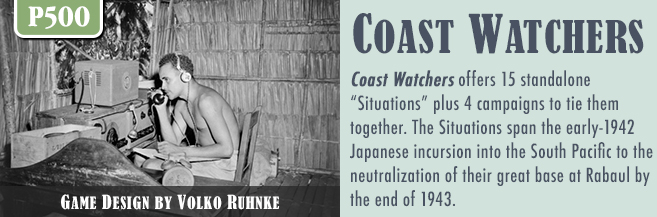
Volko: Coast Watchers includes 15 scenarios, called “Situations” because they provide the military context for intelligence operations. Each Situation is a snapshot of the South Pacific campaign from January 1942 to December 1943, and each poses its own challenges to the players. The first two Situations are small learning games that each use only a portion of the rules. The remaining 13 Situations—if played in chronological order—offer gradually more open options as players learn the game. You can find a preview of the 15 Situations here on InsideGMT.
Grant: How are campaigns formed? How is victory achieved in these Situations and Campaigns?
Volko: While different cards can earn different victory points, and setup changes with each Situation, the basic scoring for taking coastwatchers captive, reporting enemy buildups, and so on remains the same throughout the game. The Japanese subtract the Allied score from their own and must reach some net VP threshold to win that Situation. So a question for the Japanese player, for example, is how many net VP launching a given operation will earn, once the coastwatchers’ VP for warning take away points. Four campaigns in the game link different trios of Situations together to look at different periods within the 1942-1943 campaign, with the winner of one Situation earning advantages in the next.


Grant: What is the focus of the solitaire mode? How does the AI operate?
Volko: We in fact have two separate solitaire modes in development: Allied solitaire and Japanese solitaire. Each has its own added rules on a separate foldout, and each uses a dedicated deck of cards to help run the automatic opponent with more sense and less predictability. Beyond the rules changes and decks to guide the robot opponents, solitaire uses the main game rules and almost all its functions and dynamics for the 13 main scenarios.
Grant: What type of experience does the game create for players?
Volko: With so much hidden information and action, players typically will not know until the final scoring who has won. The opportunities for hiding one’s main objectives and strategy and for sending false signals to wrongfoot an opponent are ample on both sides. My hope is that the experience is a tense one, with resolution of full games in under 2 hours once learned. I also hope that the 15 Situations will offer a journey through the ebb and flow of the war in the South Pacific.
Grant: What are you most pleased about with the design?
Volko: Naturally, I am proud of many aspects in Coast Watchers. The largest achievement, I hope, is to bring players into a new world within a familiar setting—the world of intelligence and security—and show how that struggle raged with as much danger and drama as the larger military engagements that they influenced.
Grant: What has been the feedback of your playtesters?
Volko: Probably the biggest challenge in developing a hobby wargame is to keep volunteer testers with you and active. Playtesting can be close to thankless and often frustrating, as the game you play is a moving target, the rules and components never quite settling so that you can just enjoy it. I am delighted not only to have had such continued dedication in the testing of the game, its many scenarios, and two solitaire modes, but also in producing Vassal and Tabletop Simulator modules and keeping them up to date. Two testers—they happen to be Australians—have played through all 15 Situations at least twice and are still going strong. So I can confirm that feedback has been that Coast Watchers has ample replay value!
Grant: What elements still need testing and refinement?
Volko: My sense is that the core 2-player engine is humming and the presentation is clear. We are down to tuning this or that card or scenario for balance. We have only begun to test the multi-Situation campaigns. But the largest refinement left will be the solitaire modes, with Allied solitaire well ahead of Japanese solitaire. Todd Quinn, one of the Australians on our team, has done a great deal of redesign and development on the solitaire systems and currently has a version “3.0” of Japanese solitaire in work, before we release that to the testers generally.
Grant: What other designs are you currently working on?
Volko: The ways that Coast Watchers limits information with location blocks and secret actions, and fine-tunes probabilities with draw cups, could well apply to a range of other intelligence and reconnaissance struggles across history. My ambition is for Coast Watchers to launch a new “Recon Series”. Volume II in such a series is already in hand as a playable prototype. I call it Drachen—Reconnaissance at Verdun, 1916.

As always, a big thank you to Volko for his time in sharing information about the game. As is usually the case, Volko did a fantastic job in sharing enough information to give me a good idea about how the game works and to simultaneously get me even more interested in the game. Can’t wait to give them on a go in the next couple of years!
One final thing. Volko has put together this 7 minute promotional video for the game that gives a great deal of information. You can view that at the following link:
If you are interested in Coast Watchers, you an pre-order a copy for $65.00 from the following link: https://www.gmtgames.com/p-1102-coast-watchers.aspx
-Grant
 The Players' Aid
Hi Grant – As always, a thorough job! As a solo wargamer, I always appreciate the attention you give to solitaire amenability, as I can’t get my wife to be that interested in wargames.
I have a low priority request/suggestion – you probably have already done this at some point, but it would be great to get a review that ranks or provides a suggestions list, for multiplayer wargames with truly excellent AI modes/experiences.
I’m not a huge fan of games that tout that they are one player games simply because one person can play both sides; a great example for me is Empire at Sunrise, from Hollandspiele which, although touts solitaire-play suitability, is no more solitaire friendly than any other multiplayer wargame ever invented – I find this type of thing misleading, i.e., a wargame playable by 1 player should feature an AI bot with some type of favorable replayability characteristic – there is nothing that makes this game any more solitaire-friendly than playing both sides of an old Avalon hill wargame, for example. As you know, some multiplayer games, especially the newer ones, offer true AI engines which really provide a much more robust experience; a favorite of mine is Atlantic Chase. However, it is really difficult to search on multiplayer games to reliably find solo gems – For example, if I search at Compass on 1 player games but not limited to “solitaire only,” it hits virtually on every game they make. In other words, currently, I have a hard time sorting through multiplayer games with a solitaire component, and review that helps me with this, and offers some detail as to what makes solitaire play unique (e.g., your interview below), are always appreciated.
Anyways, a blog or list directed to this topic this is just a suggestion for a future post. A great job as always with the interview below – as indicated, it gives me a flavor for the subject of the game as well as its appeal as a solo game, which is what I am usually looking for.
Best Regards, Marc
LikeLike
Volko has invested his well-earned reputation in the game biz into opportunities to explore creative new designs. He’s definitely not been one content to rest on his laurels from his earlier successes.
LikeLiked by 1 person