Sometimes a game is designed that creates a new experience. Creates a new paradigm about what games can be and how they can help you experience a historical situation. A few years ago, I, Napoleon from GMT Games was announced and it was marketed as a historical role-playing game. Not with polyhedral dice, magic and dragons but more as a “choose your own adventure” style of game where you could make choices about the life of Napoleon Bonaparte as he made his way to infamy from his humble beginnings as an artillery officer, to staging a coup d’état in 1799 and becoming First Consul and then to dominating much of Europe and being crowned as Emperor of the French Empire. This was the promise of I, Napoleon and I was very much intrigued by the concept but more importantly about how this game planned to do just that.
As you probably know, normally Ted Raicer designs hard core hex and counter wargames such as The Dark Valley: East Front Campaign, 1941-45, The Dark Sands: War in North Africa, 1940-42 and The Dark Summer: Normandy ,1944. These games are fantastic experiences that are true wargames. But, he also has an eclectic side to him and has designed one of the classic card driven games on the subject of World War I in Paths of Glory. So when I heard that he was designing this interesting looking card based historical role-playing game the first thought that came to my mind was “How is he going to accomplish this feat?” And recently, I was finally able to get the game to the table for a few plays and I want to share my first impression thoughts on how the game measures up to its promise.
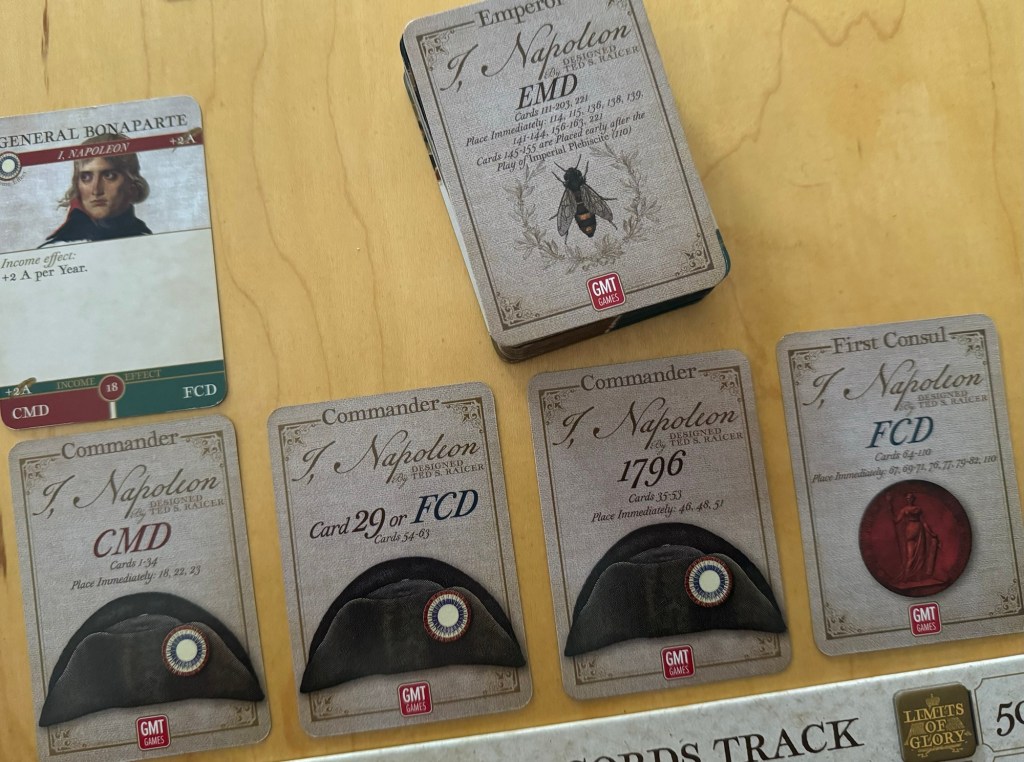
Let’s take a look at the structure and makeup of the cards first as this is a major focus of the game. The length of the game varies and you can choose to do the full campaign, which will use the full 3 decks or a shorter campaign starting in a different year. For example, if you start as Commander you start in 1793, as First Consul in 1800, and as Emperor in 1805 and you use those portions of the decks as your starting point.
The starting points allow you to experience Napoleon’s life from various positions of power and see how he rose to power and also to experience and see the pitfalls that he had to artfully deal with or dodge in order to get where he ascended. This game is intentionally very modular and can be played in any of several ways and I feel that this is major strength of the design as it gives us options for our playtime. There are three “ranks” of cards consisting of Commander, First Consul and Emperor and each of these ranks has its own deck of cards. In those decks there are cards for various things to experience including military campaigns, political events, the dealings of Napoleon’s personal life, diplomacy, strategy and tactics, Napoleon’s possible generals, the actions of foreign powers, and plain random events. All of these cards will shape who Napoleon will become and the real goal of the game is to obtain Glory, which typically comes from winning battles but also from other facets such as diplomatic victories, producing a legitimate heir, etc.
Each of these cards when drawn will be placed in various specific boxes found on the board for ease of reference and to somewhat remind you of what they are associated with and how they may be used. The game board is drawn over the top of a map of Revolutionary and Napoleonic Europe and the map is really just for some background historical color. What matters on the board are the various Card Boxes overlaid on or even adjacent to the board, where cards are kept and sorted. One of the most important areas of the board is the Campaign section found in the bottom right hand side. Here is where the players will store their Current Campaign Cards, of which you may only ever have one active in this box, Campaign Modifiers which are sometimes good benefits and sometimes bad, Commanders, Current Treaties and Strategy & Tactics Cards.
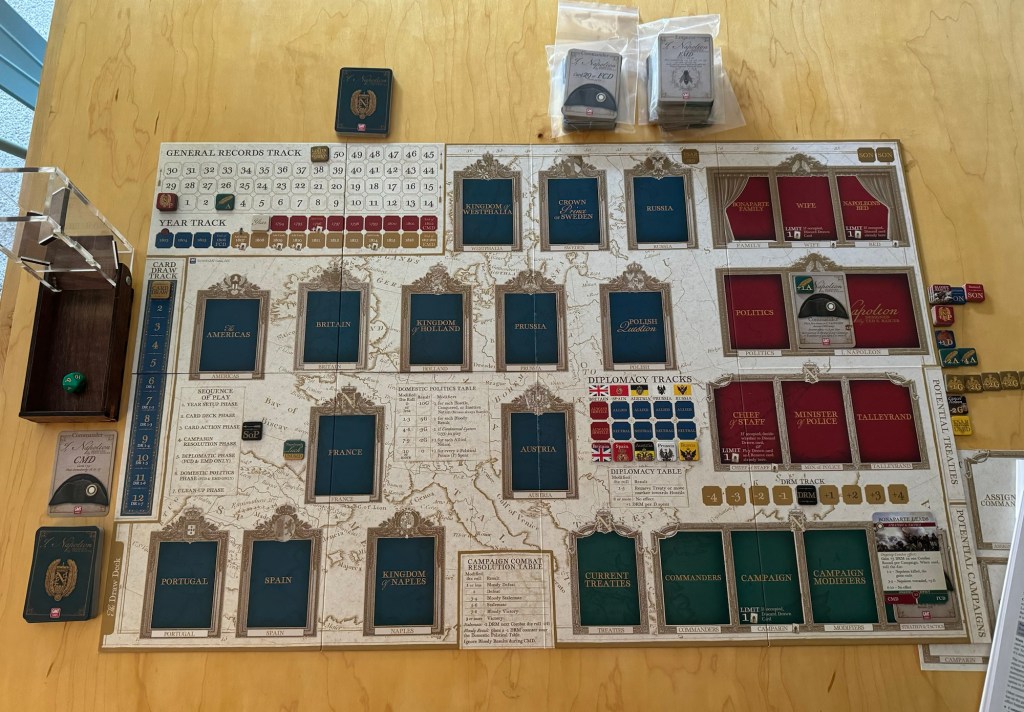
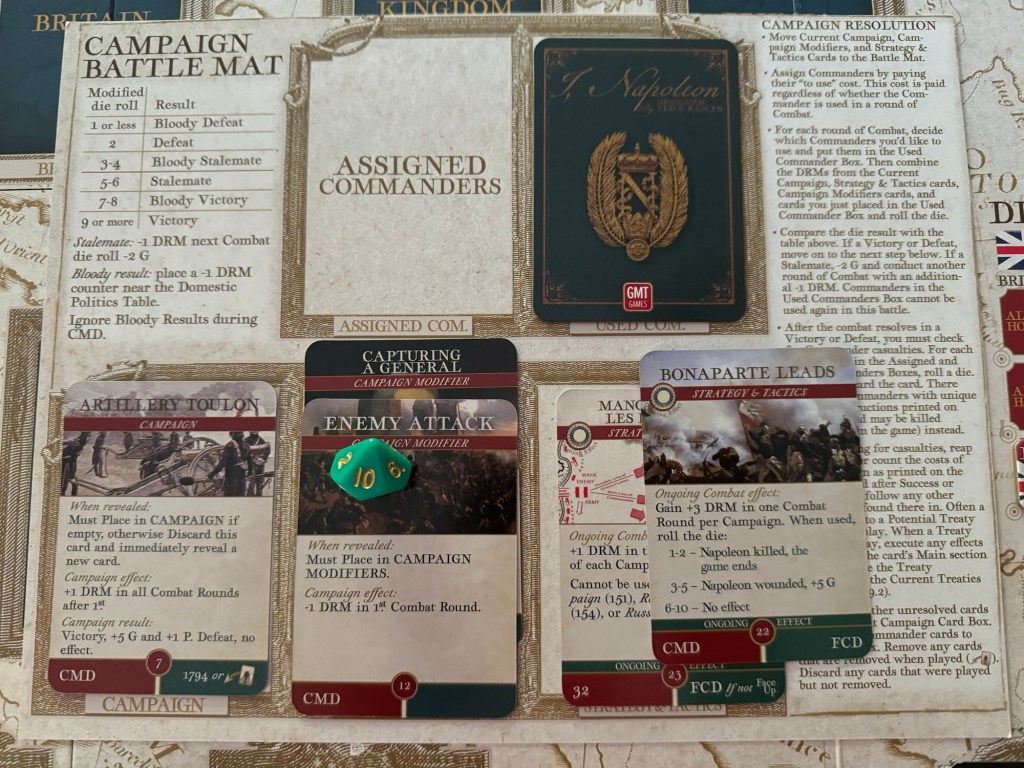
The Current Campaign Card is what the whole round really is building toward as you are attempting to accumulate your resources in the form of Administrative and Political Points in order to assign Commanders and play cards to assist you in winning the Campaign. The Campaign will come down to a series of die roll modifiers that come from your Commanders and other cards and then you will be rolling a D10 and comparing that result to the Campaign Combat Resolution Table shown below.


A result of 1 or less is a Bloody Defeat and there are real negative consequences to this result as you will place a Bloody marker near the Domestic Politics Section and you will incur a -1 DRM on any Political Checks, a Defeat means you have lost and some campaigns that are lost will mean the end of Napoleon’s career and the game ends. Stalemate means that no progress was made and combat will continue in a new round where you will only be able to use Commanders who you haven’t used yet and will also incur an additional -1 DRM during these subsequent combat rounds. Oh and you will also lose Glory Points (-2) as you have been embarrassed and your legend begins to show signs of weakness and fragility. It is important to remember though that you do have access a unique resource in the Napoleon’s Luck marker that can be used to re-roll any single die one time per year. This is a very important part of the game and I actually really like its inclusion as the dice can be incredibly unkind. But having this doesn’t guarantee as my last game played this past weekend ended with a loss at the Austrian Campaign when I rolled a 1, that was modified by only +1 as I had a negative Campaign Modifier Card out and had used some of my resources to gain extra Glory during the turn and didn’t have what I needed to win. But, I had my Napoleon’s Luck marker unused so I popped it to give me a re-roll and unsurprisingly for me I rolled another 1, ending in a loss and the game over. Such are the winds of fate with this game and one thing that I actually really like. The thesis of the game is that what Napoleon accomplished was extremely unlikely and was actually very lucky. That he wasn’t killed, as he lead from the front often, that he didn’t have major losses and setbacks, that his daring plans actually worked, that he had amazing commanders behind him, etc. It wasn’t pure luck but luck was definitely involved. Had one thing or another gone wrong, we would have only heard of Napoleon as a commander and history would have not paid him much attention. But because of how things turned out, he is and will always be a major character in world history! The game attempts to replicate that for the player and it does this very well.

One further comment about the game is that it does attempt to follow the life and career of Napoleon Bonaparte in not just his military exploits but also in the areas of his family, diplomacy with other nations, public opinion and in politics. I know that through my discussion with the designer, he felt that “one of the hardest parts of the design was simply deciding how far outside his biography I would allow the player as Bonaparte to wander. And the answer-in part dictated by having “only” 220 cards, was not that far”. And here is one of my issues with the thesis of the game. Because there are a limited number of cards (and I realize that 220 cards is a ton of cards!) that you will tend to see the same cards over and over again. I have played 4 times now, losing each of these games with Napoleon becoming nothing more than a by word in history, but I am really looking for a few cards that I need to make happen to move the game forward. An example of this is the first campaign for Napoleon. I find that I just don’t draw some of the cards that I need when I need them. The decks are not overly large, well the Emperor Deck is huge, but there just seems to be a bit of a problem with how cards tend to come out of the deck. The coup to take over as First Consul is very dependent on a few cards coming out and if they don’t then the roll is that much more difficult and has at best a 30-40% chance of success. But with the right cards, and the player having been able to gather these cards in their possession over a few turns, this chance of success can increase to 70% plus as you can gain +5 or 6 DRM’s on the roll. I think that the cards are a bit fickle and that is fine as the game is generally fast playing and you can set it back up and hope that your chances of drawing the cards improves.
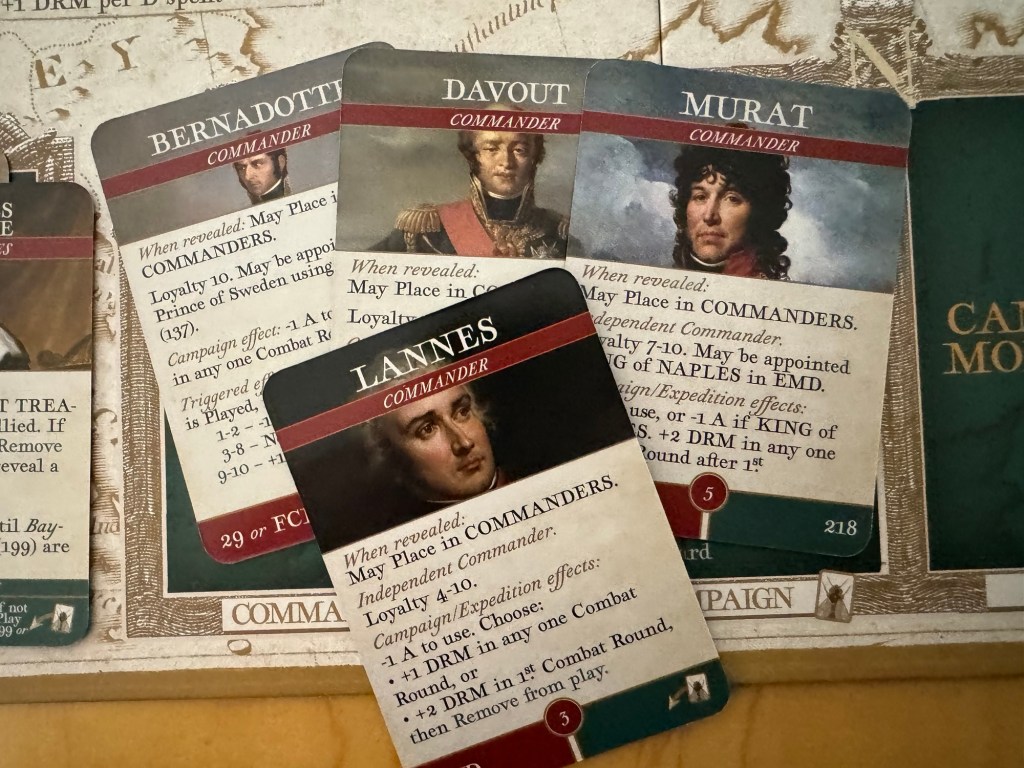
Cards are the heart of the game. Some cards are skills that give you bonuses battles some are are decisions that you have to make, and some are things that just happen to you that you have to deal with. I do feel that the game is a bit lite on actual decisions. I feel mostly that I am drawing a card and rolling a die. Sometimes I succeed and there is a cool benefit or your gain some Glory but most of the time I fail and the cards are simply removed from the game. You get one shot with most of these important events, kind of like real life, but I tend to fail them a lot. In the end, the game is a card game, not a card-driven game and you are not using Operations Points to take important actions but are more often than not being ACTED upon and I was expecting a bit more agency.
My only real initial criticism after 4 plays is that the game is a bit more random than I had expected and more than I normally like (with card draws and dice) and also is a bit chaotic with cards coming in and going out of the deck and playing off of each other. You have to stay on your toes with this one as there is a a lot to keep straight. I’m sure it gets easier as you play more and more and I would say that after 4 plays I am much more comfortable with the process and flow. Bit I would say that the best part if the historical narrative that is generated. This is the greatest strength of the game and I very much have enjoyed that.
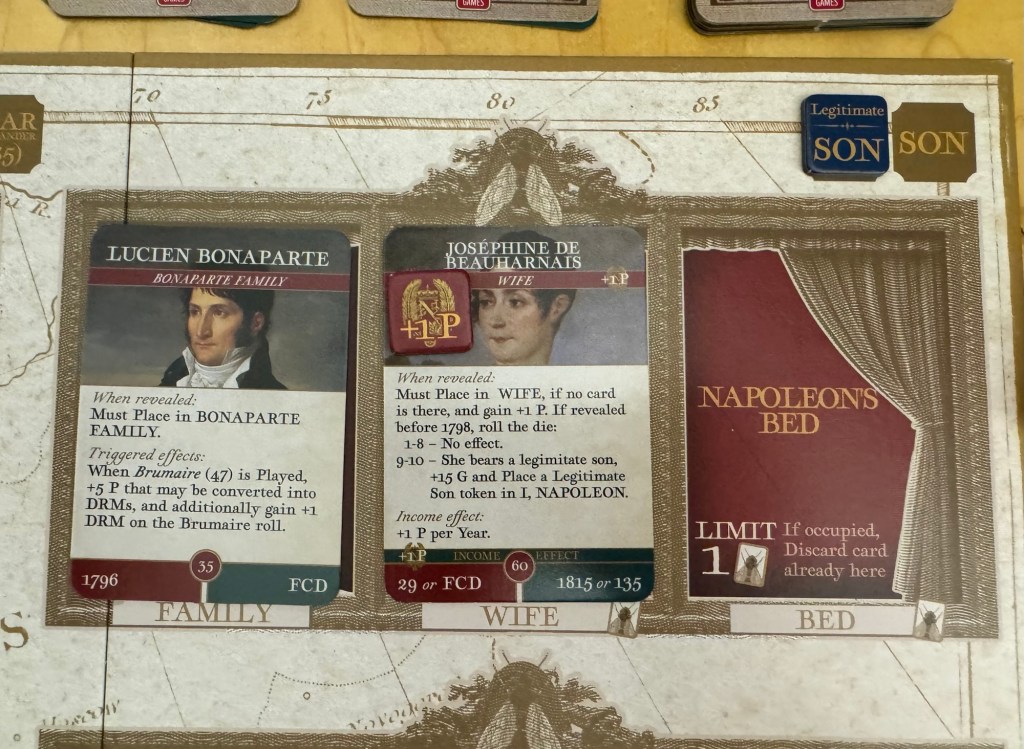
An example of this narrative that I experienced and really got a kick out of was when I drew the Joséphine de Beauharnais Card, which is the wife of Napoleon. As you can see from the card below, you roll a D10 and are hoping to get a 9 or 10 so a 20% chance of success to bear a Legitimate Son. I rolled the die and to my delight I rolled a 10 and was successful. My wife was in the adjoining room heard me shout with joy as this amazing luck and when I explained the situation to her she responded with “That’s nice dear!”. Classic response! But that is what happens in this game. The unexpected. The long odds come out in your favor…..sometimes….really very rarely….and when they do it is simply fantastic!
I have only been able to become First Consul 2 times in my plays and have yet to experience the Emperor Deck as my luck is just that bad but I will continue playing and see where it is that I can take the career of Napoleon. For me, this game is good and is very enjoyable. I can see where some people will find the rinse and repeat of the cards and the rounds to be a bit boring and rote but not every game is for everyone. I also love the feeling of losing, just barely by missing a key role or losing out on a card that would have helped, and then getting that nagging feeling of “I know that I can succeed! If I had only done this and that. Or if this die roll had succeeded.” This one gets you and is a bit addictive and I want to get it back to the table after each play. If you like a challenge, and you like a good historically focused narrative generator style of game, I, Napoleon is right up your alley.
-Grant
*As this is a First Impression style post, I was unable to cover every aspect of the game and there is definitely more to uncover as I have little experience with conquering the main Imperial antagonists of Napoleon including Prussia, Russia and Britain, nor have I dabbled much in Diplomacy with these nations. I also didn’t talk about the structure of rounds and years nor mention the very cool Card Action Phase and how it can end after just 5 card draws but also can continue for up to 12 card draws if the dice are kind. There is a lot to explore with this one and I am going to continue to try my hand at despotism!


glad you enjoyed. Personally I found it a dull experience with no meaning choices to make . The board too is a weird design having boxes that are full of course you need to constantly reference and many other boxes that are empty most of the time. Production is of course excellent t GMT quality but the game itself was painful to go through. For example the card you talk about having a baby. I had no child and later she died but I felt nothing at the effects were not particularly thematic. Same goes for most of the cards that just add a modifier here and there but have no historical text or other meaning. A big miss swiftly sold but to each their own
LikeLiked by 1 person
That is a very fair point and I share some of those feelings. I would like to see a bit more choice. For example, take the top or bottom of this event depending what direction you want to go. That kind of thing.
LikeLike
“That’s nice dear!”
You made me spit out my coffee!
But very true.
I quite enjoy the chaotic nature of the game as a narrative builder. It makes me realise just how much I didn’t know about Napoleon.
LikeLiked by 1 person
When she said it I just smirked back at her. She’s got it down!
LikeLike
Thanks. I hope you do a video at some point.
As for agency, I’ll quote from your post:
“But having this doesn’t guarantee as my last game played this past weekend ended with a loss at the Austrian Campaign when I rolled a 1, that was modified by only +1 as I had a negative Campaign Modifier Card out and had used some of my resources to gain extra Glory during the turn and didn’t have what I needed to win.”
That you made those choices and therefor didn’t have what you needed to win is an example of agency and how decisions do affect the outcome of the game. Of course if you generally roll ones you are not going to do well, but there are a lot of games where that is true.
But no game is for everyone and this was never intended to be a game where Napoleon has a free hand in his choices because that isn’t how I view his career. But I will say I consider the complaint (not by Grant) about the lack of historical text on the cards unfair-it is all in the playbook and to include it on the card was just not possible.
Anyway, again, thanks!
LikeLiked by 1 person
I hope that you didn’t take my first impressions wrong. I enjoyed it but just feel it would be good if there were a few more choices. I have played 4 times and will keep at it but am very much excited about what you do with the system in the future. I heard a rumor you were working on some added cards for this one. Is that true?
LikeLike
Grant, there will be an expansion with 90 new cards to go up on the p500 in December.
LikeLiked by 1 person