With this new My Favorite Wargame Cards Series, I hope to take a look at a specific card from the various wargames that I have played and share how it is used in the game. I am not a strategist and frankly I am not that good at games but I do understand how things should work and be used in games. With that being said, here is the next entry in this series.
Card #12: English Home Card Six Wives of Henry VIII from Here I Stand: Wars of the Reformation 1555-1571 from GMT Games
Here I Stand: Wars of the Reformation 1517-1555 is an experience packaged in a game that attempts to boldly cover the political and religious conflicts of early 16th Century Europe. The game focuses on the struggle of religious reformers such as Martin Luther, John Calvin and Ulrich Zwingli as they battle the Papacy for changes in their views of God and religion. But it is more than just the Holy War as it deals with the other European countries involved in the affairs of the time including France, England, the mighty Hapsburg Empire and the Ottoman Empire in the east. They all played a role in the process of the Reformation and the design brilliantly weaves this all together into an interesting and engaging experience. The game also covers other plot lines and events of the period, including wars, marriages and ascendancies to thrones, using a unique Card Driven Game (CDG) system that models both the political and religious conflicts of the period.
Where the game is a bit divergent from other CDG’s is that each faction has a Home Card (or two in the case of the Papacy), which is a really powerful and unique card that is available each round to the power to use. The great thing about these cards is that every player knows what the other Home Cards can do and are aware of them throughout each round. They really add an air of uncertainty as well as some tension as they are really powerful. This is one of the best parts of the game and really makes a huge difference in how each player should play their hands based on their circumstances on the board.
In this post, I want to focus on the English and their Home Card called Six Wives of Henry VIII.
One of the most important things about playing as the English is to master the use of your Home Card. By the name, you can immediately see what your first and most important task should be…getting an heir! But this actually is a part that should be done after you secure your own borders, gaining a key in Scotland and improving your position with an additional card draw each round.
One of the strengths of England is their position on the board. They are somewhat isolated from the rest of the players and are separated by the ocean and as such are able to stay out of the fray until they wish to enter it. They will typically attempt to mop up Scotland pretty early and then turn their focus onto mainland Europe to take on their ancestral foes the French.
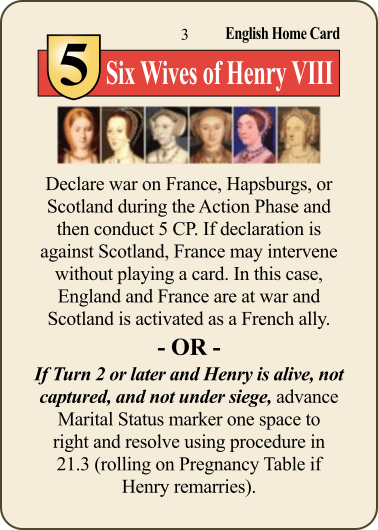
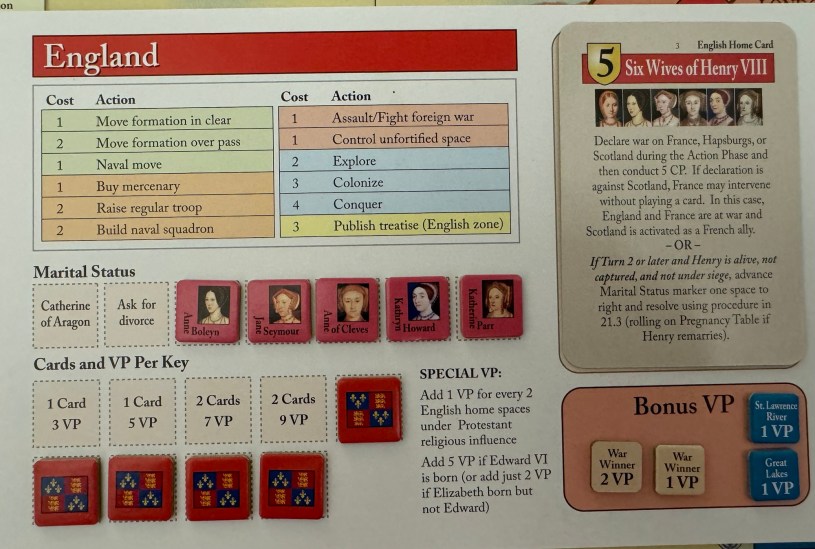
Six Wives of Henry VIII is a 5 Command Point (CP) value Home Card this has 2 very important uses for the English player. First off, the card can be used for the top portion of the Event to Declare War (actually called Declaration of War or DoW) on 1 of 3 different foes including France, Hapsburgs or Scotland. The real benefit of this Event is that this DoW can be done during your Action Phase when normally it must be done before the round starts and everyone knows your intent. This card can be used as somewhat of a guerilla action to surprise your foes so that they are not as prepared to accept your challenge and will give you the upper hand.
In the first round, the English player should declare war on Scotland and attempt to then use the 5 CP from the card to build troops and move toward Edinburgh. If the English player is committed and really focuses on this aspect for the first turn it can be accomplished and Scotland can be defeated and the important key there can be occupied to gain Victory Points as well as an additional card draw each round moving forward. This extra card as well as the VP are very important to establish a solid foundation from which to then work toward their real goal in obtaining that elusive heir.
The lower portion of the card allows Henry to attempt to bring about that heir by moving from wife to wife until he finds the fertile ground needed to plant his seed and bring about the birth of Edward VI. At the beginning of the game, Henry VIII is married to Catherine of Aragon, who has unfortunately has only been able to produce a female heir, the future Mary I. By Turn 2 of the game, Henry is convinced that Catherine will not produce a male heir, and his interest is captivated by the young Anne Boleyn. This begins the well known effort of Henry to seek a woman that will give him this male heir and he will move through the remaining 5 new wives in an attempt to produce the male heir necessary to continue the Tudor dynasty.
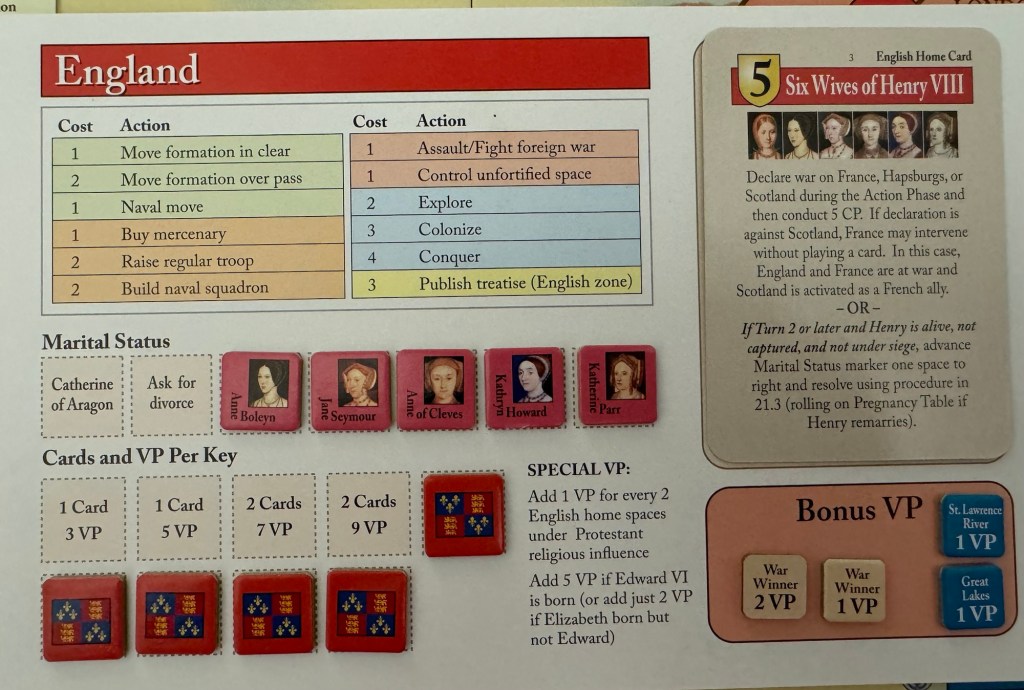
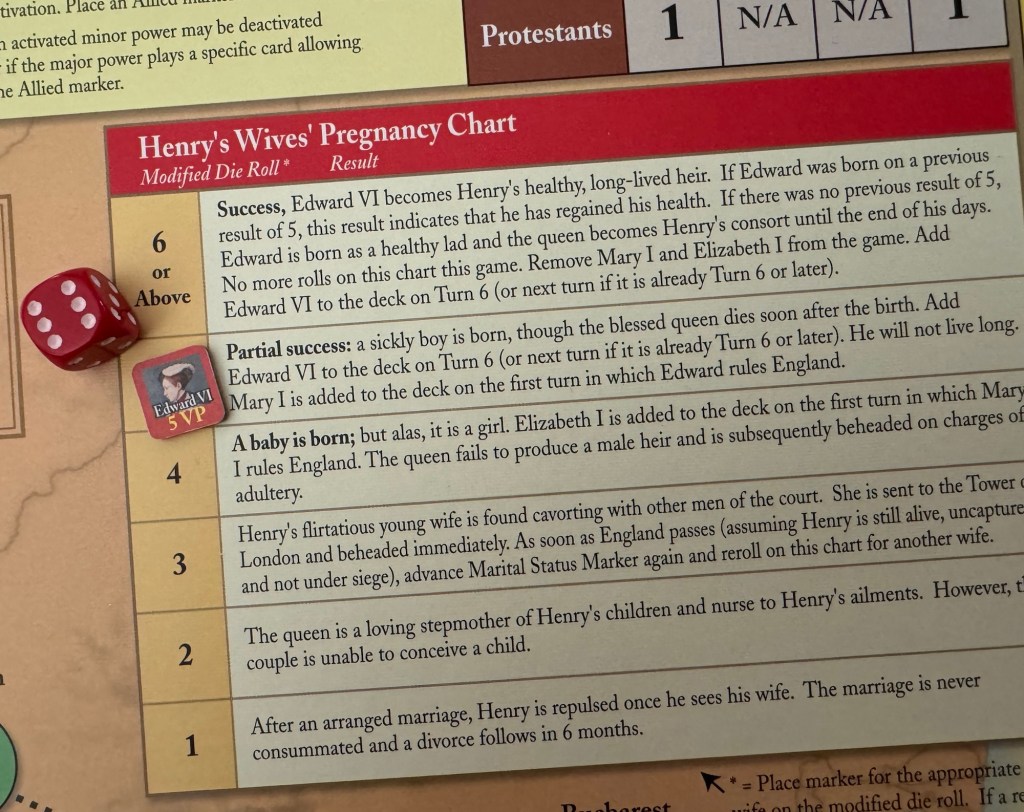
At this point, the English player may play the Six Wives of Henry VIII card to advance the marker one space to the right along the Marital Status Track on their player board. The marker can also be moved a space if the Papacy agrees to grant a divorce between Henry and Catherine or if the 3 result is rolled on the Henry’s Wives’ Pregnancy Chart. When the marker reaches a space with one of Henry’s subsequent wives, Henry has married again. Roll a die and consult the Henry’s Wives’ Pregnancy Chart printed on the game board. This roll can be modified by +1 if the new wife is Jane Seymour. After each result is achieved, place the marker for the new wife on the chart over the
number rolled. If a result is ever rolled again, move up from that modified die roll one line at a time until you come to a result that has not yet occurred. Eventually, if the player can roll well enough, they will produce this heir and will gain a 5 VP marker to place in their Bonus VP Box on their player board. I really love this part of the game for the English. It can be frustrating, and there is never a guarantee of it happening but it is very much a joy when the result of a 5 or 6 comes as this 5 VP is very important to the English and can make or break their attempt to win the game.

Once the card has served its purpose and Scotland has been conquered and a male heir acquired, the card still retains significant value to allow the English to sneak attack either the French or Hapsburgs and begin the process of gaining ground on mainland Europe. I have always found that there are significant military victories to be had in Europe for the English and they must be opportunistic and jump on the first sign of weakness from France to seize keys.
What can be said about the strange journey of the man of half a dozen wives? Henry VIII was the King of England from 1509 until his death in 1547. Henry is famously known for his 6 marriages and his efforts to have his first marriage to Catherine of Aragon annulled. By 1526, Henry was infatuated with Anne Boleyn and dissatisfied that his marriage to Catherine had produced no surviving sons, leaving their daughter Mary as the presumptive heir at a time when there was no established precedent for a woman on the throne. His disagreement with Pope Clement VII about such an annulment led Henry to initiate the English Reformation, separating the Church of England from papal authority. This lead to Henry appointing himself as the Supreme Head of the Church of England and dissolved convents and monasteries, for which he was ultimately excommunicated by the pope. Such an interesting twist of fate here with England and I really love to play them in Here I Stand.
In the next entry in this series, we will take a look at Common Sense from Liberty or Death: The American Insurrection from GMT Games.
-Grant
 The Players' Aid
IMHO this is the one problematic rule in the game: you almost always get a “Healthy Henry”. In 20 or so games I played, only once did a Healthy Henry not appear( ! ).
The three times I played England I rolled a “6” on the first or second try: won all those games… And in all contests the French had no chance at all as England was thus on it’s back from the get-go. Ahem…
We now play using these house rules:
1- You roll two dice on the Wives table, keeping the lowest.
2- To compensate, you get points for BOTH Henry and Elisabeth.
3- We also double the number of “Grey” Neutral Armies on the board.
Carl
LikeLiked by 1 person
Nice. I have only seen a healthy Henry 1 time in my 7 or 8 plays of the game. But of course the dice hate me! hahahahahaha.
LikeLike
Oh my… Incredible!!!
Got to play with you: I take France or the Papacy. 😛
LikeLiked by 1 person
I think that each game will be different. I have seen people hit all of the New World items with crazy rolls (double sixes for circumnavigate) and the game is very well balanced. England might get that 5 points but it could take a lot effort and card plays over the course of a game or could come up on the 1st die roll. The same could be said for any of the factions. To me the genius of the game is that each side has their own special items, some easier than others, but they seem to balance out. I have seen all sides win in my games. I have won as England, the Papacy, France and the Protestants. Never won with Hapsburgs or Ottomans but I have only played those once each.
LikeLike
I would think rolling a 6 is almost inevitable if you continue to roll on the pregnancy chart after getting a 5.
LikeLiked by 1 person