With this new My Favorite Wargame Cards Series, I hope to take a look at a specific card from the various wargames that I have played and share how it is used in the game. I am not a strategist and frankly I am not that good at games but I do understand how things should work and be used in games. With that being said, here is the next entry in this series.
Card #6: Janissaries from Here I Stand: Wars of the Reformation 1517-1555 from GMT Games
Here I Stand: Wars of the Reformation 1517-1555 is an experience packaged in a game that attempts to boldly cover the political and religious conflicts of early 16th Century Europe. The game focuses on the struggle of religious reformers such as Martin Luther, John Calvin and Ulrich Zwingli as they battle the Papacy for changes in their views of God and religion. But it is more than just the Holy War as it deals with the other European countries involved in the affairs of the time including France, England, the mighty Hapsburg Empire and the Ottoman Empire in the east. They all played a role in the process of the Reformation and the design brilliantly weaves this all together into an interesting and engaging experience. The game also covers other plot lines and events of the period, including wars, marriages and ascendancies to thrones, using a unique Card Driven Game (CDG) system that models both the political and religious conflicts of the period.
Where the game is a bit divergent from other CDG’s is that each faction has a Home Card (or two in the case of the Papacy), which is a really powerful and unique card that is available each round to the power to use. The great thing about these cards is that every player knows what the other Home Cards can do and are aware of them throughout each round. They really add an air of uncertainty as well as some tension as they are really powerful. This is one of the best parts of the game and really makes a huge difference in how each player should play their hands based on their circumstances on the board.
In this post, I want to focus on the Ottoman Empire and their Home Card called Janissaries.
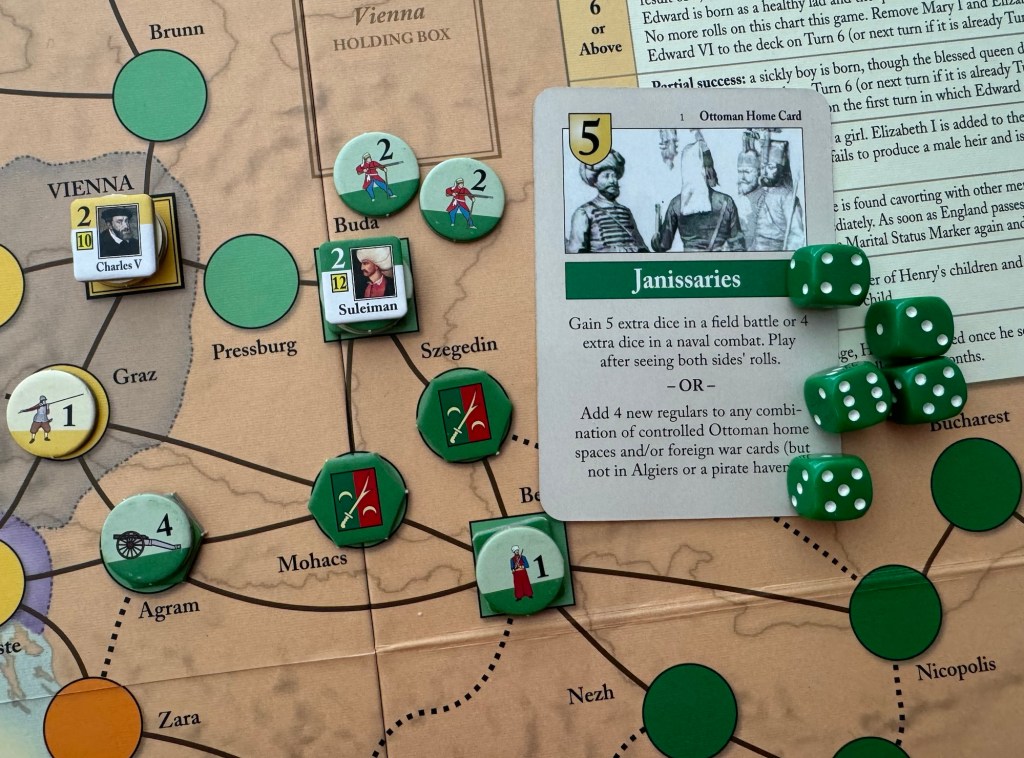
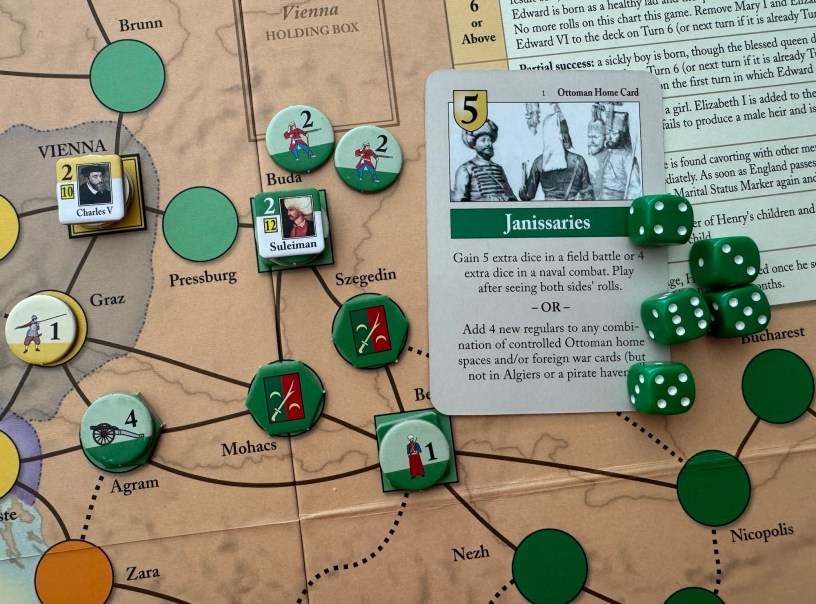
Janissaries is a 5 Command Point (CP) value Home Card this is quite utilitarian and gives the player a few different ways to use it. First off, the card can be used for the Event to simply build 4 new Ottoman Regulars in Ottoman Home Spaces. This gives the ground army some nice reinforcements and can really make a difference if they are strategically placed with a large force that simply needs that extra nudge to get up the guts to assault the Hapsburgs in Vienna. This is a confrontation that will always happen and in my opinion the sooner the better as it puts a lot of heat on the other players to begin worrying about the Ottomans chances of winning the game. It is important to remember though that these units can only be placed into Ottoman Home Spaces so they have to made part of an expeditionary force prior to them leaving the confines of the Ottoman Empire and seeking conflict on the frontier. I really like this card as it is going to give you some really nice reinforcements every single turn.
Also, as a 5 CP Value card, the return on this investment for using the printed event is greater than you would be able to get by simply spending the CP’s on building new Regulars. Each new Regular unit costs 2 CP’s to build and with 5 CP’s you would normally only be able to buy 2 Regulars (4 CP’s). By using the event, you will get the benefit of basically using a total of 8 CP’s and will gain an additional Regular. Over the course of the game, this will net the Ottoman player 20+ units to use on the offensive. This is typically the way that I use this card.
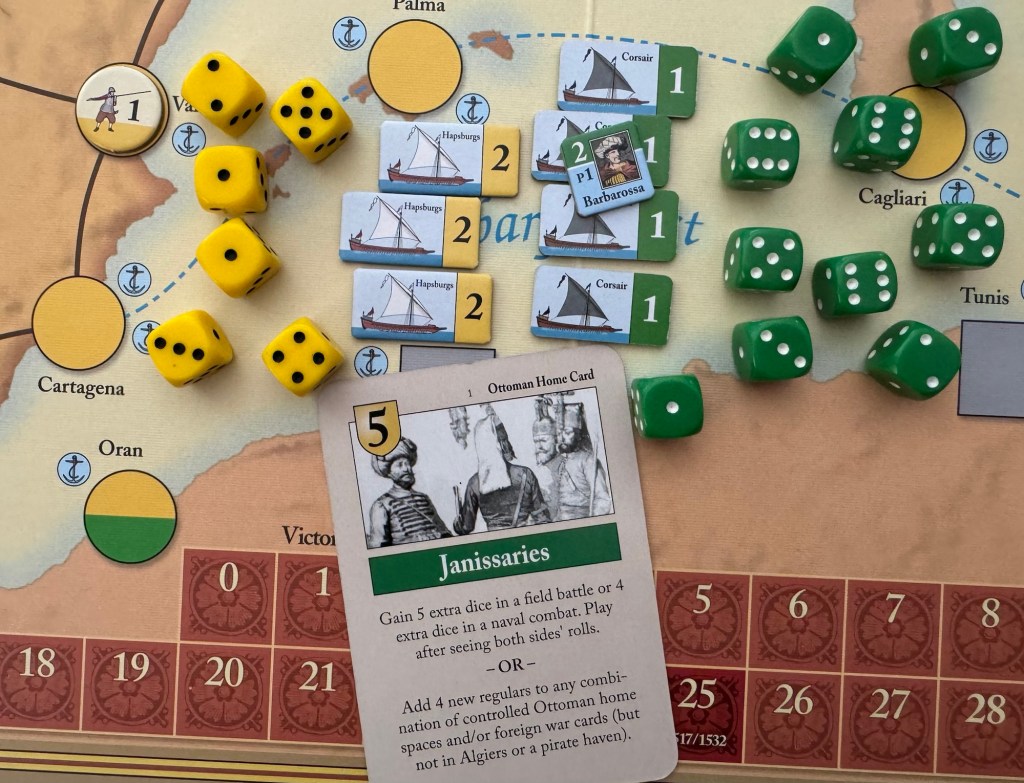
But Janissaries gives you options and options are always a good thing in Here I Stand as the situation can rapidly change and you have to be prepared and able to respond in order to come out victorious. Janissaries can also be played as a Combat Card, which will end up providing the player with additional dice to roll in combat. The card grants 5 extra dice in a Field Battle or 4 extra dice in a Naval Battle. And the card may be played after the dice have been rolled in combat to see if you need more dice to win or gain a more favorable outcome. Combat is always tough in the game as hits are typically only scored on a result of 5 or 6 on 6-sided dice. More often than not, players will be rolling multiple dice based on their number or units, ratings of their main Leader in the combat and other factors. Adding more dice is always nice but this is my least favorite way to use this card.
The one true weakness of the Ottoman’s is that their hand size is not great. It is much less than that of their immediate enemies the Hapsburgs and if Janissaries is not used to build units then Suleiman will have loads of difficulties in matching Hapsburg builds because of their large hand size. But, all things considered, there are times and situations where the Ottoman player will be forced to use the card for its 5 CP’s though. Also, if there is ever a key opportunity to deal a significant blow to the Hapsburgs by say taking Vienna or capturing one of their Leaders, particularly Charles V, the card can and should be used for the extra dice.
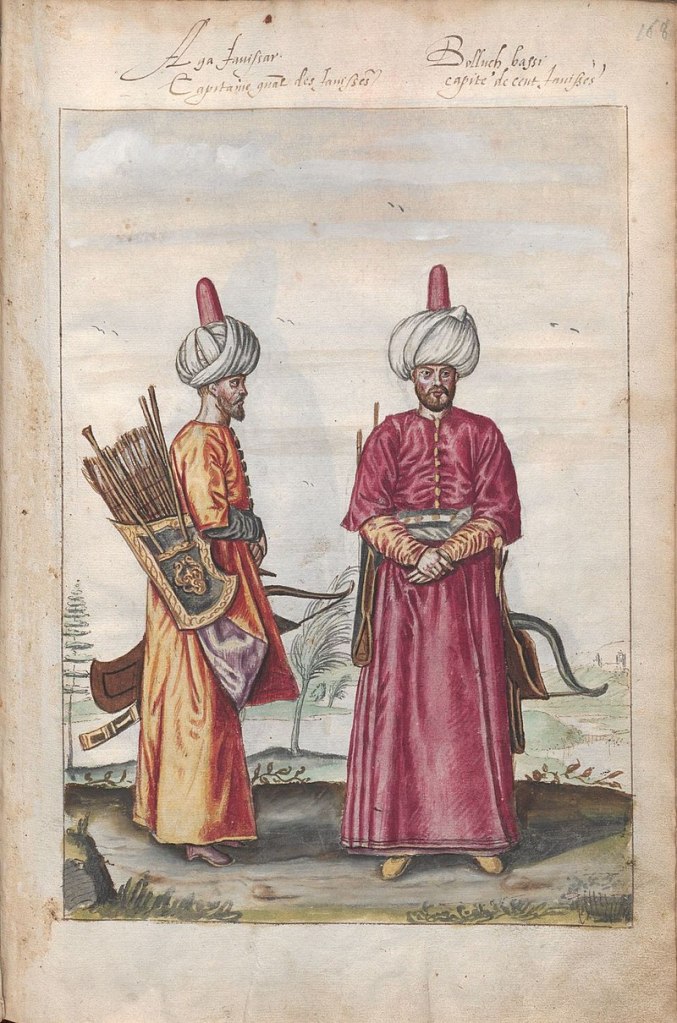
A janissary, a word that literally means “new soldier”, was a member of elite infantry units that formed the Ottoman Sultan’s household troops. They were the first modern standing army and perhaps the first infantry force in the world to be equipped with firearms such as Muskets, including a large “trench gun” that fired a 3.1″ ball, hand cannons such as the abus gun and even grenades.
Janissaries began as elite corps made up through the devşirme system of child levy enslavement, by which various conquered nation’s people were taken, levied, subjected to circumcision and conversion to Islam, and incorporated into the Ottoman army. They became famed for internal cohesion cemented by strict discipline and order.
In the next entry in this series, we will take a look at Augmented Reality from 2040: An American Insurgency from Compass Games.
-Grant


One inaccuracy is that Ottoman player can’t build mercenaries so they would not have that desertion problem.
LikeLiked by 1 person
I couldn’t remember if they could or not.
LikeLike