
While attending WBC in 2018, we got a look at an early prototype copy of a huge Grand Tactical Series game called The Greatest Day: Utah Beach from Multi-Man Publishing. At that time, we were lucky enough to sit down with 2 of the designers including Tom Holliday and Joe Chacon to discuss the design and also got a look at the game on the table in the open gaming area. We were really taken aback by this monster wargame! It also is a part of a very revered series that we have yet to play. Now, with our larger table with a recessed play area, we could potentially set this one up and give it a go over an extended period of time. The Greatest Day: Utah Beach, which is volume two in The Battle for Normandy Series, is a such a monster but it also has some smaller scenarios and some additional maps and cards to use along with those so space may not be too much of a concern for those plays. We reached out to Tom Holliday recently to get some more information on the game and he was more than willing to accommodate.
I highlighted this game in my Most Anticipated Wargames of 2024! post a few months ago and you can read that at the following link: https://theplayersaid.com/2024/01/19/grants-most-anticipated-wargames-of-2024/

Grant: What is the focus of GTS The Greatest Day: Utah Beach?
Tom: The Greatest Day: Utah Beach is the second game in a 3-game series that will cover the first 9 days of the Battle for Normandy. The first game, The Greatest Day: Sword, Juno, & Gold Beaches covered the Commonwealth beaches on the eastern side of the invasion. Utah Beach covers the westernmost invasion beach on the Cotentin Peninsula and includes the American airborne landings.
Grant: As a part of the Grand Tactical Series, how does the system fit with the fighting experienced on Utah Beach?
Tom: GTS is a great system for a “playable monster” game. The Utah Beach campaign map is approximately 6.5’ x 5’ with a total of 12 Divisions (6 American and 6 German) at various points throughout the campaign, so it fits perfectly with the “playable monster” concept. However, players will notice a significant difference in the terrain, as the Cotentin Peninsula was primarily covered with French Bocage and Apple Orchards. This is in contrast to the area behind Gold, Juno, and Sword beaches which was much more open and rolling countryside. This forces a much closer fight and requires the players to develop different tactics than the ones they used in the first game.
Grant: What are the major tenets of the Grand Tactical Series?
Tom: GTS is a company-level game that allows players to command Divisions, while maneuvering individual companies at a scale of 500m per hex. Fire & Maneuver is modeled in the way the turns play out with a chit-pull system for activations which lets players set conditions for success or failure in achieving their objectives. Utah Beach, similar to Sword, Juno, & Gold, has both beach invasions and Airborne drops that are modeled with subroutines to give players the feeling of assaulting the Atlantic Wall.
Grant: Who are the different members of the design team? What does each of you bring to the process?
Tom: I am the primary Designer and Game Developer. I have played all of the GTS games and was on the playtest team for Sword, Juno, & Gold, however, this was my first foray into game design. I do bring years of research into this battle, specifically the American Airborne operations, as my grandfather jumped into Normandy on June 6, 1944.
Vincent Lefavrais is a Co-Designer and built the German Order of Battle and lives in the Normandy region. He also built the German OOB for Sword, Juno, & Gold. He was instrumental in making sure we got the most accurate data on German units and the overall placement and names within the Cotentin Peninsula (map).
Joe Chacon is a Co-Designer and helped write the Exclusive Rules. He is the designer of 3 additional GTS games (Operation Mercury, Race for Bastogne, and Strike-Counterstrike). He was designing the last 2 while Utah was in design, and we would cross-reference unit statistics and rules to make sure we were not out of sync for the entire series.
Nick Richardson is the Series Developer and arguably the smartest person on the Grand Tactical Series, since he was involved in its original creation. He also managed the formatting of all books for Utah Beach.
Niko Eskubi is the Artist as he has been for all GTS games.
There are also numerous other people that played roles in getting this game off the ground.
Grant: What elements from the Normandy Invasion did you need to model and include in the game?
Tom: First and foremost was the naval invasion and airborne assaults. Fortunately, the majority of these were already created in Sword, Juno, & Gold. With regards to the Naval invasion, the only real difference is the manner in which drifting occurs (a small change). The Airborne rules use the same general structure and the exact same drop table as the 1st game, but airborne drift results were added to disperse the American paratroopers more and the consolidation of forces were restricted some as it took the Americans much longer to reconstitute following the jump.
The ability to cross-attach units within the American and German divisions was updated and will give players a much more dynamic capability which modeled the historical commander’s abilities. If done correctly, it can alter the way players set conditions to be successful, although it is not a requirement to play the game.
There are several smaller level specialty rules (airpower and anti-air capability, Allied supply limits, German Hunter-Killer teams, and a few specialty units) that were also added to Utah Beach, along with several optional rules for players to add different characteristics of a WW2 battlefield to the game if they choose to. There is an optional rule to more closely replicate the significant number of leader casualties the American Airborne units suffered in the first 72 hours of Normandy.
There are also several scenarios dealing with the planned American Airborne operation that was completely changed on 24 May 1944 when the Americans realized there was a German division occupying the ground they planned to drop on. This caused a change that required Generals Bradley and Eisenhower to approve. It may have led to a completely different history if they hadn’t been willing to adjust at the last minute.
Grant: What is the scale of the game and force structure of the units?
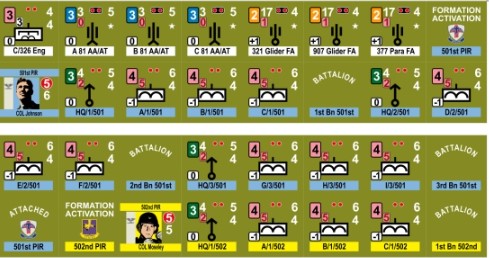
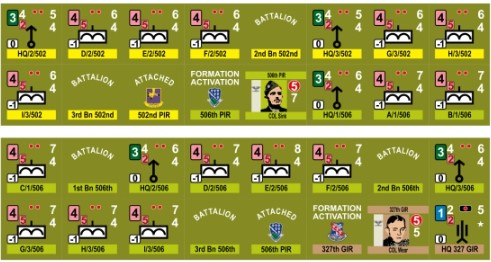
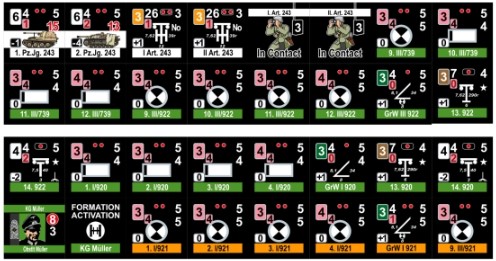
Tom: The map is at a 500m per hex scale and most of the units are Company-level. There are a few units that are smaller and range from reduced companies to platoon size. As with the other GTS games, a Division is made up of multiple formations (Regiments/Brigades/Kampfgruppen) and each of those is composed of the company sized units. There are also independent units within the Divisions as well as Corps/Korps assets that can be utilized by the leader counters in the game.
Grant: What sources did you consult to get the details correct?
Tom: There are too many to list. A bibliography is provided in the Exclusive Rules. However, the bibliography only highlights the main source material. There were probably 2-3 times that many smaller reference documents that we used to ensure the best accuracy we could.
Grant: Where did you find your information for the basis of the OOB?
Tom: As far as the Germans go, I would refer you to Vincent. His knowledge and access to German original documents was instrumental in getting their OOB correct.
For the Americans, my primary source is a series of OOB books called United States Army Ground Forces: Tables of Organization and Equipment World War II by J.J. Hays. This was a great foundation for the American OOB, but each unit had to be cross-referenced with operational plans and after-action reports to ensure they followed the American Army’s established structure. I would say they were about 90% in line with the structure, but there were differences, such as when units received specific types of equipment (artillery upgrades, AT upgrades, etc…). One additional “off the books” element was the 82nd Airborne Recon unit, which did not “exist” as far as the Army was concerned in June 1944. This unit was formed after the airborne drops in Sicily and Italy to provide the Division a recon element. After Normandy, it was added to the Airborne division structure.
Grant: What challenges does this scale bring to your design process?
Tom: I’m not sure there were any challenges due to the scale. Given that this is the second game in a three-part series, it had to follow the established pattern, since they are designed to be linked if anyone wants to try a true “Monster Game.” I for one will be doing that.
Grant: What area of Utah Beach does the map cover?
Tom: The map covers an area that stretches across the Cotentin Peninsula at the base of the peninsula and slightly east toward the Omaha Beach area. It includes cities like Valognes, Montebourg, Carentan, Pont-l’Abbe, St-Saveur-le-Vicomte, Portbail, Isigny, and la Haye-du-Puits. I have included an image of the Campaign Map layout as well.

Grant: Who did the map art and counter graphics? How did their work improve your vision for the game?
Tom: Niko Eskubi was the primary artist. Since this is the second game in a series, we remained true to the artwork in Sword, Juno, & Gold, so there weren’t too many modifications. He did change some of the layout of the Divisional Display to allow for the attachment rules and a scalable Command and Dispatch Point system.

Grant: How does combat work in the design?
Tom: There are some differences from most games in the way the Combat System works. Namely, the modifiers are to the Fire Rating of a unit and not to the die roll. The first several times you play, using the fire ratings modifier chart is necessary, but it doesn’t take long to essentially memorize these modifiers and most seasoned players can calculate the modifiers in their heads, roll the die, and consult the CRT for the outcome.
Anyone that has played a GTS game will see no real difference in the combat system. There were a few tweaks in how certain units are used in the assault sequence, especially regarding minefields. Most of the “changes” that exist were placed in the optional rules (alternate artillery resolution, Indirect Fire scatter, Assaults involving 0-step units, and an “Alone & Afraid” marker to replicate the disadvantage vehicle units faced in such confined spaces when attacked by infantry hiding in hedgerows).

Grant: What is unique or interesting about the makeup of the CRT?
Tom: I find the CRT a very unique way of handling combat, when compared to other game systems. However, any player of a GTS game will recognize the CRT, as it has not changed over the last couple of games.
Grant: What different scenarios are included?
Tom: There are 19 total scenarios included in the game. Here is a small sampling of what you can expect:
1 Learning Scenario with an option to add additional units for a “second” scenario.
“The Battle for Brécourt Manor” – 0900 6/6/44 – 1100 6/6/44
This scenario covers the initial small unit fights that were happening all over the Cotentin Peninsula on the morning of June 6th, 1944. It also provides an opportunity for players to learn the basic mechanics of the Grand Tactical System.
4 Introductory Scenarios
“We’ll Start the War from Right Here” – 0700 6/6/44 – 1100 6/6/44, Introductory Scenario #1
Utah Beach was the most isolated of the landing beaches on D-Day. It took almost a week before elements from Omaha would link Utah to the rest of the invasion force. As planned, the 8th Infantry Regiment, 4th Infantry Division was to land around the small beach town of Les Dunes de Varreville. However, due to smoke obscuring the coastline and a few minor navigational errors, the assault force arrived on the Cotentin Peninsula approximately 2 km’s southeast of their intended target. This placed the “Ivy” Division Soldiers along a slightly less defended portion of the coast. The 8th Infantry Regiment was commanded by Colonel James A. Van Fleet, a leader destined for greatness. Attached to Colonel Van Fleet’s units were elements of the 70th Tank Battalion, the 87th Chemical Mortar Battalion, and the 237th Combat Engineer Battalion.
Landing with the first wave of Americans was Brigadier General Theodore Roosevelt Jr. Quickly realizing his forces had landed in the wrong place, he made the command decision to continue from where they were, push inland, and allow the rest of the invasion forces to follow the 8th Infantry, instead of diverting to the originally planned beach.
Facing the Americans along the coast, the Germans positioned the static 709.Infanterie-Division, which had arrived in Normandy at the end of 1942 and had been preparing for the Allied invasion ever since. However, this division was given a 60-mile stretch of coastline to defend, so on 6 June 1944, they were still not completely prepared. They did put up some resistance and the German artillery continued to harass the Americans on Utah Beach throughout the first 24 hours of the invasion.
“Storming Utah” – 0700 6/6/44 – 1300 6/6/44, Introductory Scenario #2
After years of planning and preparation to assault Hitler’s Atlantic Wall, the Americans had determined that the small French coastal town of Les Dunes de Varreville would offer the best opportunities to establish a firm beachhead. Unfortunately, the planners were incorrect. This portion of the Normandy coastline was the most heavily defended sector within the German 709.Infanterie-Division.
As fate would have it, the Americans would not land here. Not because they realized their errors in intelligence and planning, but due to smoke obscuring the coastline and a few minor navigational errors. This led the coxswains of the Utah Beach Assault Force to land the lead elements of the 8th Infantry Regiment under the command of COL James A. Van Fleet, 2 km’s to the south. This did, however, disprove the adage that “two wrongs do not make a right.”
But what if fate had not intervened? What if the Americans had landed right where they had planned, into the teeth of the German defenses? Would Utah Beach have been as bloody as Omaha Beach? This scenario offers you an opportunity to find out.
6 Intermediate Scenarios
“Hold Until Relieved” – Night 6/5/44 – 1500/8/44 (short scenario) or 6/10/44 (long scenario)Intermediate Scenario #1
This scenario is a hypothetical one that covers the absolute worst case for the paratroopers of the All-American Division. Hold until relieved, a Soldier’s worst fear, but in many cases a standing order for the 82nd Airborne Division. This is the expansion for the “Stick to the Plan” scenario, allowing the German players to get their best shots in and the American players to see just how tough they really are. It focuses solely on the fight that the 82nd Airborne Division would have had if fate hadn’t intervened, and military planners hadn’t changed the plan for the airborne invasion. This is not an easy fight and will ultimately turn into an attrition battle to see if the paratroopers can survive until the beach invasion can reach them.
“The Lions of Carentan” – 0700 6/11/44 – Night 6/12/44, Intermediate Scenario #2
The 101st Airborne Division was assigned the task of seizing the city of Carentan to protect the southern flank of Utah Beach and set the stage for the link-up with forces from Omaha Beach. Unfortunately for the American paratroopers, Major von der Heydte and his unit, Fallschirmjäger-Regiment 6, had other plans. Following an initial assault into the American’s flank between 6 and 8 June, the German fallschirmjägers fell back to Carentan, enlisting any German units they could find and dug in deep. The terrain north of the city, having been flooded by the Germans prior to the invasion, made the perfect location to defend against a numerically superior attacking force. Ironically, this area was flooded as part of the anti-airborne defenses in Normandy. Little did Major von der Heytde, nor Generalfeldmarschall Erwin Rommell know at the time how effective it would be against a ground assault from those same airborne forces. These German fallschirmjägers would earn the title “The Lions of Carentan” for their tenacious defense of the city against 4 to 1 odds. After several days of combat and a stubborn defense, their low supply would force them to pull out of the city on the night of June 11th.
The lead element of the 101st Airborne would be COL Cole’s 3rd Battalion, 502nd Parachute Infantry Regiment. This regiment would take significant losses on June 11th, fighting the fallschirmjägers, with fighting ultimately degrading to hand-to-hand combat and a bayonet charge led by COL Cole. For his actions that day, he would receive the Medal of Honor. Although not single-handedly successful, his actions and those of his regiment would open the door for the rest of the division to successfully dislodge the fallschirmjägers.
3 Advanced Scenarios
“Westward Ho!” – Night 6/5/44 – Night 6/13/44 to Night 6/16/44, Advanced Scenario #1
This scenario covers the advance across the Cotentin Peninsula from the airborne drops until the peninsula is cut. It pits the majority of the American VII Corps (82nd Airborne Division, 90th Infantry Division, 9th Infantry Division, and elements of the 4th Infantry Division along with Corps assets) against half of the reinforced German LXXXIV Korps (91.Luftlande Infanterie-Division, 243.Infanterie-Division, 77.Infanterie Division, elements of 709.Infanterie-Division, and Korps assets). The end of this scenario is based on when the Americans succeed in cutting the peninsula and isolating the port of Cherbourg.
“Was Leigh-Mallory Correct?” – Night 6/5/44 – Night 6/13/44, Advanced Scenario #2
This scenario involves the hypothetical aspect of the initial airborne plan to cut the Cotentin Peninsula shortly after landing in Normandy and isolate the port of Cherbourg from reinforcement. As Allied planners were trying to decide the best way to support massive troop concentrations on the continent, they decided on a bold plan involving two Airborne Divisions which would land along the base of the Cotentin Peninsula, effectively isolating Cherbourg on June 6th. The 101st Airborne would land on the eastern half of the Peninsula and support the seaborne landings, while the veteran 82nd Airborne would land on the western half of the peninsula, isolated until linkup. In mid-May, Allied intelligence discovered the presence of the 91.Luftlande Infanterie-Division, whose mission was to counter airborne operations. This German division was positioned at the base of the Cotentin Peninsula, right between the planned dropzones for the two American Airborne Divisions. The dropzones were changed in an Operations Order, issued less than two weeks before the invasion (28 May 1944)…but what if the Americans had not discovered this German Division, or they felt it was too late to change the invasion plans? This scenario allows you to play out the eventual outcome of just such an audacious plan. What would have happened on the Cotentin Peninsula – an overwhelming American success, or an utter American and possibly Allied failure?
5 Campaign Scenarios
“One Great Day” – Night 6/5/44 – Night 6/6/44, Campaign Scenario #1
This scenario covers just the first day of the campaign game and is ideal for 2-5 players. While it covers only one day, it was an eventful day. End the game at the conclusion of the June 6, Night turn – when one chit remains in the mug.
“We’ll Take It From Here” – 1300 6/6/44 – Night 6/13/44, Campaign Scenario #2
This scenario covers the entire campaign without having to play the naval invasion and use the Naval Sequence of Play. It begins on the afternoon of June 6th, once the Americans had established a small beachhead and were pushing inland.
“The Greatest Day: Utah Beach” – Night 6/5/44 – Night 6/13/44, Campaign Scenario #3
This is the entire shooting match. This is the historical invasion of Hitler’s Atlantic Wall on the Cotentin Peninsula, where the VII Corps assaulted Utah Beach. It involves two American Airborne Divisions, the 82nd and the 101st dropping on the night of June 5, followed closely by the 4th Infantry Division assaulting Utah Beach.
This scenario is ideal for multiple players between 2 and 10, and can handle as many as 12 players effectively. The scenario ends at the conclusion of the June 13, Night turn – when one chit remains in the mug.
“What Might Have Been” – Night 6/5/44 – Night 6/6/44, Campaign Scenario #4
Prior to May 24th, 1944, the Allies were planning an airborne landing that would effectively cut the base of the Cotentin Peninsula, isolating Cherbourg on June 6th. In mid-May, Allied intelligence discovered the presence of the 91.Luftlande Infanterie-Division, whose mission was to counter airborne operations. It was almost as if the Germans knew what the Americans were planning and believed they could throw them back into the sea. The Germans were going to give it their best shot. This scenario is hypothetical and covers just the first day of the invasion if the American leadership had not changed the plan at the last minute.
“There But for the Grace of God” – Night 6/5/44 – Night 6/13/44, Campaign Scenario #5
This scenario involves the initial airborne plan to cut the Cotentin Peninsula shortly after landing in Normandy and isolate the port of Cherbourg from reinforcement. It includes five American divisions and five German divisions, both with elements from additional divisions and corps. This is the hypothetical full monte.
This scenario is ideal for multiple players between 2 and 10, and can handle as many as 12 players effectively. The scenario ends at the conclusion of the June 13, Night turn – when one chit remains in the mug.
Grant: How did you guys make the game more playable?
Tom: I would not say it is more playable than the other GTS games, but as a system it is very playable for the scale and scope it is dealing with. Joe Chacon was instrumental in helping keep my preferences to be more realistic in check. As a new designer, the added sounding board helped ensure I didn’t go overboard and make the game “less playable” in order to add realism.
Grant: What do you feel that the design excels at?
Tom: This is more of an answer about the GTS system and some of the subroutines for The Greatest Day Series – I have always felt that this system and exclusive rules for the series give players the ability to make decisions their historical counterparts were making and to get a “feel” for how those decisions led to the outcomes they did. It gives me a very immersive experience. I give that credit to the original designers and all the play testers who helped make this series and this game what they are.
Grant: What other designs are you currently working on?
Tom: The Greatest Day: Omaha Beach is the next in the series. There are already many components of the design that have been built while working on Utah Beach. However, the devil will be in the playtesting and ensuring that Omaha Beach is capable of connecting the 3 games together.

Thanks for your time in answering our questions Tom. I know that this game has been pretty anticipated over the past 6 years. I still look back fondly on our chat at WBC in 2018 and really appreciate your time and effort with that at the time. Here is a link to that video interview:
If you are interested in The Greatest Day: Utah Beach, you can order a copy for $332.00 from the Multi-Man Publishing website at the following link: https://mmpgamers.com/the-greatest-day-utah-beach-p-358
I have read where the game will be shipping soon!
-Grant
 The Players' Aid