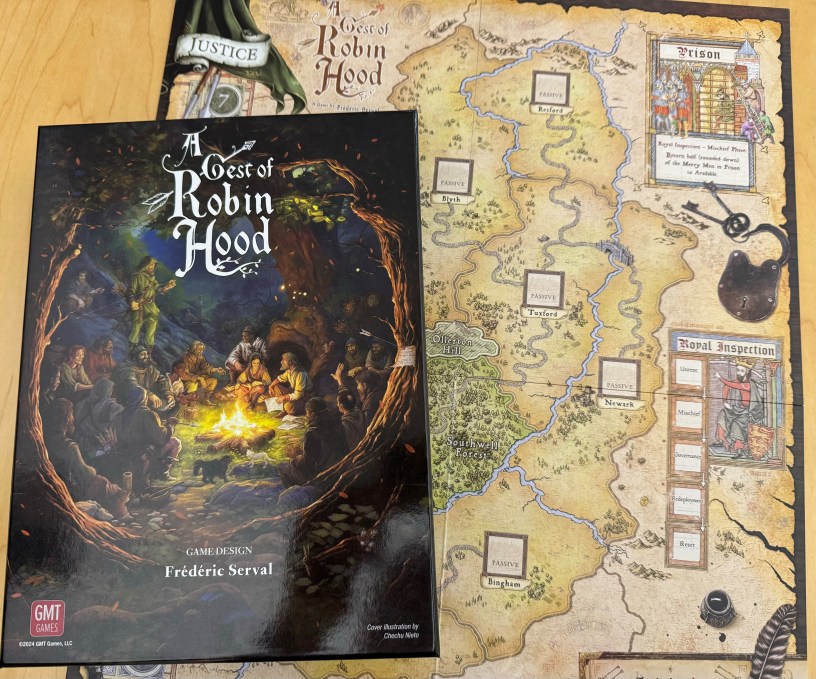
As you know, I love the COIN Series and anything associated with it. This new Irregular Conflicts Series is considered COIN adjacent and shares some of the same elements. The 2nd volume called A Gest of Robin Hood is a 2-player game that is set in the world of literature but based on actual events of the time as it covers the bandit known as Robin Hood as he patrolled the Sherwood Forest around Nottingham and attempted to relieve the evil Prince John of the money that he stole from the peasants and give it back to them. The game is very much asymmetric as each of the sides has different goals and objectives but also have different actions, called Plots and Deeds, that can be used to great effect to change the landscape of Nottinghamshire and plant the seeds of insurrection or pacify the locals and keep them paying those juicy taxes. We have played the game a few times now and have really enjoyed what is it that we are seeing and experiencing. The game is a great entry point into the world of asymmetric gaming and also teaches some of the basic principles of the COIN Series mainly focusing on the Sequence of Play, card assisted framework and diverging player sides with vastly different focus. The game is very approachable but also has a lot of meat to it and is really an interesting experience.
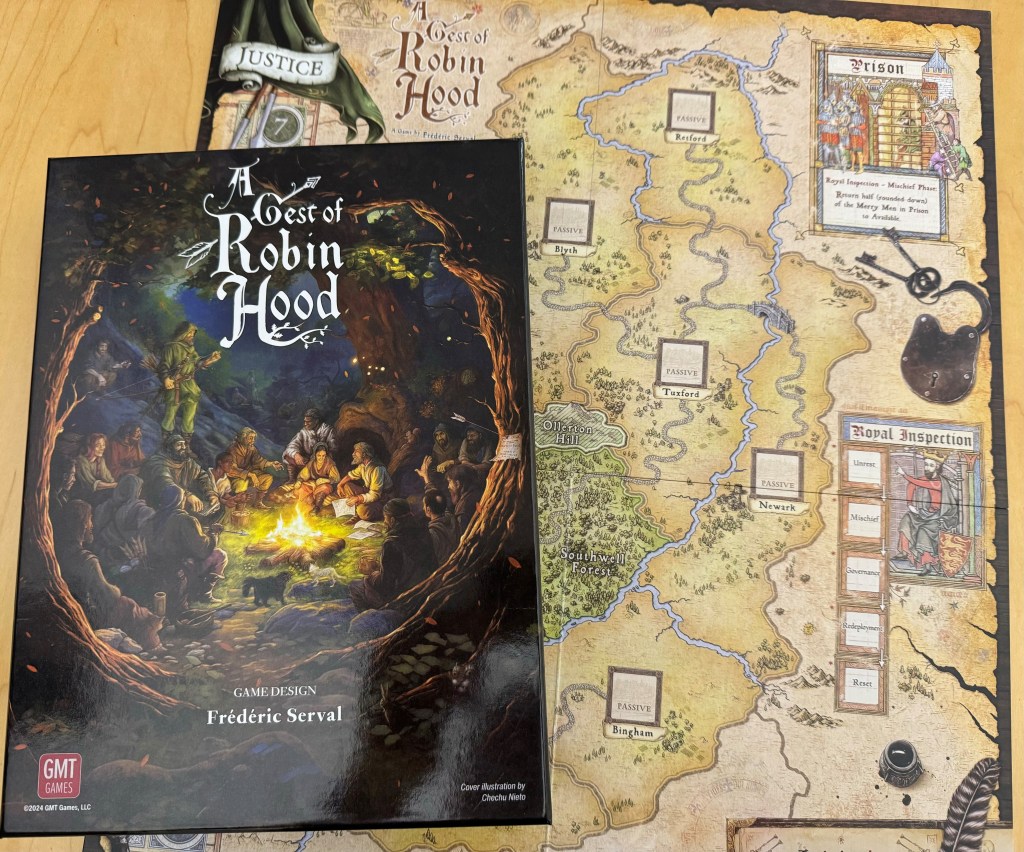
In this series of Action Points, we will take a look at the Game Board, which is absolutely stunningly beautiful yet very functional, and discuss the different areas including Prison, the Justice/Order Track and various other spaces, we will investigate the 2-player Initiative (Sequence of Play) Box to understand what makes this process unique, take a look at the menu of Plots & Deeds for the Sheriff, compare and contrast the menu of Plots & Deeds for the Merry Men, check out the different types of cards in the game including Event Cards, Fortune Event Cards, Traveller Cards and Royal Inspection Cards and finally discuss some points of strategy to keep in mind.
Game Board
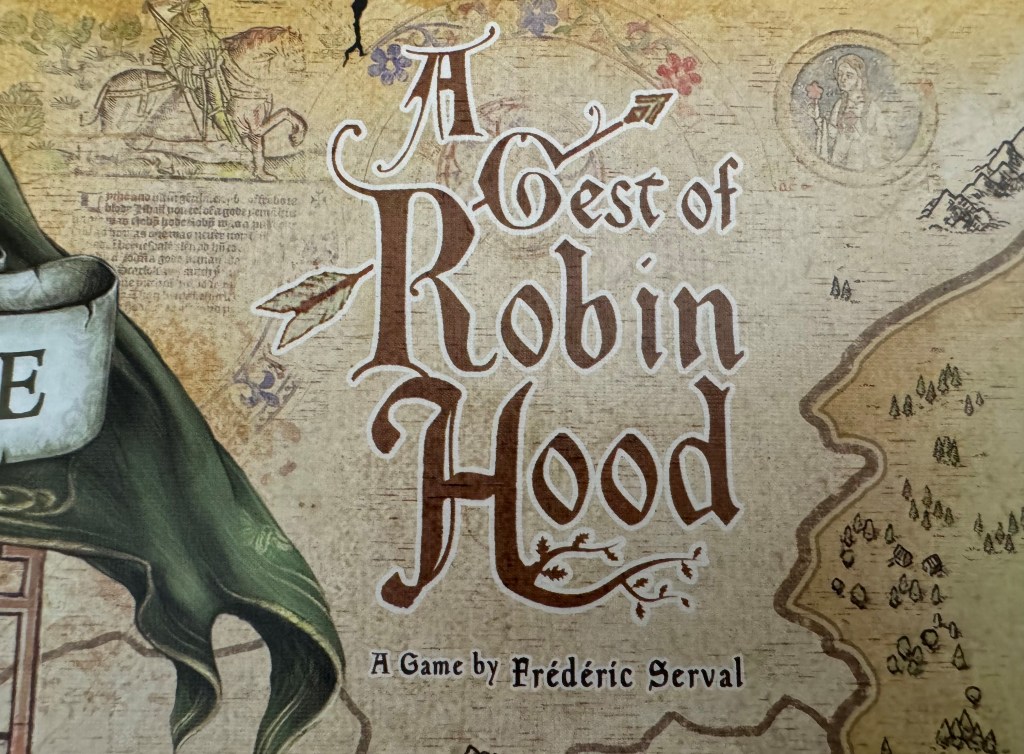
One of the best elements of the production of this game is the Game Board. It is simply beautiful and is not crowded nor forced. The board shows the areas in and around Nottinghamshire in 12th-century England with the main focal point being on the city of Nottingham. The Game Board also has all of the required boxes and tracks needed to ploy the game but they are not your typical faire as they are all beautifully incorporated into the board to further reinforce the thematic setting for the players. These boxes and tracks are adorned with various drawings of people, items and weapons of the time and truly assist in transporting the player away to a long forgotten time where bandits and outlaws fought off the forces of tyranny and repression.
City of Nottingham
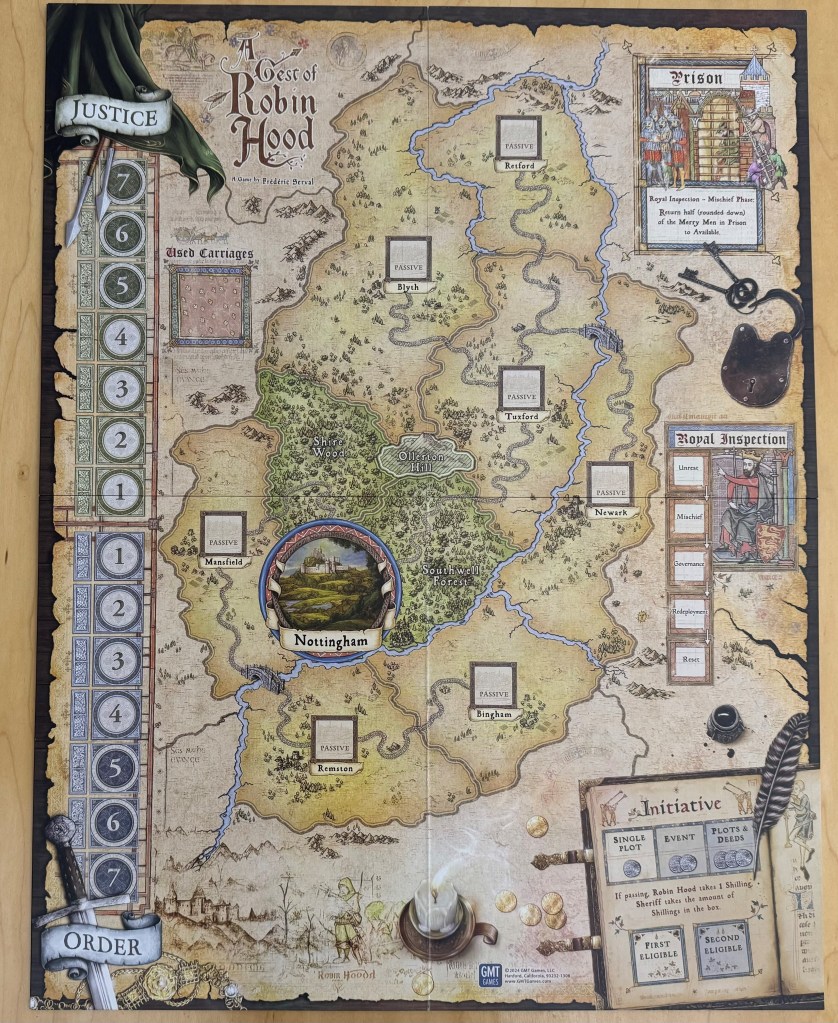
More or less located in the center of the Game Board is the urbanized city of Nottingham. The city is represented by a circle with a daunting castle drawn inside located at the top of rolling green hills. The circle itself is beautiful with the name being written in a long forgotten script on a piece of winding and thinning parchment. The outside of the circle is ringed by a light blue thick border that is to remind the player that the city of Nottingham is the Sheriff’s territory and is Pacified. Here the Sheriff protects, or more appropriately attempts to protect, the treasury as his numerous Carriages laden with gold and silver return from the Parishes to the bank to be used by the Sheriff to enforce Order in the land.
Roads and Rivers
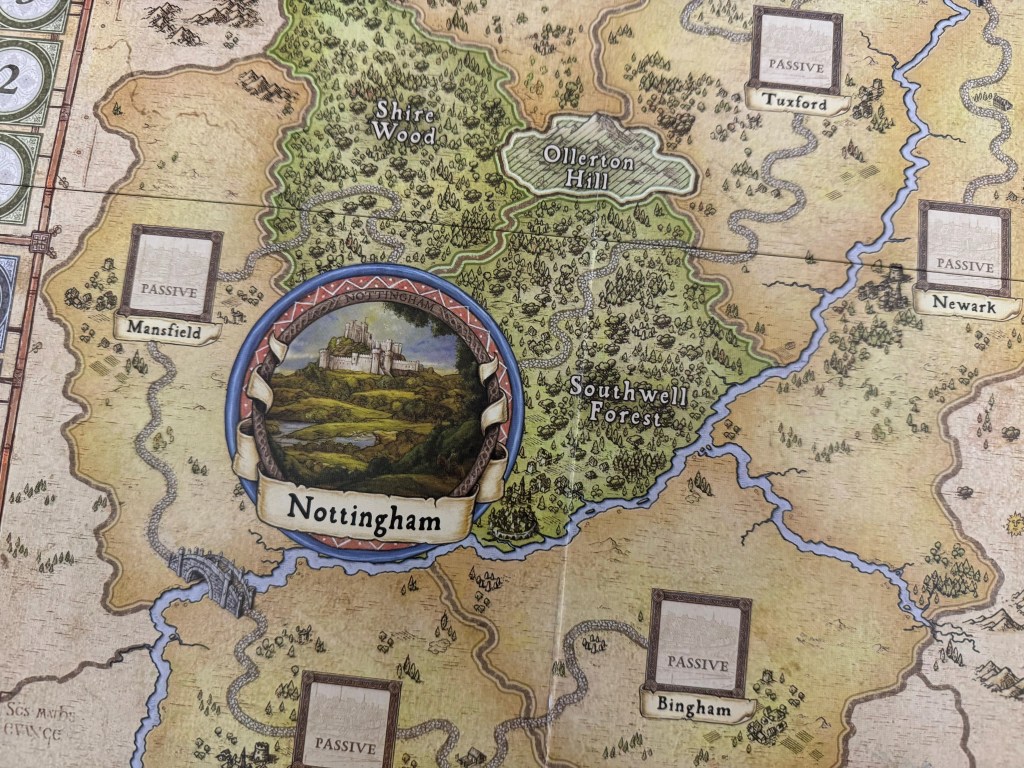
One thing that needs to be pointed out are the various roads that lead into the city. These are the roads that the Carriages must follow in order to make it into the city to the safety of the King’s Treasury and you can see that they wind through both the Shire Wood and Southwell Forest, which is the domain of Robin Hood and his band of thieves known as the Merry Men. The Sheriff player will be placing these Carriages into the outlying Parishes, trying to focus on placing them as closely to their end goal as possible to ensure they have a short and uneventful journey. But there are requirements to place them and that is that the Parish in which they are placed is Pacified and that it must then be changed to Revolt as the peasants are upset about their pockets being picked. This will limit your choices of where you can place these Carriages and also will keep you busy in re-establishing Order in these unruly Parishes once the Sheriff has relieved them of their gold.
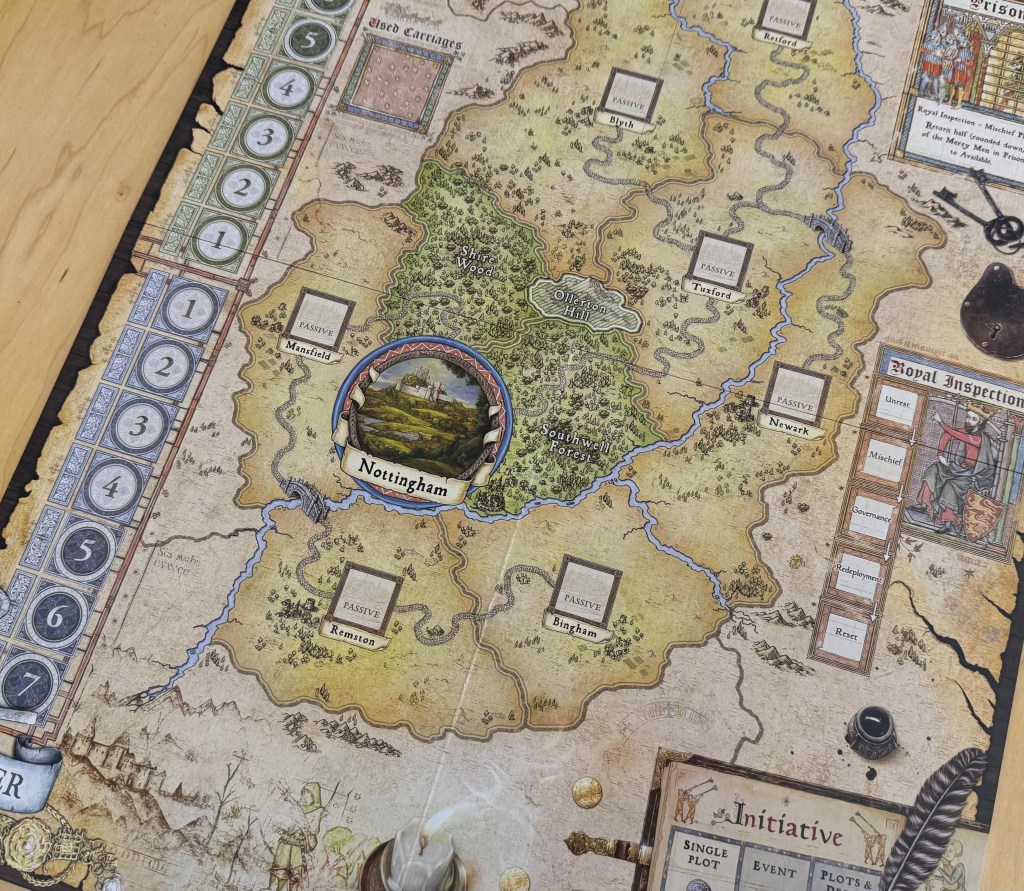
The rivers running through the countryside also act as borders for the Parishes and prevent adjacency from one Parish to another. The rivers can only be crossed at locations where there are bridges built over them and this will limit how the Sheriff can both spread out their Henchmen from Nottingham but also where the Carriages can ultimately go. But, never fear, there is an Event Card that will allow for the building of a bridge to create adjacency. Alas, this bridge cannot be placed to shorten the route of the royal Carriages but only in creating adjacency.
Parish Spaces
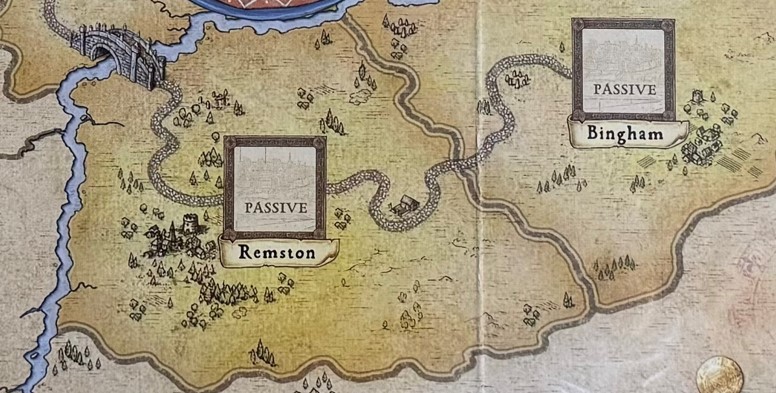
The 7 Parish spaces are marked by the use of a historical name of the major market town located within its boundaries. They carry names such as Retford, Blyth, Tuxford, Newark (not New Jersey!), Bingham, Remston and Mansfield. Each of these Parishes contain a holding box which houses a status marker to indicate whether the local population of the Parish is currently Submissive or Revolting. The Parishes are where the Merry Men will congregate at their placed Camps, recruit new men and also sow the seeds of insurrection. The Parish spaces are a bit less concealing and the Sheriff’s Henchmen find it easier to flush out the Merry Men as they are hidden among the local populace. The current status of the Parish will also make various activities harder or easier for the Merry Men as it will determine which of the 2 game dice are being rolled for activities such as Robbing. The Parish can house 1 of Robin Hood’s Camp pieces but there is no limit on the number of Henchmen, Merry Men and Carriages. Lots of activities will be based on which side outnumbers the other in the Parish and it will be important for the Sheriff to get his lackeys out of Nottingham and into the Parishes where they can disrupt the seditious activities of the men in tights! It is also important for the Merry Men to remain hidden as they are more effective when in this state as many of their Plots and Deeds require them to be hidden and then to be revealed as a condition of the actions.
Forest Spaces
The Forest spaces of Shire Wood and Southwell Forest are also key for the Merry Men as they keep them hidden and make it much more difficult for the Sheriff’s Henchmen to find them and arrest them. These forests are all considered to be adjacent to the city of Nottingham but are not populated by peasants. This means that the forests will never be considered either Submissive or Revolting. Each of these Forest spaces can contain one Camp and any number of Henchmen, Merry Men and Carriages. There is 1 Event Card that will allow for the Robin Hood player to place a 2nd Camp in a Forest space.
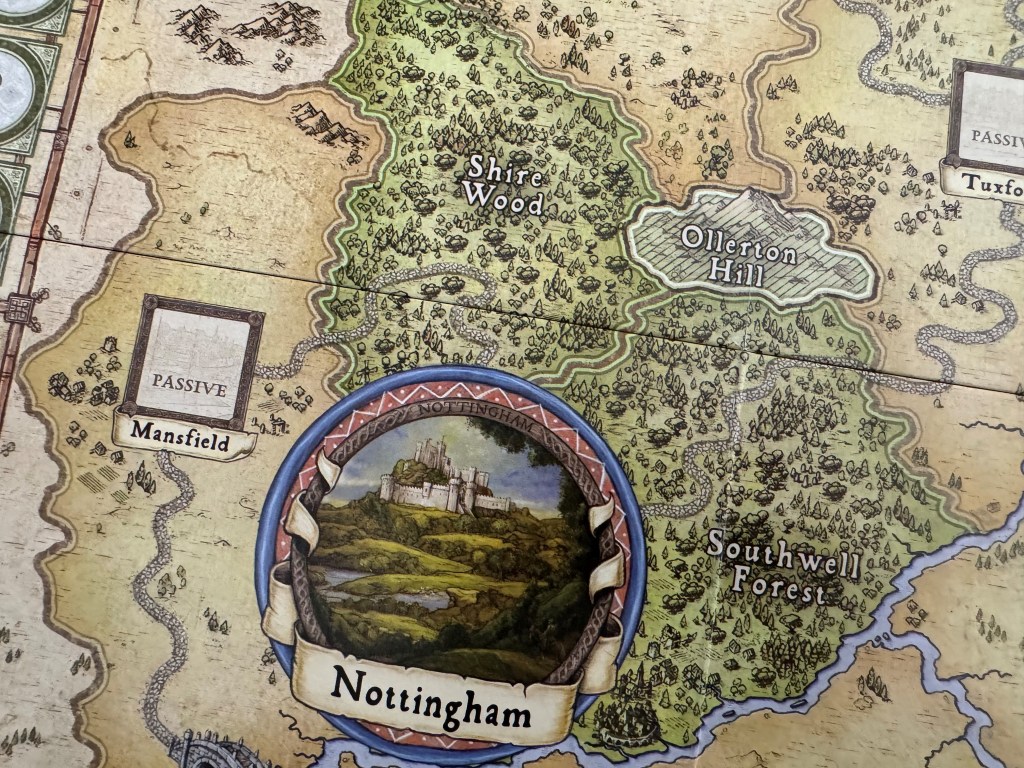
The Ollerton Hill space is located at the point between both of the Forest spaces and is adjacent to both Parishes of Blyth and Tuxford. Ollerton Hill is not a playable space unless the unshaded effect of the Major Oak Event Card is played, which will place a Camp there and causes Shire Wood/Tuxford and Southwell Forest/Blyth to be treated as adjacent to one another for the Robin Hood player only. The Camp placed by this event in Ollerton Hill is considered to be located in a Forest and will therefore earn Robin Hood an additional Shilling during the Mischief Phase of the Royal Inspection Round. No other game pieces may ever enter or be placed into the Ollerton Hill space. It is only for the effects of the Major Oak Event Card and cannot continue to be a location where Merry Men are rallied.
Now that we understand the playable spaces and their purpose and limitations, let’s take a look at some of the other spaces on the Game Board including the Justice/Order Track, Prison Box, Used Carriages Box and Initiative Track.
Justice/Order Track
The Justice/Order Track is used to track the status of Justice and Order in Nottinghamshire and the track acts as a pendulum when one side scores either a Justice or Order shift they will move the red Royal Favour Cylinder, which is marked with an embossed crown symbol, up or down depending on where the marker is located.
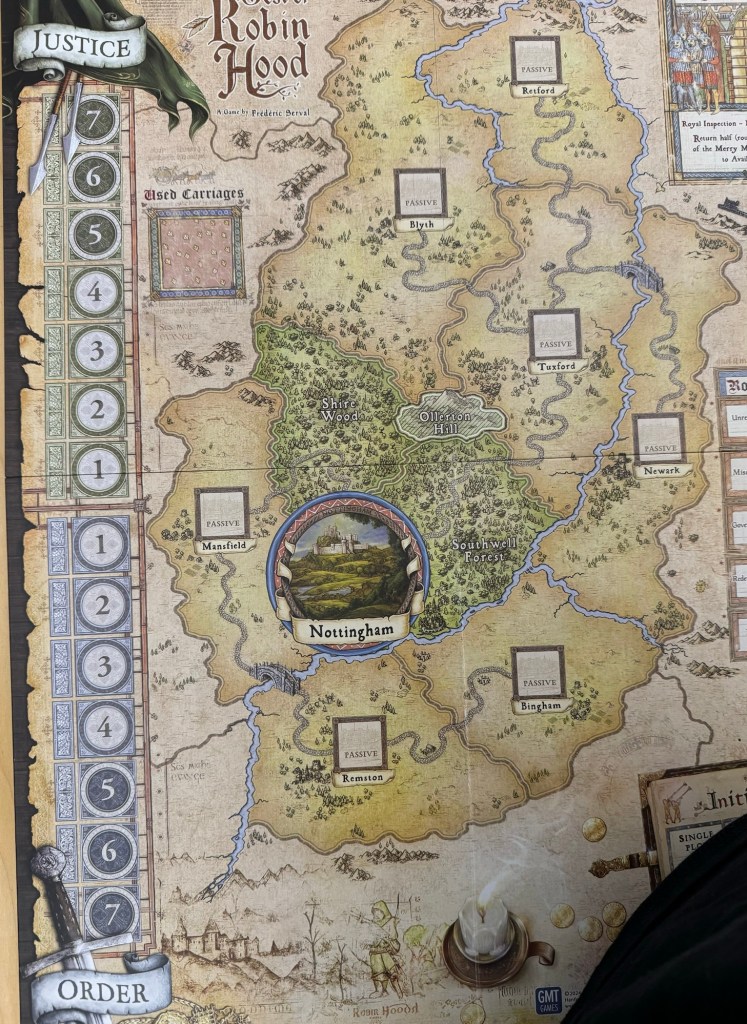
If the game reaches the final Inspection Round, the winner will be determined by what side of the track the Royal Favour Cylinder is resting in. The track is marked from 7 Justice at the bottom to 7 Order at the top. It is important to note that there is no zero space.
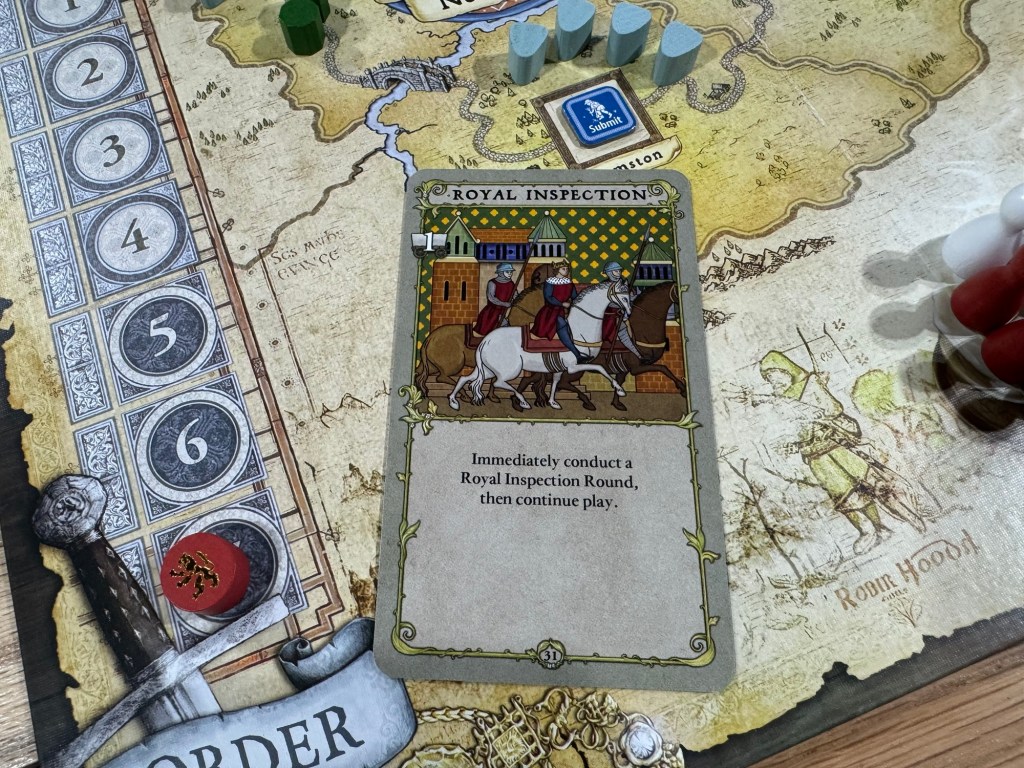
The game is won based on the concept of how much the people of Nottinghamshire embrace the opposing concepts of Justice or Order. The spaces of 5 onward are different colored than the first 4 spaces on each track as these values from 5 to 7 allow for an automatic victory to be earned if either player reaches them during the game. This Justice/Order Track can be manipulated by the play of various Event Cards or through actions such as a Carriage arriving at Nottingham, a Camp being removed by the Sheriff or Robin Hood inspiring the locals to resist.
Players must always keep an eye on the status of the Justice/Order Track. It can snowball very easily and can get out of reach quickly. The player should make decisions about what Plots or Deeds they take each round, or whether to take the effects of an Event Card, based on the status of the Royal Favour Cylinder. If the game can be won or lost by taking a specific action or playing a revealed Event Card, the player would be wise to do so. But keeping this track under control and in your favor is one of the keys to the game and is the 2nd most important aspect to focus on with only the Initiative Track being the most important as it can lead to controlling or manipulating the Justice/Order Track.
Prison Box
The Prison Box is used to hold Merry Men pieces, including the dastardly Robin Hood, that have been removed from the Game Board during the course of play through the use of the Sheriff’s Capture Plot or through the play of an Event Card. Merry Men may only be removed from the Prison Box during the Mischief Phase of the Royal Inspection Round, by some Event Card effects or through the use of the Swashbuckle Deed by the Robin Hood player to specifically remove the Robin Hood piece. As noted at the bottom of the Prison Box, the Robin Hood player will gain half of the Merry Men in the Prison Box rounded down back to their Available supply during the Mischief Phase of the Royal Inspection Round at the end of each turn.

The Prison Box is also just gorgeous and makes me want to spend a night there just to get a closer look at the details of the place. I also really appreciate the keys and lock drawn under the Prison Box for that added touch of flavor.
Used Carriages Box
When a Carriage is removed from the Game Board, by either successful Rob or once it reaches the safety of the Nottingham treasury, it will be placed into the Used Carriages Box until the next Royal Inspection Round Redeployment Phase. When Carriages are placed by the Sheriff on the board, they are chosen from a supply of 6 Carriages with 3 different types (Tallage, Tribute and Trap) and placed face down on the Game Board to hide their true identity. If the Carriages are not successfully Robbed, because the dice or defense values were not favorable, they will remain revealed and will continue along their journey to Nottingham in open view of the Robin Hood player. This is one of my most favorite aspects of the game and we will cover this in our discussion of the Sheriff’s Plots and Deeds.
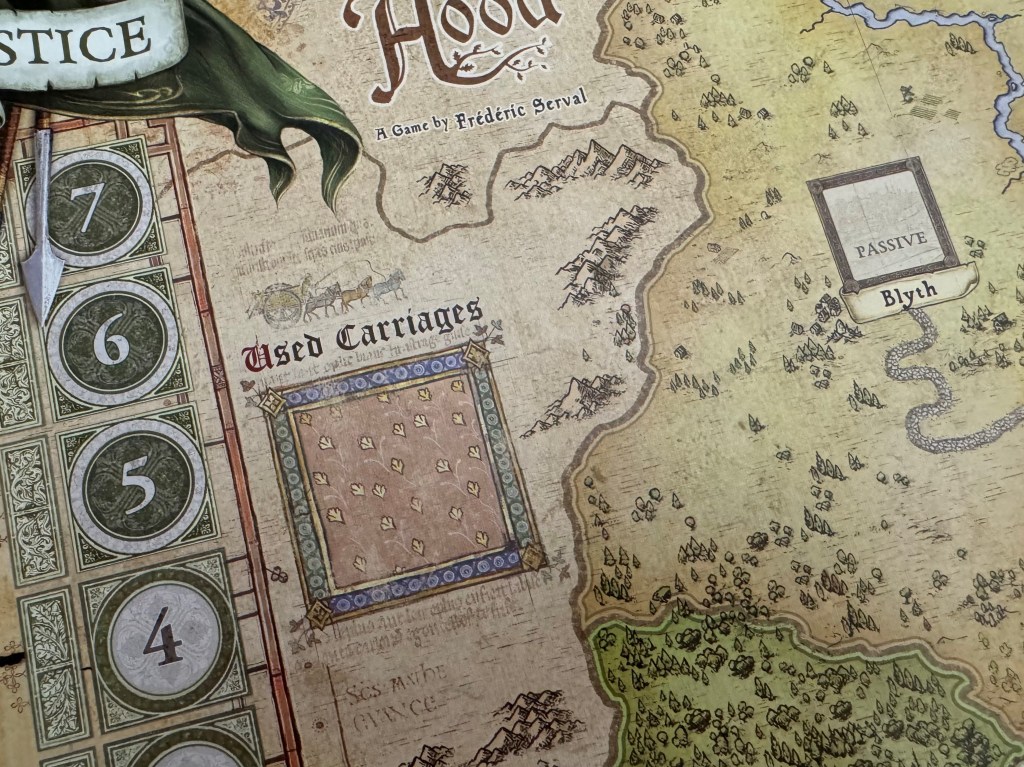
One of the important things about the Used Carriages Box for the Robin Hood player is to keep in mind what other types of Carriages are out on the Game Board or in the Sheriffs reserve. Knowing what he has deployed and what is left is key as you plan your Robs to stop him from scoring Justice by having Carriages successfully arrive in Nottingham. And if those Tribute Carriages arrive safely, the Sherriff will reap a huge advantage with a total increase of +2 Justice (+1 due to the Carriage arriving and the other +1 for the Tribute Carriage itself) as this can be a really important aspect to understand and swing the game in the favor of the Sheriff.
Initiative Track
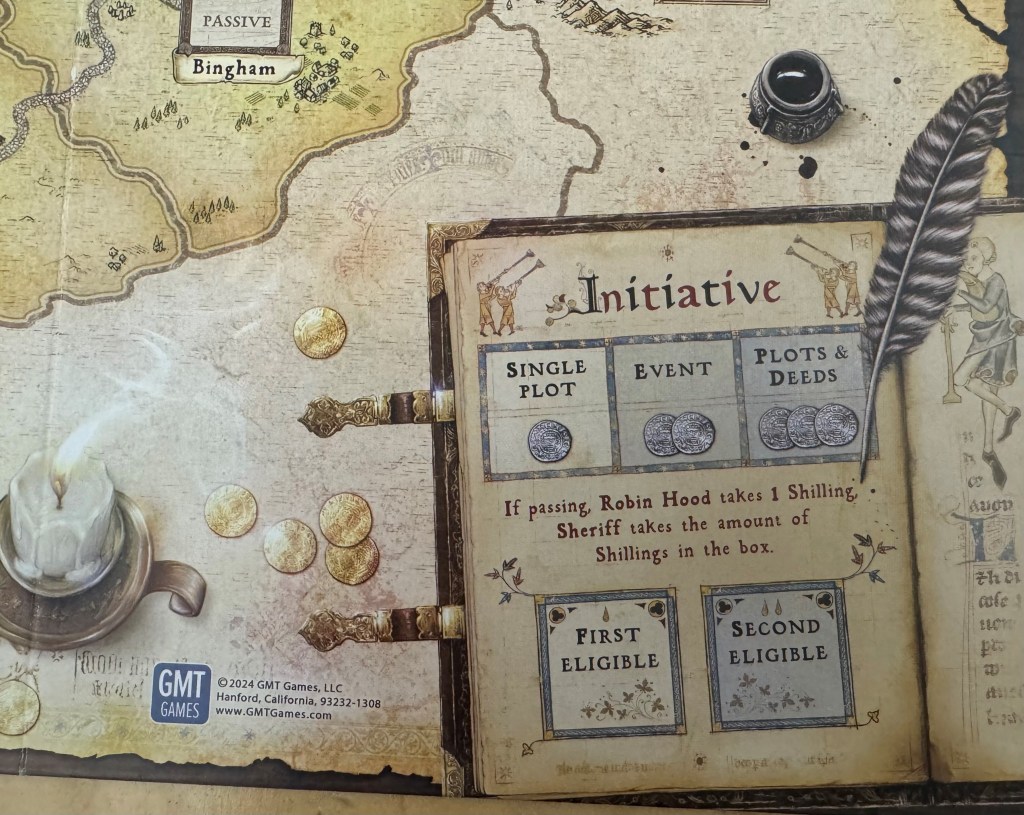
We will discuss the Initiative Track in greater detail in Action Point 2 of this series but I want to just cover it briefly here to give you an idea about what function it plays. The Initiative Box is based on the 2-player Initiative created for Volume VII of the COIN Series Colonial Twilight by Brian Train. This Initiative Track innovation (yes I said innovation as it is a great upgrade to account for lesser player count volumes in the series and was the basis for the 2-player Initiative Track found in The British Way designed by Stephen Rangazas and also modeled here in A Gest of Robin Hood) creates some very interesting choices for the players. Remember, that both players will be able to act on each Event Card in initiative order and no player is ineligible as in other volumes.
The First Eligible player’s choice of actions will change the access to the various options for the Second Eligible player and will also determine who is First Eligible on the next Event Card. As you can see from the picture below, there are 3 choices for the players including a Single Plot, the Event and Plots & Deeds. You will also notice the coins drawn at the bottom of each of the boxes. These are the number of Shillings that the Sheriff will earn if they choose to pass. If the Robin Hood player passes, they will only get 1 Shilling. The choice of passing is in itself a choice to block a specific action choice from the other player as the passing player has to move their cylinder to the box. I don’t want to go into it too much at this point as I am going to dive deeper into the Initiative Track in the next post.
Royal Inspection Round Phases Track
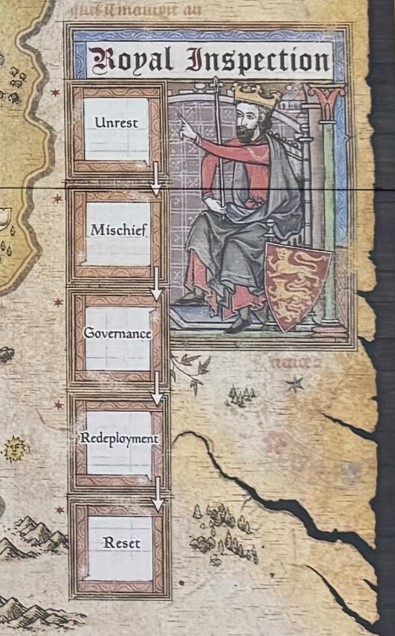
The final part of the board that I will point out is the Royal Inspection Round Phases Track that is found located on the right side of the board between the Initiative Track and the Prison Box. This Track allows the players to keep the various parts or phases of the Royal Inspection Round straight and there is a counter provided that you can place in the current phase box and move down as you make progress. These type of player aids are always helpful to keep things moving along and allow the game to be played without keeping your nose in the rule book. The players start in the Unrest Phase, move to the Mischief Phase, followed by the Governance Phase, Redeployment Phase and finally the Reset Phase. Each of these phases is important and provides the players with opportunities to move Order and Justice up or down, hide their Merry Men, gain income for the number of Camps and Passive Parishes and then get ready for the next round. It also helps that this part of the board is also adorned with a nice Medieval style painting of a King accepting tribute.
Well, as you can see, the game is beautiful, both from a production standpoint as well as a great example of good layout and graphic design. The game really is a fairly simple entry point to the genre of asymmetric games and also the COIN Series and I really have enjoyed our few plays. There is a lot for me to learn and opportunity to better hone my approach and strategy but this one is a keeper for sure.
In Action Point 2, we will further investigate the 2-player Initiative (Sequence of Play) Box to understand what makes this process unique and how players should approach it as a strategy.
If you are interested, you can read our interview with designer Fred Serval at the following link: https://theplayersaid.com/2022/11/21/interview-with-fred-serval-designer-of-a-gest-of-robin-hood-insurrection-in-nottinghamshire-from-gmt-games/
We have already played a few times and shot a full playthrough video as well as a short video review and those should be up on the channel over the next month or so. More coverage to come on this fantastic little game!
-Grant
 The Players' Aid
It celebrates the resilience of the human spirit and inspires us to overcome challenges with grace.
LikeLiked by 1 person