In our travels to several gaming conventions over the years we have made some great friends, which include gamers, designers, publishers, other content creators, etc. While attending the World Boardgaming Championships a few years ago, we had the chance to interview Mark Miklos who is the creator of the Battles of the American Revolution (BoAR) Series. We also got to include in this video his development team including Rob “Cappy” McCracken and Dave Stiffler. We discussed the series in general, the newest upcoming volume at that time Battle of White Plains as well as the new upcoming Small BoAR Series which will focus on smaller lesser known battles.
Here is a link to that interview:
I am really glad to see these games rolling out and the interest still being strong after 11 full volumes. In May, we got news that the new 11th volume is coming, which focuses on the Battle of Green Spring in 1781 as a prelude to the final battle at Yorktown that ended the revolution and forced the British to surrender while playing The World Turned Upside Down! We reached out to Mark and he was more than willing to respond to our questions on the game.
*Keep in mind that the design is still undergoing playtesting and that any details or component pictures shared in this interview will change prior to final publication as they enter the art department.

Grant: How is the Battles of the American Revolution Series doing in your opinion? What is the appeal of the system to gamers?
Mark: The series (we call it BoAR for short) is now in its 26th year and going strong. Volume XI, The Battle of Green Spring, is now in development. When finished, it will represent the thirteenth American Revolutionary War battle covered by the series. In total, these battles comprise thirty-one scenarios.
Some of the appeal, therefore lies in the diversity of subjects offered, from the better known battles like Saratoga, Brandywine Creek, Monmouth Courthouse, and Germantown to those less well known like Eutaw Springs, Rhode Island, White Plains, Newtown, and yes, Green Spring. Even Pensacola. You may say, “Wait, an Am Rev War battle in Florida? Florida wasn’t one of the thirteen colonies.” And you’d be right. Nevertheless, a major battle was fought there among America’s Spanish and French allies and the British. It was significant because it had far reaching consequences for the eventual expansion of the new American nation westward.
Newtown is another excellent example of a very significant yet relatively unknown battle. Fought on August 29, 1779, Newtown was the only pitched battle fought during the Revolution between an actual army of Native American warriors supported by a few Loyalists against approximately one third of the Continental Army. It was fought in western New York state, known then as Iroquoia. The Continentals pursued a scorched earth campaign that would make latter-day General Sherman howl. In doing so they broke the back of Iroquois resistance, with a few minor exceptions, for the rest of the war. Despite its significance, very few people can identify Newtown as an American Revolutionary War battle. The series does not shy away from introducing some of these lesser-known subjects while it also seeks to tell the story of the more famous battles.
Diversity of subject matter, however, is not the only appeal of the series. It was designed from the outset to be approachable. Seldom will you see a BoAR game rated higher than 6 on the complexity scale with average ratings closer to 4. I wanted the game to be simple enough for a non-wargamer to dive into yet challenging and nuanced enough for the experienced gamer to keep coming back for more, and I think we’ve succeeded in finding that sweet spot.
The fact that BoAR is a series is also a compelling point because the core game system remains the same across all the games. That core system is covered in about twelve pages of rules. That low rules-overhead is then supplemented by Exclusive Rules for each game; those things that made each battlefield unique like Daniel Morgan’s riflemen sniping British artillery crews at Saratoga, American troops looting the British camp at Eutaw Springs, the oppressive heat during the Battle of Monmouth where more men fell from heat stroke than from enemy action or friendly fire that caused American units to panic off the field at Germantown. In later volumes of the series we introduced Opportunity Cards that help bring that historical narrative into even sharper focus.
Another feature of the design that draws players to it is what I call the game-within-the-game. I’m referring to the interplay between army morale, tracked on a sliding scale along the edge of the map boards and individual unit capabilities on the battlefield. Breaking the opponents will to fight was the essential outcome of most Revolutionary War battles and not the kind of wholesale slaughter you find in later eras like Napoleonics or the American Civil War. In BoAR an army will either be in High Morale, Fatigued, or Wavering before eventually becoming completely Demoralized and quitting the field. Each lower level degrades the ability for your side to seize initiative or for your units to perform at maximum ability in combat or during morale checks. The Morale Track is fluid and will rise and fall according to outcomes on the battlefield such as causing an enemy unit to lose a step of damage or when a leader becomes a casualty. Occasionally morale adjustments are tied to gaining objectives on the map. The ballet that is achieved in the game as one manages tactical necessity while keeping a weather eye on army morale is foundational to the series and elegantly captures the spirit of warfare on these battlefields. If you know baseball, think of the best shortstop-second baseman double play combination that you know of and that is a good way to think of how morale and tactics are intertwined in BoAR. Players love it!
In terms of rules architecture, I have designed BoAR so that even when you are not the phasing player, you are engaged in the flow of the game. For example, the non-phasing player gets defensive artillery fire after the phasing player has moved and rallied but before he continues with his turn, assuming you have artillery units within range and line of sight. Additionally, rifle fire in the game is simultaneous and occurs during each half of a game turn. When you are the phasing player and when you are not, you have the potential for rifle fire, again assuming you have rifle-armed units within range. These structures keep both players completely engaged all the time. Seldom will you have to wait for long periods of time, and leave to get coffee or take a phone call while the phasing player is moving without having something to do.
We have a dedicated cadre of players who have followed the series for years and an ever-growing number of initiates who are discovering BoAR for the first time, and playing it all around the world. Many play for fun while many others play competitively at tournaments such as the World Boardgaming Championships and Prezcon where we host RevCon, a mini-Con dedicated to the playing of games about the American Revolution. By offering competitive formats as well as casual game-play I try to meet players where they are.
Grant: Why do you feel it is important to tell the story of these battles for American Independence?
Mark: I hesitate to make a social commentary but I feel that we have lost our way as an American nation. History was sacrificed in curricula beginning some thirty years ago and as a consequence, we have cut our anchor cables. Many no longer appreciate their antecedents or the sacrifices that were made that this nation might live. What better time than the eve of our 250th anniversary to become reacquainted with the principal actors and to re-learn some of the greatest moments from the founding of our nation? In a small way, I hope my series can be a catalyst for that.

Grant: What is your new game in the series The Battle of Green Spring about? Why was this a battle that you wanted to cover in the series?
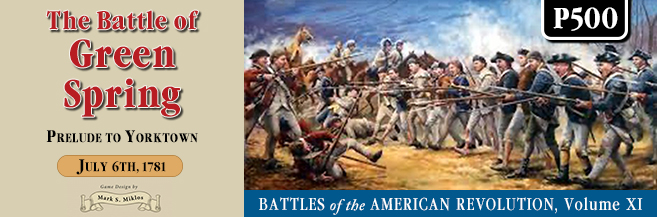
Mark: The Battle of Green Spring (aka The Battle of Green Spring Plantation, The Battle of Green Spring Farm, or The Affair near James Island) was fought on July 6, 1781. It was the largest field battle fought in Virginia during the American Revolution with over 10,000 combatants on the field or in proximity to it. Indeed, this battle was Lord Cornwallis’ final victory in North America and served as the immediate precursor to the Siege of Yorktown. According to Lt. Colonel Banastre Tarleton and others, the outcome at Green Spring directly influenced the forces available to the protagonists at Yorktown and hence played a direct role in Yorktown’s eventual outcome.
Lieutenant General, the Earl Cornwallis displayed tactical finesse while luring Major General, the Marquis de Lafayette, whom he pejoratively referred to as “that boy,” into a trap. Meanwhile, Brigadier General “Mad” Anthony Wayne displayed the kind of dash and élan for which his name had by now became synonymous, staving-off disaster for the Americans with a desperate bayonet charge.
For all these reasons, the Battle of Green Spring deserves more than the footnotes it typically receives in most histories. Volume XI in GMT’s Battles of the American Revolution Series sheds light on this important action and allows the hobbyist and historian the opportunity to fully appreciate its significance.
Grant: Has it been a challenge to represent the 10,000 forces arrayed in this battle? What challenges did this present for the design?
Mark: Not really. The orders of battle for both armies are available. Scaling is always a concern because in my series, a hex is 200 yards, a turn is 1-hour, and a strength point is approximately 100 men. Configuring the regiments, battalions, companies, and cavalry troops into corresponding combat units so that players have enough counters to work with is a process but one that I welcome as I dig into those orders of battle.
I also had fun doing some extra research that uncovered a couple of very interesting facts. For example, not listed in formal OB’s is the William and Mary Company. These were students and faculty from William & Mary College in Williamsburg who formed an elite militia unit in 1777. Their activities were suppressed while the British occupied Williamsburg but they later emerged as a unit in the Continental Army at the Siege of Yorktown a mere three months later. I offer this unit to players on a conditional reinforcement basis in the game.
On the British side, I created a unit of armed refugees. There was a significant minority of persons and families in Williamsburg who remained loyal to the Crown throughout the war. During the Whig Ascendancy they were suppressed both socially and economically while some were imprisoned or tarred and feathered. They chose to depart en masse with Cornwallis’ army when he marched away. The record indicates that many of these individuals joined the British army and surrendered with it at Yorktown, while some got stationed elsewhere like Charleston or the Caribbean. In the game they are loosely organized and are in-tow with the British where they can assist in defensive combat only.
Grant: As a prelude to Yorktown, how did this battle affect that situation historically?
Mark: The American army under Lafayette that fought at Green Spring was made up primarily of crack light infantry units. Indeed no other game in the series features so much light infantry on the battlefield. These were supported by a few battalions of Pennsylvania and New Jersey Line as well as Virginia militia.
Cornwallis laid a trap and the Americans fell into it. Because the battle was fought in the late afternoon and twilight hours of a warm summer’s day in the Virginia Tidewater, and because Cornwallis’ orders required him to march to Portsmouth across the James River, he elected not to pursue and the Americans were able to lick their wounds and live to fight another day; at Yorktown. British Lt. Colonel Banastre Tarleton pressed Cornwallis to pursue the defeated Americans in order to completely defeat them and later wrote that had his Lordship agreed to do so, it is likely the American army would have been utterly defeated. In such an event, not only would those numbers be absent from the army before Yorktown, but also the fighting quality of those crack units would have been sorely missed.
From the American perspective, Lafayette only committed a portion of his force historically while keeping reserves a few miles to the rear. In the campaign scenario, the American player fully commits the American army in a bid to destroy Cornwallis’ army. No Cornwallis, no Yorktown!
Grant: What from the Battle of Green Spring did you need to take care to model and consider in the design?
Mark: At the very moment in the battle when the situation for the American army was dire and bleak, and the American line was about to be double-enveloped, outnumbered General “Mad” Anthony Wayne launched a headlong bayonet charge into the teeth of the advancing British. The British line staggered in surprise and halted just long enough for the bulk of the Americans to make good their escape. It was costly, but it worked.
It was very important for me to get this right in the design. There is an Exclusive Rule governing this bayonet charge which uses a special table to articulate the results. This is one of those events like I described previously of something occurring on a given battlefield that made that battle unique in some way from others in the series. Wayne’s charge at Green Spring will live again on your gaming table.
Grant: What is your overarching design goal with this volume?
Mark: As with all games in the series, I want to place players in space and time on the battlefield. I hope to educate the players about this lesser-known but vital battle and to create a design that is balanced with a high replay quotient.
Grant: What scenarios are included? What experience do each of these present for the gamer?
Mark: The game includes three scenarios. The standard game is historical and lasts 8-turns. The British begin in their historical deployments while only that portion of the American army committed by Lafayette, approaches and deploys. Depending on card-play, this scenario may be extended one turn into night.
There is a Short Historical Scenario lasting only 4 turns and involving just those units from both armies that actually engaged at the Harris farm in the late afternoon and twilight hours of 6 July, 1781. Players familiar with the series will immediately recognize the nail-biting tension presented in this scenario as reminiscent of the Freeman’s Farm scenario in Saratoga or the Chatterton Hill scenario in White Plains where one can ill-afford even a single strength point loss and victory can turn on a half VP on the last half of the last game turn.
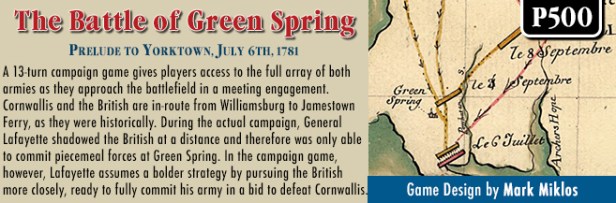
A 13-turn campaign game gives players access to the full array of their armies as they approach the battlefield in a meeting engagement. Cornwallis and the British are en route from Williamsburg to Jamestown Ferry, as they were historically. During the actual campaign, General Lafayette shadowed the British at a distance and was therefore only able to commit piecemeal forces at Green Spring. In the campaign game, however, Lafayette assumes a bolder strategy by pursuing the British more closely, ready to fully commit his forces in a bid to destroy Cornwallis.
Grant: What sources did you consult for the historical detail? What one must read resource would you recommend?

Mark: Regrettably there is no comprehensive secondary history of this battle. In most general histories such as The Road to Yorktown: Jefferson, Lafayette and the British Invasion of Virginia by John R. Maass, The History Press 2015, or 1781: The Decisive Year of the Revolutionary War by Robert L. Tonsetic, Casemate Publishers 2011, or From Savannah to Yorktown, The American Revolution in the South by the venerable Henry Lumpkin, University of South Carolina Press, 1981, Green Spring may receive anywhere from a mere mention to two or three dedicated pages; not much. Even the West Point History of the American Revolution only gives a passing mention. Arguably, the most comprehensive secondary source is Osprey’s Campaign Series #47, Yorktown 1781: The World Turned Upside Down by Brendan Morrissey, Reed International Books 1997. Not only does it give a good summary of the Virginia Campaign and an adequate although brief account of the battle, it also features maps, illustrations, and an Order of Battle for Green Spring.

Other sources I used include British Forces in North America, 1774-1781, Their Distribution and Strength, The Battle of Green Spring: A Footnote on the Road to Yorktown, by Conor Robison, Journal of the American Revolution, November 10, 2022, and The Affair Near James Island (or, The Battle of Green Spring) by Charles E. Hatch, Jr., The Virginia Magazine of History and Biography, v. 53. I also gathered information from the Historical Society of Pennsylvania, The College of William & Mary, The Hessians in the Revolutionary War by Edward J. Lowell, historical newspaper accounts such as one in the Caledonian Mercury from October, 1781, Regimental histories such as that of The 2nd Virginia Regiment, 1775-1780, and various other on-line resources like Emerging Revolutionary War Era that discussed Green Spring in a posting dated July 12, 2016 by Mark Maloy. For the broadest brush strokes one can start with Wikipedia’s Battle of Green Spring or books dedicated to battle statistics like A Guide to the Battles of the American Revolution by Theodore P. Savas and J. David Dameron, Savas Beatie LLC 2006. Green Spring is also included in Battle Maps of the American Revolution, v. 3, by the American Battlefield Trust, Knox Press 2021.
Grant: For those unfamiliar with the BoAR Series, what are the hallmarks of the system?
Mark: I have partially answered this in the above responses but to elaborate, Initiative determines player order. This is not an “I go, you go” game. Momentum allows a player to influence the Initiative die roll or to call back an adverse die roll in close combat and force a re-roll. In some of the games, Momentum can also be used to accelerate incoming reinforcements or to acquire additional Opportunity cards. Diversion allows a player to forgo a “soak-of ” attack by diverting the enemy hex in order to combine with other friendly units in an attack against a neighboring enemy hex. It comes at a cost however. That cost is a negative 1-column shift on the Combat Results Table. Army Morale and its interplay with tactics has already been discussed. It is truly the game within the game. Tactics cards linked to leader capability is another feature. In combat there are base tactics that a player may always choose from. Having an eligible leader in command, however, allows for a wider selection of tactics and puts greater emphasis on leader casualties. Not only does one lose a leader’s combat and morale modifiers but also the ability to select from a wider tableau of tactics. Playability, play-balance, and low rules overhead are also hallmarks of the system.
Grant: What area of Green Spring Plantation does the board cover? What interesting terrain is included in the battlefield? How does this terrain force commanders to consider their approaches?

Mark: The area of play begins approximately one mile north of Green Spring Plantation and is bordered by the James River to the west and south at Jamestown Ferry, and on the east by the road to Williamsburg which is approximately six miles away off-map. The dominant terrain feature is “The Morass.” This east-west belt of swampland and bog is tidal along the James and then brackish further inland and presents a significant military barrier that the American army must cross. While there are a few paths through it, there is only a single primary road that utilizes a Corduroy causeway to cross the morass proper. South of the Morass, as one approaches the ferry, the land opens up and is covered by several farms and plantations. It’s a battlefield that offers interesting challenges and options for maneuver and combat.

Grant: Who is the artist? How have their efforts assisted you in the setting and thematic immersion of the battle?
Mark: GMT’s Charlie Kibler has worked on the maps for the series since Volume VI, The Battle of Pensacola. His distinctive touch and attention to detail help players have an immersive experience. His work on Green Spring will be no different.

Grant: What is the anatomy of the counters?
Mark: Infantry regiments, battalions, and companies, cavalry troops, artillery batteries and individual leaders. Combat units are rated for unit morale, strength points and movement points and leaders for close combat modifiers, morale check modifiers and movement.
Grant: What special units are included on each side?
Mark: The British player has skirmishers. At Green Spring, Cornwallis deployed skirmishers with orders to give ground grudgingly and fall back slowly to the masked positions of the main British line. They performed well and took 50% casualties including each of three successive unit commanders. Exclusive Rules were written to represent their elasticity, stealthiness and resilience. The British also have decoy artillery that they used as part of the lure to bring the American army forward into the trap they had set.
There is also a British naval landing party that can come ashore under certain conditions. And there are the armed refugees already mentioned. The remnants of a once mighty southern British army along with its Hessian mercenaries, Highlanders, and Loyalists are there. The latter includes the Queen’s Rangers horse and foot under John Graves Simcoe and the British Legion under Tarleton. One detachment of light dragoons from Benedict Arnold’s American Legion is also present among the British; Arnold having changed sides by this point in the war. He had campaigned in Virginia but was recalled to New York with the bulk of his legionnaires before the battle.
The Americans have crack light infantry, line battalions supported by a few guns, lots of militia of dubious quality and the William & Mary Company already mentioned. American cavalry was outclassed at Green Spring as evidenced by Armond’s Legion. The Legion was poorly mounted on inferior draft horses commandeered from local farms. The Legion’s commander, Lt. Colonel Charles Armand Tuffin, Marquis de la Rouerie, was absent in France on a mission to raise supplies and funds for the Legion. These factors, together with the unit’s heterogeneous composition of foreign volunteers, Hessian POW’s, and the remnants of Pulaski’s Legion, as well as its dwindling numbers due to losses sustained during long and hard campaigning, all conspired to create conditions under which the American cavalry with few exceptions performed poorly at Green Spring.
Overseeing the whole array was a stellar corps of American Generals including Lafayette himself, “Mad” Anthony Wayne, “Devil Pete” Muhlenberg, and Baron von Steuben.
Grant: What are the Opportunity Cards and how are they used?
Mark: A deck of twenty six cards, thirteen for each player, represent moments from the historical narrative of the Battle of Green Spring. For example, on the Fourth of July the American army fired a “Feu de Joie” in celebration of the Declaration of Independence. If the American player plays this card he can add +1 to his army morale. “A Tap of the Cane ” is a British card intended to represent the moment that Lord Cornwallis himself walked up behind MacDonald’s Highlanders and tapped several troops on the shoulder with his cane, exhorting them to the attack. When played, this card allows MacDonald’s Highlanders to move 5 MP instead of the standard 4 MP but only if moving adjacent to an enemy unit to attack it in Close Combat.

Some of the cards are more generic in nature like “Chaos on the Battlefield” that requires attacking units to make a pre-attack morale check and retreat if they fail. It also penalizes all ensuing attacks with a -1 DRM. “Grapeshot” allows the British artillery to automatically disrupt one American unit within range and line of sight, without a die roll.

One of my favorite cards was inspired by the epitaph on a grave of an unknown American soldier who fell at Green Spring. It reads, “Thou that passeth by, tell them that here, I died for Independence.”
Grant: What are the tactics cards and how are they used? Can you show us a few examples and explain their use?

Mark: At the beginning of the game, each player takes one set of eight identical tactics cards. During every close combat, each player will secretly select one eligible tactic to influence the battle. Once both players have made their selections, the cards are simultaneously revealed. The result will yield a DRM that is cumulative with any other applicable DRM’s in that combat.
There are certain tactics-use restrictions that pertain to leadership and position, such as Turn Flank that requires not only a commanding leader but also a vacant hex adjacent to the combat to execute it.
In the example provided here you see the attacking British player has selected Attack Echelon while the defending American player has attempted to Withdraw. The attacking British player looks down the “Attack” column and finds the defender’s selection, “Withdraw.” At the same time the defending American player looks down the “Defend” column and finds the attacker’s selection, “Attack Echelon.” The outcome is identical on both cards; a +1 DRM which is applied to the British player’s attack. The withdraw tactic, in this case, was unsuccessful.

While most players like the mind-game of tactics card play and feel it adds another exciting element to BoAR there have been a few players over the years who have said that tactics cards slow down the game. Ultimately the combat system favors the accumulation of DRM’s over outright odds and tactics cards are one mechanism available to boost those DRM’s.
For solitaire players, an excellent matrix of “Solitaire Tactics Tables” was created by Joel Toppen and published in C3i Magazine #22 which makes using the tactics cards a seamless experience while playing solitaire.
Grant: What are the new Diversion Markers and what role do they play?
Mark: As mentioned above, one of the choices a player has during close combat is to declare a diversion against one enemy hex in order not to attack it and instead, throw-in on an attack against a neighboring hex. It absolves a player from having to make the dreaded, and artificial, “soak-off” attack. In the smaller BoAR scenarios with low counter density it is easy to keep up with this once-per-combat-phase diversion benefit. In larger battles, however, with lines of battle potentially extending for miles across the battlefield, it can get confusing, particularly when a game has been going on for a few hours and players may no longer be fresh. Having a marker to label the hex receiving the diversion is just a handy way to keep up with this benefit. In effect it works just the way the Rally on Me marker works as a reminder to players that they have a disrupted unit within a stack and of the need to do a morale check in an attempt to rally that unit. Consider these to be player-aids.
Grant: What is the makeup of the CRT? How did you reflect the makeup of and the different styles of the fighting covers in the CRT? What advantage does the use of a 10-sided die in combat give the system?
Mark: The CRT ranges from a low of 1-3 odds to a high of 4-1 odds, including a 3-2 column. Odds of less than 1:3 are treated as 1:3 with an automatic DRM of -1 to the attacker. Odds of greater than 4-1 are treated as 4:1. The d10 is read 0-9 and die rolls range from a modified -2 or less to a modified 11 or greater. Combat results include:
- No effect
- No Combat (If one player successfully withdraws by playing a Withdraw tactic.)
- Loss of -1 Army Morale point
- Retreat (1 hex)
- Disruption (Retreat 3-hexes and incur operational penalties until successfully rallied.)
- 1-step of damage (Many but not all units are back-printed.)
- 2-steps of damage
- Capture (May be at Attacker’s or Defender’s discretion as specified on the CRT.)
- Pinned (Opposing units remain locked in combat until the next player-turn)
- Leader casualty (Assigned to certain step-loss results)
- Momentum gain (For attacker or defender depending on odds and die roll)
There are two kinds of combat in BoAR; fire combat and close combat. This discussion of the CRT is relevant to close combat, which is an abstraction of musketry and cold-steel.
Fire combat is governed by its own set of tables in which strength points firing are cross-referenced with the range to the target, modified by terrain and other factors, yielding a “to-hit” number that must be rolled or exceeded. If successful, a second roll is made on rifle or artillery damage tables and the outcome applies only to the targeted unit.
In close combat, each player designates a lead unit whose unit morale becomes a modifier to the combat. Lead units must advance after combat if the defender’s hex is vacated but must also suffer the adverse effects of combat, if any. Thus, while it seems obvious to always select high value units with superior morale as lead units, it may not always be prudent to do so. While lead units carry the brunt of a close combat, other units involved on the losing side must make morale checks to determine if they hold their ground or retreat.
Modifiers are cumulative and so leadership, terrain, position, tactics as well as the unit morale of the lead unit, as modified by army morale, are all taken into account. In BoAR we say, “It’s the mods, not the odds.” Even a relatively low-odds attack can be decisive given enough of a DRM advantage. Coupled with the variability of a d10, there is a wide range of retreat, disruption and pinned results and a narrower range of step-loss and capture results. This creates a lot of tension in the game and reflects the scrum of battle as each side pushes upon the other, seeking a breakthrough. When a decisive outcome does occur, it is noteworthy and has the potential to manifestly affect the situation on the battlefield. In short, the CRT is non-sanguine yet tension-filled.
Grant: What are the victory conditions?
Mark: Fundamentally, all BoAR games offer three levels of victory; decisive, substantial, and marginal. In Green Spring, a decisive victory is linked to the elimination or capture of a certain percentage of the enemy’s forces. Substantial victory occurs as soon as a player drives the enemy’s army morale to zero or, in certain scenarios, to cause it to waver. Marginal victory is based on an accumulation of victory points achieved by eliminating or capturing enemy units and leaders and for achieving certain terrain objectives by the end of the game.
Grant: Which side has the more difficult time in meeting theirs?
Mark: That’s an unfair question LoL. Generally, decisive victory conditions are written so as to be a goal but not one that is readily attainable. There were few decisive victories in the Revolutionary War when you come right down to it. Games will usually be decided by the player who can erode his opponent’s morale and his will to fight first. If both players are tenacious, it will come down to scoring points at the end of the game. But as to which player has the inside lane, you will have to get the game on the table to find out. Disclaimer: I strive hard to make BoAR games as balanced as history will accommodate.
Grant: What are you most pleased about with the design?
Mark: I strive for accuracy; accuracy in my battle maps (we walked the ground at Green Spring, most of which is private property today), accuracy in my Orders of Battle, and accuracy in reflecting the special circumstances that make each battle in the series unique. I hope I have accomplished that in Green Spring. I’m also proud to have been able to tell this story.
Grant: What other games are you working on?
Mark: Volume XII is already in concept. It will be a dual-pack; the Battles of Camden and Hobkirk’s Hill. These were fought about 8 miles apart around Camden, SC. The Battle of Camden represents the British conquest of South Carolina in 1780 while the Battle of Hobkirk’s Hill represents General Nathanael Greene’s reconquest of the state in 1781.
Grant: Can you give us an update on the status of the first volume in the Small BoAR Series?
Mark: The first volume of Small BoAR, The Battle of Cowpens, is scheduled to hit GMT’s P-500 in September! The Designer is Bruno Sinigaglio with his Developer being Dave Stiffler.

Thanks as always for your time in answering our questions Mark. I have said this before but I really appreciate your passion for the BoAR Series and for the history of the American Revolutionary War. You always seem to bring that with you when you discuss these topics and I am very grateful for your commitment to this important series.
If you are interested in Battles of the American Revolution Volume XI: The Battle of Green Spring: Prelude to Yorktown, July 6, 1781, you can pre-order a copy for $44.00 from the GMT Games website at the following link: https://www.gmtgames.com/p-1111-the-battle-of-green-spring.aspx
At the present time, the game has garnered 451 P500 commitments toward the required 500 orders since being announced in the May Monthly Update Email from GMT Games.
-Grant
 The Players' Aid
Fine interview on a very good game series. It’s inspired me to dustoff my existing volumes for more play!
I was just going to ask “Why no Battle of Cowpens?” very good to see it’s the first of the new ‘small battles’ series. I had a number of ancestors that fought there ergo my intense interest. I never considered it a small battle though. Guess I’ll have to go back and check the OB.
Whatever its size it was one of the key battles of the late war.
Next I’m interested to see if the nearby Battle of Kings Mountain can make the list. Certainly it was a small battle by any measurement.
Keep up the good work Grant. I know this is one of the conflicts you have a keen interest in.
Rober Reese
LikeLiked by 1 person
1,900 Continentals to 1,150 British Regulars at Cowpens is small in comparison to other battles in the series I think. I am sure that King’s Mountain and the Waxhaws will also be in that series.
LikeLike