
We love our tactical level wargames around here and we have played several by Joe Chacon with the most recent being Front Toward Enemy from Multi-Man Publishing. And now there is a new tactical offering designed by Joe that deals with modern warfare with American and Russian forces going at it in Decisive Action. We reached out to Joe about an interview and he was more than willing to answer our questions.
*Please keep in mind that the artwork and layout of the various components shown in this interview are not yet finalized and are only for playtest purposes at this point. Also, as this game is still in development, rules and scenario details may still change prior to publication.
Grant: First off Joe please tell us a little about yourself. What are your hobbies? What’s your day job?
Joe: I am a retired U.S. Army officer, retiring in 2010 after 25 years of service. I served as an armored cavalry officer and tactical military intelligence officer from platoon through Joint Task Force level with experience in the 1st Cavalry Division, 82nd Airborne Division, and as a tactical trainer at a U.S. Army Combat Training Center. Besides the United States Military Academy and Command, and General Staff College, I attended the Naval Post Graduate School to study Modeling and Simulations. Since retiring, I work for the Joint Chiefs of Staff on military system interoperability between the U.S. military services and partner nations. I am lucky that I get to plan and lead joint and coalition tactical-level interoperability exercises a couple of times a year. It is really amazing to be able to work with soldiers and marines on the ground, all types of aircraft, and even guided-missile destroyers to demonstrate warfighting with up to 20 coalition partners.
I started gaming when I was 11 years old with SPI’s MechWar ’77, my first wargame. I enjoy playing most any scale and period, but I am most fond of tactical games. I think those early modern tactical games (i.e., modern in the late 70’s and early 80’s) drove my choice to attend the United States Military Academy and ultimately become an armored cavalry officer in the Army.
After a career in the Army, and now with my current job, gaming and designing games is like having my cake and eating it too.
Grant: What motivated you to break into game design? What have you enjoyed most about the experience thus far?
Joe: Before Decisive Action, I got caught up in playing MMP’s Grand Tactical Series and mentioned to the GTS designer that I thought Crete would make a good game for the series. He was not interested but encouraged me to try designing it. I had no idea what I was in for, designing a game that big as my first design, but loved the process and have enjoyed designing ever since.
I love the research and problem solving involved in designing a game. There is a certain level of gratification throughout each step of designing: finding a good subject, researching an order of battle, creating a map, coming up with workable mechanics, and determining the unit dispositions to create accurate scenarios. Each step is a puzzle to solve to the best of your ability and have the satisfaction and confidence that you’ve created something that you can share with other folks.

Grant: What is your game Decisive Action about?
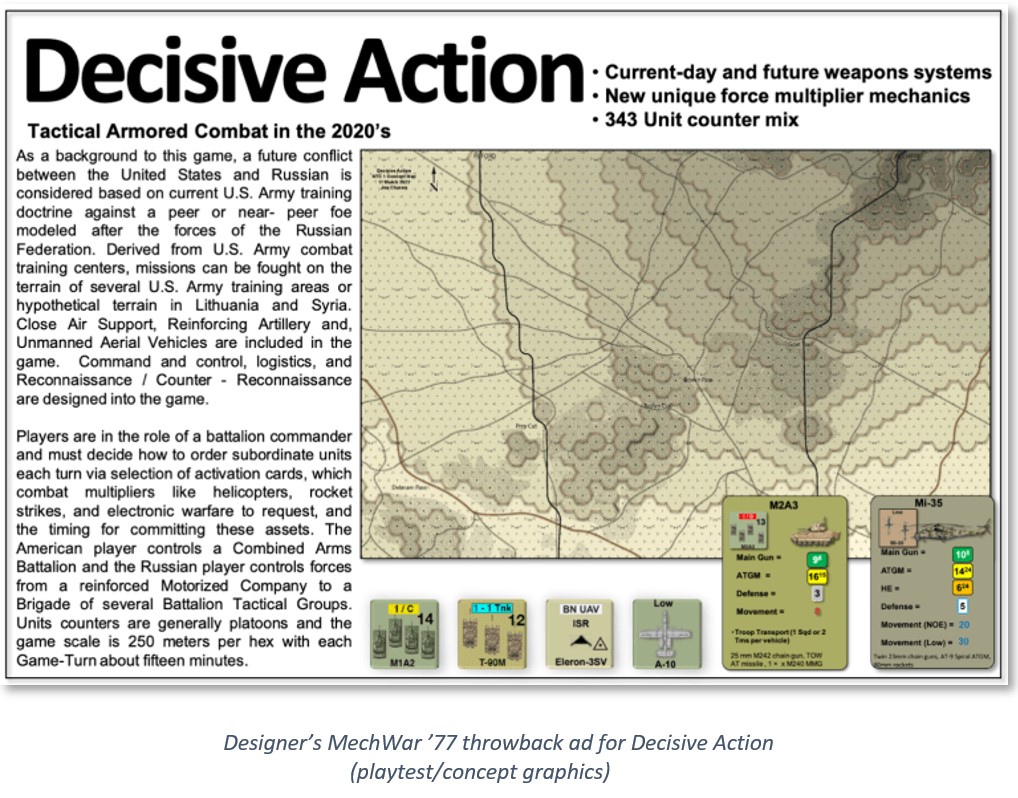
Joe: Decisive Action is a game of tactical level warfare between current American and Russian forces. Players take the role of a battalion commander, with the emphasis being on decision-making, so the players must decide what orders to give to subordinate units, how to fire and maneuver with those units, and how to allocate combat multipliers (Assets in game terms).
This first Decisive Action game is based on a U.S. Army Combined Arms Battalion (CAB) conducting traditional high-intensity force-on-force missions against variable-sized Russian forces, including a reinforced Motorized Rifle Company, a Battalion Tactical Group (BTG), or a Composite Brigade, depending on the mission.
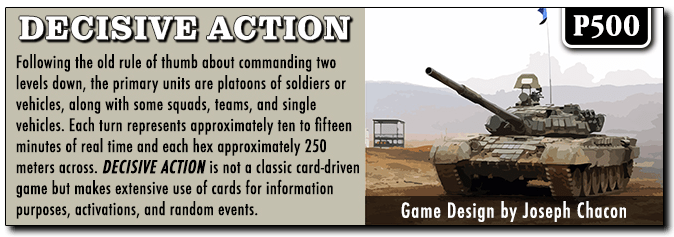
Following the old rule of thumb about commanding two levels down, the primary units are platoons, with some squads, team, and individual vehicles represented as well. Each turn represents approximately fifteen minutes of time and each hex measures approximately 250 meters across.
Grant: What does the title of the game reference? What should it convey to players about the situation?
Joe: The title first reflects the U.S. Army’s shift of focus from the counter-insurgency operations we lived through in Afghanistan and Iraq to large scale combat operations against peer or near-peer threats. Part of that shift was from the terminology of Full Spectrum Warfare to reviving the term Decisive Action. Using that for the title is meant to convey that same shift in focus from counter-insurgency operations to more conventional force-on-force operations.
With that, the U.S. Army developed a training model called the Decisive Action Training Environment (DATE), which is the official training setting to replicate complex operating environments involving high-intensity conflict and peer or near-peer threats. Currently the United Kingdom, Australia, Canada, and New Zealand have adopted DATE to build interoperability and further advance partnerships. Decisive Action borrows heavily from this unclassified model for its order of battles and weapons capabilities.
Grant: Why was this a subject that drew your interest?
Joe: The inspiration for Decisive Action originated when I was an observer/controller at the U.S. Army Combat Maneuver Training Center at Hohenfels, Germany in 1994. I watched twenty different battalions each conduct ten-day force-on-force exercises; I mentored the intelligence sections, observed battalion staffs, and tracked battle after battle of Movement to Contact, Attack, and Defense missions (which, not coincidentally, are the main scenario types in Decisive Action).
One of the many realizations I had while observing battalion commanders and their staffs agonize over battlefield decisions was just how complicated what they did was — planning, battle tracking, reacting, and fighting the battle. It was a wonder to watch them work through the Intelligence Preparation of the Battlefield and Military Decision-Making Process to come up with their plan. It takes incredible analysis, coordination, and decision-making to plan when and where a battalion will defend and build its engagement areas. There is tremendous planning needed to determine what assets to request, to calculate the time and distance from finding the enemy to engaging him, and then to successfully mass assets to destroy him.
Grant: What is your design goal with the game?
Joe: Within Decisive Action, I’ve tried to capture the essence of battalion-level command and control and decision-making, with a focus on platoon-level combat and maneuver.
To start with, Decisive Action has some solid basic mechanics for moving and shooting. I want to keep the process simple so players don’t win or lose based on mastering the game system, but rather from good planning and tactical execution.
On top of basic moving and shooting, I added a simple command and control mechanic with headquarters units and command radius, as well as a random activation mechanic to replicate some of the chaos on the battlefield. Combined with the activation process is an orders mechanic that dictates which action a unit can perform.
I really wanted to replicate the commander and staff aspect of combat, so I included operation and command points mechanics that influence changing activation orders, requesting and committing assets like attack helicopters and UAV’s, and managing indirect fires.
Finally, I really wanted to start to stretch the boundary of “modern” combat by looking at current forces, modern systems, potential adversaries, and potential battlefields.

Grant: What is the role of Evan Yoak? What skills and abilities does he bring to the table?
Joe: When I started designing games, it was explained to me a developer helped polish a game design and was supposed to help take all the great ideas of a designer and make sure they make sense. Evan is a great developer.
Evan is the developer for Decisive Action. This was his first game in that role, but he has since become a staff developer for GMT Games and has worked on several other projects, including China’s War, In the Shadows, and Cross Bronx Expressway, and soon to include several WWII tactical titles. His academic background is in English and the Classics, which has helped with editing, and he started a master’s degree in International Affairs around the same time he came on board for Decisive Action, which he recently completed.
In general, Evan has helped out to make sure the rules sound to players how I intended, as well as to nitpick the details of the game so they’re consistent. He’s also led the playtesting effort. Lastly, he’s quite enthusiastic about Decisive Action – he thinks it succeeds as a tactical wargame emphasizing planning and decision-making where other tactical wargames have come up short on those fronts.
Evan has been a great help and the game being prepared for production is due, in large part, to his efforts to make sure it is ready.
Grant: What elements from modern tactical combat are most important to include in the design?
Joe: Modern military officers are trained to look at a situation and a map and then intuitively conduct analysis as to where they can maneuver, where the enemy is likely to attack or defend, and where there might be chokepoints and key terrain. This leads to overlaying time and distance estimates of friendly and enemy movement on top of this map analysis to plan the best place to mass fires to kill the enemy. A commander and his staff use several tools to do this: intelligence preparation of the battlefield, modified combined obstacle overlay, and decision support templates and matrix.
Good gamers instinctively do the same thing when sitting down to play a game and planning out their attack or defense.
Decisive Action tries to codify some of this process with the pre-game planning for indirect fire targets and purchasing and allocating assets. The game systems lead players to view a battle in the same way as a commander and his staff do. How well they do it is up to the player.
Grant: What does this game offer that other tactical games do not?
Joe: I hope the game is unique on several levels.
First, I wanted something that addressed current forces, systems, and potential battlefields. There are lots of great tactical games focused on NATO–Warsaw Pact conflicts, but that timeframe is over 40 years old. I wanted something that was truly modern, something “ultra-modern.”
In a way, I think the combat system is unique in that you basically roll a to-hit/to-kill die for each element in the firing unit (each tank, IFV, or infantry squad). For that I used a twenty-sided die so that I could take my perceived to-hit/to-kill probabilities and translate them to percentages. A twenty-sided die lets me break them down to 5% increments.
The most unique thing is the whole battalion-level asset management mechanic. A modern battalion relies heavily on assets outside the battalion to defeat an enemy. How well they manage those assets, along with the other aspects of battalion-level command and control (i.e., orders to subordinate units and managing indirect fires), often determines success or failure for a battalion. I’ve tried to include all that in Decisive Action.
Grant: What is the purpose of the staff and command mechanic? What does it replicate from battlefield command?
Joe: Decisive Action uses an operations point mechanic to replicate the commander’s and staff’s limited bandwidth to plan and issue orders before and during a battle. Both before the game starts and then during the course of the mission, the player uses operations points to “purchase” and allocate assets such as close air support, helicopter gunships, and reconnaissance drones. This process also figures into changing the orders of subordinate units and executing fire missions. When a battalion does this, it takes a full staff of highly trained professionals; I hope that I’ve boiled down the process to give players a taste of what goes on behind the scenes.
Grant: I read where you have said Decisive Action replicates both a “training and hypothetical near-future conflict”. What do you mean by this?
Joe: Two of the maps for the game are from the Army’s Combat Training Centers (CTC): the National Training Center (NTC) at Fort Irwin, California, is the best combined arms crucible short of live combat, and the Joint Multinational Readiness Center (JMRC) at Hohenfels, Germany, is a training center focused on integrating our European partners. You could theoretically play out a game of Decisive Action and then go and fight out the exact same situation as a training exercise with real Abrams and Bradleys at a CTC.
The other settings for the game include a map of the Suwalki Gap in Lithuania and one of Syria, both representing potential areas of conflict against a Russian foe. These are drawn from actual terrain from 1:50,000 topographic maps.
In this way, Decisive Action represents both training environments and hypothetical near-future conflict.
Grant: What is the concept of Fire Power types?

Joe: Units in Decisive Action have different sorts of attacks, called Fire Power types, that run the gamut from large-caliber main guns to air defense to anti-tank guided missiles (ATGM’s). All the types are color-coded and listed on each combat system’s data card, so you can see at a glance which Fire Power type(s) a unit has. The “standard” Fire Power types (guns, small arms/MG’s) can all fire twice in a turn, while the “specialty” types (air defense, ATGM’s, engineer attacks, and HE) can fire once a turn, which represents the increased prep time needed to use them, ammo limitations, etc. Regardless, every unit can fire up to two times in a turn, including Opportunity Fire, subject to the single-shot limitation on specialty weapons.
Grant: What is the Fire Power Matrix and how has it guided your effort?
Joe: The Fire Power Matrix lays out which Fire Power types can attack which types of targets, which include unarmored ones like personnel, lightly armored ones like armored personnel carriers (APC’s) and infantry fighting vehicles (IFV’s), and heavily armored ones like tanks. So a tank’s main gun attacks opposing tanks and other vehicles and uses it’s machine guns to shoot up troops or airplanes, soldiers can attack other soldiers and light vehicles but can’t knock out a tank with rifles, and so forth.
Grant: How does combat work in Decisive Action?
Joe: Attacks are simple to resolve. A single unit fires at a time, targeting one opposing unit.
The target must be in line of sight (LOS) to the firer and within Sighting Range; the latter encompasses the difficulty of seeing infantry hunkered down in trenches at a distance versus the ease of seeing a vehicle zipping about the battlefield (though units that fire are automatically sighted at any range at the moment of firing).
You then take the Fire Power value of the weapon being fired and modify it based on various factors like the defensive value of the target, the terrain, overstacking, etc. The advanced rules take into account more factors like facing and weather, while the optional rules add in extra detailed modifiers like advanced protection systems (APS) and limited fire control (LFC).
Then, for each vehicle, squad, or team in the firing unit, you roll 1d20 and compare it to the modified Fire Power value: 1’s always hit and 20’s always miss, but other than that, for each roll less than or equal to the modified value, you score a hit and your opponent removes one vehicle, squad, or team off the targeted unit. If elements of the target survive, the unit rolls a Troop Quality (TQ) check. If they fail, they become Suppressed, and if already Suppressed, they become Broken.
Grant: How are things like advanced protection systems (APS) and limited fire control (LFC) integrated into the equation?
Joe: These things are Optional Rules that add a bit more realism and address evolving capabilities but require a few more markers and player manipulation.
Advanced Protection Systems (APS) are countermeasures used to defeat certain types of anti-tank weapons like ATGM’s; the United States and supposedly Russia have developed and are fielding APS for their tanks and IFV’s. While not widely used yet, players may want to test this emerging capability.
While most systems have advanced optics, stabilized sights, and advanced limited visibility imaging, some combat systems do not have these capabilities. The Limited Fire Control (LFC) optional rules allow players to replicate this with a few more rules and Fire Power modifiers for low-visibility conditions like rainy weather and for moving targets.
Other optional rules include Russian use of chemical weapons, chemical protective postures, variable staff quality, more detailed slope rules, Russian performance, and UAV swarms.
Grant: What is the Troop Quality (TQ) check? How does this affect units in fire combat?
Joe: Troop Quality is intended to represent the unit’s training and moral. Higher is better.
It is used to check if a unit becomes Suppressed or Broken when the unit takes casualties and if it can activate when out of command.
Grant: What is the anatomy of the counters?
Joe: A couple of things played into my concept for the counters. First, with age I am finding I like less cluttered counters more and more, so I wanted the counters to be functional but minimalist for aesthetics and ease of use. This meant that I moved most of the combat unit information off the counters and on to cards. The second is, at this scale, I like a top-down view of the vehicles, almost giving a miniatures feel, or actual military tactical symbols, making it feel like you are fighting the battle off a map in a battalion tactical operations center. I spent my whole life using and looking at tactical symbols on a map to help convey combat information, so am comfortable with using them on the counters where I can. I want to expose players to actual military graphics to help give them a feel and convey a bit of authenticity.
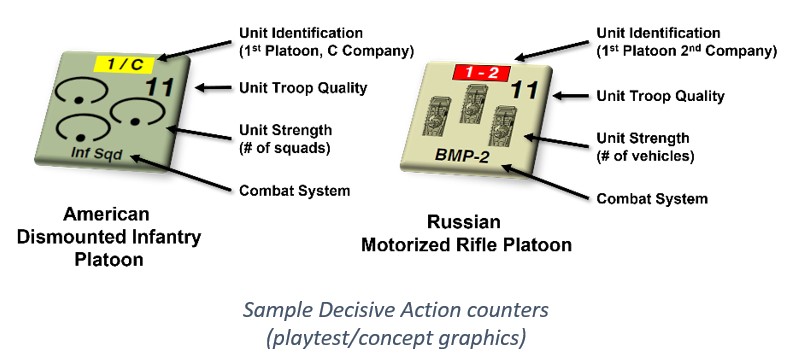
The counters only have unit designations, a Troop Quality number that changes as the units takes losses, the combat system for the unit – which matches a card with all the stats – and the number of vehicles, squads, or teams in the unit. The background color of the counter indicates the unit’s battalion. The color of the unit identification indicates which Company formation the unit belongs to or if it is an Independent unit. As the unit takes losses, it is flipped or replaced with a counter with fewer vehicles or squads on it.

Grant: What different units do players have access to?
Joe: The primary combat units are tanks, (M1A2, Sepv2 and T90M), infantry fighting vehicles (M2A3 and BMP-2), and infantry squads.
There are plenty of other units including air defense, reconnaissance, mortars, artillery, anti-tank, weapon squads, unmanned aerial systems, attack helicopters, and close air support attack aircraft.
Grant: What role do the Activation Cards play?
Joe: Decisive Action uses random formation activations, mainly by company, to drive the action. The companies’ Activation Cards represent broad sets of orders given to the company formations for carrying out their mission.
Every turn, each company formation receives an Activation Card. All of these cards are shuffled together and during the Execute Actions phase of the sequence of play, a card is drawn, which activates the formation on that card.

Units within that formation then activate one by one: if the unit is in range of an HQ (3-5 hexes, depending on the HQ type and nationality), or if the unit is independent, it may activate automatically, choosing an action listed on the Activation Card. If the unit is out of command range, then it must make a Troop Quality (TQ) check to activate; if it fails, it can’t do anything. When the player has finished with all the units in the formation, the next card is drawn, and so the process repeats.
Grant: How do you handle actions and unit activations?
Joe: The Activation Cards contain a list of actions that units in the formation can choose from (except for Independent Activation Cards, as independents can choose any action). These are the actions:
Move: The unit may move up to its full movement allowance; it may not fire.
Fire: The unit may fire twice; it may not move.
Fire and Maneuver: The unit may move up to half its movement allowance and fire once (in any order).
Assault: The unit may Assault, which is used for entering an adjacent enemy hex and coming to close quarters to clear the enemy out.
Rally: The unit may remove a Suppressed Marker or flip a Broken Marker to its Suppressed side.
Bear in mind that every unit can fire twice in a turn regardless of the chosen Activation Card. Opportunity Fire provides a way to get in those shots if your Activation Card options restrict you.
Grant: Can we see a few examples of cards? Can you describe what we are seeing?
Joe: Decisive Action uses several different types of cards, not as a card driven game, but to help with information management (Combat System and Asset Cards), random activations, and for random events.

Instead of putting unit values on the counters, each Combat System has a corresponding card with the relevant data for reference during the game.
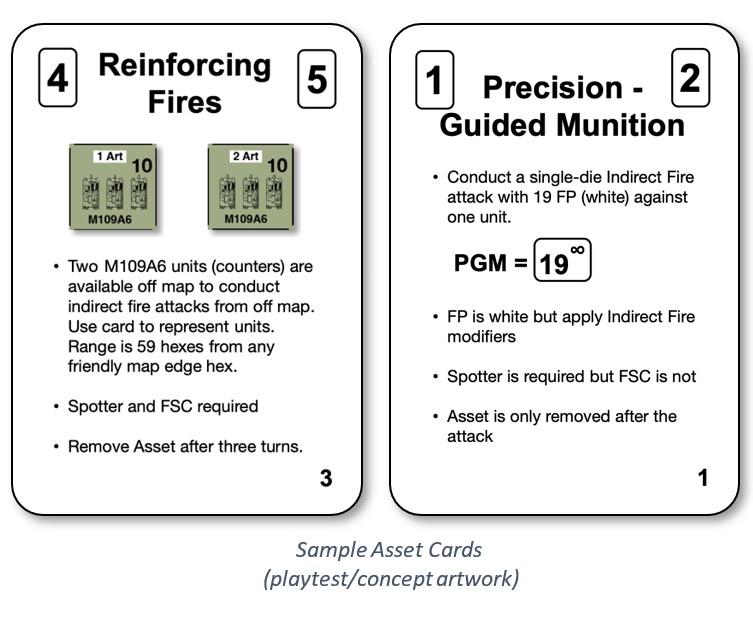
Assets are represented by markers that track when they are committed on the Game Turn Track, unit counters or markers for temporary use on the map, and cards that explain how the Asset is used.
Grant: How do the different sides Orders of Battle differ?
Joe: Accurate Orders of Battle is really an obsession with me in my designs and maybe I spend too much time researching trying to do my best.

The American player always uses a Combined Arms Battalion (CAB). He has a choice between a tank-heavy battalion with two tank companies and one mechanized infantry company, or a mech-heavy battalion with two mechanized companies and one tank company. Of course, a tank-heavy CAB means the Russian player will have access to some anti-tank units to keep up the force ratios. Besides the companies, the American player has the normal battalion units like scouts and mortars, plus some brigade-level attachments like an artillery battery and air defense.
With force modernization, I do not believe any two CAB’s across all the different divisions are the same, so I’ve done my best to provide a representative battalion.
The Russian player generally has the choice between a Tank or Motorized Rifle (BMP) Battalion Tactical Group (BTG) with brigade attachments. Probably even more so than American battalions, it is likely that no two BTG’s are the same, so again, I’ve tried to provide good representative units.
Grant: Which side has an advantage? Or does each side have their relative strengths and weaknesses?
Joe: I think generally, American units are slightly better, more accurate and better protected, but naturally, there tend to be more Russian units to contend with.
American command and control can be more flexible but at a higher cost in operations points, while the Russians can shift postures in set sequences as battle drills at no cost, but are less flexible outside their battle drills.
The Russians tend to have access to more artillery-based assets while the Americans can call on more attack helicopters and close air support.
My goal is that the game subtlety shows the asymmetry in the forces and abilities of the two sides.
Grant: What type of experience does the game create?
Joe: I grew up playing MechWar ’77, October War, Assault, MechWar2, and First Battles. Back when they were published, these games provided a forward looking glimpse at what modern warfare might be like. I loved that platoon-level modern gaming.
Along with the realistic command and control that gives the player a bit of the experience of a battalion commander and his staff, I hope Decisive Action can bring back some of the magic of trying truly modern tactical combat the way those games did over forty years ago.
Grant: What do you feel the game design excels at?
Joe: I think Decisive Action stands out in capturing the essence of the military decision-making process and accurately portraying Russian tactics and weapon systems versus U.S. tactics and weapon systems.
Players step into the shoes of commanders and staff sections, crafting detailed plans that involve terrain analysis, pre-planned targets, and the phased allocation of combat enablers such as unmanned aerial systems, close air support, attack aviation, and artillery support.
The game’s inclusion of the most modern elements of combat seen on the battlefields in Ukraine, such as drones and electronic warfare, is unique to tactical gaming and tries to provide a truly modern simulation.
It is already being used in its playtest / concept format to train U.S. Army Military Intelligence Officers at the U.S. Army’s Military Intelligence Officer Transition Course.
Grant: What are your future plans for the Decisive Action Series?
Joe: I’d really like to see Decisive Action turn into a successful series much like how the Next War Series has grown.
Supplements will allow for updates to order of battles and the introduction of new assets and events as militaries continue to evolve. I’m picturing supplements that provide a Russian BTR-based Battalion Task Group (in the current game they have BMP’s), a U.S. Army Stryker Battalion, or a NATO enhanced Forward Presence Battle Group (eFPBG). I have a great order of battle for a Canadian-led eFPBG that has mechanized infantry and tank companies from Canada, Italy, Spain, Poland, and Latvia. How cool would it be to fight with that kind of force?
I see future full-sized games based on this ruleset addressing other forces (Chinese People’s Liberation Army and U.S. Marine Corps Battalion Landing Team) and areas (jungle, beaches, airfield, urban, etc.). I am already working on the OB’s and mission sets for China and Marine units, which will probably include some Australian augmentation. I am hoping to interview some Marine Corps Infantry Battalion commanders and staffs in the coming months to help.
Grant: What other designs are you currently working on?
Joe: I’ve got the design bug pretty bad. Unfortunately, my job is pretty demanding, more so these days with all the conflicts or potential conflict going on, so my free time to design has taken a big hit. Nevertheless, I try to find some.
After doing several games for MMP’s Grand Tactical Series (GTS), Operations Mercury, Race for Bastogne, and Strike-Counter Strike, I took a break from GTS. With the design and playtest work of Decisive Action pretty much done, I am now anxious to get back to some GTS designs.
I worked on a GTS game of Guadalcanal Battles that is about 80% done but have set that aside for now to work on a remake of Adam Starkweather’s flagship Grand Tactical Series game, The Devil’s Cauldron, making the battles for Nijmegen and Arnhem available with the 2.0 version of the Grand Tactical Series rules.
I plan to follow that with a remake of Where Eagles Dare, as well as completing my Guadalcanal Battles GTS. I’d like to design a follow-up for my tactical Vietnam game, Front Toward Enemy, introducing U.S Marines and Main Force VC, as well air support and campaign games.
Lots and lots of things I’d like to be working and just not enough time. I also want to make sure a design is thorough and complete. For now, the focus is on finishing up Decisive Action and The Devil’s Cauldron remake.
I’d really like to take the opportunity to thank Grant, Alexander, and the Player’s Aid for the time and patience in interviewing me about Decisive Action. The game is really ready for production. The design is solid and the playtesting is done. We are starting to move forward from my playtest / concept art to professional artwork. We just need a few more pre-orders to move to production and your interest will only help that. Thanks!

Thanks so much for your time Joe. I really appreciate your insider’s information and knowledge and know that will help with making this a fantastic game. Thank you also for always being willing to meet with us when we have made it out to WBC. I hope to be able to see you there this year maybe!
If you are interested in Decisive Action, you can pre-order a copy for $65.00 on the GMT Games website at the following link: https://www.gmtgames.com/p-1007-decisive-action.aspx
-Grant
 The Players' Aid
Joe Chacon is a top-shelf designer (he’s done a great job carrying the GTS ball for MMP), and obviously his heart is in this project… should be interesting!
LikeLiked by 1 person
Joe Chacon is a top-shelf designer (he’s done a great job carrying the GTS ball for MMP), and obviously his heart is in this project… should be interesting!
LikeLiked by 1 person
Agreed. I have played a few of his games and he does a great job. Really enjoyed Front Towards Enemy.
LikeLike