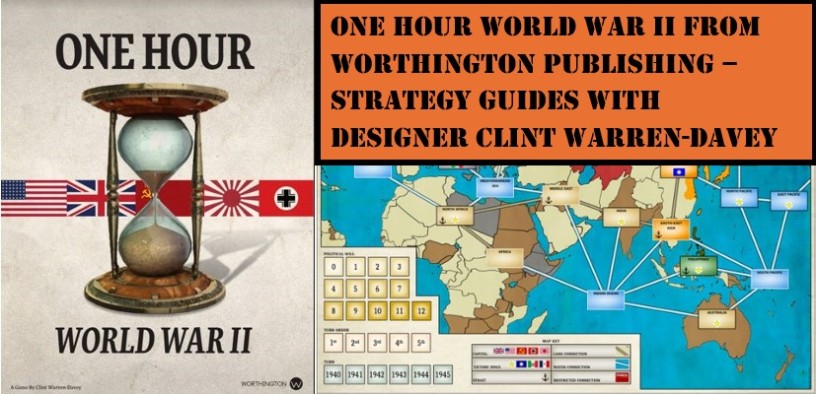
In this series of articles, we are looking at the overall strategy recommendations for the very interesting and unique strategic level wargame One Hour World War II from Worthington Publishing. This is general tactical consideration advice for the various factions in the game and will be of interest to anyone who might want to better understand the framework of the design around which the game focuses. The images used here are prototypes and not necessarily the final product. For this 5th article, which is the conclusion to the series, we are focusing on the United States of America.
USA Strategy Guide
The USA is the Arsenal of Democracy, with more Action markers than any other Nation to reflect its economic might. It starts far from the action and must support the other Allies from a distance for at least the first half of the game before decisively entering the fray. With a huge supply of Fleets, it can conquer the oceans and establish supply lines to land anywhere from Italy to South-east Asia. With so many Action makers in the late game, the USA has the luxury of pursuing multiple strategies simultaneously and fighting in both Europe and the Pacific. It must still be decisive though, and not leave forces dangling on the end of a logistical tail that leads nowhere. The USA should choose a few key targets and focus on them, while doing what it can to support the other Allies and prevent an automatic loss.
Opening Moves
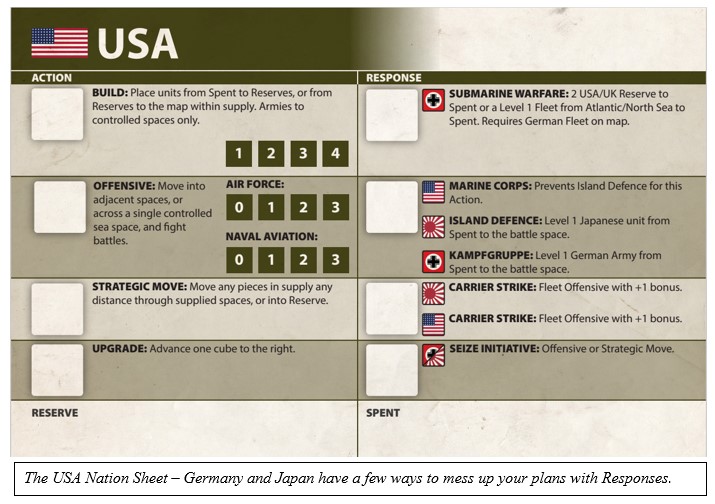
The USA starts with a single Action marker and only two units on the board – an Army in the USA itself and a Fleet in the East Pacific. Neither of these are in position to do any damage to the enemy. So, the USA is not going to be taking any ground in 1940. Instead, your initial moves will be focused on either building up your infrastructure or using Responses to drain the Axis and support the Allies. Here are some ways to efficiently use your first few Actions of the game:
–Chinese Nationalists: This move requires some co-operation with the other Allied Nations. If the Japanese launch an Offensive, you can use the Chinese Nationalists Response to shift one of their Armies from China to Spent or to place a Chinese Army in China. This by itself is not really worth it. But, if the Soviets use Chinese Communists and the UK also use Chinese Nationalists (both USA and UK can choose this), two Japanese Armies can be removed from China and replaced with a single Chinese Army. This can give the Allies a crucial edge during scoring, offsetting the inevitable gains by Germany in the first turn. If the UK and Soviets are willing to go along with it, this is a great first turn move.
–South Pacific Fleet: This move is a way to lock down half the Pacific Theatre and perhaps bait Japan into attacking you (and thereby earning the Axis Attack Action marker). You use the Build Action to place a Level 1 Fleet from Spent to the South Pacific. Note that this can only be done if the Japanese have not done the same thing, as you cannot Build in a sea space containing enemy Fleets unless it is adjacent to your capital. Now, having a Fleet in the South Pacific does a couple of things. It opens a supply line to the Philippines (and the Indian Ocean, as the Philippines is a Strait) which means you can Build Armies there. It also protects both Australia and the Philippines from a Japanese amphibious assault. The Japanese will either have to attack you or go around you by maintaining their land-based supply line through China and Building in the Indian Ocean. Finally, it allows you to choose the Submarine Warfare Response whenever Japan does a Build Action. This powerful Response sends a Japanese Fleet from the map to Spent, without needing to fight any battles. An excellent way to take control of the North Pacific from the Japanese.
–Atlantic Fleet: Placing a single Level 1 Fleet from Spent to the Atlantic opens up a lot of options for the rest of the game. As early as 1941 (turn 2) the USA can launch an Offensive into North Africa using the Army in USA. This is a big help to the British, who will often struggle with an early game invasion of North Africa by the Germans. A Fleet in the Atlantic also opens up the possibility of building Armies in the UK and a Fleet in the North Sea. This in turn will eventually allow an invasion of France and create another difficult front for Germany to contend with.
–Upgrade Build: The USA has a lot of units, most beginning in Spent rather than Reserve. In particular, it is the only Nation to have two Level 2 Fleets, which will be needed against Japan. But to take advantage of this huge pile of equipment, it is essential to improve the USA Build track, preferably all the way to 4. This allows, for example, a fresh Level 2 Fleet to be shifted from Spent directly to the map, ready to fight. Upgrading the Build track on the first turn is a great way to get a head start on this process. It means that by 1941 you can be pumping out soldiers and ships, ready to overwhelm the Axis.

Pacific Theatre
When it comes to actually fighting the Axis, there are two broad directions to go in – the Pacific Theatre (fighting against Japan) or the European Theatre (fighting against Germany). The Pacific Theatre is more pressing, as it is where the enemy can actually strike you and kill your units. You start with a Fleet in the East Pacific that is vulnerable to attack from the Japanese Navy and you have a Home Territory space – the Philippines – which the Japanese will probably also attack. In addition, the other two Allied Nations are not in a good position to take down the Japanese – it is very clearly the USA’s job. So, how do you handle the Pacific Theatre?
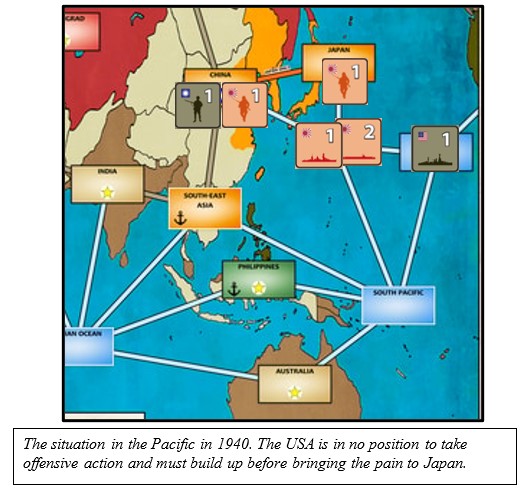
First, it is actually a good thing to be attacked by Japan – the earlier the better. You will gain the special “Axis Attack” Action marker for the rest of the game, representing the surge of patriotism and national unity which followed Pearl Harbor. This means that if the Japanese are dumb enough to attack you in 1940, they have given you six extra Actions over the course of the game. For this reason, it is OK to have your units a little vulnerable and even bait the Japanese into attacking you – a single American Fleet sitting in the South Pacific may be enough to do this.
When you do begin taking the fight to the Japanese, there are a few things to remember. First, holding the East Pacific is absolutely critical. It is a victory space (representing Hawaii, Midway and other American possessions which are abstractly condensed into this single space) which the Japanese can easily strike from the North Pacific. Even a single Japanese Fleet in the East Pacific denies your control of it, which will hurt you in scoring. Secondly, the East Pacific is America’s staging ground for all operations in this theatre. You need control of it in order to access the North Pacific and South Pacific, and thereby actually take victory spaces like Australia, the Philippines and Japan itself. If the Japanese deny your control of the East Pacific they are essentially locking you out of the whole theatre and gaining the edge in scoring.
Now, when you do fight the Japanese, there is no need to fixate on taking Japan itself. Getting an “auto-win” by taking control of both Germany and Japan is a nice way to win, but it is not the only way. If the Japanese make this impossible by stacking the North Pacific with Fleets and stacking Japan with Armies, you can change your approach and go for other victory spaces instead. Actually taking Japan is incredibly difficult and will require multiple turns worth of dedicated effort – you need to sink every Japanese Fleet in the North Pacific, position Armies ready to invade via amphibious assault, and then destroy the Armies defending their homeland. This approach can be worth it IF you know that the Allies will also be taking Germany. Otherwise, a better approach is to protect the Allied victory spaces in the Pacific and retake them quickly if possible. Do not let the Japanese just sit on the Philippines if they take it in 1942 while you build up a huge Fleet for Operation Downfall – take it back as soon as you can. Also, leave India to the British. They already have a supply line there and should do at least some of the heavy lifting against Japan.
Regardless of which approach you take in the Pacific, you will need to confront the Imperial Japanese Navy. They have the edge over the US Navy at the start of the game, with superior Naval Aviation and a Level 2 Fleet on the map. Besting the Japanese at sea will require some Upgrade Actions. Try to get your Build track up to 4, this way you can put Level 2 Fleets directly onto the map from Spent, or just shift tons of units from Spent to Reserve. Upgrading your Naval Aviation is also good, though you usually won’t need to go all the way to 3. Your big strength is numbers and the ability to replace losses. With a Build track of 4 you can go through a cycle of Build > Offensive > Build > Offensive, etc. that will wear the Japanese down.
European Theatre
In most games, you will need to confront Germany as well. This takes time to set up. At the very least, you will need a Fleet in the Atlantic. From there, you have three main choices for an invasion route into Germany itself: Italy, France and Scandinavia.
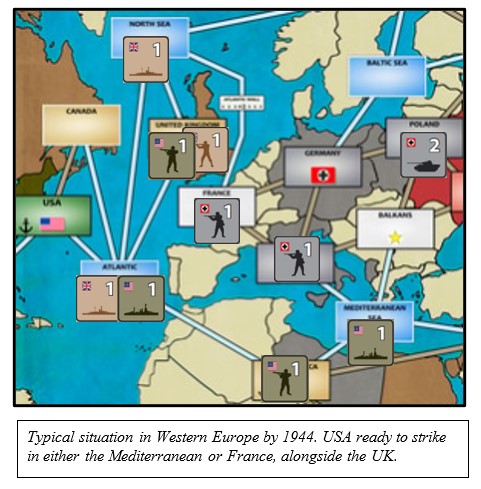
–Italy: If you vie this route, your next step after placing a Fleet in the Atlantic is to place one in the Mediterranean. You can only do this if the Italian Fleet has been destroyed, which the British should be able to do. If they haven’t, it may not be worth expending multiple Action markers just to kill the Italian Fleet with American ships – change your strategy and go elsewhere. If you do manage to get control of the Med, you will need Armies ready to go in North Africa. This threatens both the Balkans and Italy and the opportunity for an American invasion of the Balkans may present itself, but generally it is easier to let the Soviets handle that. Italy is a better option, and once you take control of it the Italian Army will be permanently destroyed.
–France: France is a slightly more valuable space than Italy, as it is a neutral victory space that both sides can benefit from. Taking it from the Germans both denies them a victory space and gives one to the Allies – a swing of 2 in terms of scoring. To take it, you will need a Fleet in the North Sea and a significant build-up of Armies in the UK. Taking France will usually be harder than taking Italy due to the Atlantic Wall rule – any German Armies defending the French coast against an invasion from the North Sea will get a +2 bonus to their initial strength. Combined with the German Air Force bonus, this will make a single German Army in France very hard to beat. But there are still ways to take France despite this disadvantage. First, you can work with the UK to do a Joint Offensive Response – this allows you to unite your forces in a single Offensive. You can also just rely on sheer numbers to take the space, even with losses. If the Germans have one Army in France and the USA/UK have at least three, you will still take the space after losing one Army. Obviously killing Germans is better, but if landing with some losses lets you take control of France a full turn earlier it is definitely worth it.
–Scandinavia: This is a much more difficult and risky approach that requires more steps, but directly threatens the German capital. Once you have a Fleet in the Atlantic and North Sea, you will need to land in Scandinavia and then place another Fleet in the Baltic. The UK is in a much better position to do this, but of course you can work together. The advantage of the Scandinavia route is that it bypasses Germany’s defences in France and Italy while threatening the German capital directly. If the German player is not paying attention, you can grab Berlin pretty easily! But usually this will result in a German naval build-up in the Baltic or just a massive build-up of Armies in Germany itself. This is still useful as it distracts them from other fronts, but it also means you are not taking victory spaces and may have your Political Will drained to 0 before the war is over. The Scandinavian gambit should only be attempted by experienced players.
Bombs Away!
Do not forget Strategic Bombing. It is a great way to wear down Germany at a distance, without having boots on the ground in Europe. Every time Germany does a Build or a Strategic Move Action, both you and the UK can jump in and do a Strategic Bombing Response. This either shifts two German units from Reserve to Spent, or downgrades Germany’s Build track by 1. With you and the UK working together, you can do both! Doing this over a few turns will totally cripple Germany’s efforts to maintain a front line. With their Build track at 1, they will be unable to put units directly from Spent to the map and with no Reserves it becomes a lot easier to find opportunities for an Allied breakthrough. Strategic Bombing is one of the best ways to help the Soviets indirectly in the middle game – and they will need it. There are other ways to help them too, like giving them piles of stuff…
Lend Lease
The Soviet Union is going to bear the brunt of the fight against Germany and helping them out will make your job easier. The Soviet Union can take advantage of American economic might in the form of the Lend Lease Response. This is a Response chosen by the USA player which can follow a Soviet Build or Strategic Move Action. It lets the Soviets shift two units from Spent to Reserve, basically a “free” Build for the Soviets. This is incredibly helpful and lets the Soviets keep a steady pipeline of units supporting the front line. In many games it will be absolutely essential to save Moscow. Indeed, it should be used AT LEAST once per game, if not several times. The USA has more Actions than any other Nation over the course of a typical game but is far from the action. Lend Lease allows American Actions to be put to work right where they are needed – putting Armies on the front-line against Germany.
Conclusion
The USA has the greatest Action economy in the game and must take the fight to the enemy in the second half of the game. It will play the decisive role in defeating Japan and should also try to open a front against Germany. It can support the Soviet Union with Lend Lease and the Strategic Bombing of Germany while doing Joint Offensives with the UK to get a foothold in Europe. Despite being so far from the main theatres of war at the outset of the game, the USA is essential to Allied victory.
If you are interested, you can read our interview with the designer Clint Warren-Davey on the blog to find out more about the design at the following link: https://theplayersaid.com/2024/06/04/interview-with-clint-warren-davey-designer-of-one-hour-wwii-from-worthington-publishing/
And if you are interested in One Hour World War II, you can late back the project on the Kickstarter page at the following link: https://www.kickstarter.com/projects/1456271622/one-hour-world-war-ii?ref
Here are links to all of the previous entries in this Strategy Guide Series:
-Grant
 The Players' Aid
Thanks for posting enough info to actually try a pencil and paper game. Is there a way to ask questions? Thanks!
LikeLiked by 1 person
If you ask questions here the designer will answer.
LikeLike
Thanks! I have several small questions and one big one. Here is the big one: it appears the only amphibious invasion path to the island of Japan is from China. Is that correct? Or am I missing something?
John
LikeLiked by 1 person
Just finished first “paper and pencil” game. Narrow victory for Axis. Much fun and looking forward to the release.
Would like to clarify Action and Response.
“Kampfgruppe” and “Not One Step Back” occur AFTER the battle resulting from the action. The additional armies moved from spent to the battlespace do not participate in the battle, correct?
“Island Defense” and “Marine Corps” seem a bit different. If “Defense ” is played first by Japan, can “USMC” be used in response? If USMC” is played first (Japan out of actions, passed or “Code Breaking” has moved US to first in sequence) that would seem to prevent play of “Island Defense”, correct?
Can an Offensive Action be used to move into an unoccupied controlled or uncontrolled location (to avoid Response to a Strategic Move?
Thanks for the help.
John
LikeLike