One thing that I do love is a good fantasy wargame. I have not played that many of them but those that I have played are always a blast! Games such as Titan from The Avalon Hill Game Company, Wizard Kings from Columbia Games and War of the Ring from Ares Games are just special games that merge two of my loves in wargaming and fantasy worlds. Last year, I came to learn that Hermann Luttmann was designing such a game for Blue Panther called The Struggle for Zorn: The Red Blight. As you know, Hermann is a very prolific designer and frankly has designed a few of my most favorite games including In Magnificent Style: Pickett’s Charge, Dawn of the Zeds, At Any Cost: Metz 1870 and A Most Fearful Sacrifice among others. His games are always fun, well designed and very playable. The Struggle for Zorn: The Red Blight is marketed as a semi-cooperative fantasy wargame and definitely had my attention from the first mention of the game. Recently, we were able to get a play in of the game with Hermann Luttmann while attending Buckeye Game Fest and I really had a good time experiencing what he was trying to show. In this First Impressions post, I want to show what I really liked about the game and how its narrative is wound into the very fabric of the game and creates a very satisfying experience that puts this one up there in my esteem with a few of the other games that I have mentioned.

The Fantasy Setting is Well Thought Out and Creates a Great Canvas for the Narrative
I think that one of the things that must be present in these fantasy wargames is a great setup. The world has to be well fleshed out and detailed. The villains have to feel villainous and the heroes have to be heroic. There also has to be a clear distinction about the place of sorcery and magic in the world and what role it plays. If the game cannot get these elements under its feet before I dive into the game then it is not necessarily going to go well. It won’t be believable. It won’t have the power to suck me in and make me care at all about the dilemma we are facing in the game. I know that may seem harsh but it is the way I feel about playing a fantasy wargame. A fantasy wargame has to have the narrative driving power that it promises. I like history because we know that truth is always stranger than fiction and creates a narrative worth remembering. That is why the battle, or mission or campaign is remembered historically and is now having a game made about it hundreds if not thousands of years later. A fantasy setting has to be even more so as the narrative has got to be strong. Strong enough to make me believe it and see it as a real possibility. Do the details ring true? Does the premise make plausible sense? Are the motivations of the bad guys worth fighting against and are the people being oppressed willing to raise up and buck the status quo? These are the things that matter in these fantasy setting games and I think that The Struggle for Zorn: The Red Blight does a pretty plausible job at doing this.

First off the story is there. Zorn is a fantasy land which has a rich history and is just coming into its own, finally beginning to unite under the steady leadership of King Rufus V. A happy and peaceful kingdom with a bright future…until that is when the first signs of trouble begin showing themselves with the arrival of the Red Blight Ambushers. These marauders began raiding along the roads entering the Slumbering Troll Valley from the north, taking prisoners, looting valuables, and destroying villages. This is the first sign of trouble and I like how it sets up the game. Usually, the Big Bad Evil Guy (BBEG) sends out his initial feelers and things just start to get strange. After that initial wave of lightning strikes from the Ambushers, larger and more powerful evil forces marched down on the unsuspecting valley. And with very little military presence in the region as the peace loving people of Slumbering Troll Valley had forbidden men-at-arms in their community, the entire valley was easily and quickly overrun and subdued. The Red Blight forces consolidated their gains and established Blight Dens, in which they housed their ill-gotten gains and kept their captives. And then they moved in the Tortoses Garrisons, mutated turtle-like creatures, who stationed themselves in the dens and kept them secure. This lead to the great houses of the kingdom mobilizing and assembling to work together to defeat this new evil. There are a a total of 5 Houses and I really like how they were fully fleshed out with a unique name, there own color, coat-of-arms and a slightly different unit makeup for their House Armies. The five Houses are named House Vandalay, House Jerrold, House St. Bennetts, House Remarque and House New Mahn. I even really like that they chose the names from several different sources including Seinfeld and the design team names to give them that little bit of extra personal touch.
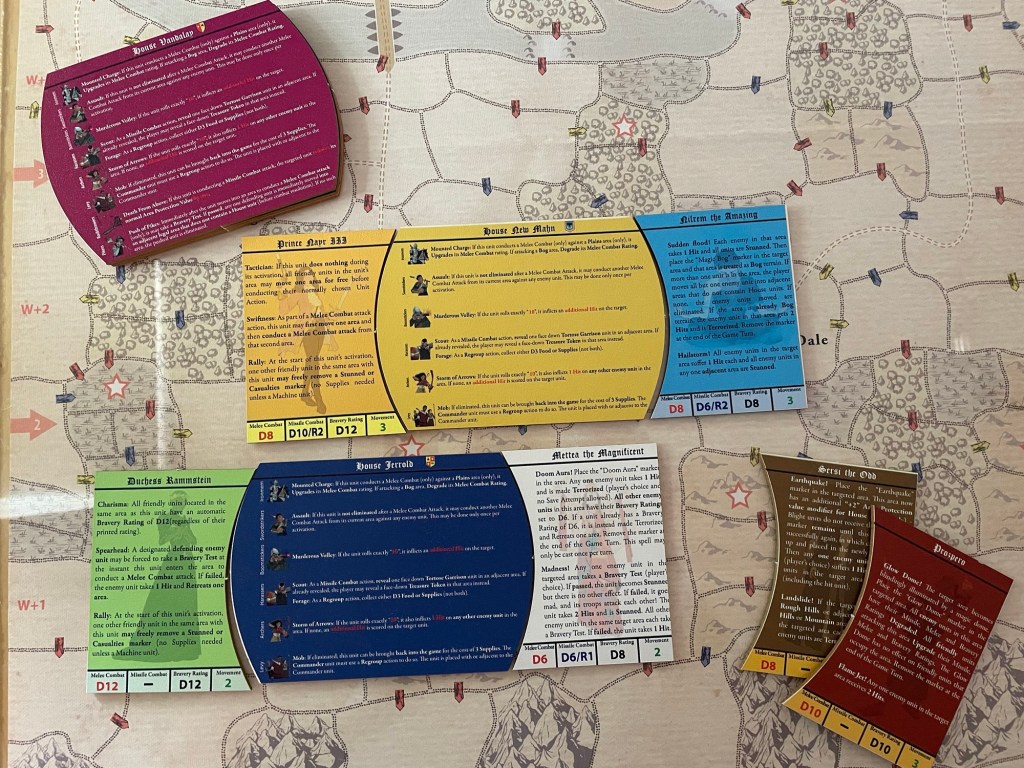
I also really like the fact that the world is a major player in the game as the board is very well laid out, with some track like groupings of terrain that the evil guys will move down and that the players can focus on to better work together and support each other. The terrain is a key element to the game as well and provides bonuses but most importantly is a limiting factor on how many units can stack in each space. Smart players can use this to their advantage and keep the hordes of the Red Blight at bay by smartly planning out defense and attack routes.
The enemies are very well done and create a real challenge as there are multiple types of units all that have a purpose in trying to overrun the land and also to best the House Armies. These enemy units are divided into 6 different units that each have their own focus. Let’s take a quick look at these enemy units as they are also a large part of the believability and connection with the theme.
Tortoses Garrisons: These are the basic foot units and all start stationed over specific Blight Dens. The Tortoses represent mutated turtle creatures that are assigned to guard the hoard of valuables and hostages in the Blight Dens. These enemy counters are randomly placed face-down on each Blight Den area at the beginning of the game on top of Treasure Tokens. These units are unique in many ways as they move very slowly, have the Hard Shell ability making them very tough and the Snapping Jaws, which cause extra casualties on combat ties. They are tough but do have vulnerable soft underbellies and will take fewer Hits to kill.

Ambushers: These units represent large swarms of demented creatures (spiders, snakes, rats, roaches and the like and they come out of hiding in the nooks and crannies of the landscape and often at the worst possible times. They are fast and have the Sneak Attack ability which allows them to single out enemy units for a quick strike. They also appear during an Ambush action, which can occur when some Tortose Garrisons are initially revealed when the players attack them.
Minion Hordes: The demonic, gargoyle-like mainstays of the Red Blight which make up a bulk of its forces. These hordes have a Missile Combat ability and can launch quick, deadly Counterattacks.
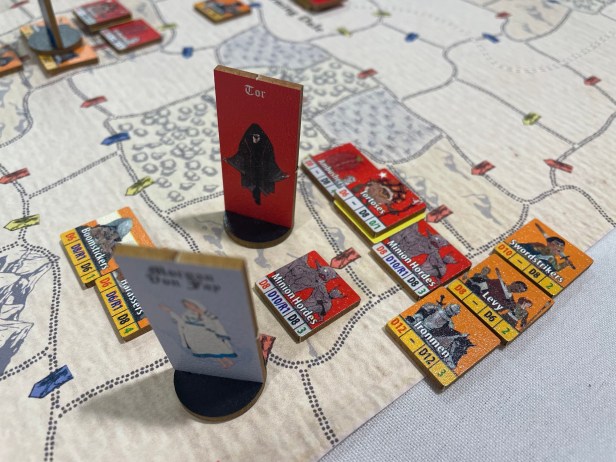
Terror Beasts: Each of these units represents enormous and vicious monsters, housed, and trained in the bowels of the Red Blight’s beast pens. These each have two Special Abilities – Infectious Bite causing poisoning and Terrorizing Screech, which can make enemy units flee before combat. I found these to be the really bad units with that screech as our units broke more often than not and ran away.
Fetid Knights: These are very powerful once human melee units that are horrifically mutated elite warriors. They have the Overkill ability, which means when they do any damage, they do a lot of it. They can also make a teleportation attack via the Blight Portal Trap.
Far-Seer Champions: These are the leaders of the Red Blight and are individual named characters that are represented on the board with standees. They are the toughest Blight units in the game and each has a unique set of special and very deadly abilities including the ability to lead the other Blight units.
All of these elements, from the background to the various monstrous units, meld well together to create an interesting and believable story for the basis of the game.

Enemy Movement is Very Clever
When I first looked over the board, I was a bit confused by all of the different colored arrows that appear. But, after reading the rules, and then seeing how the Blight uses them, it actually made a lot of sense and was easily adjudicated once we got used to the concepts. The Red Blight forces always operate as a Bot and is controlled by the game regardless of player count. The way that works revolves around the use of Blight Activation Cards and the associated multi-colored Blight Movement Arrows found printed directly on the map. Each time the Red Blight activates, the players will draw an Activation Card and simply follow its instructions. This could lead to the spawning of new Red Blight units on the board, the movement of certain types of units, Red Blight units conducting an attack if there are targets or an Event. The Red Blight units when ordered to move will follow the Red Blight Movement Arrows printed on the map. This will generally lead them south, towards the bottom of the map and towards potential trouble for the House players. The Red Blight will generally score Terror Points for each of their units that move off the south edge of the map and the more powerful the unit is means the more Terror Points that will be scored. Sometimes, the players will lose if any units get off the map but those situations are typically only found in the shorter scenarios. The Blight Movement Arrows will dictate an adjacent area for the units to move to. In some of these cases, there will be two arrows available in the space they are leaving and this is referred to as a Forked Area. The exact path taken will depend on the Forked Area Direction indicator found at the top of the map, which will be either odd or even as established at the start of a turn. And each game turn, the Red Blight units will be preferring different paths. This order makes the game somewhat predictable but does allow the players to plan ahead a bit. I would shudder to think about a totally random movement option but that would most assuredly ratchet up the tension.
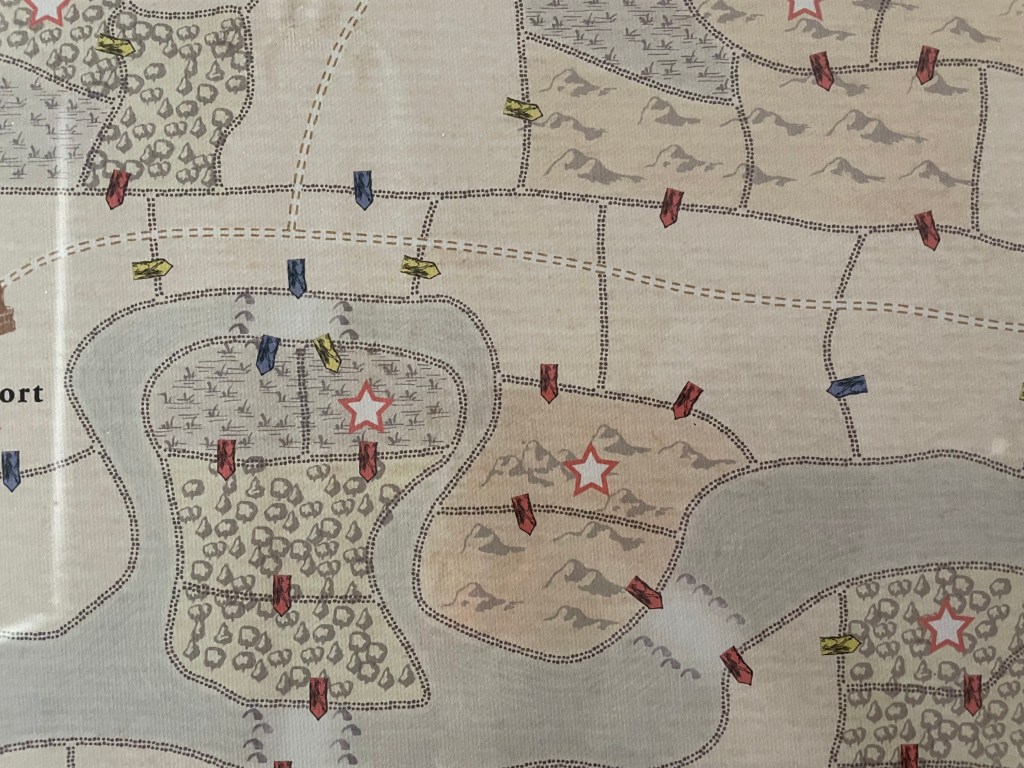
I really liked the movement and how it worked as it kept it simple to adjudicate but also allowed a bit of planning by the players. And working together in this game is paramount as The Red Blight Units are just wicked!
The Game is Best Played in Cooperation Even Though is Touted as Semi-Cooperative
The game is touted as being semi-cooperative and this description is very important. Semi-cooperative is a style of cooperative game where the players, as a group, work together toward their common goal. They can lose the game as a group, so if the team does not succeed in the game, the game wins and there can be no player winner. Blame can then be levied against your favorite player to hate! The concept of everyone loses is the cooperative part of the game. But, the key distinction here with the design that brings in the need for the prefix semi is that if the group’s goals have been achieved and they beat the game, then a determination is made as to which of the individual players is the real winner. This is done by the players each keeping track of the different victory points they’ve earned during the course of the game. In The Struggle for Zorn, these victory points are measured with Glory Points. Glory Points are earned by a player for defeating Red Blight enemy units, capturing the magical Relics that are guarded by the Tortoses Garrison units and also from gathering valuables, including gold, and the status of their units. So, this boils down to the semi-cooperative fantasy wargame aspect of the design being the players representing the various Houses of Zorn and how they must team together to rid the land of The Red Blight. The wargame aspect of the game comes in because the players primarily must have their units move across the map and engage Red Blight units in combat in order to defeat them and capture back important territory. I really love this balancing act of the game and have played a few games like this. We all will lose together (cooperative) but if we win, there was someone specifically that made us win more than the other players (semi). This concept is key to the game and even allows a bit of PvP (Player versus Player) action where you can actually attack the other players. This is not necessarily recommended but if you see that you are going to win, but you notice that one player is hording all of the Glory from themselves, you might just need to knock them down a notch.
We really love cooperative games and just truly enjoy the strategizing and discussions that lead to decisions being carried out on the board. One of the other aspects about this cooperative aspect that leads to some tension with the semi-cooperative concept is the activation draws. Depending on the number of players, there will always be a few wild activation counters in the mix that when drawn can activate any of the Houses. This is something that the players have to agree upon and this creates an even greater level of interaction. I found us surveying the board and the threats that were facing us first but then always glanced at the other players situation with Glory. This was a very good part of the design and I am glad that Hermann and the design team added this element in as it just creates some really great interaction.
I am a wargamer and am never mad about direct combat. Even direct combat that sees me damaging or hindering the other players if the time and opportunity is right! The Red Blight really does this part well and creates some very interesting dynamics between the players. Let’s take a bit of a closer look at this combat.
Combat
As we were playing with Hermann and Ryan Heilman (2 of the 3 designers), it was interesting to discuss their thought process on the game. I know that one of Hermann’s main goals with this game was to make sure it remained playable and accessible to all experience levels of gamer. Though the term “wargame” sometimes scares off players, thinking they’re going to see complex and detailed CRT’s, laundry lists of modifiers and all sorts of other charts and tables, that’s just not the case with The Red Blight. I admit that I love rolling dice and I love rolling all sorts of different types of dice and Hermann wanted to make sure that dice mattered in the game. To that end, the unit’s combat abilities are rated by the type of die they will roll when in combat. The better their rating, the higher die that they will roll ranging from a lowly D6, to D12’s (and even a D20 for certain special spells). We all know the rationale behind upgrading and using larger dice as this equates to more sides and higher possible results to the die. So, a low rated D6 equates to possible results anywhere from 1-6 while the highest rated D12 gives better result potential with a range from 1-12. That being said, one of the things that I really liked about the combat system was that even if you have a D6 unit versus a D12 unit, it is still possible for the D6 unit to win. And that means constant tension with every single combat. The dice rolling also makes the game balance out a bit as the better units will win more often but there is always a risk. It is important for players to understand this and plan accordingly. You just shouldn’t be attacking that D12 wielding Fetid Knight with your Harrassers who only throw a D6. You will lose more than you win theoretically. But, chance is always there and you sometimes just have to forget the odds and throw the bones!
One other note that I need to point out with Melee Combat particularly is that units must be in the same area with each other, and the combat is resolved as one big engagement. All of the units in the space who are involved (and not Stunned) will roll their Melee Combat die and a total die roll result is achieved. Then the totals are compared, and the lower total is divided into the higher to achieve the number of Hits scored by the higher side. With Melee Combat though the maximum Hits allowed is 4 Hits which can be slightly modified by any Special Abilities. Melee with a larger number of units on both sides will tend to be lighter net casualties with one side pushing the other side one area away, unless a severely high or low total is achieved. According to Hermann this was by design and reflects 2 large armies mashing up against each other finding it challenging to discover a weakness or an exposed flank to exploit.
I mentioned that some units have Special Abilities that allow for superior tactics, extra tenacity, stalwart defense and the like. Here is where players can utilize these Special Abilities to gain an edge against the enemy. When in combat, you have to understand what it is that your units can be and also what the enemy can do. For example, if fighting in Melee Combat with the Swordstrikers unit, they have the Assault ability which states if the unit attacks in Melee Combat and is not eliminated, it can attack again. So, remembering to use this ability is key. I found that I forgot these things a lot but that was our first play and I won’t make the same mistake next time.
Challenging Yet Winnable and That is What I Want in this Style of Game
My final point here is that the game is really, really challenging! The forces of The Red Blight are really difficult to defeat as they have some really nasty abilities and frankly just keep coming. Players will have to have their wits about them and also work together effectively to survive the game. But this is one of the hallmarks of any good cooperative and or semi-cooperative game. The greater the difficulty, the more planning and thought needs to be put into it and this creates greater interaction, and sometimes even bartering, between the players. I have found that when we play a cooperative game that we walk all over, we don’t typically get that game back to the table often. We want to be challenged, and tested and pushed around to see if we can recover and get it done. This just makes the cooperative genre shine in my opinion and keeps the games grounded in what they are. The Red Blight is winnable but will push the players to their limits. Because of this, I see this game staying on my shelf and appearing regularly at game night when we are looking for a challenging and interesting semi-cooperative wargame.
In discussions with Hermann, he really emphasized to me that the main goal was to provide a solid multiplayer experience, with the semi-cooperative play dynamic, while still also offering a legitimate fantasy wargame narrative at the same time. He really wanted the mechanics to create the theme and then bring them together to establish a cohesive experience. After playing the first time, I found the game play to be fairly straightforward, with very clean rules and a good outline of how things work, but also that created a really meaty and amazingly rich experience with tons of player interaction and decisions about how to best play the game. The wargame part of the whole affair was also very good and felt very tactical with the different units and their abilities as well as how movement and the map worked together. My final comment will be that the game establishes a very good fantasy setting that allows for the players to create a memorable narrative as they fight against the relentless and persistent forces of The Red Blight. I also really like the variety as well as you can play one of the Houses but with a different Commander or Magic User each game that will create its own unique experience.

If you are interested in The Struggle for Zorn: The Red Blight, you can order a copy for $95.00 from the Blue Panther website at the following link: https://www.bluepantherllc.com/products/the-red-blight?_pos=1&_sid=6bff77433&_ss=r
-Grant
 The Players' Aid
What a fantastic write-up Grant! Luttmann certainly has the magic touch.
LikeLiked by 1 person
Thanks. Yes he does. I think that one of Hermann’s main strengths in design is nothing is off the table. No subject, no approach, no mechanic. He is willing to try anything if it will make a great gaming experience.
He also is very thoughtful and truly ponders each of the additions to each system. He also had a really good team on this one with Ryan Heilman and Fred Manzo. The dream team as Dan Pancaldi would say!
LikeLike
My first thoughts as I read the first couple of sentences – https://en.wikipedia.org/wiki/Fantasy_General (the old computer game based on the Panzer General engine).
The beauty of a fantasy war-game is that there is no history to repeat – scenarios can be whatever they want to be. The downside is then having to create a narrative that fleshes things out. Sounds like all of that has been worked out.
LikeLiked by 2 people
Agree. That is what I was trying to say with the introduction and the first part. It just has to be believable to make sense. Otherwise it can come off as a jumble of nothingness and doesn’t draw you in like a really fantastical historical event can.
LikeLike
True, it really gives Fantasy General vibes!
LikeLiked by 1 person
I need new glasses. I read both the headline and the box cover as, “The Struggle for Zion,” and then was very befuddled by the opening sentence about fantasy wargames!
LikeLiked by 1 person
Hahaha I can relate! I need glasses to read everything nowadays.
LikeLike
Vandalay, New Man, Jerrold? They’re Seinfeld references!
LikeLiked by 2 people
I’m very interested in this one. It seems to have some design similarities to Plum Island Horror (i.e. bad guys marching from top of board to the bottom). Any comments to compare/contrast those 2 designs?
LikeLike
Looks delightfully old school… while still drawing new people into the wargame sphere!
LikeLiked by 1 person