Raymond Weiss has designed some pretty solid wargames over the past few years including titles like SCS Rostov ‘41 from Multi-Man Publishing, 1950: The Forgotten War from Conflict Simulations Limited and 1914: At Villers Cottérêts also from CSL to name just a few. These games are pretty good and we have seriously enjoyed playing them. But recently Ray appears to be on a bit of a design journey. What I mean by this is he is playing all types of games not just wargames, including Euros, Roll and Writes, Card Driven Games and even some trick taking games, all in an effort I believe to see how these mechanics and forms fit into wargaming. He is experimenting and recently we played one of his new experimental games called The Great Northern War from Conflict Simulations Limited. The Great Northern War covers the conflict between Sweden and a coalition between Russia, Denmark, Poland and Saxony in the early 18th century. The conflict commenced once Charles XII of Sweden ascended to the throne and this struggle was over control of the region. As many of you may know, at the time, Sweden was a major player in the area and had a significant military presence known for their skill in battle. After playing this game, we were really blown away by its simplicity and solid design that created a very tense and interesting back and forth. I want to share my thoughts on the game here in this First Impressions style post.

What is Trick Taking? And How Does it Belong in a Wargame?
The concept of trick taking is usually found in card games such as Euchre, Hearts, Pinochle and Spades or any other number of games. The players will use their cards to outduel each other to win a trick that will be held for points later in the round. Typically, these games have what is called a Trump Suit that can be used to overpower all other suited cards in a single trick to win unless someone else plays a higher valued Trump card over yours. The mechanic keeps a game lite but creates great moments of strategy as players have to decide how to play their cards and in what order when they are in control. If a player plays their cards properly, they can smoke out other Trump cards or can win tricks by simply having the highest valued cards of the suit that is played. Understanding the table and what cards the other players might be holding based on the contents of your hand and what has been played in the round is also very important and I see this as the single most in common element of trick taking games with wargames. I enjoy Euchre a lot and played tons of it in high school and at college but have gotten away from that type of game over the past 10 years or so.
The game utilizes a normal deck of cards, but there are namely 2 types of cards in the game. Normal cards in a player’s hand range from 2-10 and represent all 4 of the major suits including Hearts, Diamonds, Spades and Clubs, and then all the face cards and jokers are Decision Cards, which can be bought by either player and then be used to break rules within the framework of the game, and/or get modifiers for manipulating hand size, movement or combat. Decision cards are open to each player and can be bought at any time with some exceptions for various cards which require other things to take place on the map first, such as controlling an objective.
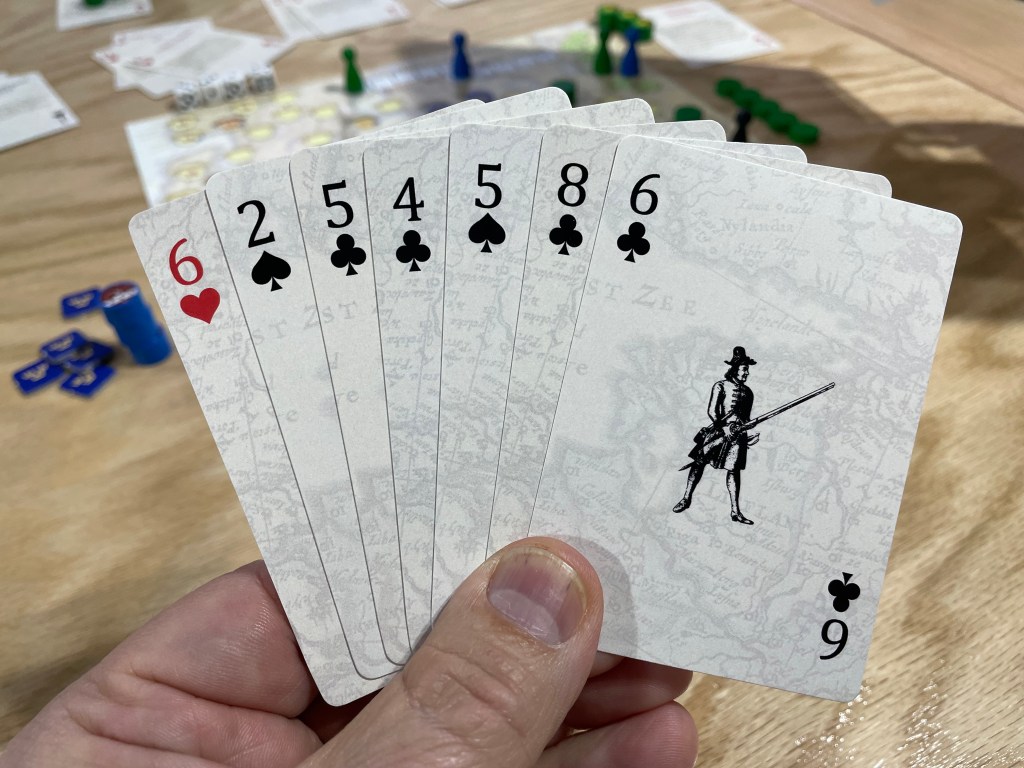
The main driving mechanic of the game involves trick-taking, so a vale/suit which a player leads with whenever taking an action is more about their tactics. The really interesting part of the game is that the current round’s Trump-suit is randomly determined each round which makes every turn truly unique. This happens as the first card of the round is turned over from the deck and then players take note of the suit as it will represent the Trump for the round. Players then are going to play a card from their hand against each other to win this card. This is called the Planning Tricks and is a very important aspect of the game to grasp. Winning the trick is great if the card that is showing is a good card, meaning the number value is high (either a 7, 8 or 9) or it belongs to the Trump Suit. This is really one of the great parts of the design and gets the players thinking and considering how they are trying to build their hand for the upcoming turn and for what purpose. This war off aspect is simply comparing the numbers of the played cards and the player who played the highest card or a Trump Card will win that trick and claim the faceup card. The loser will get to draw a random card off the top of the deck, which can be a blessing or a curse as you just don’t know what you are going to be getting. This is done 2 times and the players will add 2 new cards to their drawn hand.

So why is this important? Well in order to take any actions, the players must play a card from their hand and your opponent can attempt to overcome your played card with a higher value of the suit you played or by using a Trump Card. If they defeat your card, you may not be able to take the action, such as in the case of trying to purchase a Decision Card, or you will be taking actions at a disadvantage. An example of what I am trying to say here is with Movement of your armies on the board. Each army can be moved by a Leader up to 3 movements. If you have won the trick to get to move, the Leader will have a chance to overcome fatigue after the movement is complete by rolling a D6 and getting a result equal to or less than their Command Value, which is usually 1, 2 or 3. If you fail this roll, the Leader will be exhausted and will flip over at the end of the move. Their printed Combat and Defense Values will then not be useable by the player until the current turn is over. This is very important with a plan for attacking as if you don’t have those modifiers it is harder to win a battle. So the winning of these tricks or war offs to take actions is a significant part of the game and was way more enjoyable than I originally thought.
The Game Within the Game – The Fight for Decision Cards
Now that I have covered the basics of the trick taking, I want to go a bit deeper into the acquisition of the Decision Cards. These cards are very important to both of the players and provide various alternative ways of winning the game including reducing your opponents hand size to zero or making it so you cannot keep the majority of countries at the end needed to win the game. They also have interesting abilities or special effects such as automatically making a siege successful or rerolling dice for a Field Battle. These cards are very important as they do not take up spots in your hand and they have really great abilities.

But getting a hold of them can be a challenge as you have to have the cards to defeat your opponents effort to stop you as you will do a trick taking effort by choosing a card and leading it allowing your opponent to play one of their cards to stop it. They can defeat your efforts by either playing a higher value card of the suit you lead or by using a Trump Card of any value to defeat your efforts. This is a very important part of the game and you have to have planned well during the Planning Trick segment of the game but also you have to keep in mind what you know that your opponent has in their hand based on the cards they have played, based on the cards you saw or didn’t see them win in the Planning Trick Phase or by remember the cards they have acquired in the Diplomatic Appeals process (that we will cover a bit later). This game forces you to remember information and hold onto it in order to play well and I love that. Too often, we have access to all of the information in a wargame and I love how this hides the information. And the Decision Cards are definitely worth fighting over. Their abilities really change the game for the player that owns that card. They make your opponent take them in to account as they are planning their turns. But, they also are typically single use and once used go back to the general supply of Decision Cards where the players can fight over them again the next turn.
The Diplomatic Appeals Track
There is more to this game that just trick taking. There is war and there is also a bit of abstracted diplomacy which is used to strengthen the position of the player by providing them with better cards and certain key events. Instead of leading a trick to take one of the basic actions like move, recruit, attack, etc., players can discard one of the cards in their hand with the same suit found in the next available box on their side of the Diplomacy Appeals Track and with an equal or higher value in order to move their pawn towards the next box on the right of the track. As it progresses, players gain access to more powerful hand cards (the 10 cards do not start in players hands, but are earned during play), and it can open up the usage of various specific Decision Cards and it can trigger foreign intervention in the case of the Ottoman Empire. Players cannot ignore this part of the game as if the other player does diplomacy and gains a good benefit, you will find yourself getting behind if you don’t somewhat follow suit. I always feel like aspects like this in a game put a certain player in the cat bird seat. Meaning if they commit to this action and use a card to move up the Diplomacy Track it causes the other player to assess where they are in relation and possibly make a change to their immediate plans to counteract that progress their opponent made or new benefit they gained.

The key here is that you can gain new and better cards but also will trigger certain events that will cause the game state to be altered and give one player an advantage over the other. For example, for the Anti-Swedish Coalition, getting to the 8 box is very important as this will open up Prussia to them providing them with new territories to control and put pressure on the Swedes to now have to take over more territories. I can assure you that this is a very important part of the game and needs to be focused on by the players to play the game well.
How is this a Wargame?
I know that the inevitable question will be how is this a wargame? And I will tell you that it is a wargame because it has Field Battles, Sieges and a focus on Supply. As each side musters their forces and moves out into the wilderness to conquer cities and towns, they have to do so with a key concept in mind – supply. Your supply will only extend out up to 3 spaces and if you wish to win as the Swedish, you will have to conquer at least 1-2 areas that are up to 5 spaces away. Here is where the Supply Depot comes into play. As an action, the players can attempt to build a Supply Depot by placing a flat disk in a territory they control with one of their Leaders present. This Depot then acts as an extender of that supply line into up to 3 adjacent areas. In some cases, the players might need to build up to 2 of these Depots to be able to reach the areas they need to conquer.
But, building these Depots is not just about extending that supply but is about protecting it as well. The placement of the Depot disks is a very intricate and strategic choice and players have to keep in mind their movement capacities, available forces, disposition of the other side’s troops and their proximity to your Depots. Because if these supply lines are cut, your troops will begin to starve and become subject to attrition and you will end up losing your forces. If you lose them, it is very hard to recover in this game so you have to make the best choices possible about placement of these Depots and also about where your forces are placed to protect them. And keep in mind that you just don’t seem to have enough forces to really cover and protect everything so you have to take a chance sometimes and throw caution to the wind. I love this part of the game as it is very simple yet well done and its inclusion in the design was masterfully implemented to create a true logistical puzzle for the players to struggle against.

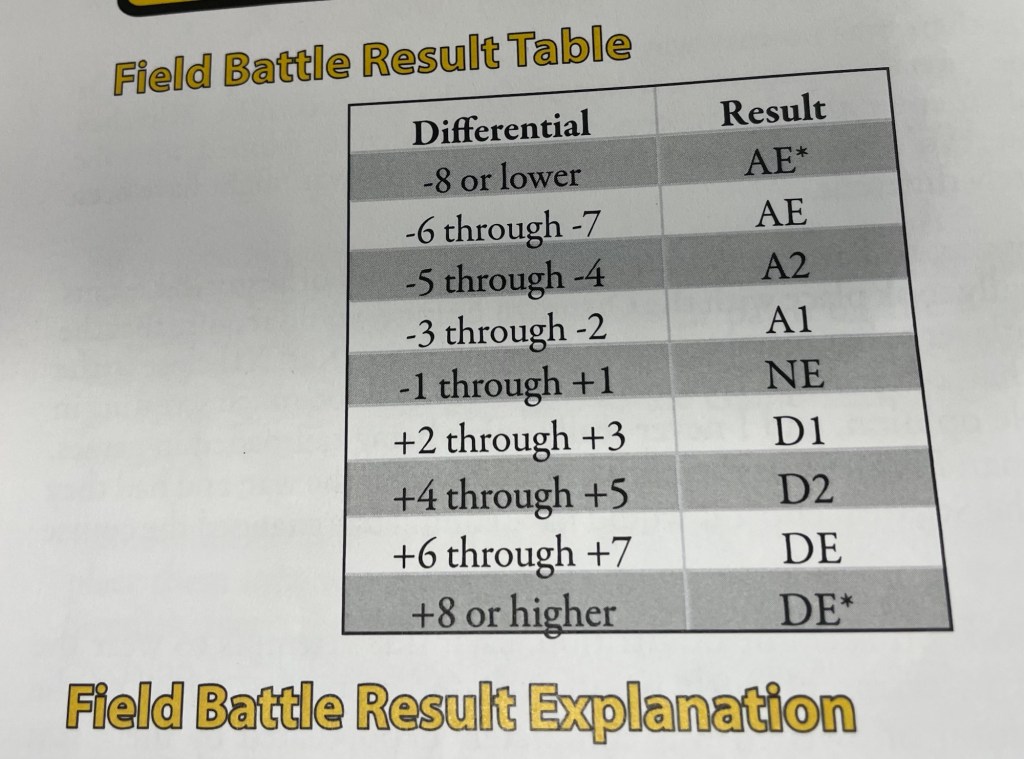
I also wanted to cover the Field Battles as I think that these were well done also. The process of a Field Battle is similar to the old kid’s game War. Both players will simultaneously reveal one of the cards in their hands and then each roll 2D6 and add that value to the value of the revealed card plus any modifiers from Leaders present in Attack or Defense. If one player is in a space with a Fortress they can then reroll the lowest result of their 2D6. Once these numbers are all added together, the difference of the attacker minus the defender results determines the losses and to which side. As you can see from the below picture of the Field Battle Result Table, anything above a -6 differential means that either the attacker or the defender is eliminated. This is just really hard to achieve though but with bad dice anything can happen. I really like the decisions you have to make with these Field Battles. Do you risk your best Leader because he has a positive Attack modifier? Which card do you play? There are times where you may know your opponent holds a 10 and your best card is a 7. What do you do? Also, have your acquired the correct Decision Cards to risk a less efficient attack? What outcome do I truly want and what can I live with? I just love how tense these battles get. It is a very simple way to adjudicate the combats but also is very well done and thematic.
For these couple of reasons, I consider this a hybrid wargame but a wargame nonetheless.
I really enjoyed our play of The Great Northern War. It is different for sure to the type of games that we normally play but I really liked that. It is strategic, cagey, bluff filled and requires you to put your thinking cap on and truly examine what you are trying to do and more importantly what your opponent is trying to do. This game is definitely one that makes me think differently and I am always on the lookout for games that force me to see things in a new way. Ray Weiss did a great job with this one. I also love that it is a game about a rarely gamed topic and that I was able to learn something about history that I didn’t know. Well done Ray! And I recommend that you go out there and get a copy and get it to the table and see if you can see what I saw.
Here is a look at our unboxing video to get a good look at the great looking components:
I also posted a designer interview with Ray on the blog and you can read that at the following link: https://theplayersaid.com/2024/04/15/interview-with-raymond-weiss-designer-of-the-great-northern-war-from-conflict-simulations-limited/
If you are interested in The Great Northern War, you can order a copy for $59.99 from the Conflict Simulations Limited website at the following link: https://www.consimsltd.com/products/the-great-northern-war-pre-order
-Grant
 The Players' Aid
In terms of historical narrative how do you explain the trick taking concept? In another playing card game series (Friedrich/Maria) I found at a certain point of (it’s Brabant it must be Hearts) caused the golden bowl to break. Yet I return to them hoping next time it will not.
LikeLiked by 1 person
I would have to think about that one a bit but I would say trick taking in this context represents things like reconnaissance, leadership and morale as typically it is about taking actions to be successful and not exhaust your leaders.
We played once and need to play again but it was very interesting and something I’ve never really considered as a wargame mechanic but it just worked.
LikeLike
We often deck out our favourite mechanisms with real-world (or read-world) examples. Hence my asking.
LikeLiked by 1 person