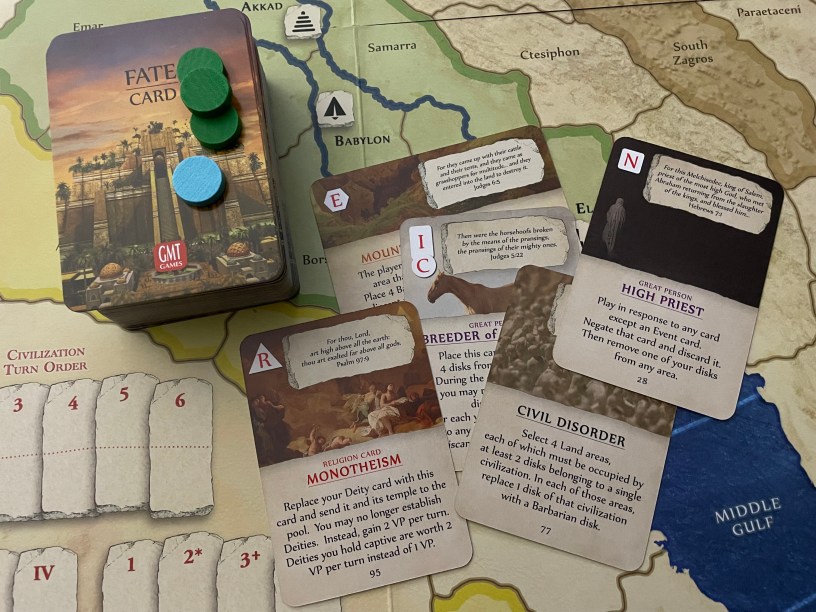
Do you like a little bit of chaos and unpredictability in your game play? Or do you prefer a game with scheming, subtlety and a little bit of turnabout? I may have a game for you that has a bit of both in it. Ancient Civilizations of the Middle East is a lite civilization building game that sees 1-6 players take on the role of an ancient power to see if they can build up their civilization and conquer the opposing great civilizations of the ancient Middle East. The game uses the same system as the first game in the series called Ancient Civilizations of the Inner Sea but does add some new tricks. First, the game now adds terrain. Second, the game not only has more playable civilizations (17 basic civilizations plus several additional civilizations in historical scenarios) but also gives some civilizations a second or even third choice for where to place their Homeland. The game is about competition to gain the most area in the ancient world, spreading your cultures influence and religion and reaping the economic benefits of your conquests. This competition comes in the form of gaining Victory Points through building cities and acquiring gods and sacking and looting cities through war and domination of the sea.
In Action Point 1, we took a look at the Game Board and its features, showing off the new Terrain and other aspects. In Action Point 2, we dove into the Growth Phase, including a discussion about how you acquire disks, deploy those disks and the purpose of spreading your culture. In this Action Point, we will explore the Card Phase and take a look at the different types of cards that appear in the Fate Deck.
Card Phase
Before we take a look at how cards are used in the Card Phase, let’s take a look at the different type of cards in the game. There are only two different types of cards, including Fate Cards and Deity Cards. But, I want to point out that there are several different type of Fate Cards.
Fate Cards
The Fate Card is the most common type of card in the deck but as mentioned earlier there are several different categories of Fate Cards including Negate, Investment, Competition, Religion and Event. Let’s take a bit of a closer look at each of these types of Fate Cards.

Negate Card
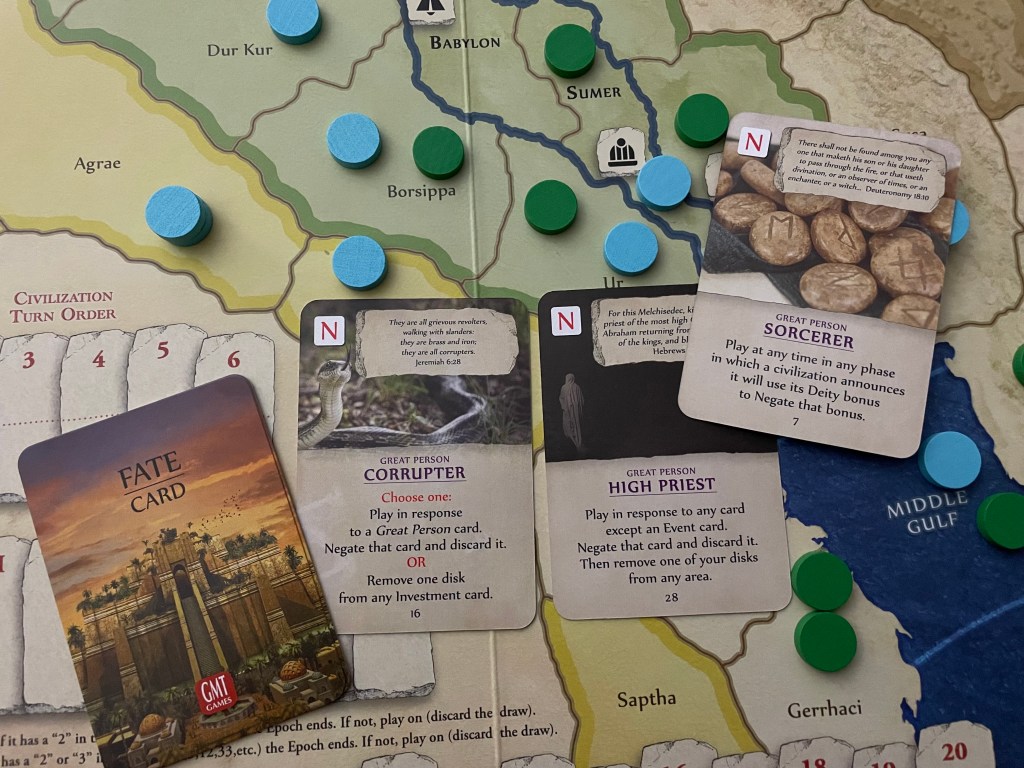
If the card has a red “N” inside a square in the upper left hand corner, that denotes that the card is a Negate Card. A Negate Card will be used by the players to cancel the effects of another card of a specified effect. This Negate Card can be used to out of the player’s normal phase to cancel a played card. These are very powerful and should be treasured by the players as they are the only way to get out of a negative effect. These are pretty nasty cards and can really ruin someone’s day!
Corrupter is a good example of a Negate Card that targets Great Person Cards as it allows the player who holds it play against another player who has just played a Great Person Card to cancel that effect. It also has an added element of utility as it allows the player to decide to play the card instead of cancelling some effect from another player’s card to hit someone in the gut and take a disk from an Investment Card. These cards are vicious and that is one of the reasons that there are only 6 of them in the entire Fate Card Deck.
Investment Card
If the card has a red “I” inside a rectangle in the upper left hand corner, that denotes that the card is an Investment Card. Typically, Investment Cards are played face-up onto the table with a specified amount of the player’s disks placed upon them for some type of future benefits. Grain Storehouses is a perfect example of this type of card. Once it is played, the player will place 4 disks from their Supply on top of the card and then the player can remove disks from the card to prevent a disk from being lost on the board.
Another really great card shown below is Master Scribe. This card is a Great Person Investment Card (and this is important because some Fate Cards refer to specifically this type of card) that allows the player to draw an additional 3 cards during the Draw Step, keep 1 of those cards and then discard the other 2. This gives the player options and more cards in hand are always a very good thing.

Competition Card
If the card has a red “C” inside a circle in the upper left hand corner, that indicates that the card is a Competition Card. A Competition Card may only be played for its effect during the Competition Phase. Some of the Great Persons and Investment Cards included in the game may also be Competition Cards or have an effect or ability that can be used during the Competition Phase. A Competition Card is important to the player to gain an advantage in Competitions over control of Areas. These advantages can include adding in extra disks, removing an opponent’s disks, preventing the loss of disks or some other similar effect.
Traitor is probably one of the most powerful such Competition Card as it allows the player playing the card to remove all of an opponent’s disks in a Contested Area where they also have disks. The most important part is that the target player cannot prevent that removal by discarding a card or spending a Mina from their treasury as is usual. The only prohibition is that the card cannot be played on a civilization’s Homeland.
The other example shown below if the very nice Warrior King that allows the player to place 2 white Competition Disks into the competition and also 1 white Competition Disk into each areas adjacent that is currently contested. Those white disks are like extra disks that you can burn off first during the competition. This card is a game changer and when used at the right time can really change the fortune of your competitions for that round.

Religion Card
If the card has a red “R” inside a triangle in the upper left hand corner, that denotes that the card is a Religion Card. This is a new type of card in the Ancient Civilizations Series and has a focus on civilizations their pantheon of gods. One of the requirements to play a Religion Card is that the civilization has to have adopted a Deity. A “godless civilization” may not play a Religion Card for its effect, but may still discard the card in lieu of losing a disk, or as a Resource when establishing or re-establishing a Deity.

Event Card
If the card has a horizontal orientation with a red “E” inside a hexagon in the upper left hand corner, that indicates that the card is an Event Card that must be played immediately when drawn or revealed. There are eight such Event Cards in the game numbered 96 to 103. 5 are Barbarian invasions and 3 are Events of note. When an Event Card is drawn, it is immediately replaced by another card drawn for the civilization’s hand.

Generic Card
There are plenty of cards that can be played at anytime during the Card Phase as long as they don’t identify with one of the other named phases or types. These cards are called Generic Cards and either allow the players to do such things as place a certain number of disks or remove a certain number of disks of one of your opponents or gain a certain number of Talents or take a certain number of Talents of one of your opponents. Those type of things. They also unleash Barbarian hordes that other players will have to deal with and can be really nasty as they force those players to deal with that threat rather that expanding their empires.

There are a total of 103 Fate Cards included in the Fate Card Deck and below is a graphic that shows the number of each type of card. As you can see, the lion’s share of the deck is taken up by the Generic Cards. Negate Cards are the most rare type of Fate Card and there are quite a bit of Competition Cards.

Fate Cards are drawn from the top of a facedown deck throughout the game. After a Fate Card is played it is discarded to the top of the face up discard deck unless the card specifically says otherwise.
Each civilization has a maximum Fate Card hand size of 6. If a civilization ever has 7 or more Fate Cards in their hand, they must immediately choose and discard the excess cards and this discard occurs after any drawn Event Cards are resolved, since they are never put into a player’s hand. A civilization’s hand does not include cards that have been played face-up to the table, such as in the case of Investment Cards. This hand limit really keeps the game in check and moving along as it would be fairly easy to simply acquire more cards and lengthen the game. The game is meant to be a fast playing and lite card game.
Deity Cards
Available Deity Cards begin the game face-up next to the board with their corresponding stickered block representing their temple atop them. These cards can be acquired and used by the owning player to great advantage during the game and each is very unique so there is something for everyone. We will cover these Deity Cards in our next entry in the series.
Pass
The final part of the Card Phase we will take a look at is the ability to Pass. You know the old country song “you’ve got to know when to hold ’em…”. This is exactly what taking a Pass is during the Card Phase. When a civilization cannot or chooses not to play a Fate Card or acquire a Deity Card they must Pass. Once they have passed they cannot get back into the card playing during the Card Phase. When you have passed you can play a Negate Card though but cannot play any further generic Card Phase cards. This is a key choice but the Card Phase will not end until all players have passed so passing is not the end of the world.
That was a quick look at the Card Phase and how it works. This really is at the heart of the design and can be the cause of a lot of chaos, grief and immediate gains and losses for players. You will live or die by the cards and you have to be in a frame of mind to simply accept whatever happens without getting upset or bothered. Check your feelings at the door because this game is a bit mean spirited, filled with take-that, pile on the leader and if you don’t get in and roll around with the other pigs (your opponents) you will surely lose and have hurt feelings. Enjoy because this card play also makes it hard to follow through with strategy and plans. This is both my favorite part of the design and my least favorite.
In case you are interested, we also posted an interview with the designers Mark McLaughlin and Christopher Vorder Bruegge and developer Fred Schachter and you can read that at the following link: https://theplayersaid.com/2019/12/16/interview-with-mark-mclaughlin-christopher-vorder-bruegge-designers-and-fred-schachter-developer-for-ancient-civilizations-of-the-middle-east-from-gmt-games/
If you are interested in Ancient Civilizations of the Middle East, you can order a copy for $90.00 from the GMT Games website at the following link: https://www.gmtgames.com/p-836-ancient-civilizations-of-the-middle-east.aspx
In Action Point 4, we will dive a bit deeper into the new addition of Deities, review those cards and their abilities and then discuss how they are acquired.
-Grant


I really enjoy this game and its predecessor. They make for great convention games to play in a large group of 5 or 6 players!
LikeLiked by 1 person
I agree. Lite and fun. My only issue is the long play time. We always do just 1-2 Epochs.
LikeLike
Yeah, I usually do “we’ll play until 11” or something, and not worry about scores; I tell people to just enjoy the experience!
LikeLiked by 1 person