We have played a lot of wargames over the past 10 years but some of the classics have eluded us thus far. I say eluded but a better word would be are either unavailable or the cost is prohibitive. So when one of the classics gets a new edition, especially one that is updated with new graphics, new rules and clarifications all intended to assist and enhance gameplay, we are really excited and try our best to get a copy.
This story actually begins way back in 2017 or so when GMT Games announced the Deluxe Edition reprint of The Russian Campaign on P500. The last time The Russian Campaign was in print was sometime in 2002 and the game was sold out and out of print as of 2007. That is a long time ago and for such a classic and well thought of game, it was about time for a reprint and with changing production values and more knowledge some additional rules and tweaks. I was excited and mashed that button to reserve my copy. Well, at the time I thought this would maybe take a year or so to get to print and on my table but it actually took much longer than that and just became available earlier this year. So after waiting for about 8 years, we finally gave this one a spin and instantly I could immediately understand why so many wargamers held this game in such high regard. In this First Impressions post, I want to share our experience with you and also dive into some of the new material included with the Deluxe Edition reprint.
The East Front in All It’s Glory!
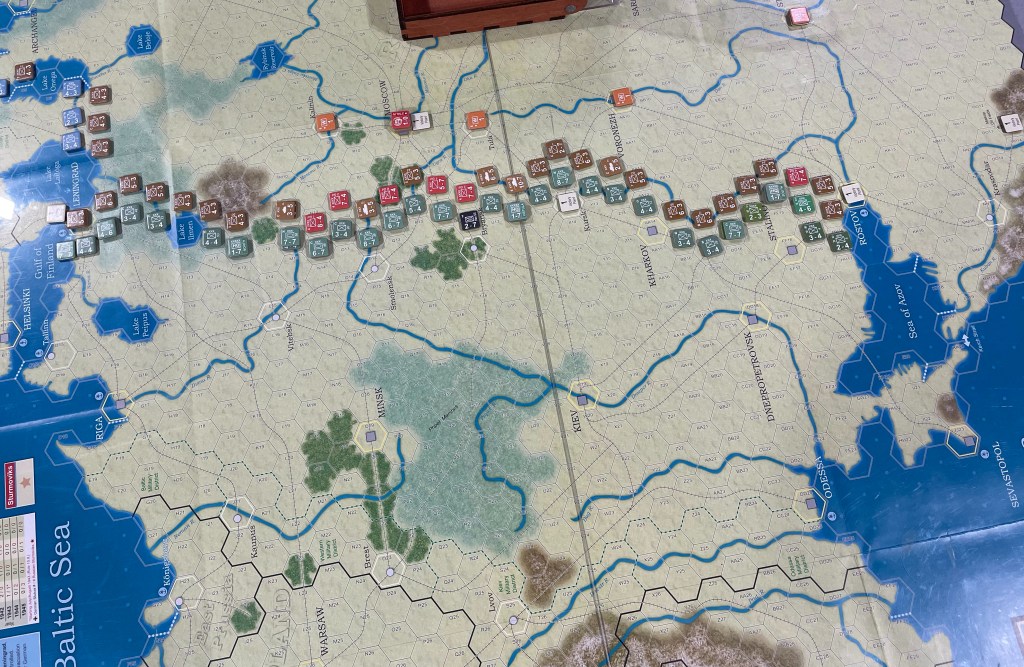
The game is true to its name as it represents the entirety of the East Front of World War II stretching from Leningrad and Finland in the north all the way to the Caucasus Oil Fields, Rostov and Stalingrad in the south. I have said this before, but there is something a bit romantic about East Front games. Long lines of contiguous counters. The German blitzkrieg pushing the Soviets back for the first dozen turns. The Soviets gaining their strength, bringing up bigger replacement units and pushing back. A continuous bloody wave of motion and combat and attrition. Bad terrain, bad weather and bad luck all combining to spoil the best laid plans of commanders. It is all here. The entire East Front in all its glory and beauty and I think that this is one of the main draws of the game and the genre. Can my decisions lead to better advances? Can I do more than historical? Can the Germans break the red wall of Soviet units and capture Moscow to knock them out of the war? All great questions that can be answered in this fairly simple and standard wargame.
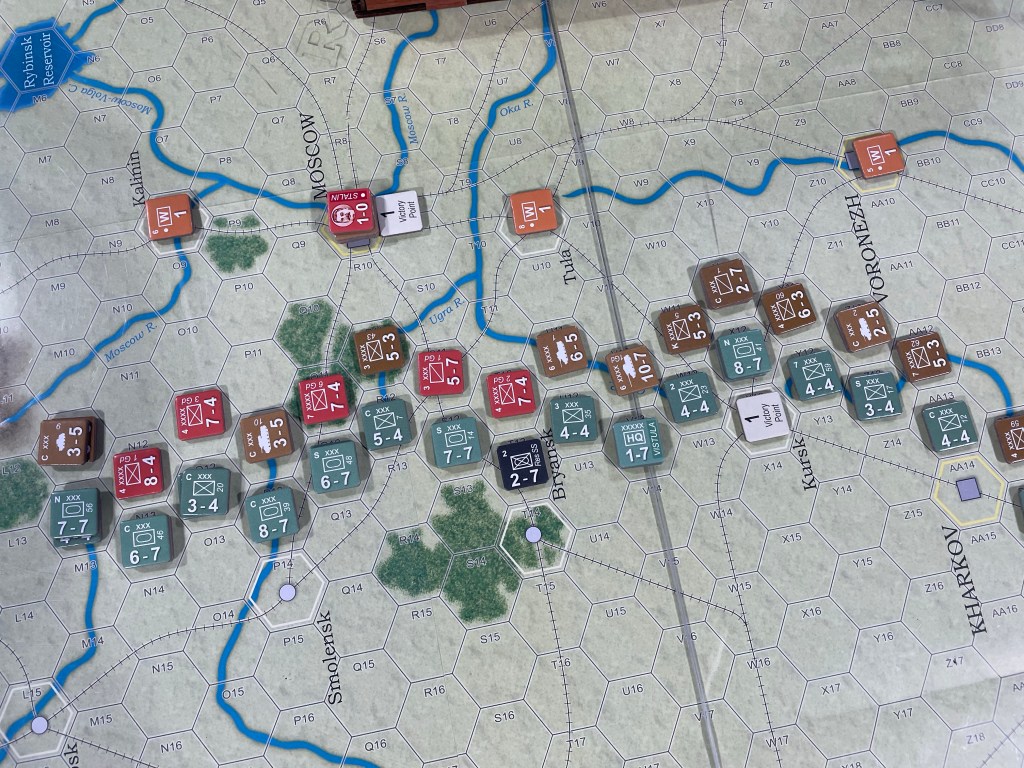
One of the things that I really liked from the get go was the fact that units that start a turn in an enemy Zone of Control must attack that turn. This doesn’t mean that each unit has to attack the unit’s Zone of Control they are in but must be a part of an attack. So in typical East Front wargame fashion players will be stacking different units in adjacent hexes to make more powerful attacks against the enemy. It is important that you remember this rule because it is key to the design and creates a definitive experience with this moving front that replicates what was experienced in the war in 1941 and 1942. If you are up front and in contact with the enemy, you will have to fight or move to the back.
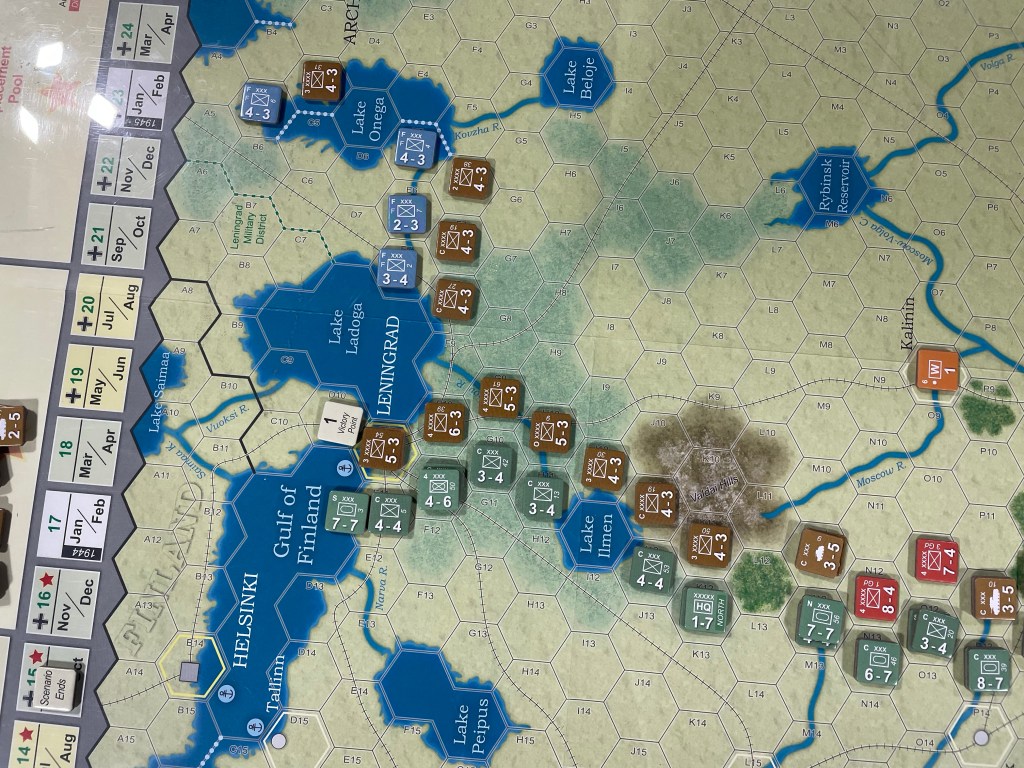
The other great thing about the way the game starts is that the Finnish front is more key than I have seen in other wargames on the subject. What I mean by “more key” is that if the Germans don’t at least try to put up a simple defense here with the few Finnish units available, the game can go very wrong if the Soviets capture Helsinki and the Germans will find themselves mired in the meat grinder that is Leningrad and the slow moving marshes located outside of the city proper. This area is key to the German effort and must be neutralized to give a realistic chance at taking Moscow.
When I play wargames like this, meaning a true blue dyed in the wool hex and counter wargame, I feel the love and affection for this genre swell and grow in my whole mind! Just awesome simplicity that creates a very tenses and back and forth experience. I have truly grown to love East Front wargames and I am glad that I was finally able to get to The Russian Campaign.
Multiple Scenarios
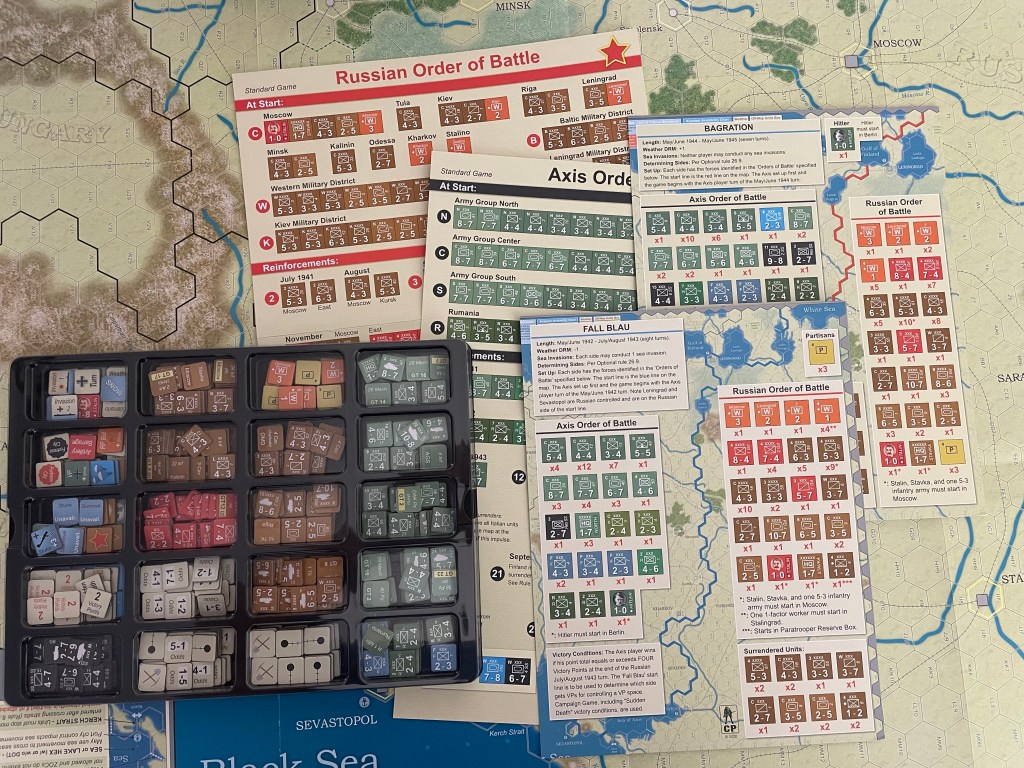
There are many ways to play and experience The Russian Campaign. If you are in it for the long haul, you can play the 25 Turn Campaign game where you will see the whole of Operation Barbarossa all the way through to the end of the war in May 1945. This is the way that I would like to experience the game but for time’s sake, and to allow ourselves to get the rules down on our first play, we chose to do the 8 Turn Fall Blau Scenario. There are a total of 5 scenarios ranging from 5-10 Turns and these include The Breaking Storm (May/June 1941-January/February 1942 – 5 Turns), Barbarossa (May/June 1941-November/December 1942 – 10 Turns), Fall Blau (May/June 1942-July/August 1943 – 8 Turns), Zitadelle (May/June 1943-March/April 1944 – 6 Turns) and Bagration (May/June 1944-May/June 1945 – 7 Turns). Each of these have their own set-up cards and Orders of Battle as shown in the picture below.
You will note on the Fall Blau and Bagration Scenario Cards you can see a blue and red line that shows where the front starts and where each side will start the game. The Soviet units can setup on the eastern side of that line while the Germans must stay on the western side. I thought the cards were very helpful but I really found it difficult to identify quickly where those lines were on the map and how the line on the setup cards translated to the individual hexes on the map. The hex numbers are found on the setup card but frankly they were pretty small, too small to read for me, and caused confusion. I wish that they would have taken the opportunity to put those thick, heavy colored lines directly onto the maps to make setup easier.
Setup Freedom
One of the things that I found really interesting was regarding setup as each player had the freedom to place any of their units anywhere along the front identified in the setup. There are no communication or command restrictions in the design so this provided a lot of freedom. The Germans setup first generally and then the Soviets can setup after and use what they see on the front to their advantage.
There are HQ Units that are included in the setup but they are typically only used to direct Air Strikes from the various air assets provided to players. These HQ’s have to be within 8 hexes of a hex that is targeted for the use of a Stuka or Sturmovik unit. The HQ units do have a 1 combat value that is added to an attack when they are directly located in an attacking stack.
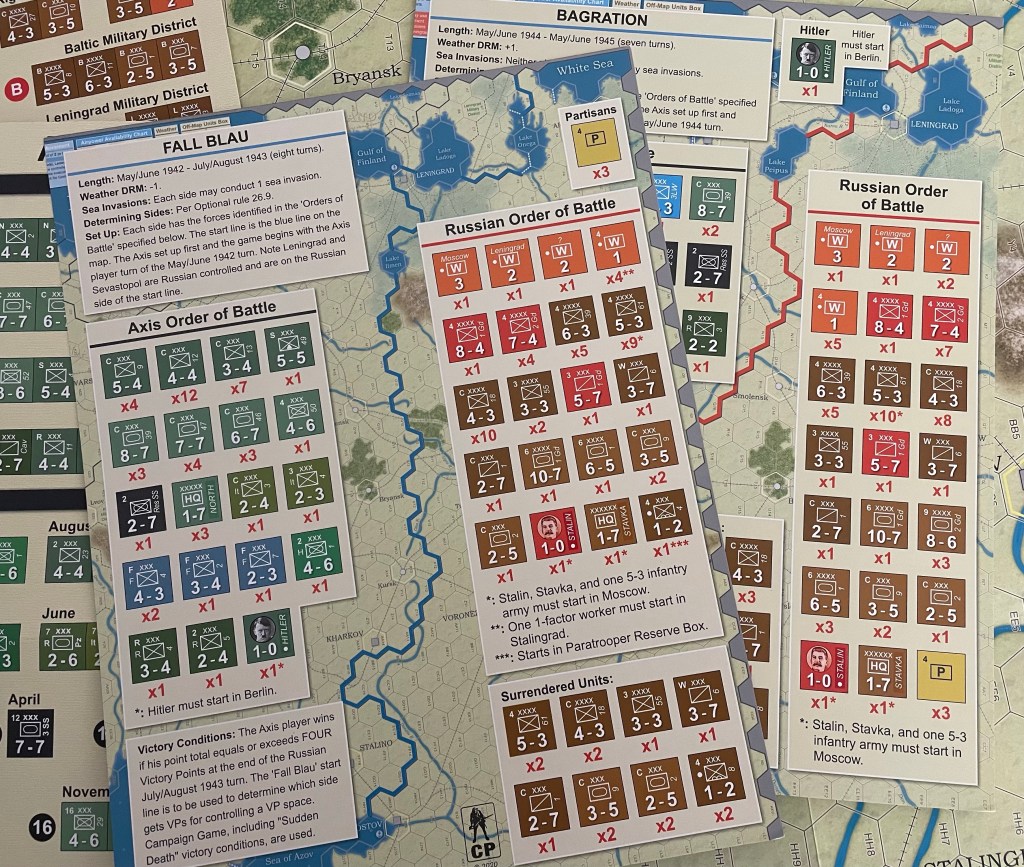
I took the tact that I wanted 3 different axis of advance in the game along the front including assaults on Leningrad, the area to the east of Kharkov and then toward Rostov in the south. With this in mind, I placed my most powerful armor units along with my best infantry units in these areas and focused the use of air power here to make the most effect from attacks. I really liked the setup freedom and enjoyed being able to make these decisions for myself. Normally in these classic hex and counter wargames, the setup is very rigid and is typically along the Army/Formation level with HQ’s located historically.
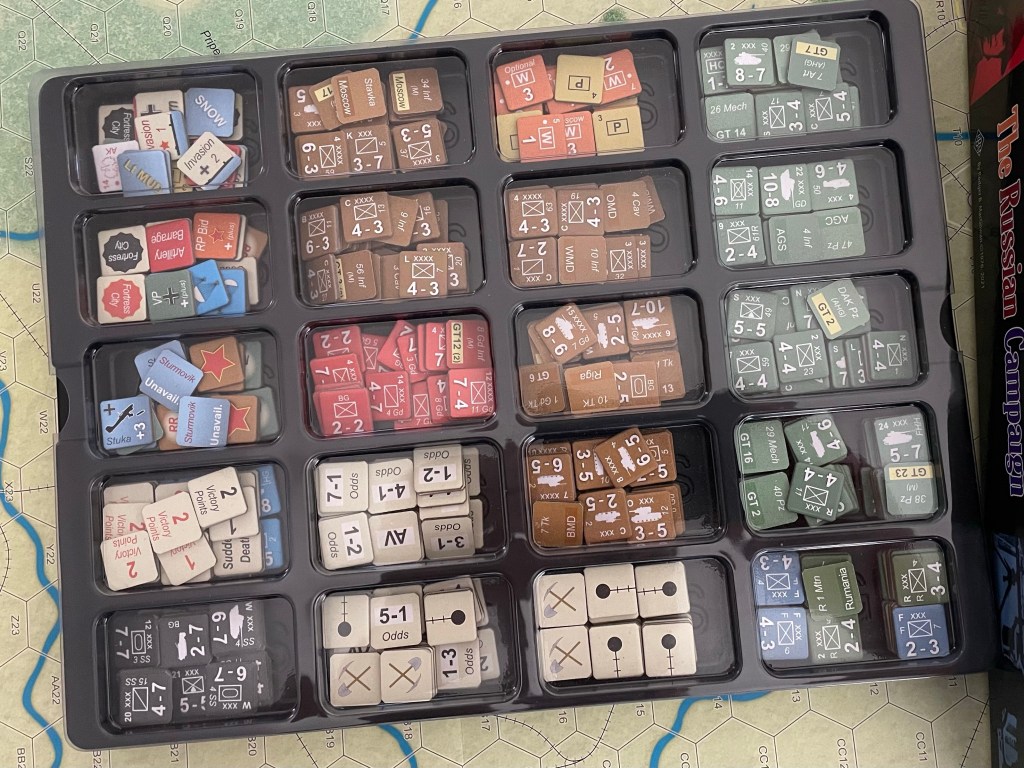
The other thing about setup is that the game comes with both NATO symbol counters and unit silhouette counters for all Armor units. This gives the players a choice and as you can see from our pictures, I used the NATO symbol counters while Alexander used the silhouette counters.
Multiple Impulse Movement and Combat
The game is established using a multiple impulse phase approach with regard to activations where there is a First Impulse Movement Phase followed by a First Impulse Combat Phase. Once the first phase is completed by the first player, the same player then continues into the Second Impulse Movement Phase followed by a Second Impulse Combat Phase. With Movement being the first step in each phase followed by a combat phase there are lots of decisions that need to be made here with regard to unit withdrawals and then filling those gaps created on the line with new reinforcements and then leading into combat. During the First Impulse Combat Phase, the player will force enemy units to retreat but cannot fill those holes created until the Second Impulse Movement Phase. This really creates some issues at the end of the Second Impulse Combat Phase as you will be unable to take advantage of combat and move into position but must sit there and watch as your opponent moves back into position, sometimes with stronger units, to take their revenge and counterattack. The other key with the Second Impulse Movement Phase is that only certain units are allowed to move a second time, including mobile units such as armor, mobile infantry and the like. I really did like this situation though and found it to be pretty interesting and create some really interesting situations that I don’t think that I have necessarily experienced with other systems. I liked it but don’t know if this was a standard form back in the day or if this was something that was unique then.
All air units must be used by the players in their First Impulse Combat Phase and are unavailable in the Second Impulse Combat Phase if not used.
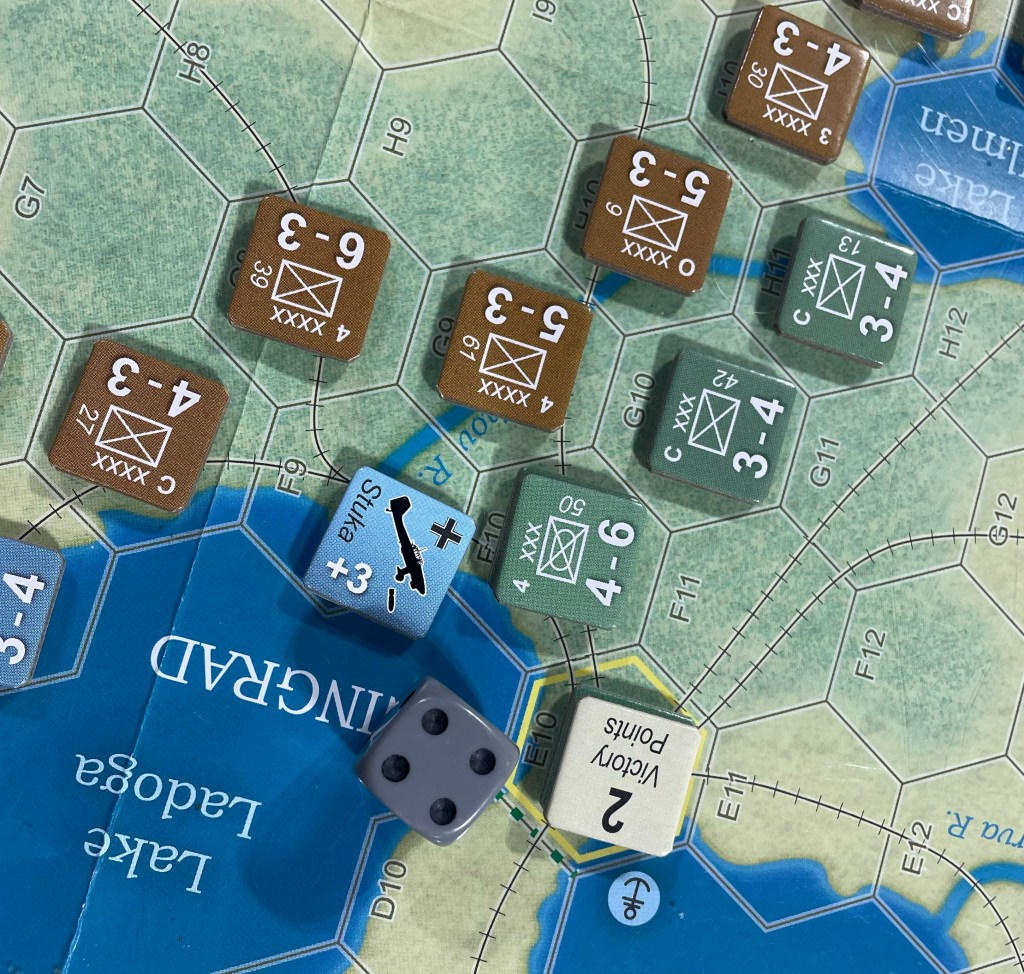
As I mentioned earlier, there is a mandatory combat requirement when units are located in an enemy Zone of Control. This was a definite different philosophy from other wargames I have played, as The Russian Campaign follows a classic model of not allowing units to be adjacent without having combat. This was the only part that we had to really think about as we played the game as we just co0uldn’t keep in our head that all units had to attack when in the EZOC. This sometimes leads to very poor odds attacks and losses so you really have to keep this in mind as you go down the line doing your attacks and planning your future moves. The game really works hard to make the players think about how best to deploy and use their forces as contact means combat.
The Debate Over Mountains Near Lvov
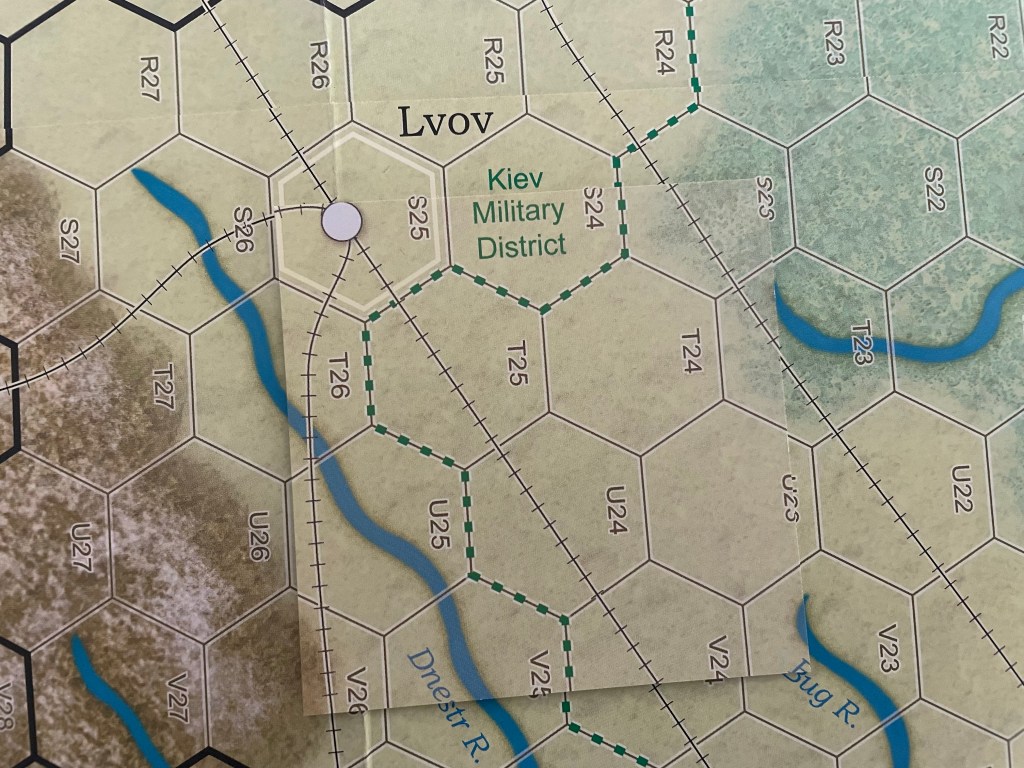
From the original game, there has always been a set of 3 mountain terrain hexes outside of Lvov that has been discussed and debated over the years. In order to address this issue, GMT included a special card stock square that has the same 4 or 5 hexes on it that takes out these mountains. I have read a couple of different opinion writings on the issue and the general argument is that the areas shown as mountains are not mountains at all in real life. The real issue here is that the true terrain in this area is more akin to rough terrain that will make it a bit harder to traverse through and could provide some defensive benefits but the game doesn’t have a Rough Terrain. The GMT Games team assigned to this project contends that the elevation of the area in question is higher than that of the Valdai Hills and that they put these mountains on the map due to this fact. But, that creates a bit less than historical issue here with the game and there are many that have been concerned over it. I also read that there is a small area of more mountainous terrain here but it amounts to no more than 1 or 2 hexes at most. So, the way to address this is to include the map square to use if you are concerned about it. It eliminates the 3 mountain hexes located in T25, T24 and U24 with replaces them with open terrain.
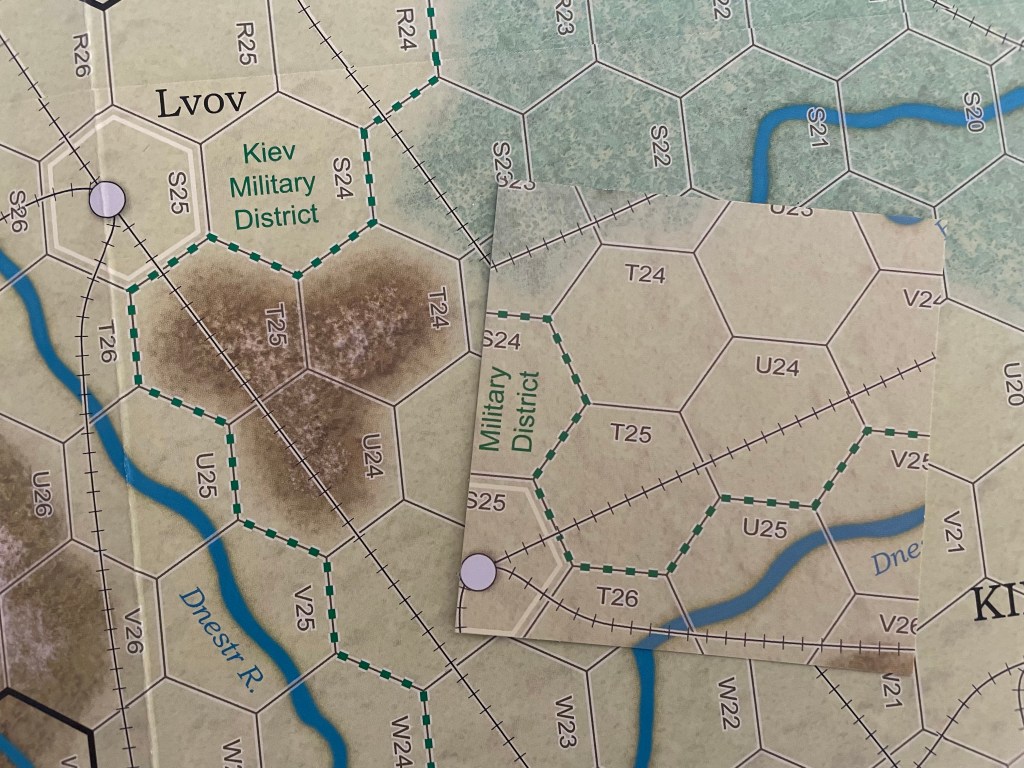
I think that the solution they provided works very well and if placed appropriately and carefully on the map, ensuring that the numbers and other lines here are lined up, and then covered with a thin sheet of plexiglass, the fix will be stable and stay put as you move units through and around the effected areas.
Eminently Playable
One of the ways I have started assessing games is how playable they are. This includes the accessibility of the rules, the clarity of the language used and whether or not examples are provided. I also look to see how the rules and the system work together to create a good simulation. I also don’t really like fiddly mechanics and systems as they lead to slow playing and plodding games that cannot hold my interest. What I found here with The Russian campaign is an eminently playable game. The game is pretty straight forward, the system works well with the situation and creates a lot of opportunity for proper deployment of units, quick movement to the front to fill holes and mount offensives and there were very few real rules questions once we got through the first turn and got used to the double impulse situation.
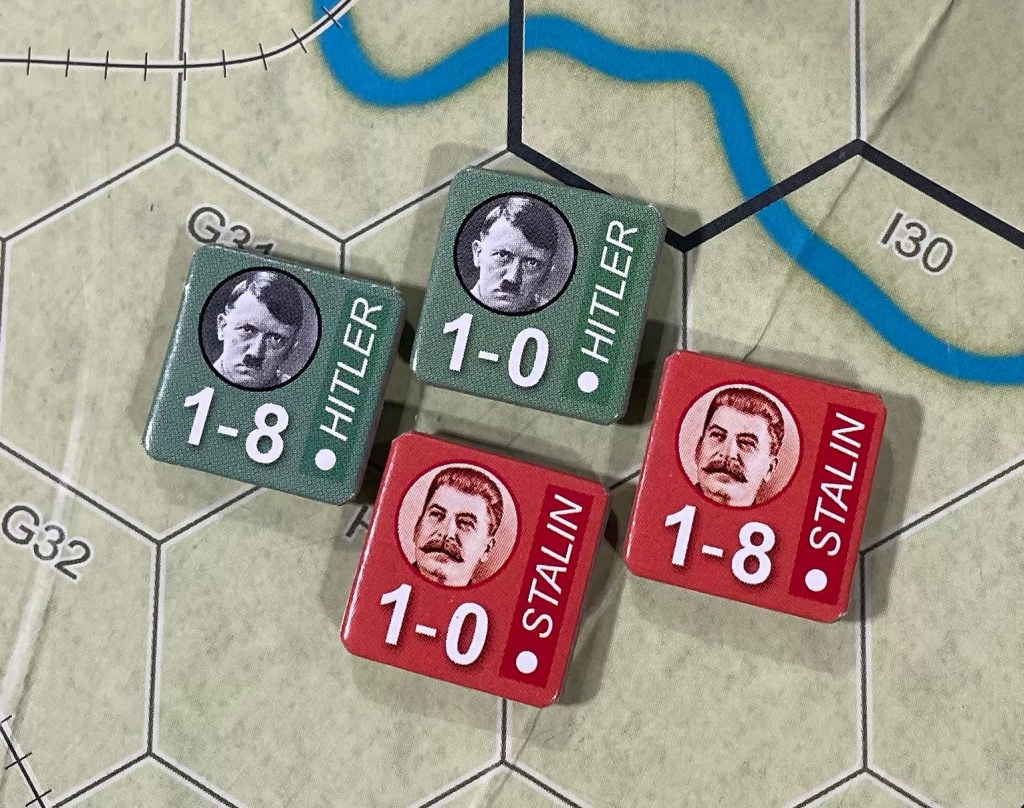
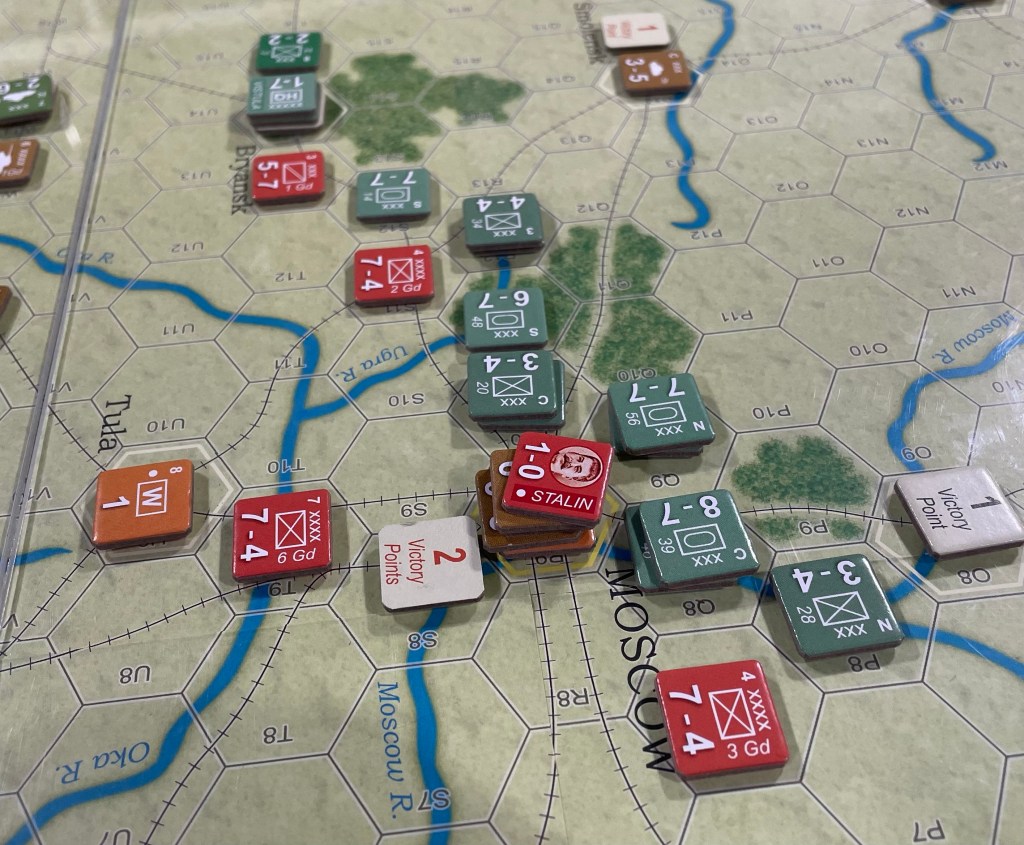
There are also lots of options included in the game as Optional Rules. These are not required to play the game but they give the players some more effects and mechanics to explore and decide whether they improve or detract from the game. I am not going to give a full accounting of these Optional Rules here but there are plenty of them, some major and some really very minor, and some that really do improve the game. These include things like Fortress Cities, Strategic Movement, Russian Recovery, SS Unit Replenishment amongst others. One that I noticed was that there are optional counters and rules that can be used to increase the role of the two dictators in the war in Hitler and Stalin. They can be used on the front lines to add to their combat value to stacks. But, if they are lost their are negative effects on their units over the next turn as their movement value will be zero.
In my opinion, the Optional Rules can be used to achieve a play-balance depending upon which side you are more familiar with playing and the skill level of your opponent. Less experienced players should be allowed to use some of the Optional Rules to aid them in grocking the system and giving them more of a competitive chance. But, once both players are very familiar with the game, and its strategies, I would say no to Option Rules and just leave it at that. The random weather generation really leads to the game being winnable by the Germans and still unwinnable if the rolls are poor.
We found that the game was a very good game with solid mechanics and that seemed to really flow very well. We were actually able to play our 8 Turn scenario in about 4 hours, which was very surprising to both of us. The game had lots of tension and it was very possible for the Germans to gain a victory. Especially if you are using the random weather table and not the historical weather.
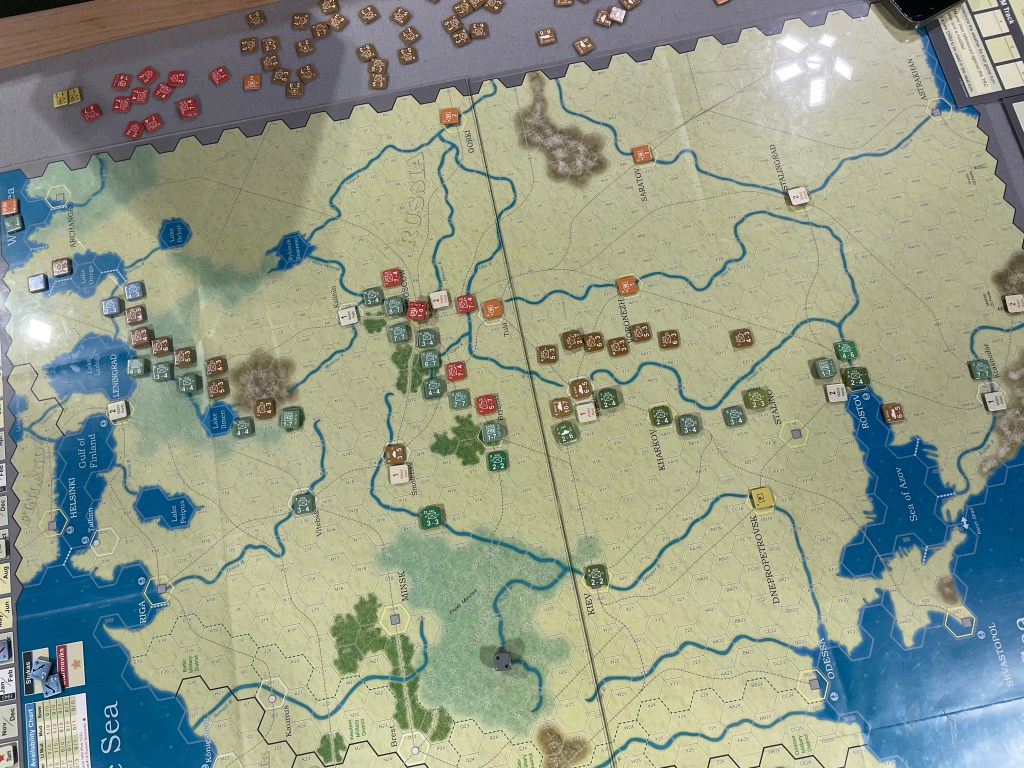
The other really strong part of the game is that it creates a very good narrative. Almost like a tactical game as movements and maneuver make a huge difference to the situation and provide the players with lots of alternatives to think about as they go about the game and find opportunities.
Minor Quibbles
My only real quibble with the game was that the counter color choices were just too close to each other and made identifying the different units really difficult. The real issue was with the Minor Allies for the Axis, which included the Rumanian, Bulgarian and Italian units. These units are simply varied shades of green and are almost indistinguishable from the main German units that are colored Feldgrau or field grey. Differentiating them on the game board is a serious problem. But the only saving grace here is that there are no stacking or combat restrictions involving the various minor allies and German units so it really isnt a big deal.
Other than that this game is a very fine example of a classic hex and counter wargame that is very playable and has enough opportunity for the Germans to win as the Axis. I have heard many people say that The Russian Campaign was their first wargame and that they played it so much that they wore the ink off of their counters. I used to think that this was just nostalgia and a fuzzy mind speaking but now after playing it I can fully understand and feel their affinity for the game, its system and mechanics. They all seamlessly work together in perfect unison to create a memorable and classic gaming experience.
Here is a look at our unboxing video so you can get a look at the components:
If you are interested in The Russian Campaign Deluxe 5th Edition, you can order a copy for $60.00 from the GMT Games website at the following link: https://www.gmtgames.com/p-591-the-russian-campaign-deluxe-5th-edition.aspx
-Grant


Great discription of the game. Compass Games did a reprint of the original in 2021.
LikeLiked by 1 person
A true classic wargame. Along with Up Front (also still available) and Ambush almost a must have for any board wargamer.
Personally I played TRC a LOT in my younger days and I saw that the next generation of 40-50 year old grognards these days do not know it very well.
A pity the 3rd/4th edition of Rise and Decline of the 3rd Reich was never reprinted, because that one is also a golden oldie from Avalon Hill.
Btw I agree with your remark about the set up front lines. In the 3rd edition of the game these lines were printed on the map!
I also love the original AH map. Somehow these white/blue clear maps had that extra art/simplicity that lured me into a true time machine.
Ha, the good days are finally back again…😜
LikeLiked by 1 person
I think that things are cyclical. And stuff always comes back around.
LikeLike
Grant, your commentary on TRC capture the flavor of that classic. I first played it, 3rd Edition, in 84, and replayed it many times, one of my all tome favorites. In 3rd edition, the Stukas can attack in 2nd impulse combat, the Russian sets up first, and you only have to attack if you are adjacent to an enemy on 2nd impulse. Not advancing after combat was an awful obstacle to overcome as you noted.
LikeLiked by 1 person
Excellent! I am glad that what I wrote sounded good. I always hesitate on doing these first impression posts because sometimes its hard to explain concepts after a cursory play.
LikeLike