I wanted to do a quick post today sharing a bit about the process for how I go about doing the Designer Interviews that we have on the blog nearly every Monday of the year. I take these very seriously and do them to provide a bit more information and an inside look into the games which are out there, typically on pre-order or still in-design, so that gamers can make a more informed decision about whether they pull the trigger or not.

In 2023 through November, the blog has hosted a total of 49 written Designer Interviews, with an additional 7 video interviews from WBC last year. That means that sometimes I do multiple interviews per week and I would say that when this is the case it is because we are covering a game coming up on Kickstarter and we have released that interview on launch day, which might fall on a day other than a Monday.
When I do these interviews, I have 3 goals in mind. These goals are as follows:
- To provide insight into the designer, including their background, previous designs, interests, hobbies and most importantly why they got into design. I think that understanding who the designer is and where they came from are important to understand their design process.
- To provide a look at the subject game and what it is about. I like to dive first into the historical setting and the research the designer has put in but also take a look at the mechanics, sequence of play, how actions are taken, etc. all to give a bit more insight into how the game will play.
- To better understand the reasons behind their choices in the design. This includes unit values, CRT results and makeup and major components like the maps, player aids, etc. and how they are used in the game. But I also want to know what challenges they had to overcome and how they solved the problem.
Now keep in mind that sometimes I cut the interviews down and ask less questions so I am unable to go into great depth on each interview. But those 3 guidelines are the hallmarks of my approach and are intended to share information, provide insight and inform.
The First Step – Reach Out!
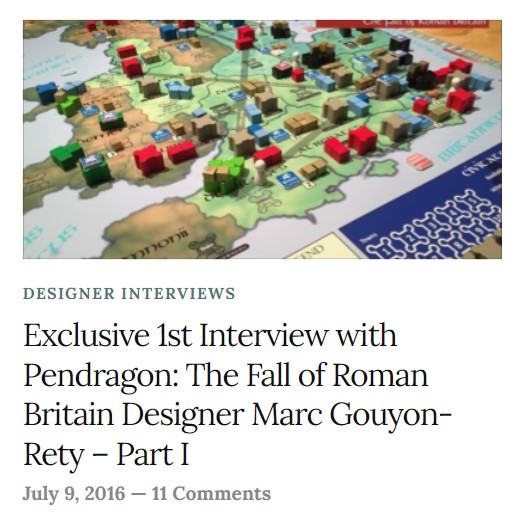
I remember the first time I reached out to a designer to do one of these written interviews. It was Morgane Gouyon-Rety for her new COIN Series design called Pendragon: The Fall of Roman Britain in 2016 and I was a bit nervous about it. We were still very new on the scene and frankly I didn’t expect much of a response, especially from a cold call type of email. But, Morgane did such a fantastic job with the interview and gave me such great depth of information that I decided to break the interview into 3 separate parts. This really gave us some mojo early on and provided me with a good example of what I was looking for to share with prospective interested designers.
What I do now is troll the various wargame publisher’s sites and once a new game has been announced on pre-order, I use Board Game Geek to get their email address and then reach out with a request. Most designers know who we are now and it is a bit easier for sure but it still takes my effort to first reach out and invite them to participate.
Step 2 – Craft Questions
Once I have them hooked I request a draft set of rules from them to peruse before putting my questions together and sending them back. I read the rules over and highlight what I think is most interesting and then begin writing the questions down. Now, after doing well over 400 of these interviews I kind of have the formula down and use a lot of the questions over and over again tailoring them or changing them slightly to better address the design. But as mentioned above, I am most interested in why they made certain decisions about mechanics and then want to know their inspiration, their design goals and typically the process along the way of working with developers and playtesters to vet decisions and make further changes.

I try my best to keep the number of questions to around 20-25 but sometimes there is simply too much to cover and I have to ask 25-30 questions. I have never really had much trouble with getting these interview opportunities and then getting them completed within a reasonable amount of time, usually within 30-45 days of having sent the questions out to the designers. My true response star here though is Gregory M. Smith who turns answers around in about 1-2 days! I don’t expect that but it is much appreciated and I always know if I am in a pinch and need something pretty quick he will be there for me! Other designers who have been absolutely fantastic have been Brian Train, Volko Ruhnke, Paul Rohrbaugh (Hight Flying Dice Games), Mark Simonitch and Morgane Gouyon-Rety.
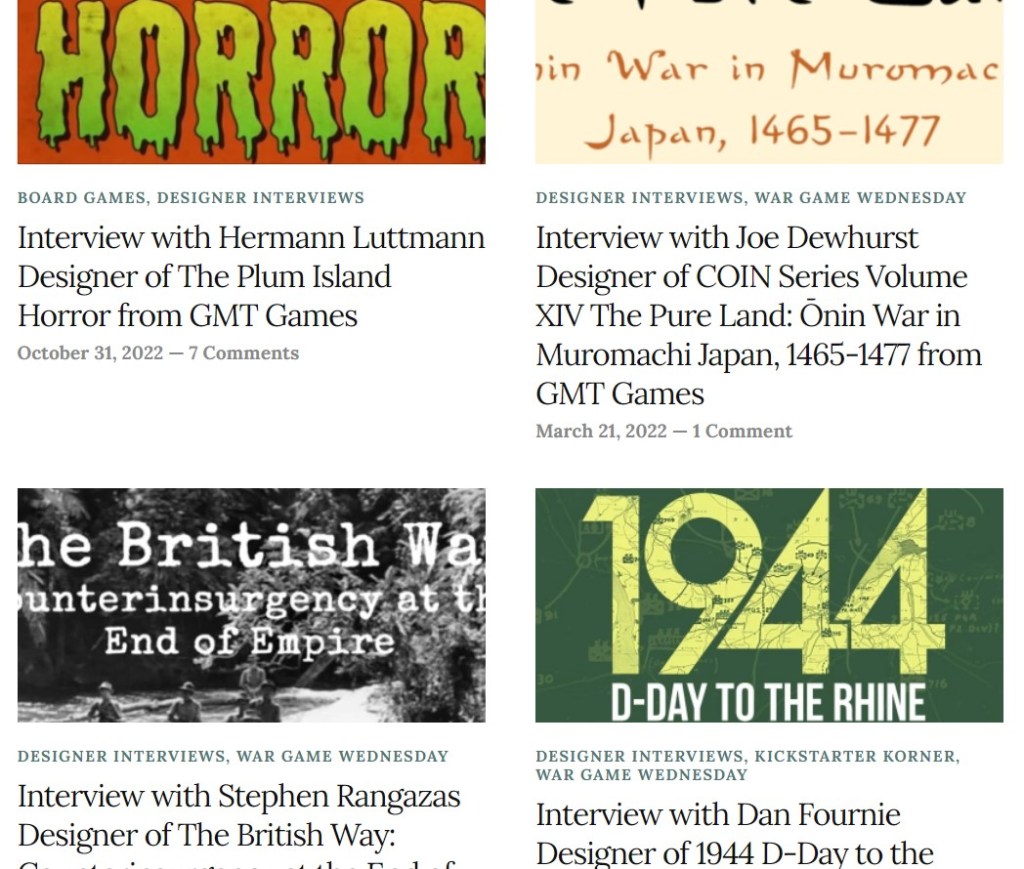
As you can see from the photo to the right, I always have at least 4 of these interviews scheduled into the future on the blog. I also try my best to have at least 3-4 sets of questions out at any given time as that seems to be the magic number to keep a weekly interview coming out. What typically ends up happening though is I will get 2 or 3 back at the same time, and then scramble to get them formatted and scheduled on the blog. The most that I have ever had scheduled ahead was 9 just a few months ago but I don’t like that to be the norm as it keeps the designers on edge about when it will post and it somewhat breeds laziness in me and I lose the fire to keep it going.
Step 3 – Format and Post the Interview
I end up doing a lot of the proofreading and formatting of these interviews on my laptop at home in the evening while watching tv, typically sports, or just relaxing. I am able to get them formatted in about 2 hours as I do try to search the internet for images, pictures of components, graphics, etc. I like these interviews to look good and read well and try to go over them a couple of times before posting them. I absolutely hate it when I read a post later and find a syntax error.

One of the most important parts about the formatting is also adding a link to the game where interested parties can go ahead and take a deeper look and possibly even order. We don’t get any kickback for these interviews from the publishers or designers but I feel like the information about the game is just as important as how the gamers can order the games.
Step 4 – Follow Up Once it is Posted
I always try to let designers know when I plan to post their interview and then also follow up with them to let them when it is posted and to provide them with a link to share out on their social media channels. I also share these interviews out on our channels and also send them to publishers to share as well. The more sharing the better as it will extend the post’s reach and exposure.
Each of the interviews get anywhere from 500 to 5,000 views over a period of time. Most get 150+ views on the first day and then an additional 50-500 over the next few weeks. If publishers share them, and even post them on their game pages, they will be evergreen typically until the game is published and available. Sometimes, I will get a burst of 50-200 views over a few days on an older interview and it usually is because the game is shipping and people are searching for information and come across our blog.
There you have it! A look inside the process for these Designer Interviews. I love doing them and have no plans to stop but I have noticed that their overall views have decreased slightly over the past few years. That is probably a change in how you as gamers consume information as videos have taken over the lion’s share of people’s time and effort in researching games but also because people are just not that interested in the boring rote list of questions and that is fine.
Thank you to all of the designers who have given of their time to me in answering these interview requests and providing me with information. Overall, I have given lots of different games and designers exposure and brought to light many smaller publishers and their games.
Please let me know your thoughts on my Designer Interviews, the process and maybe even some criticism about what you would like to see done differently.
-Grant
Here are links to the last 2 months worth of interviews if you wish to catch up:
Tony Birkett Codesigner of OCS Crimea: Conquest & Liberation from Multi-Man Publishing
Nicola Saggini Designer of Nothing Left to Bomb: The Skies Over Malta, 1940-1942 from SNAFU Design
Wolfgang Klein Designer of Assault Sicily 43: Gela Beachhead from Assault Games
Shayne Logan Designer of Old School Tactical Volume 4 Italian Theater 1943-45 from Flying Pig Games
Stefan Ekström Designer of Iskra: Spark of Victory, 4th Sinjavino Offensive from Three Crowns Games
Luis Álvaro Hernández Designer of ONUS! Under the Eagle from Draco Ideas
 The Players' Aid
Great post! Always interesting to get a peek inside your well-oiled blog machine 😀
LikeLiked by 1 person
Behind the curtain is really pretty messy though….but thanks!
LikeLiked by 1 person
‘Behind the curtain is really pretty messy though’.
Maybe so, but the results are well worthwhile and appreciated. Short, informed and interesting questions and then allowing the designer plenty of space to answer them makes for a great read. (I’ve just read your recent Justin Fassino interview which reminded me to comment here).
LikeLike
Thanks Brian. I really enjoy doing those interviews. I get a great insight into the game and am able to share some additional information with others who might be interested as well. Thanks for reading.
LikeLike