Not every wargame has to be deep. Some of them are light and fast playing and are just fun and interesting to experience. But, with this lightness, that doesn’t mean that the game isn’t a good representation of the history or an interesting play experience. Such is the case with a new game called Road to Independence: The American Revolution, 1775-1783 from Blue Panther.
Road to Independence: The American Revolution, 1775-1783 is the second in a planned series of games that will simulate various important conflicts in American history in a casual format. The first game was called French & Indian War from The Historical Game Company and the third game will cover the American Civil War. In this game, two players clash and take the sides of the British or the Americans fighting over the control of the Thirteen Colonies. One of the interesting things about the game is that it not only includes the Eastern seaboard but also the conflict in the far Western territory, a theater not often covered in games on this conflict. Both players will fight for control of important locations using specially made dice that represent British and American regulars, Native American allies, militia units, and (for the Americans) French and Spanish forces. Each player also has their own deck of Event Cards that will allow special events and actions to occur, ensuring that no two games will play the same.
In Action Point 1, we looked over the Game Board and discussed the two theaters depicted including the Wilderness Theater and the Eastern Theater and their differences. In this Action Point, we will take a look at the Location Cards and their use.
Location Cards
In the game, there are various purposes for the Location Cards, which are tied to specific locations on the Game Board. The Location Cards are used by the players to help keep track of their Victory Points throughout the game rather than having to add each time a Location is attacked and conquered. This convenience is not their only purpose but is one of the things about the design that was really well done. Once attacked and defeated, the physical Location Cards will be collected from the opponent and added to the tableau in front of the attacking player. Then, the player will add their Control Marker to the Location on the Game Board, unless it is one of their starting Locations, at which point no Control Marker is necessary as it is shown in the Location Box, and can then adjust the Victory Points on the British Victory Point Track.
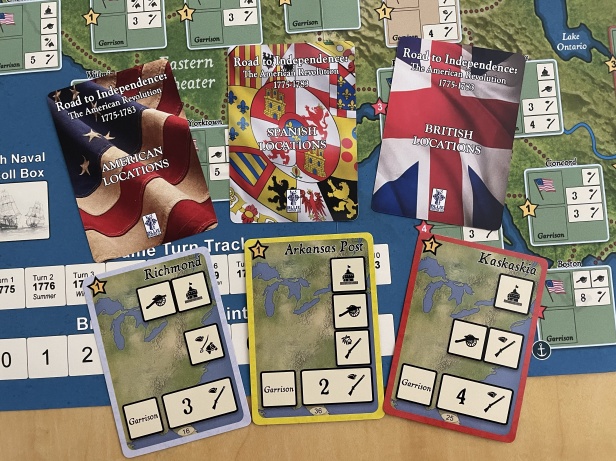
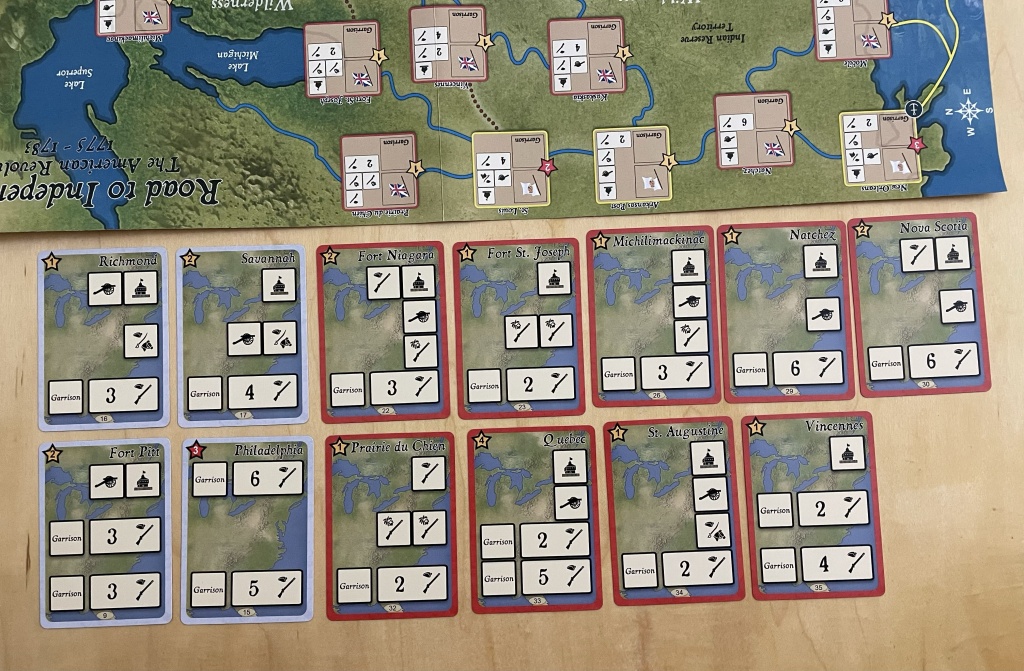
There are 38 Locations shown on the Game Board with 20 Locations being located in the Eastern Theater identified by green colored boxes and 18 Locations located in the Wilderness Theater identified by tan colored boxes. Of these 38 Locations, the British start with control of 15 Locations (Natchez, Prairie du Chien, Mobile, Kaskaskia, Vincennes, Fort St. Joseph, Michilimackinac, Pensacola, St. Augustine, Fort Detroit, Fort Niagara, Montreal, Fort Ticonderoga, Quebec and Nova Scotia) worth of a total of 25 Victory Points. Of the remaining 23 Locations, the Americans control 20 (Albany, Augusta, Baltimore, Boston, Camden, Charleston, Concord, Falls of the Ohio, Fort Pitt, Guilford Courthouse, Hillsboro, Maine, Morgantown, New York, Philadelphia, Richmond, Savannah, Wilmington, Wyoming Valley and Yorktown) worth a total of 36 Victory Points and the Spanish control 3 Locations (New Orleans, Arkansas Post and St. Louis) worth 6 Victory Points.

Let’s take a look at the various Locations and their Victory Point values in the following table:

The main purpose of the Location Cards is to clearly identify the defenses of the Location. These defenses are represented by various icons that indicate units and structures stationed there such as Forts, Cannons, Infantry, Cavalry and Auxiliary units including Indians, Rangers or Militia. If these icons include a number beside them this represents that the defense has more than just 1 strength and will require multiple icons or numbered icons to appear on the dice rolled for the attack to be successful.

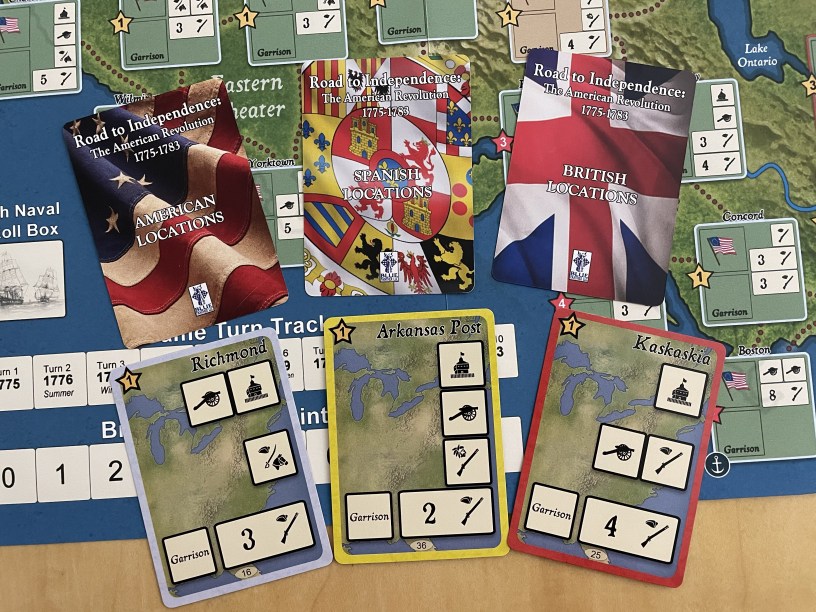
In the picture above, we are taking a look at the Richmond, Virginia Location. This Location has a Victory Point Value of just 1 and has several different defenses located on the Location Card. At the top of the card, you see that there is a Cannon icon and a Fort icon on the same row. This means that these defenses are located together as they occupy the same row. What this means is that when a player attacks this Location, they will have to use 2 separate dice from a single roll (you cannot hold and place a dice with a type of icon on it for use later) to satisfy the condition to defeat this row of the defenders. Below the top row, there is a single Cavalry icon. On the 3rd and final row of defenses, there are two different boxes, one that says Garrison and the other that lists a 3 Infantry icon. The Garrison Box is where the Patriot or British player, whoever controls the Location, may place one of their limited Garrison Units here to add to the defense of the Location. These Garrison Units are Infantry only and have a single icons or icons accompanied by a number of 2. The Infantry Box on the Richmond Location means that the dice placed here in an attack roll must equal a total of 3 Infantry, which can be divided up among 3 dice or satisfied by a single Continental Regular or British Regular die with a 3 Infantry on it.
The Location defenses are varied and the more Victory Point value that a Location has, such as a 3 or 4 as in the case of New Orleans, New York or Quebec, the more varied and higher strength points will be present as these Locations are highly fortified and will require a commander with the guts to attack but also with the help of some key Event Cards and a bit a good rolling.

The Locations are very good at giving the player a visual reminder of the defenses of each Location. As you can see on the Game Board, the defenses of each Location are shown but they are fairly small and using the cards is much easier on the eyes and also doubles as a good holder for the dice that are being used by the attacker to defeat the Location defenses.
In case you are interested, we also posted an interview with the designer Steven Kling and you can read that at the following link: https://theplayersaid.com/2023/09/18/interview-with-stephen-l-kling-jr-designer-of-road-to-independence-the-american-revolution-1775-1783-from-blue-panther/
If you are interested in Road to Independence: The American Revolution, 1775-1783, you can order a copy for $60.00 from the Blue Panther website at the following link.
In Action Point 3, we will take a look at the various custom dice and what units they represent and how they are used in the game in combat.
-Grant
 The Players' Aid
How much of this game is determined by luck and how much is determined by player skill and strategy?
Also is the map linen or paper? Can the map be purchased in linen?
LikeLiked by 1 person
It’s dice rolling so quite a bit of luck but it’s in knowing where to go, what areas to conquer to keep your opponent off balance and then knowing when to risk it and when to play it safe with rerolls and the odds. It’s a lite game.
LikeLike