Old School Tactical from Flying Pig Games is a tactical combat system that has focused solely on World War II to date (don’t get excited as I don’t have any information on any other subjects at this time!). The game focuses on the simulation of small unit combined arms engagements where historical units, weapons, armor and vehicles will clash on a well crafted board full of hexes. During a turn, players will go back and forth using an Impulse Point System to activate units to either Move, Assault Move or Fire. The players will play through a predetermined amount of rounds and at the end, victory points and casualty points will determine which side is the victor.
The first volume in the series was Old School Tactical Volume 1 Eastern Front 1941/1942 and focused on battles between the Russians and Germans. Old School Tactical Volume 2 West Front 1944/1945 was a follow-up effort and focused on the struggle in Europe following the D-Day landings in 1944 with battles between the Americans and Germans. The most recent released volume was Old School Tactical Volume 3 Pacific 1942/1945 and includes battles between the Japanese and their Special Naval Landing Force and the American Marine Corps. Now designer Shayne Logan is taking the system to the Italian Front to fight over control of the Italian Peninsula referred to as the “soft underbelly” of the Reich. We reached out to Shayne to get an inside look at the new volume and he was very gracious (and extremely quick) in answering our questions.
If you are interested in Old School Tactical Volume 4 Italian Theater 1943-45 from Flying Pig Games, you can back the project on the Kickstarter page at the following link: https://www.kickstarter.com/projects/markhwalker/old-school-tactical-vol-iv-italian-theater-1943-45

Grant: First off Shayne please tell us a little about yourself. What are your hobbies? What’s your day job?
Shayne: Well, I’m in my fifties now, happily married with children, and I live in a smallish town in Southern Ontario, Canada. My day job is gone now as I took early retirement a couple of years ago. At the time nothing too exciting, I was a United Steel Worker being overpaid to babysit large machines and not having them rip my face off. My interests include science and history, art and creativity, and sports. And a hobby which has spawned from this is my game design and game artwork for other designers.
Grant: What motivated you to break into game design? What have you enjoyed most about the experience thus far?
Shayne: I think a lot of people start designing these games as they think they can bring something new, or something that improves upon something out there. That was what I was thinking. I enjoy tactical wargames and believed I could put together a good system that looked good and played smoothly. I think complexity and realism are two different things in game design at the tactical level. I believe a game can be playable and have a realistic feel without needless stats and mechanics.
There is always a danger for rules creep though, with so many rabbit holes to avoid. I want a scenario to flow, naturally and I want the battle to play out almost like a good movie. With a smooth, streamlined system in place, players can focus on their tactics and the battle at hand. I designed a tactical system that had the details, but kept them under the hood so to speak, so that players weren’t bogged down with the minutiae. I look at it almost like a code for computer games, where players just concentrate on their tactics and play the battle.
I enjoy a lot of my experiences in this small industry. I like talking to the publishers, other designers, other artists, and other gamers not just about my games but other aspects of our hobby as well. I also like when all the parts come together, art assets, map designs, scenarios, layouts, etc. It’s a long process, with many moving parts, but it’s pretty cool when at the end it’s a tight fit.
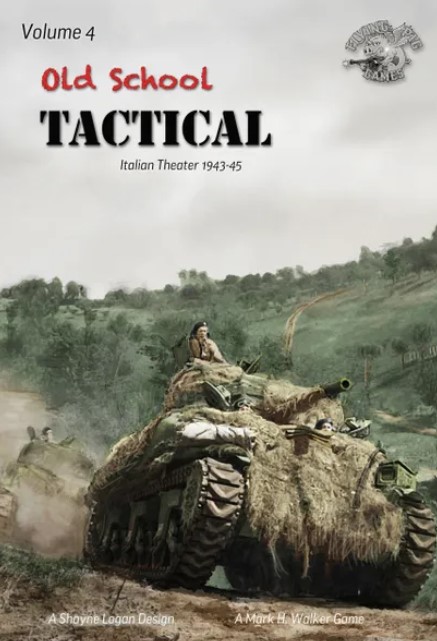
Grant: What is your upcoming game Old School Tactical Volume 4 about?
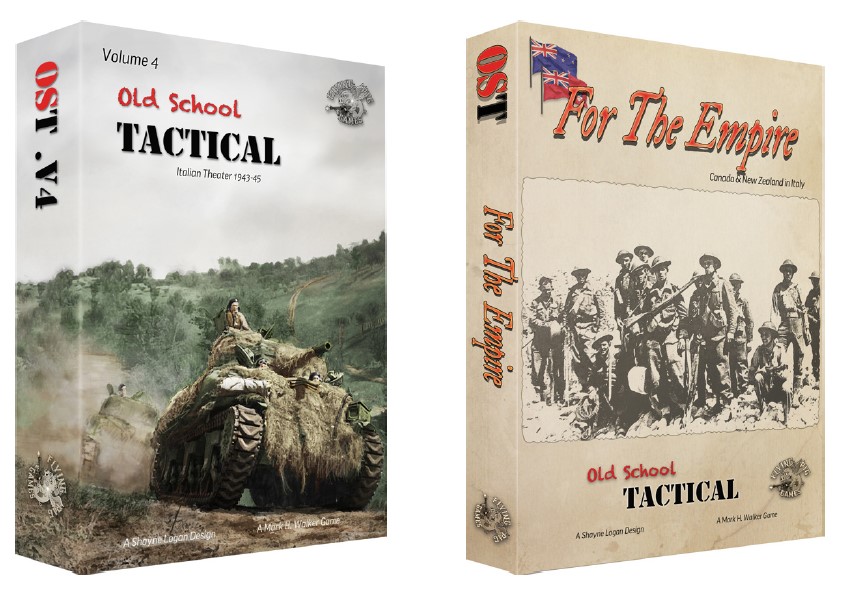
Shayne: This volume of OST centers on the fighting in Italy and Sicily. British, German and Italian troops are involved in the main volume. And again an add-on boxed expansion will be offered. ‘For the Empire’ adds Canadians and New Zealanders as well as the Fallschirmjägers for the Germans.
Grant: Why was this a subject that drew your interest?
Shayne: Initially it was a desire to get the British and some of her Commonwealth forces into the OST mix. And of course I wanted to get my historical Canadian Regiments in play.
But, I also wanted to learn more about the campaign, as when I first started the process, I knew very little about it. The Italian Theater doesn’t get the attention of other campaigns from the war, even though it was a long drawn out and bloody affair. Even the soldiers at the time often felt forgotten, and at one point were calling themselves the ‘D-Day Dodgers’.
It was also a truly allied effort with soldiers from America, Great Britain, Canada, India, Poland, New Zealand and French colonials. They had every advantage in terms of manpower, air power and sea power but the campaign was a slog.
They were countered by terrible terrain, terrible weather and a deft strategy by Albert Kesselring.
Grant: What is your design goal with the game?
Shayne: A cohesive design to challenge tactical wargamers. Interesting scenarios. Gameplay that provides great narratives. Good artwork that immerses players in the battle. One of the things I enjoy with tactical games are the stories they reveal to players. After playing a scenario, one always looks back at this or that point in the action and the battle comes to life.
Grant: What elements from WWII and specifically the Italian Front are most important to include in the design?
Shayne: First and foremost the terrain was important for this game. It can hinder movement and it allows soldiers to put up a stodgy defense. Here is a sample from the map in the base game that shows the tough terrain.

Lots of hills, rivers, rough terrain, groves and vineyards.
And here is a sample from the add-on, which adds some ruined town terrain for scenarios in Ortona and Cassino.


Grant: What research did you do to get the details correct? What one must read source would you recommend?
Shayne: I list 11 books in the bibliography for this game design. A few of the good ones are by Mark Zuehlke on Operation Husky, Ortona, and the Liri Valley. I used many of the Osprey Campaign series of books as they offer a lot of condensed information.
And of course, I gleaned what I could online, especially when digging up unit info and their histories. One must read I can recommend is The Day of Battle by Rick Atkinson. A great look at both the large and small battles in this campaign. He has a WWII trilogy of books, the others being An Army at Dawn and The Guns at Last Light, which I will have to acquire at some point as well.
Grant: What is different about this entry in the Old School Tactical Series?
Shayne: Whereas the last volume of OST (Pacific) had opposing forces that were wildly different, this volume is more akin to the second volume (West Front) of the series in which most of the fighting forces are fairly evenly matched. The British and Commonwealth forces can dish it out with the Germans.
Grant: What different units are represented in the game?
Shayne: As a tactical game, counters in the game represent squads of soldiers, crewed weapons, single persons as well as individual vehicles and support weapons. There are Rifle squads, Pioneers and Sappers, Commandos and Snipers, as well as many armored fighting vehicles.
Grant: This is the first appearance for the British in OST. How did you go about tailoring the system to fit their strategic capabilities and fighting styles?

Shayne: The British and by extension, most of their Commonwealth allies, were well trained and up to the task to fighting the Axis. And although some of the leadership was rigid and unimaginative, the troops themselves carried out their duties calmly, even under terrific stress. One of the things I came across time and again in my research was this patience and professionalism under fire. So in this volume, British, Canadian and New Zealand units receive a bonus of +1 DRM when rallying units.
Another thing I find interesting about these forces, is that they kind of have a ‘make do’ way of thinking as far as fighting the enemy and equipping their forces. They used vehicles like the tiny Carriers, slow moving large tanks like the Churchill and even mounting cannons on their lorries.
And also with their weapons, a spring loaded PIAT anti-tank weapon and sticky bombs, which were just as likely to stick to the Tommy using them. It is kind of like they were saying ‘okay, make the best of it boys’.
Grant: The other new nation in the game are the Italians. How did you go about capturing their fighting style?

Shayne: The Italian units in the game are tricky to use as a player. By this stage of WWII, many of the soldiers were done with the war. They are not top quality units and some of this is reflected in the Italian Rifle units with lower Firepower and Range values and their Defense is also sub-par. And they have a tendency to surrender in some scenarios. I did not include any of the better quality Italian units in this volume.
Grant: How did you differentiate each side’s forces?
Shayne: Differences do come through in individual unit types, but the sides differences are normally reflected in the scenarios. Things like a side’s Gut Check, or morale level affects how a side’s soldiers will fight in a scenario. For example, in this game the Italian forces suffer from poor morale and leadership, so they have higher Gut Check levels of 8 or 9. This means in the game that they are more likely to Shake or Break when they are in combat.
The Impulse Point totals for each side reflect many things going on in the background, and injects some chaos or friction into the battlefield.
Grant: What is your process for assigning combat and movement values for each side?
Shayne: When researching, I normally check out typical weaponry and fighting styles for different unit types for different nationalities at a given point. I check out their training and discipline, the quality of the soldiers and their leadership. A unit’s movement possibilities including maneuverability.
With vehicles, you also have to look at their weapon’s penetration power for armor as well as its’ high-explosive power. Then the protection for the vehicle with it’s armor thickness and slope.
There also may be some flaws or bonuses involved with a unit. What I am trying to say is that there is a lot of thought that goes into assigning values to a unit, but there is no hard and fast formula for it.
Here are a couple of examples.
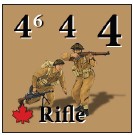
Think of this Canadian Rifle squad as representing a well trained and equipped foot unit. It has a firepower of 4 with a range of 6 hexes (denoted with the superscript white number to the right of the Firepower on the counter). It also has a decent defense value of 4 and a movement value of 4.
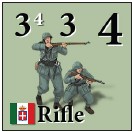
Now compare that to An Italian Rifle squad which has a poorer firepower rating of 3 with a range of just 4 hexes and a lower defense value of 3. This means the Italian Rifle is about 25% less effective than the Canadian Rifle squad shown. This unit has less cohesion and is less inclined to push a fight and has to engage at a shorter range.
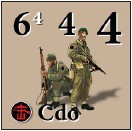
And finally let’s take a look at the British Commandos. They are an elite unit which gives them certain bonuses on the battlefield. They have a higher firepower of 6 reflecting more powerful weaponry loadouts and skill. Range is shorter as well to show more use of weapons like submachine guns rather than rifles. Defense of 4 and movement of 4 reflect good skills on the field.
Grant: What different tanks are included?
Shayne: I’ve included some counter pics.
New Axis vehicles include a couple of 8 wheeled armored cars, a flak vehicle, Nashhorn, Marder III, Panzer IIIN, Panzer IVG, Elefant, a Semovente Italian SPG converted for German use, as well as some Italian Renault light tanks. There are also scenarios involving StuG IIIG’s and Tigers.

Allied vehicles include Stuart and Sherman tanks, 2 variants of Churchills, Carriers, Fox armored car and a M5 Recce which is a Stuart with the turret removed.

Grant: Can you share a few Unit Data Cards with us?
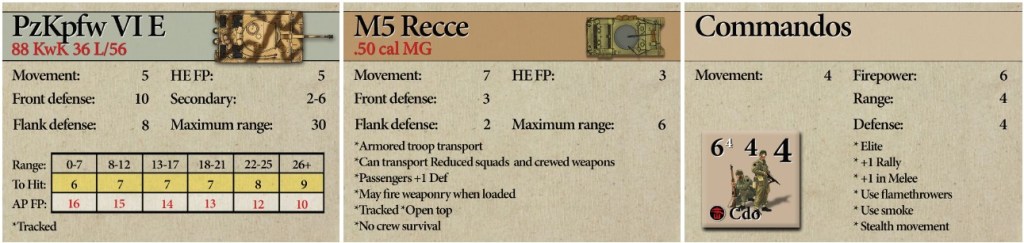
Shayne: Sure, here are samples for a German Tiger Tank, a Canadian M5 Recce and a British Commando squad.
Grant: How did you represent the many river valleys and fortified lines that existed in Italy?
Shayne: A river runs through the map in Volume 4 and there are also many multi-level hills. There is rough, rocky terrain, as well as dense olive groves and vineyards, which are totally impassable to vehicles.
The terrain in the Italian Theater was challenging to the soldiers and OST players will find it equally as challenging to play on these maps.
And there is a Pantherturm counter for the Germans, which is a fortification mounting a Panther turret.

Grant: What role do the Luck Cards play?
Shayne: Luck Cards are a simple one off to add some unknowns to a battle. The effect may be large or small depending on when and how they are used. Or they may not make a difference at all.
Grant: Can you share a few examples of these cards with us?
Shayne: Sure, here are a few.

Grant: You also do all the art. How do you do both?
Shayne: I have been creative forever, and the artwork of the game is very important to me. I think immersion in wargames is very important and gets players into the battle. Especially with wargames on the tactical level. The artwork for large maps is one of the first things I think about.
As I read, I take note of the terrain in and around the various battles to come up with an overall feel for the map. While keeping loose ideas for scenarios as I go along, I figure out the layout for the map. Then I put in the work on the textures and coloring.
As I’m researching, and thinking up scenarios, I also build lists of units needed for the game. Once I have this list, I start building all the art assets for the counters.
I paint figures for the troops and paint and camo the vehicles, then mount them on the counters and slowly get them done.
Grant: How does your style contribute to the overall success and playability of the system?
Shayne: As I was saying earlier, I design games that I want to play. I want them to look good and I think my artistic style allows players to enjoy the experience that much more. I think that the system is solid and offers lots of opportunity for players to try out various strategies. There also are lots of scenarios and different situations.
Grant: What different scenarios are included?
Shayne: There are 14 scenarios in the Volume 4 base game. Scenarios that cover a wide range of action. Scenarios such as ‘Fallen Allies’ in which a group of Italian soldiers fight back against an encroaching German force outside of Rome. Or ‘Guards Brigade’ where units of the Coldstream Guards are pressed by a counter-attack by German panzers at the Tusciano River. Or ‘Queen’s Revenge’ where Shermans of the 9th Queen’s Royal Lancers look for payback on a pair of retreating Tiger Tanks.
There is another 14 scenarios in the For the Empire add-on covering actions with New Zealand and Canadian forces.
Scenarios such as ‘Albaneta Farm’ where Kiwi tankers from the 20th Armoured Regiment try a back road into Monte Cassino. Or ‘Dead Horse Square’ where Canadians of the Seaforth Highland Regiment fight over a piazza in the town of Ortona against a force of determined Fallschirmjäger.
Grant: What different stretch goals are included?
Shayne: The stretch goals will be similar to earlier OST Kickstarters.
Things such as the neoprene mats and border strips as well as improved components such as linen finish cards.
We will see as things progress what more is needed.
Grant: What are you most pleased about with the game?
Shayne: That it is finished and I can start my next project :-).
I am happy that all the moving parts of the design have come together once more. It looks great and the scenarios are fun to play. I hope OST players and any new recruits to the system enjoy it.

Thank you so much for your time in answering our questions Shayne. It is pretty funny but we have played all of the volumes of the Old School Tactical Series and loved them but this is the first time that we have had you for an interview on the blog. I am glad to see the system continuing to come out with volumes and there is always North Africa and maybe the north including Norway and Finland for future expansion.
If you are interested in Old School Tactical Volume 4 Italian Theater 1943-45 from Flying Pig Games, you can back the project on the Kickstarter page at the following link: https://www.kickstarter.com/projects/markhwalker/old-school-tactical-vol-iv-italian-theater-1943-45
-Grant
 The Players' Aid
Great review and congratulations Shayne on this awesome looking entry into OST; Awesome to see the Canadian contingent included and done by a fellow Ontarian no less. How appropriate that this review was done on Thanksgiving. Keep up the great work and really excited to get this one next year.
LikeLiked by 1 person