
We all love Twilight Struggle….and if you say you don’t, you really do but just want to be different or are a contrarian! The game is phenomenal and has done very well for GMT Games with 8 Printings as well as the Turn Zero Expansion and now a series of smaller geographically focused spin off games starting with Twilight Struggle: Red Sea – Conflict in the Horn of Africa. Twilight Struggle: Red Sea deals with just two regions located in the Horn of Africa including Africa and the Middle East. The game uses the familiar Twilight Struggle formula of Cards with both Events and Operations Points that can be used by players to perform Coups, do Realignment Rolls or place Influence in an effort to gain control of the most Countries in the Regions to score Victory Points and win the game. The game is fast, furious and only lasts 2 hands of cards (unless you choose to play the special 3 Turn variant) so there isn’t a lot of time to mess around and players must be focused on what they are trying to accomplish. The best thing about the game is that it plays in 45 minutes as compared to 3-4 hours for Twilight Struggle.
In Action Point 1, we took a look at the board and discussed the two Regions depicted, examined the various Tracks, including the Action Round Track, DEFCON Status Track, Turn Record Track, Victory Point Track, Required Military Operations Track and Space Race Track and also briefly discussed the new Strategic Sea Lanes Box and the addition of some handy reminders for how various Operations work on the board. In Action Point 2, we examined what is new in this smaller focused addition to the series including the Strategic Sea Lanes Box, Flashpoint Countries and the updated Space Race Track along with a few other new tricks. In this Action Point, we will take a look at examples of new cards for both the Soviets and the Americans as well as Neutral Cards.
One of the best parts about any new Card Driven Game is learning the cards. How they work? What strategies are behind them? How to plan to most effectively use them? What historical event do they spawn from? And in a great game like Twilight Struggle, which we have played dozens of times and know each card intimately, getting new cards in the same system is a real treat. Let’s jump right in and take a look at a few examples of new United States Cards, Soviet Cards and Neutral Cards.
There are 51 total cards in the game. 21 are Soviet aligned, 20 are United States aligned and 8 are both aligned (Neutral). The final 2 cards to round out the number are both Scoring Cards, including Africa and the Middle East.
United States Cards
The first United States Card we will take a look at is called The Victorious Leader, which refers to Siad Barre, the self styled “victorious leader” of Somalia. The card is a Mid War Card and has a 3 Ops Value. Any card that allows a player to place Influence in a country, even if it is enemy controlled, is a very valuable and powerful card. Remember, in Twilight Struggle when a country is controlled the player will have to expend 2 Operations Points to place 1 Influence in that space. But, when a card instructs the player to place Influence this is the work around to the penalty. And this card really does a lot for the United States player by giving them 4 Influence to place. There are 2 limiting factors to the placement of the Influence granted by the card though. The first is that there can be no more than 2 Influence per country placed and second the Influence must be placed into countries that were adjacent to countries controlled by the USSR at the start of the round.

Let’s take a look at how this card will work. The United States player will take 4 Influence and can then place them according to the 2 limiting factors as explained above. In this example, Influence can be placed into 5 countries shown in the picture including Yemen (which contains 2 Soviet Influence and is therefore Soviet Controlled), S. Yemen (which contains 2 Soviet Influence and is Soviet Controlled), Djibouti (which contains 2 Soviet Influence and is Soviet Controlled), Somalia (which contains 4 Soviet Influence and is Soviet Controlled) and finally Saudi Arabia (3 United States Influence). The target countries have to be adjacent to Soviet Controlled countries, so Somalia is adjacent to Djibouti allowing placement, Djibouti is adjacent to Somalia allowing placement, Djibouti is also adjacent to S. Yemen allowing placement, Yemen is adjacent to S. Yemen allowing placement and finally Saudi Arabia is also eligible for placement as well as it is adjacent to Soviet Controlled Yemen.

2 of those available United States Influence are placed directly into S. Yemen to take Control away from the Soviets there actually gain Control for the United States and the remaining 2 Influence are split up and placed into Yemen and Djibouti to also wrest Control from the grip of the Soviets. Remember, this card allows you to place Influence 1 for 1 into Controlled countries so take advantage of that!
Next up we will take a look at Peace Corps, which refers to the organization created by President John F. Kennedy and became somewhat of a tool in the Cold War struggle as it began to influence perceptions in the developing world. The card is a Mid War Card and has a 2 Ops Value. But its real power is that playing it as an Event actually provides the equivalent of 3 Influence as it takes away a Soviet Influence and provides 2 US Influence to place in any 2 US Controlled countries. Think of this card as a defensive measure as it gives extra Influence to bolster your presence in a country you already Control. I also really like the thematic tie in here with the erosion of Soviet Influence due to the good work of the volunteers in the Peace Corps.

Let’s take a look at how this card will work. The card is played and the United States player first removes a Soviet Influence from Sudan, which flips Control from the Soviets to the United States. The player then decides to bolster their presence in 2 Controlled countries in both Egypt (already Controlled but increasing from 2 to 3 Influence) and S. Yemen (already Controlled but increasing from 3 to 4 Influence). This card has taken away Control from the Soviets and also strengthened US Control in Egypt and S. Yemen.

Now that you have seen 2 United States Cards in action, let’s take a look at some of the tricks for the Soviets.
Soviet Cards
The first Soviet Card we will take a look at is called Seychelles and it is a Late War Card with a 2 Ops Value. The Seychelles are an archipelago of 115 islands with a total population of 90,000. In 1976, they received independence from Britain and immediately their socialist leaning Prime Minister France Albert Rene staged a coup and took them in a decided pro-Soviet direction. The Seychelles card is a huge boon to the Soviet player in the continuing battle for control of the Strategic Sea Lanes Box. The Strategic Sea Lanes changes how scoring is completed. Strategic Sea Lanes are scored when a Scoring Card is played if one of the players Controls the space by having Influence equal to the Strategic Sea Lanes Stability Number, which is 4, while also having at least 4 more Influence in the space than their opponent. When a player Controls the Strategic Sea Lanes space, the effect is that this will double the Victory Points they will receive when resolving a Scoring Card. Also, the player who has more Influence than their opponent in the Strategic Sea Lanes space when a Scoring Card is played, but does not have sufficient Influence to Control the space, will receive 1 VP.

The Seychelles Card gives the Soviet player the opportunity to take Control of the Strategic Sea Lanes Box by giving them 1 Influence for each of the Middle East Countries that do not contain any United States Influence. As there are a total of 5 Middle East Countries (remember that Egypt counts as a Country in both the Middle East and Africa), this could give the Soviet player 5 Influence in the Strategic Sea Lanes Box.

In our example above, when the Seychelles Card is played when the United States only has Influence in 1 Middle East Country, Saudi Arabia. This will mean that the Soviet player will receive 4 Influence to place in the Strategic Sea Lanes Box which gives them Control. This can be a devastating play if the card is timed right as it can put the game out of reach for the United States player as it can double the Victory Points granted when the Middle East or Africa Scoring Card is played..
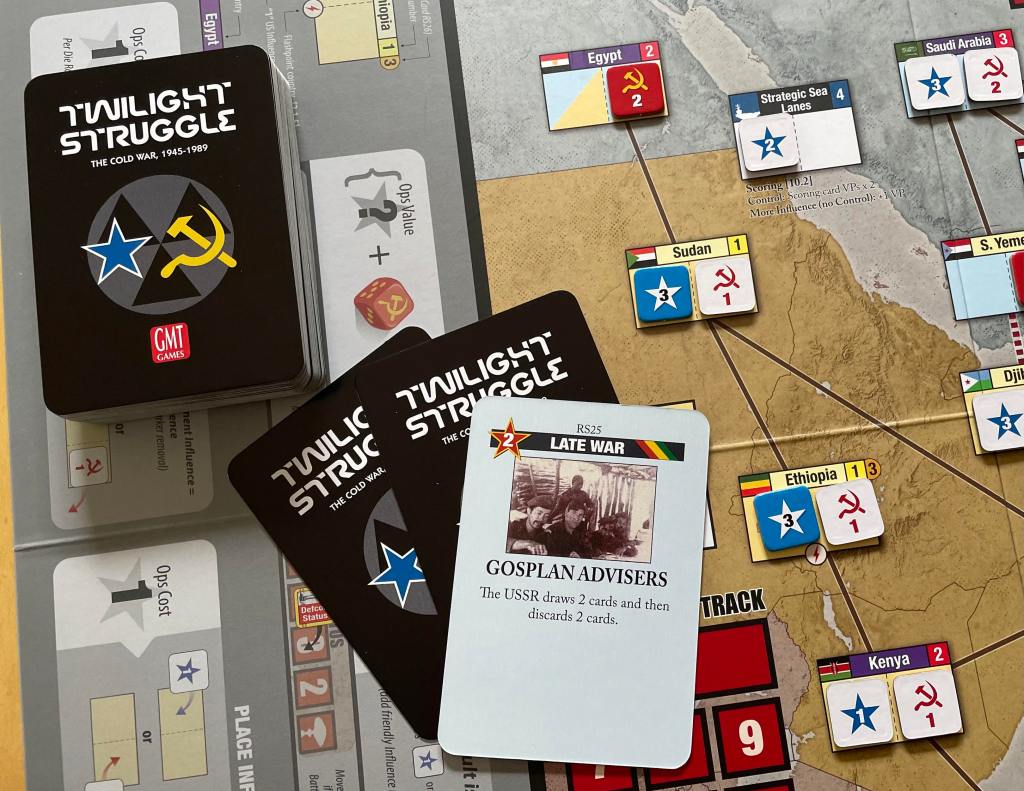
The next Soviet card we will take a look at is called GOSPLAN Advisers which is a Late War Card with a 2 Ops Value. The State Planning Committee, commonly known as GOSPLAN, was the agency responsible for central economic planning in the Soviet Union. Established in 1921 and remaining in existence until the dissolution of the Soviet Union in 1991, GOSPLAN had as its main task the creation and administration of a series of five-year plans governing the economy of the USSR.
This card is not complex but can be very beneficial when played at a time when you have a bad hand or are looking for a specific card, such as the previously discussed Seychelles. The key to being successful in any card based game is card advantage and being able to cycle through your deck to get to your best cards. GOSPLAN Advisers allows the Soviet player to draw 2 cards and then discard 2 cards. This can provide you with new cards to play but also get rid of your opponent’s cards that are clogging your hand which also may have nasty events. Think of this card as a palette cleanser.
We are now going to take a look at a few Neutral Cards, which can be played by either player for their printed events.
Neutral Cards
The first Neutral Card we will take a look at is Famine which is a Mid War Card with a 2 Ops Value. The Horn of Africa has to deal with severe drought and high temperatures that often lead to crop failures and the loss of livestock. This results in regular famines that accost the land and the Cold War powers tried to use this to their advantage by trying to convince the local populace that they could do better than their opponents. I really enjoy these type of thematic connections in the cards found in Twilight Struggle: Red Sea. They reinforce the propaganda and tactics of each super power during this titanic world ideological struggle.
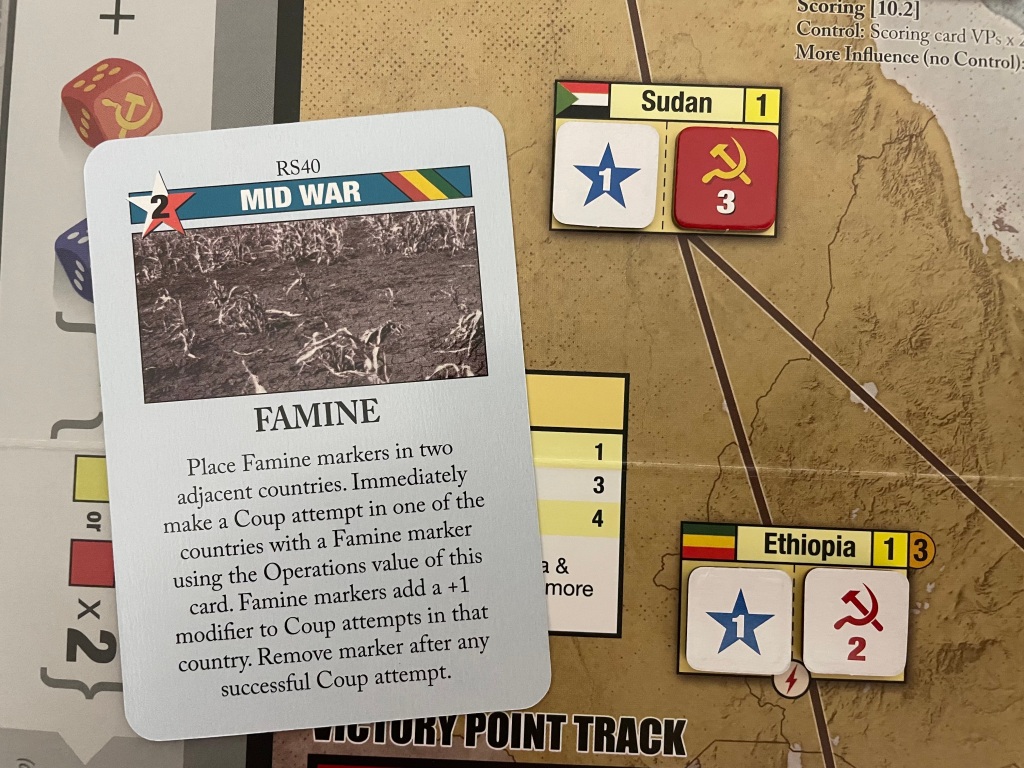
As you can see from the card pictured above, Famine allows the player using the card as an Event to place Famine Markers in 2 adjacent countries. Once these markers are placed, the player can then attempt a free Coup in one of the countries where the Famine Markers were placed with a +1 DRM to the attempt. If the attempt is successful, they will have to remove the Famine Marker but its work will have been accomplished in the region. When you play this card though you have to understand that the Famine Markers will not just benefit the player who played the Event, but the markers being there will provide a +1 DRM to future Coup Attempts by any player.

I really like the Famine Markers as they remind me of the Aid Markers found in Labyrinth: The War on Terror, 2001-? from GMT Games. A static marker placed to provide a benefit is not a new gimmick in these type of games but this thematic connection is definitely unique.
The final card we will take a look at is Water Wars, which is a Mid War 2 Ops Value card. Water Wars refers to the age old struggle between Egypt and Ethiopia for control of the Nile River as a primary water source. Over the years, dams have been built which lead to the restriction of water to Ethiopia and the argument continues.
The card allows the player playing it to remove all of their Influence in either Egypt or Ethiopia depending on which has the highest value. This can be a very important card if one player has built a lead in Egypt. Egypt is a Battleground Country and is very important to scoring.

The power to control the flow of water down the Nile is really well represented here in this event as removing Influence is a very strong action. The ability to take Control away or grant it has been a common theme in the cards that I have chosen and this one does that very well when the opportunity presents itself.

I hope that you have enjoyed this look at just a few of the Event Cards to be found in Twilight Struggle: Red Sea. An important part of the game is the concept that these Events are based in the real history of the Cold War conflict in the Horn of Africa. I think that the designer took great care to identify key events from the period and then thought long and hard about how to best introduce them into the framework of the system. I found the cards to be really interesting but also unique as they really didn’t copy too many of the concepts found in the original Twilight Struggle.
In Action Point 4, we will review the Scoring Cards and discuss how they work.
-Grant
 The Players' Aid