Over the past few years, we have played several World War I games with our focus on the Guns of August events every summer. We have really played some fantastic games including some of the true classics on the genre such as Paths of Glory from GMT Games and The Lamps are Going Out from Compass Games but also some real hidden gems like At All Costs from Hollandspiele, Devil Dogs from Worthington Publishing and Decisive Victory 1918: Soissons from Legion Wargames. This month, we have chosen 5 WWI games we are going to play and the first of those games was Verdun 1916: Steel Inferno from Fellowship of Simulations. The game is a Card Driven Game that uses cards with events and operation points to tell the grim story of the year long fighting around the French city of Verdun. The game uses a bucket of dice approach to the initial bombardments in a battle and then players choose whether to follow that with an infantry assault that doesn’t use any dice to determine hits. The game is very much a wargame but I think the cover highlights a key fact about the game by calling it a “Strategy Game” namely that it is a game as there are wildly powerful events based in history, with lots of dependence on dice not just for bombardments but also for playing certain offensives Event Cards where Victory Points are earned based on the higher numbers rolled. The game is very well done, is truly interesting and surprisingly deep with its tactical choices and decisions. I want to share my thoughts here in this First Impressions post.
The Cards…as it is a Card Driven Game
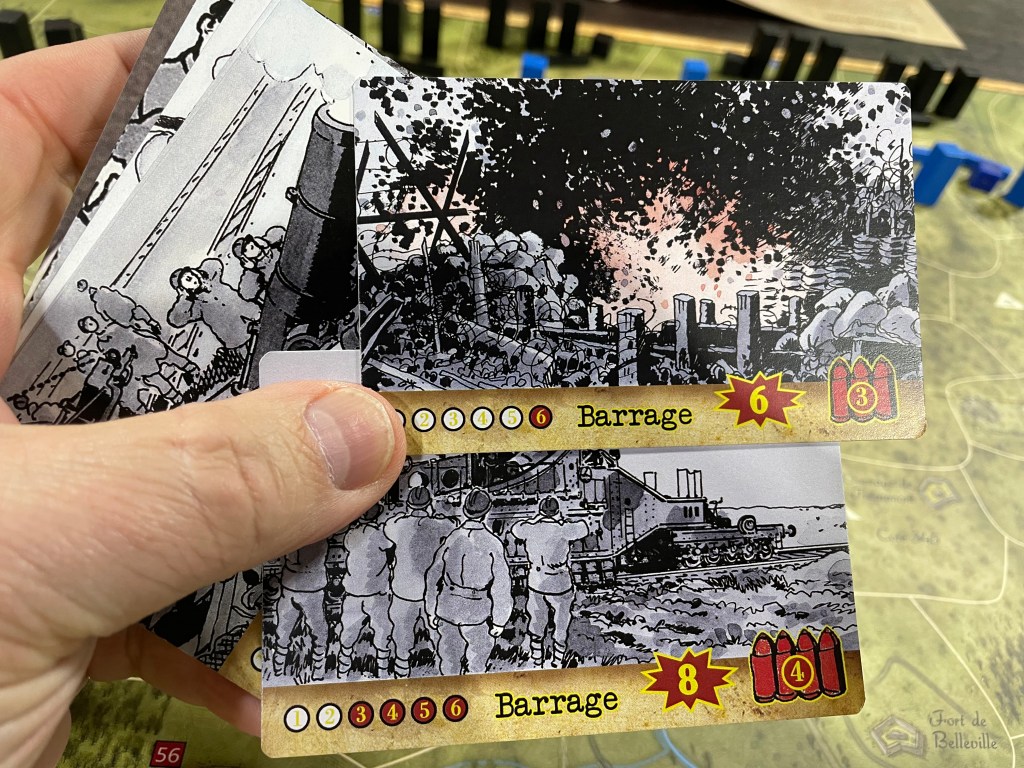
The game is a Card Driven Game and as such relies on the cards for the players to take various actions. These cards are a hodgepodge of Action Points that can be used to take specific actions for a cost like Tactical Move, Strategic Move, Refresh spent units or build trenches, or the cards can be used to perform massive Barrages on enemy positions and trenches and of course Events. The best part of the card design and how the CDG mechanic is used is that the cards are marked according to what turn they are useable in. This means that some cards are available in all of the game turns and others just during certain turns. This makes waiting for cards to become available a tantalizing game in and of itself and really creates some angst about either surviving the first few turns, as in the case of the French, or making hay while the son shines and relentlessly shelling and assaulting French positions as in the case of the Germans.
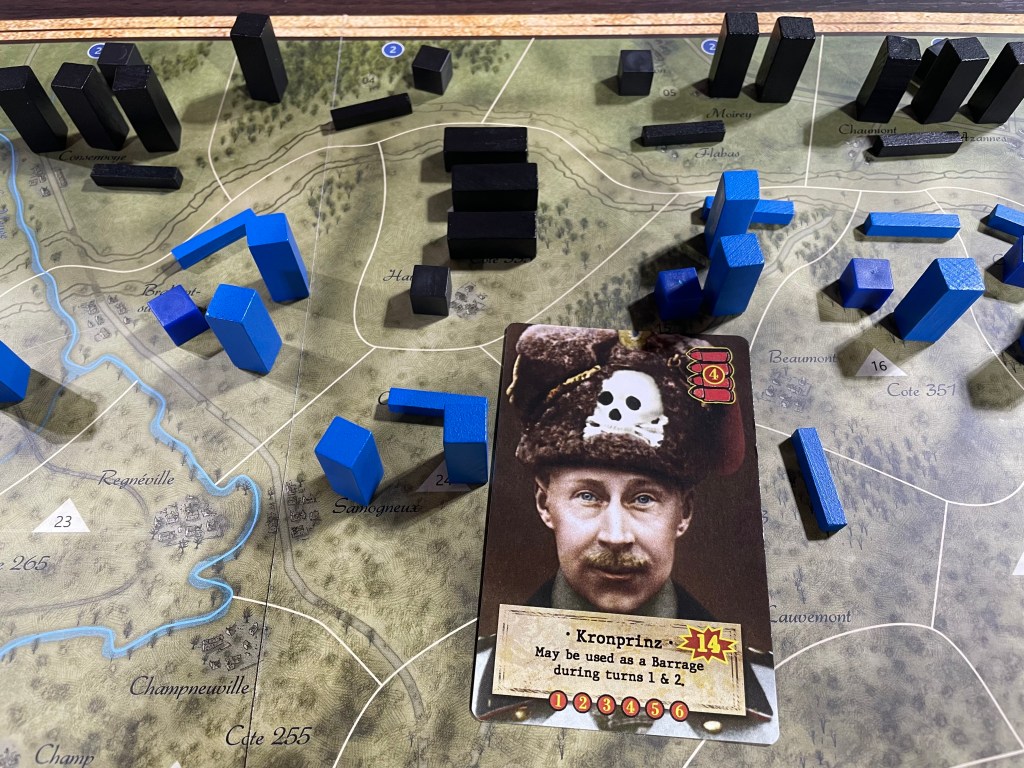
This really makes the players have to think through their strategy and understand when certain cards will become available and are useable. One really interesting concept is that the Germans start with massive Barrage cards giving them 10, 12 even as high as 16 dice to roll against dug in French defenders and soften them up for an infantry assault. The Germans will lose access to these larger more powerful cards as the game grinds on while the French will begin to get better Barrage cards in the late game making their attacks that much more likely to succeed and cause the Germans to have to replace lost units and Refresh those that are damaged.
The Events found on the cards are varied but always seem to be rooted in the history of the battle of Verdun. Although, a few of the Events are about happenings that occur outside of France and in the other theaters of World War I such as with Russian offensives, the Somme Offensive, US entry into the war and Jutland.
One thing that I really liked about the cards was how players can hunt through their deck to make sure they can pull out certain cards. At the outset of each next month players get to search their Draw Deck to select 1 card, then they may fill their hand to a max of 8 cards by drawing randomly. I thought this was odd at first but realize that this is a key point of the game as players have got to get out certain cards to really have a chance. For example, the US Diplomacy Card is the only way the French player can get the US to enter the war. If nothing is done with this, the French player will lose up to -15 Victory Points at the end of the game and that guarantees defeat no matter how well they did in defending their territory as the French VP Track only goes up to 15. I really enjoyed how the cards worked and found them to be really well done.
I feel that this game will benefit from lots of plays to the point that the players each know the cards well and understand how best to play them for their greatest effect. This is the key to a victory in the game and really does create an immediate desire to play again.
Combo Cards
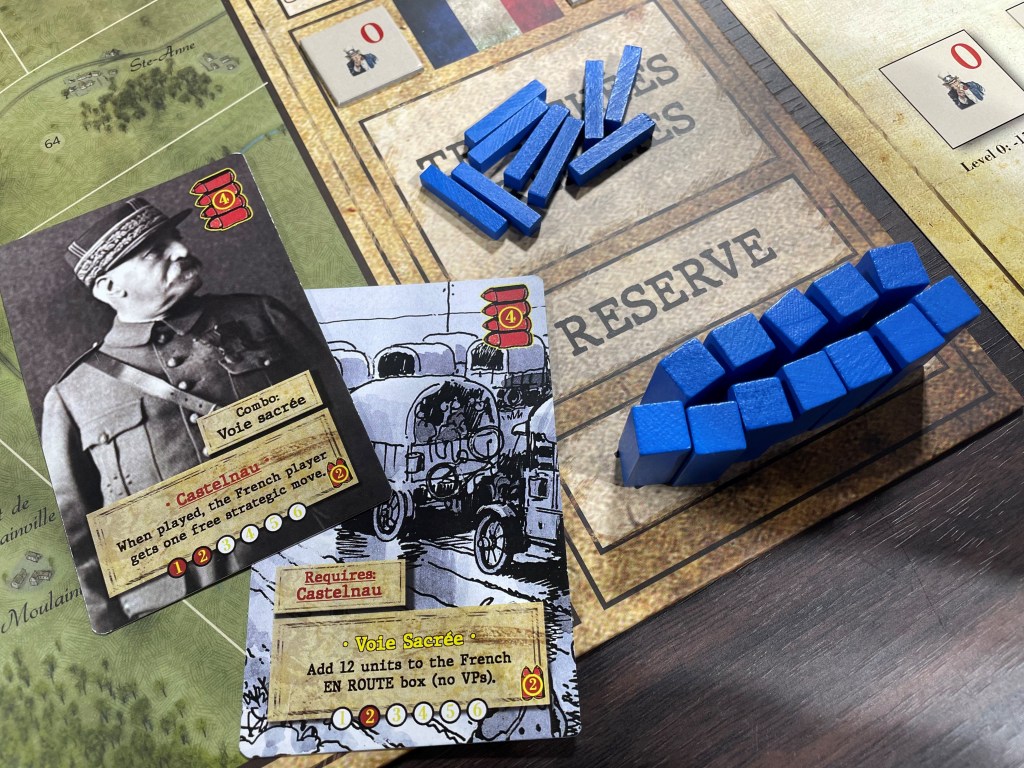
And the cards just get deeper and deeper. Some cards cannot be played as an Event until a specific named card has been played by the player. This is indicated on the card with a small “requires” box above the title of the card which shows the card that must already be in play as a Permanent Event to allow the new event to be triggered. Also, these Required Cards also have a small “combo” box above the title of the card to remind players which card they will allow to be played as a Permanent Event. Sometimes this concept of Combos must be planned for and may take a few rounds to get lined up to be able to play.
A perfect example of this is the Castelnau/Voie Sacrée Combo. Castelnau is an Event Card that must be played down on the table as a Permanent Event and is available during Turns 1 and 2. Once it is played, then that unlocks the player of Voie Sacrée and allows a very powerful Combo to go into effect by allowing the French player to place 12 units into the En Route Box on the board meaning their will be available for placement during the next Turn. This is so very powerful as in order to get that many units to use, the French player has to sacrifice a total of 12 VP (1 VP per unit added as Reinforcements). With this Combo, you sacrifice no VP’s and get 12 units to place on the board to plug the inevitable holes that will be created by the powerful German Barrages and assaults. There are other Combos as well including several specified Offensives (Russian Offensives and the Somme Offensive) that take several Turns to accomplish with multiple cards to get an opportunity to roll dice to gain VP’s. This was a very novel idea for the CDG mechanic and really worked well to create some portion of the game that required planning and an investment.
Art is Fantastic and Creates a Seriously Grim Setting for the Game
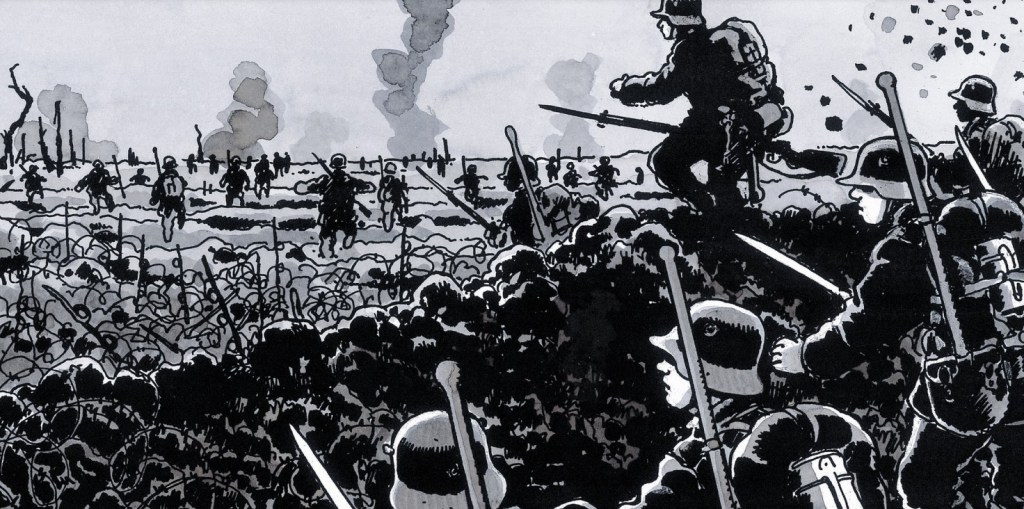
The art in this one is simply awe inspiring and extremely fitting for the grim, dreary and gruesome war that was The Great War. The artist’s name is Jacques Tardi and he is normally credited in his work as only Tardi. He is a very famous French artist who specializes in comic books. You wouldn’t think this style would be appropriate for a game on such a serious subject but his work is an absolute marvel as it creates a very thematic immersion point for players. We found ourselves pouring over the art on the cards and discovering little subtle elements that grounded the game in the trenches of WWI.
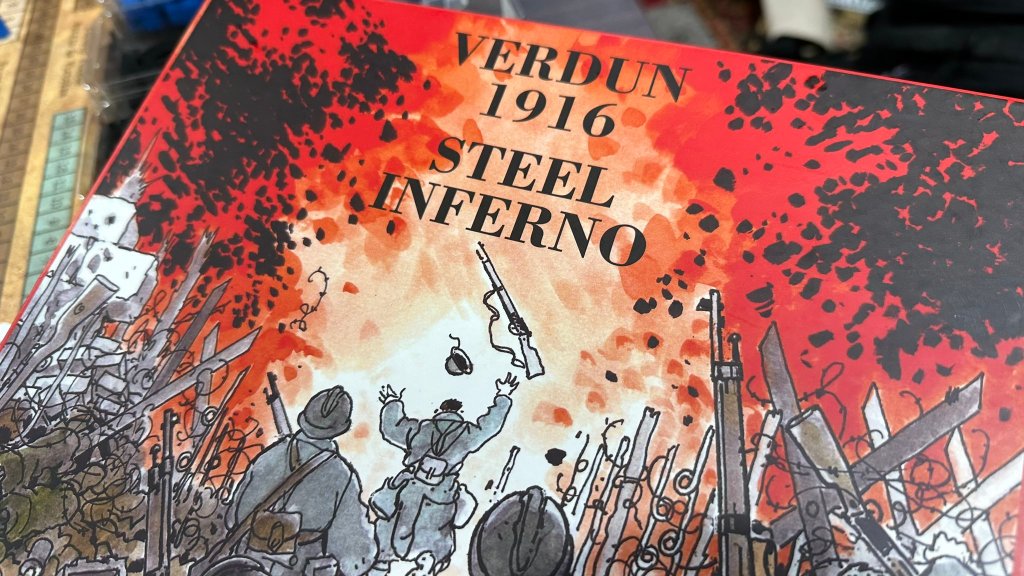
The cover itself is fantastic as it shows a French formation cutting their way through a vicious and deadly field of barbed wire only to be caught in a huge explosion from incoming artillery. The force of the explosion blows back the lead soldier whose helmet flies off and he throws his rifle from the force of the blast. The red, orange and black colors used in the explosion are really elemental and create a true sense of dread.
To Bring in Reinforcements or Not?…That is the Question
I really enjoyed the concept of having to sacrifice VP to bring on Reinforcements for both sides. These kind of choices really create a great deal of tension and internal debate as the players will be asking themselves how many Reinforcements are needed at this time?, When those Reinforcements should be brought in?, How to minimize or replace the lost VP? and Where to place the Reinforcements? I have never really seen this done so well as in this game. It just seemed to work perfectly and thematically made perfect sense as the more requests for men means that you are ultimately weakening your chances on the other battlefields and fronts across Europe and the east and the VP penalty is a way to enforce that weakening.
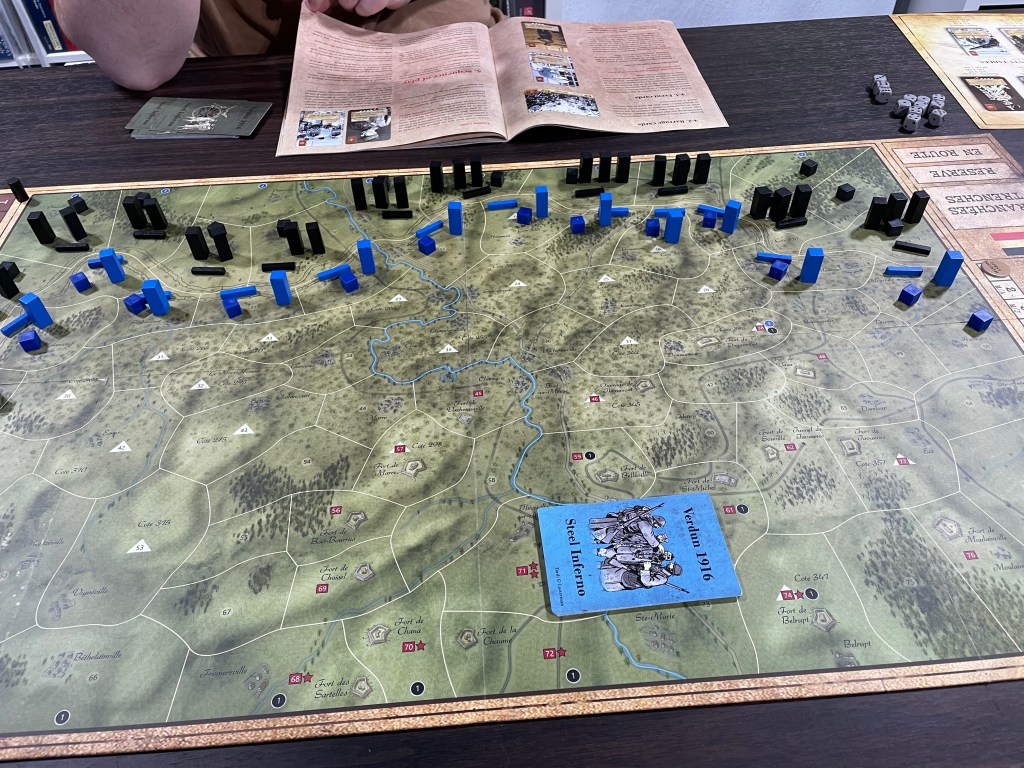
In my opinion, the French are the ones who really need the Reinforcements as they start completely outnumbered at the start of the game. The Germans have at least a 2-1 advantage in units but more often than not in most of the areas a 3-1 advantage. This is very scary for the French player and will make them want to play the Castelnau/Voie Sacrée Combo as quickly as possible but during the interim they will have to choose to bring up at least some reinforcements to bolster their lines.
Bucket(s) of Exploding Dice
One of the things that I really love about the game was that it uses a bunch of dice to resolve Barrages and Bombardments but no dice in combat. This game is all about softening up your opponent for the charge across No Man’s Land by constantly shelling them. And when a Barrage or Bombardment are used, you will be rolling lots of 6-sided dice which are determined by the number of dice listed on the card. Most of the time, the German player (Alexander) was rolling 8-12 dice while the French player, at least early in the game, is only rolling 4-8. When rolled, each result of a 4,
5 or 6 is considered a hit if the target zone where the Barrage or Bombardment is happening is adjacent to a zone controlled by the attacker. If this is not the case, hits are only scored on a roll of 5 or 6.
But the really grand thing about the dice rolling is that for each 6 rolled, 1 extra d6 can optionally be rolled by the attacking player to obtain additional hits. And guess what? If you roll a 6 on that exploding die, you get another die and so on and so forth. And in our play, this happened to both of us from time to time, more so for the Germans. But this simple rule, which seems gamey and really doesn’t’ deserve to be included in a serious wargame, creates some really exciting dice rolls let me tell you! And frankly, thematically it made sense as the artillery used at Verdun were massive and numerous. In fact, French artillery reinforcements had brought the total of 388 field guns and 244 heavy guns to Verdun, against 1,201 German guns, two thirds of which were heavy and super heavy, including 14 in (360 mm) and 202 mortars, some being 16 in (410 mm). when you have big guns firing constantly, and lots of unexploded shells lying around the battlefield, this can make for some really big fireworks!
Problems with the Rulebook
Well, this game is awesome and we really loved it and cannot wait to play again! But, the game is not perfect as we found several issues with the rulebook that caused us to be unable to grasp certain aspects properly until playing for while. The biggest issue we had was the organization and layout of the rules. We just had trouble finding certain fine points and found ourselves spending 10 minutes trying to remember where we had seen a rule that we remembered reading during setup but had forgotten. I am wondering if most of our concerns with the rules were due to translation errors as the game is made by a French publisher. At this point though, we feel pretty comfortable with most of the rules and learned from our mistakes. A minor quibble with an otherwise excellent game!
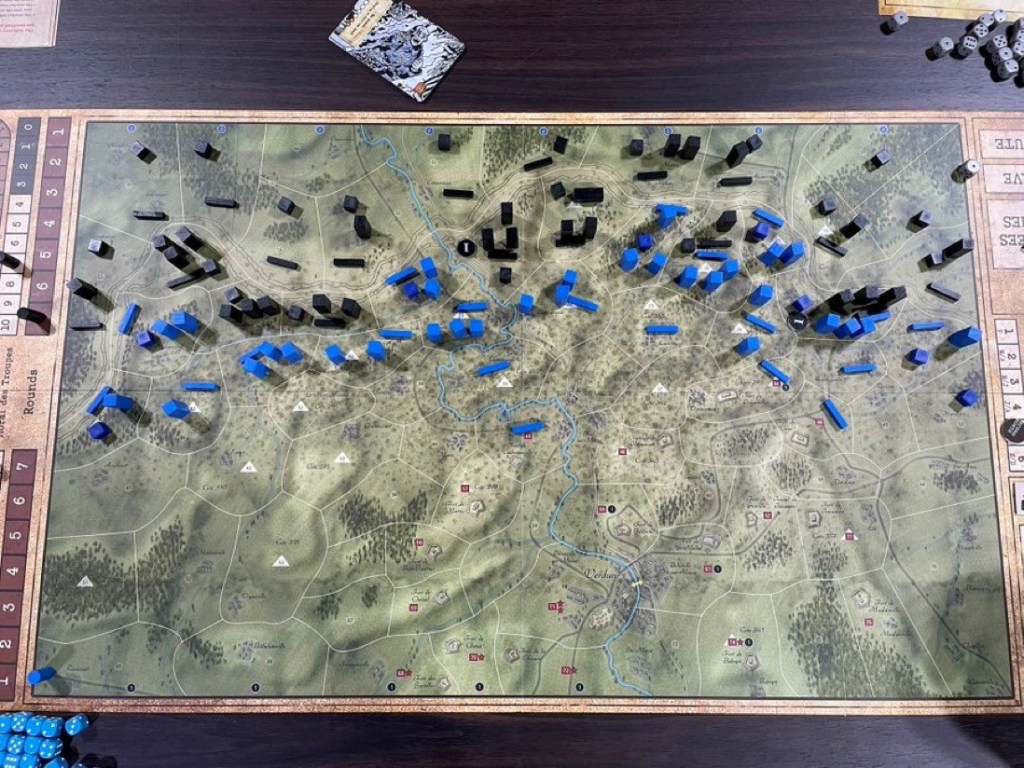
After our 4 1/2 hour play, where the Germans surrendered in October 1916, we had a great discussion and really found several things with the game absolutely fantastic. The cards were really good and we loved the mechanic of being able to “go fishing” in your deck for the card you needed at the start of a month. We also loved the VP surrender for Reinforcements and the tough choices that brought, as well as the various offensives cards that had the player roll 2d6 to try and achieve VP. It just occurred to both of use that this game is supremely interesting and unique. I might even say that this is a GREAT game with some real forward thinking mechanics that put together worked well to create a thematic and interesting game to play. I know that we are a bit late to this party as many have espoused the virtues of this game but I am truly glad we can now say better late than never with Verdun 1916: Steel Inferno.
-Grant
 The Players' Aid
One of my favorite games. Rally the troops would be the perfect place for this gem!!!
LikeLiked by 1 person
Oh you really did it! Better late, then…
Great review-impression of a great game. Glad you liked it. It really has its own place in the war/strategy realm of boardgames. I played some really tense games and have memories of those sessions. I was personally impressed by how good the game simulates trench warfare and tells the story of Verdun. Especially in the beginning as the German have al lot of breakthroughs in the French lines. The French need to decide where to put the reserves and build a new line using the Forts on the map as way to form a robust defence.
The drawing of Tardi are from graphic novels of WWI inspired by the stories of his grandfather and famous books like La Feu (under Fire) by Barbusse. The Graphic Novels contains small stories of the brutal life in the trenches. The drawings capture the mood and devastation on the front. It’s a work of art and well worth buying if they are available outside Europe. Thanks for mentioning it in the article!
LikeLiked by 1 person
Thanks for reading Sam. We loved this one and cannot wait for the next opportunity to play. We made mistakes, mostly in strategy, and learned a lot so the next time will be significantly different.
LikeLike