
We all love Twilight Struggle….and if you say you don’t, you really do but just want to be different or are a contrarian! The game is phenomenal and has done very well for GMT Games with 8 Printings as well as the Turn Zero Expansion and now a series of smaller geographically focused spin off games starting with Twilight Struggle: Red Sea – Conflict in the Horn of Africa. Twilight Struggle: Red Sea deals with just two regions located in the Horn of Africa including Africa and the Middle East. The game uses the familiar Twilight Struggle formula of Cards with both Events and Operations Points that can be used by players to perform Coups, do Realignment Rolls or place Influence in an effort to gain control of the most Countries in the Regions to score Victory Points and win the game. The game is fast, furious and only lasts 2 hands of cards (unless you choose to play the special 3 Turn variant) so there isn’t a lot of time to mess around and players must be focused on what they are trying to accomplish. The best thing about the game is that it plays in 45 minutes as compared to 3-4 hours for Twilight Struggle.
In Action Point 1, we took a look at the board and discussed the two Regions depicted, examined the various Tracks, including the Action Round Track, DEFCON Status Track, Turn Record Track, Victory Point Track, Required Military Operations Track and Space Race Track and also briefly discussed the new Strategic Sea Lanes Box and the addition of some handy reminders for how various Operations work on the board. In this Action Point, we will examine what is new in this smaller focused addition to the series including the Strategic Sea Lanes Box, Flashpoint Countries and the updated Space Race Track along with a few other new tricks.
What is New?
One of the things that I was immediately impressed by when we first played Twilight Struggle: Red Sea – Conflict in the Horn of Africa, was the fact that it was not just a reskin of Twilight Struggle. This game was a smaller, faster playing, more tightly focused regional look at the Cold War and the struggle for control of Africa and the Middle East. But it was more than that as it really had integrated some new mechanics and tricks into the design that have created a new focus and new tension for the players. In this post, we will take a look at these new elements and discuss how they change the game, without taking away the essence and feel of the original classic Twilight Struggle.
Strategic Sea Lanes
Strategic Sea Lanes are a very interesting new addition to the game that changes how scoring is completed. The Strategic Sea Lanes Box is a space found on the board but it does not represent a specific physical location. It is not a Country and is not connected to any other Countries. It has special rules for Influence Placement and Scoring. Players may also never conduct Coup attempts or Realignments in this space.
So how does it work? Strategic Sea Lanes are scored when a Scoring Card is played and will have a major impact on the resolution. In order for the Strategic Sea Lanes to be scored, one of the players must Control the space. In order to Control the space, the player must simply have Influence equal to the Strategic Sea Lanes Stability Number, which is 4, while also having at least 4 more Influence in the space than their opponent. Basically, the Strategic Sea Lanes space works the same as every other Country on the board. In the picture below, the Soviets have a total of 2 Influence in the Strategic Sea Lanes space as compared to the United States’ 2 Influence. The Soviets DO NOT Control the space as they don’t have at least 4 Influence to equal the space’s Stability Number nor do they have at least 4 more Influence than the United States. In this example, in order to Control the space, the Soviets would need a total of at least 5 Influence there.
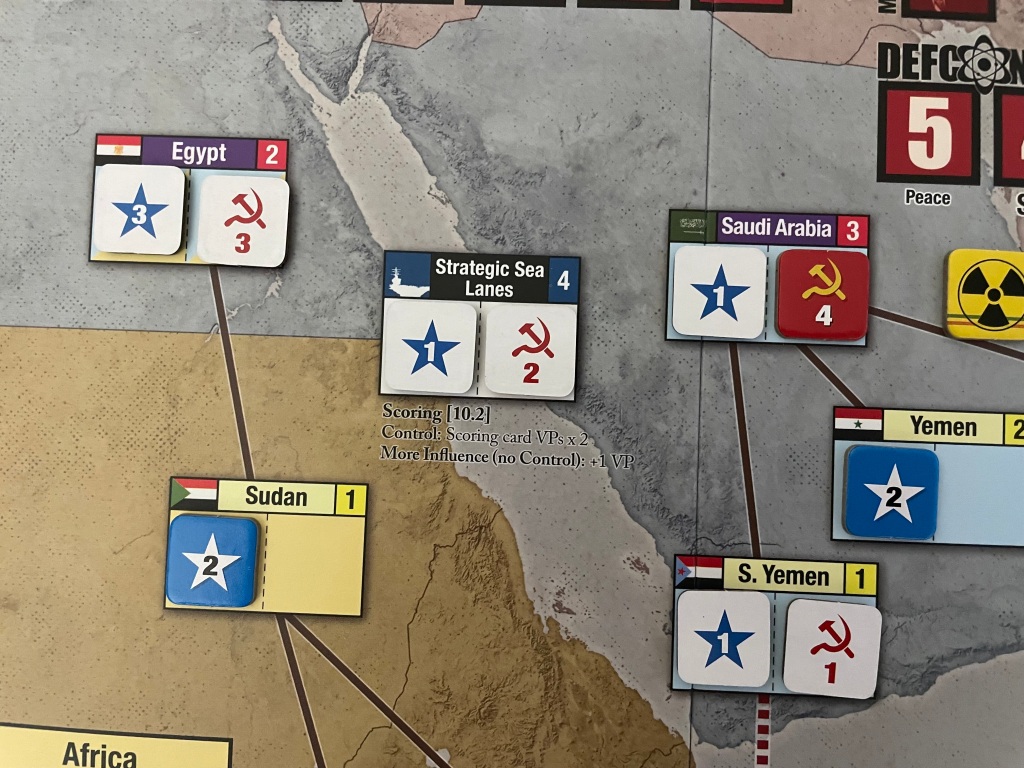
When a player Controls the Strategic Sea Lanes space, the effect is that this will double the Victory Points they will receive when resolving a Scoring Card. Also, the player who has more Influence than their opponent in the Strategic Sea Lanes space when a Scoring Card is played, but does not have sufficient Influence to Control the space, will receive 1 VP. And that is it…a pretty significant benefit that will lead both players to fight fiercely over Control of this space! I really like this inclusion as it simply adds something else that players have to think about and monitor as you cannot allow your opponent to get ahead in this space.
Flashpoint Countries
2 of the Countries in Africa are classified as Flashpoint Countries and you will notice a new symbol appears in both of their boxes. This red lightning bolt icon indicates that these 2 Countries are Flashpoints, and are distinct from Battlegrounds. The Ogaden War is a central focus of Twilight Struggle: Red Sea and both Ethiopia and Somalia work differently than in Twilight Struggle.
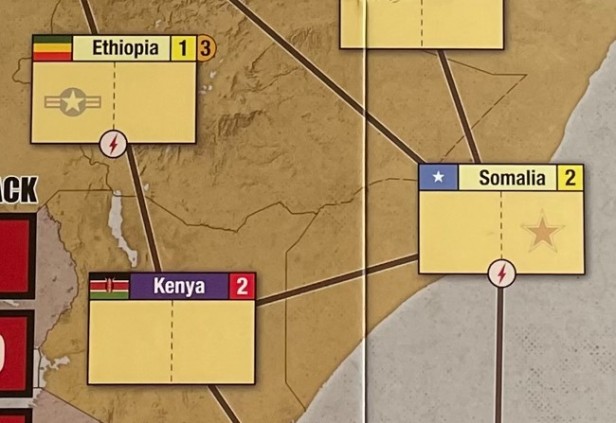
The real distinction here for Flashpoint Countries is that Coup Attempts against either Ethiopia or Somalia are conducted slightly differently. When a Coup Attempt is made against a Flashpoint Country, a card is turned over from the top of the draw deck. If it is a Scoring Card, a 1 Op Value or a 2 Op Value Card, the players will then decrease the DEFCON Status by 1 level and then this drawn card is discarded. This action could potentially trigger game-ending global thermonuclear war. Additionally, if the drawn card happens to be a Scoring Card, it will be resolved immediately before the Coup is resolved. If the drawn card is a 3 Op Value or 4 Op Value Card, it will not be discarded but will be placed on the bottom of the draw deck but otherwise will have no effect. In the picture below, the United States player initiates a Coup Attempt against Ethiopia and draws a 1 Op Value Card, which will be discarded but will lower the DEFCON Status Track by 1.

DEFCON Status Track
One of the most iconic things about the Cold War is the DEFCON Status and in Twilight Struggle: Red Sea, the same as in Twilight Struggle, players can lose the game if they cause global thermonuclear war with the play of a card that forces a degrading of the DEFCON Status to 1. The DEFCON Status Track goes from 5 to 1, with 5 being Peace and the 1 position, represented by a mushroom cloud, means you lose the game. The game starts in the 4 position, as opposed to the 5 position in Twilight Struggle, and goes from their. The DEFCON Status Track is affected by the play of certain Event Cards and by Coup Attempts in Battleground Countries. The cool thing about the DEFCON Status Track is that below each space is a reminder of the various prohibitions on actions that the players can take. Under both spaces 3 and 2, there can be no Coup/Realignment in the Middle East. This is not necessarily a major change to the game, as this also occurred in Twilight Struggle, but is a difference for sure and in such a small geographic game really changes how players will need to think about the DEFCON Status and their efforts to gain Influence and Control Countries. There is a special radiation symbol marker that can be placed in the Middle East Region to remind the players that no Coup/Realignment attempts can be made. This marker was a welcome mnemonic device and helped me in keeping this rule straight.

Space Race Track
In most Card Driven Games, particularly where your opponent’s events on cards go off when you play them for the Operations Points, there is a means to get rid of at least 1 of these cards from your hand per turn without the event going off by throwing them away via some mechanism. In Twilight Struggle, that vehicle was the Space Race Track. And in Twilight Struggle: Red Sea the Space Race Track is there but has a slightly different result. The Space Race Track doesn’t change significantly but there were a few differences that made it feel fresh and new. Players have to be aware of this important track as it is a means of avoiding pain from powerful opponent Event Cards and can also be the source of Victory Points in addition to unique abilities.
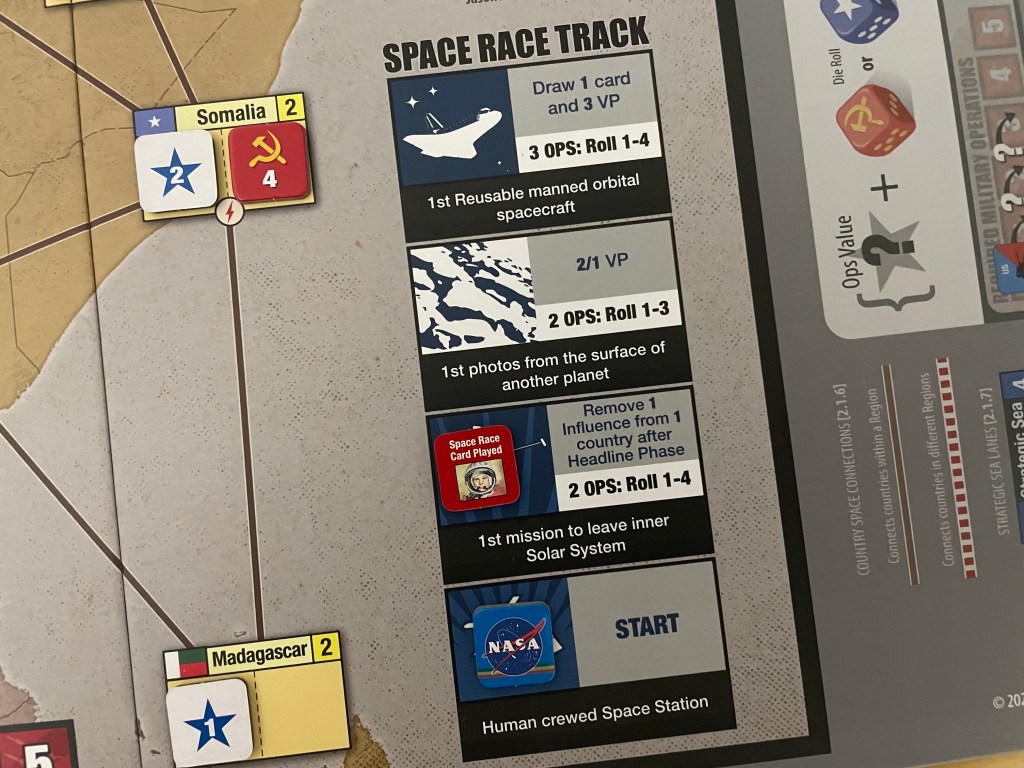
The Space Race Track has a marker for each superpower and a card can discarded with a minimum amount of Operations Points to attempt to move to the next Box on the track. To do so, the player will discard a card with an Operations Value equal to or greater than the number shown on the Box (Box 1 is a 2 Ops Card, Box 2 is a 2 Ops Card and Box 3 is a 3 Ops Card) into which they want to advance. The player then rolls one of the custom 6-sided die and compares their result to the target number. If the number falls within the range listed below the target Box, the player can move their marker to the new Box. This action can only be taken once per Turn.
Here is where the Space Race Track for Twilight Struggle: Red Sea has some difference. There are only 3 spaces, and players will only use the first 2 Boxes on the track (Box 1 and Box 2) when playing the basic 2-turn game. Box 3 can be reached when playing the 3-turn game or with use of a specific card the Apollo-Soyuz Card.
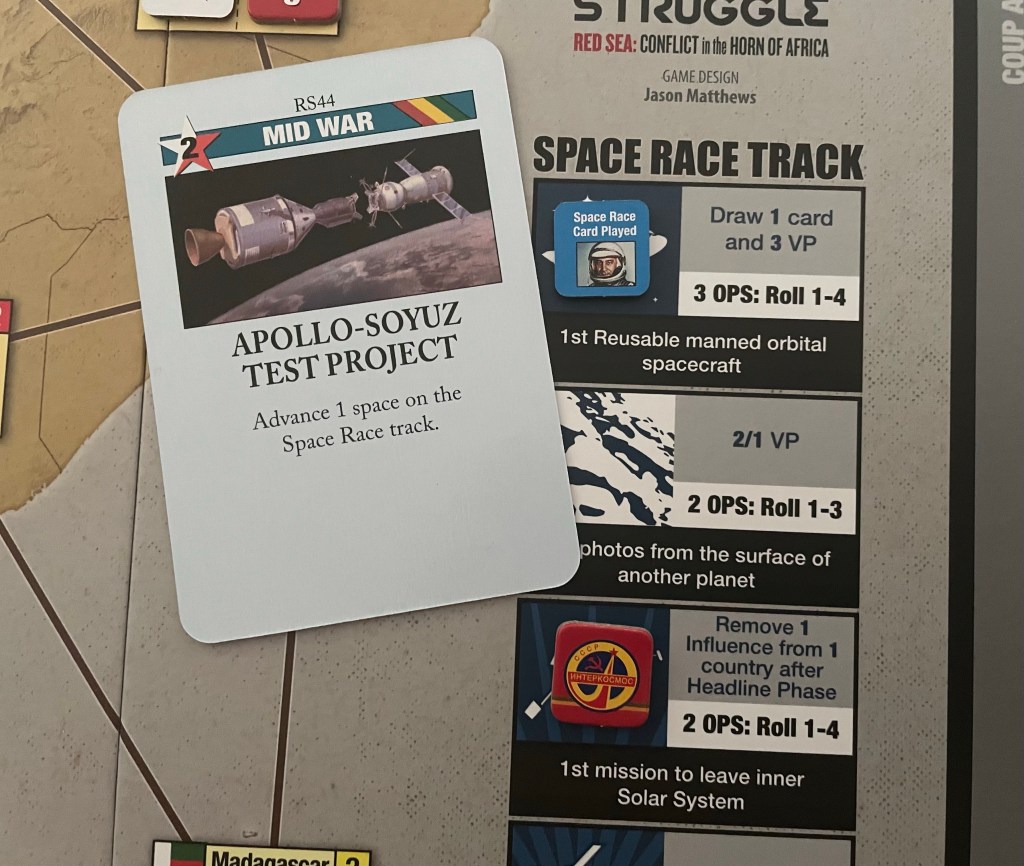
Advancing on the Space Race Track can result in the player scoring Victory Points, gaining a temporary Special Ability, or even both. Box 2 on the Space Race Track is marked with two numbers separated by a slash (2/1). This should be familiar to players of Twilight Struggle as it means that the first player to reach Box 2 gains the left VP value with the 2nd player achieving that Box receives the lesser right hand VP value. It is important to remember that granted Special Abilities will only function until the other player reaches the Box that granted the Special Ability.
Box 1 on the Space Race Track (1st mission to leave inner Solar System) will grant the player that reaches it first the Special Ability that allows them to “Remove 1 Influence from 1 Country after the Headline Phase”. This can be really powerful but remember that this will only be useable in the next turn during the Headline Phase when this ability is achieved in a 2-turn game and possibly again in Turn 3 in a 3-player game. This ability, while nice, will not make a huge impact on the game.
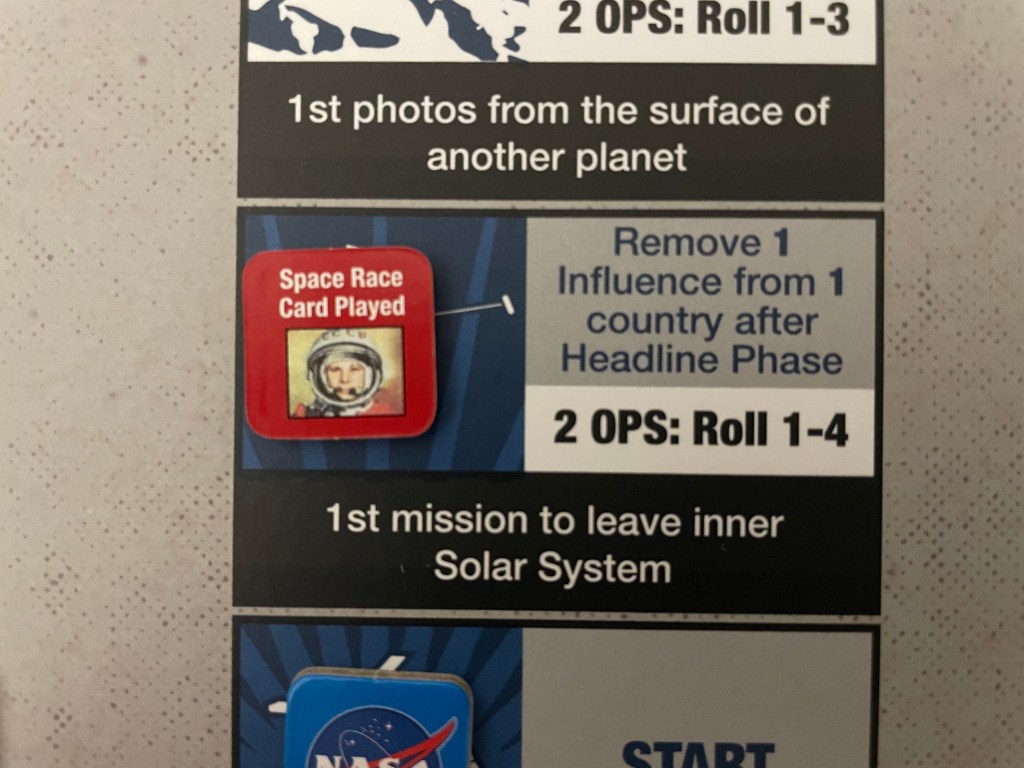
When reaching Box 2 (1st photos from the surface of another planet), the players will gain Victory Points. As stated earlier, the first player reaching the Box will achieve 2 VP and the second player will receive 1 VP. This Box 2 doesn’t grant any Special Ability but the VP is really nice, and if your opponent doesn’t try to keep up, will be a huge 2 VP swing. This is one small area of concern that I have with the game is that 5 VP from the 3 Boxes can make a huge difference and probably end in a victory for the player that achieves them. More plays will reveal whether that is the case.
Upon reaching Box 3 (1st Reusable manned orbital spacecraft) the player will draw an additional card and also score 3 VPs.
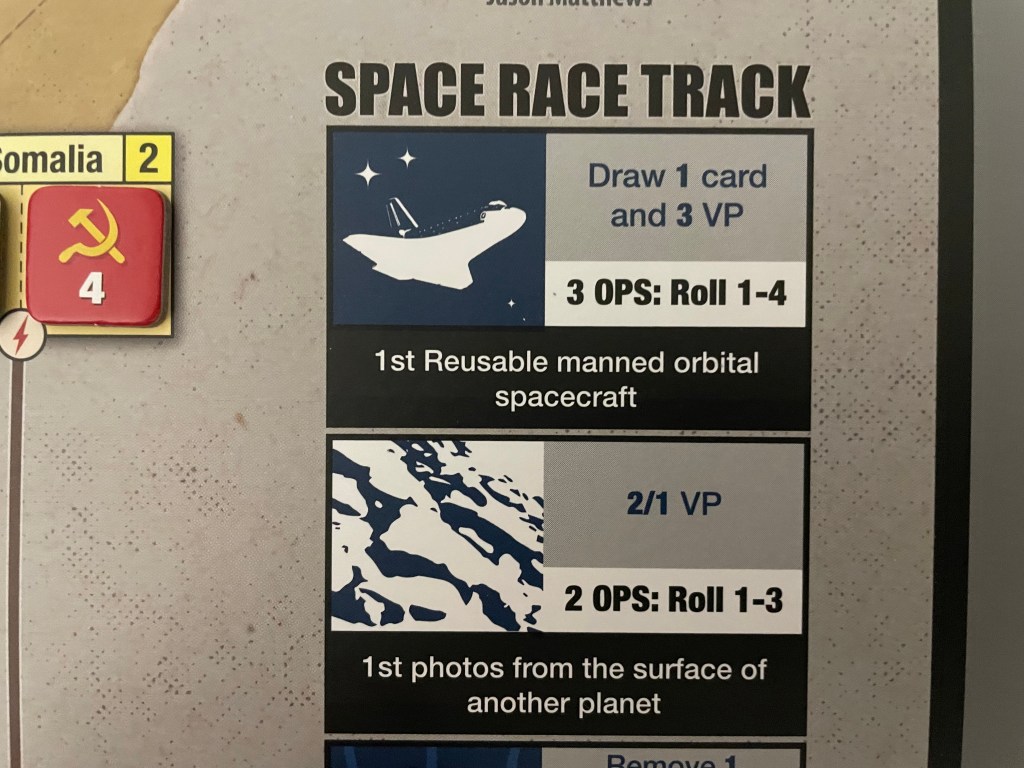
I really liked the changes here to the Space Race Track, which were implemented due to the shortness of the game having just 3 possible Turns as compared to 10 Turns in Twilight Struggle. I am reserving my judgment here on whether the VP are too powerful until further plays but my sneaking suspicion is that it is overpowered and can potentially seal up a victory for the player gaining the 5 VP’s. But, I need to remember that focusing on the Space Race Track will take attention and Ops Points away from placing Influence gaining Control of Countries, which can also garner lots of VP for the player who isn’t focused on the Space Race Track.
Ethiopia Changing Stability Number
Ethiopia is one of the new Flashpoint Countries but it also has one other very unique feature about it. As you will notice, its Stability Number is a 1 shown by the number in the yellow box in the upper right hand corner of the Country Box. You will also notice attached to that Stability Number is a number 3 contained in a gold colored bubble to the right. This is a modified Stability Number for Ethiopia that can change with the play of The Derg Card. This card is a Soviet aligned card that when played for the Event will add 2 USSR Influence in the Ethiopia Country Box. If Ethiopia is USSR controlled after the play of this Event, its Stability Number becomes a 3 permanently. So why is this important? This change in the Stability Number will make Ethiopia more difficult to be effected by a Coup Attempt. Remember, a Coup Attempt sees the player taking the Attempt roll a d6 and modify that roll by the Ops Value of the card used to make the Coup Attempt. If this modified die roll is greater than the Stability Number of the target Country ×2, the Coup is successful; otherwise it fails. So with a new Stability Number of 3, this die roll has to be a 5+ if using a 1 Ops Value Card, a 4+ if using a 2 Ops Value Card and a 3+ if using a 3 Ops Value Card. Making Ethiopia more difficult to change means that a player can control this Country more easily making their chore of controlling Africa a bit easier. Not a huge deal here but it is a good example of some of the changes to the game that make it a bit different and unique as compared to Twilight Struggle.

Automatic Victory – Africa Scoring and 10 VP Threshold
One of the largest changes with Twilight Struggle: Red Sea is the Automatic Victory Condition with the scoring of Africa. Scoring is generally the same as in Twilight Struggle, but when the Africa Scoring Card is played, if one player Controls Ethiopia and Somalia, both which are considered Flashpoint Countries, and also Controls more African Countries than their opponent, that player earns an Automatic Victory. Automatic Victory also can occur when one of the players reaches the 10 VP threshold, which is different from Twilight Struggle that required a 20 VP lead. Both of these changes really ratchet up the tension in this game and when coupled with the short 2-turn game, really makes players focus on these issues and either work toward them or play defensively to hamper their opponent from reaching them. Very good change here that makes the game very different with only a few very minor changes.

Romanian Autonomy Card in Place of the China Card
If you have played Twilight Struggle, you know about the China Card. The China Card is a unique 4 Ops Value Card that can be held by the player in addition to their hand limit thereby giving them an extra card to use. But the card also has a special ability where if they player uses the card for 4 Ops to place Influence only in Asia, it will grant the player +1 Ops Value to use in placing one additional Influence. The China Card also grant’s the player who holds the card at the end of Turn 10 a +1 VP bonus.
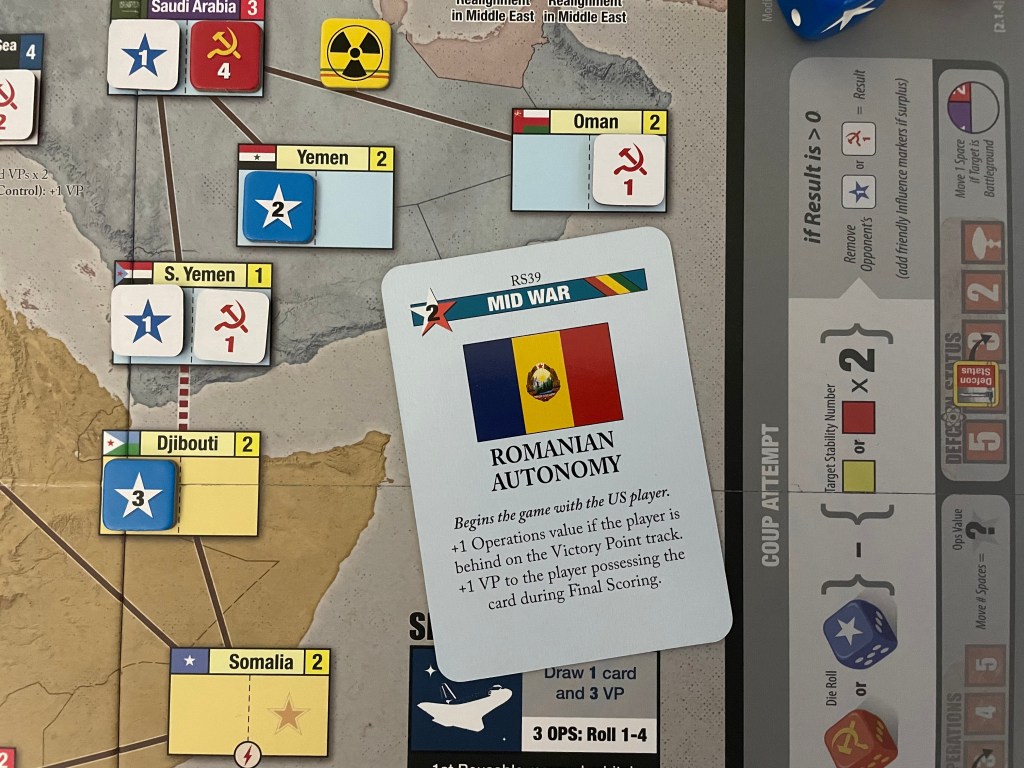
In Twilight Struggle: Red Sea, the China Card has been replaced by the Romanian Autonomy Card. This card is not as powerful as the China Card but definitely creates some new opportunities and challenges for the player playing the card. The Romanian Autonomy Card can effect their Ops Value from cards by +1 during the Turn that they play it if they are behind on the Victory Point Track and also grants +1 VP to the player holding the card during Final Scoring. I think this is really interesting concept and I think was included as a sort of catchup mechanic due to the short nature of the game. I look forward to seeing how its addition changes things and whether it is overpowered or just right. Once again, a small and subtle change to the game to create a new and interesting experience for the avid fan of Twilight Struggle or players who are new to the system.
I hope this overview of the changes and new additions to the game have given you a good understanding about the direction of this new regionally focused game in the Twilight Struggle family and eases your mind about whether this is just more of the same, with a new name and package, or a game that can stand on its own merit and provide an equally interesting and challenging experience in 45 minutes.
In Action Point 3, we will take a look at examples of new cards for both the Soviets and the Americans.
-Grant
 The Players' Aid