Both of us really enjoy narrative driven solitaire games. These type of games boil down to an exercise in chart flipping and dice rolling but it always amazes me that all of that mundane activity can generate a nail biting, heart pounding, tension filled experience all using nothing more than a few pieces of paper, some counters and dice. Along the same lines of thought though this chart flipping and dice rolling can get to some people after a while and games that feature that element just might not be for everyone. The real strength of these type of solitaire games is the narrative that is generated from the actions the player takes, their results and the outcome of the game. I like to think of these kind of games as mini episodic treatments of different aspects of war or politics where the player gets to create the story and make of that story what they will. I have said it before but you will get out of these type of games what you put into them in your effort, thoughtful consideration of the process and a focus on the participants in the historical event.
Mr. President: The American Presidency, 2001-2020 from GMT Games is a new solitaire game that fits nicely within the narrative driven solitaire game family. The game is big, has lots of content and boards and rulebooks but gives the player a simple taste at what taking on the role of the President of the United States is like. The heart of the game is the player’s goal of trying to push their chosen domestic political and social agenda while also having to react to various crises across the globe, dealing with various internal political enemies, having to monitor the ever-present public opinion, while also establishing good rapport with Congress and the press. As the job is a big thing the game reflects that with a scope that attempts to tackle and simulate all of the roles of a President, from pushing legislation, to building up your Cabinet to tackle and deal with major challenges, directing overseas surveillance and counter insurgency as you monitor and deal with terrorist cells, unruly governments, local Civil Wars and establishing trade partnerships and agreements.
This game really attempts to do it all and it works pretty well for a solitaire game. The 10+ years of design and development have paid off and we are presented with a game that means and says something and that is a good thing! Let me share my first impression thoughts with you after Alexander and I played cooperatively to get our feet wet, understand the systems and maneuver all of the many rule books and charts.

Very Involved Game
This is a BIG game with lots of lots of moving parts, rulebooks, boards and counters involved. First off the game comes in a 5″ box! I can’t even describe to you how big this monster is. This is the size box that is required but also that fits the scope and gravity of this one. I only wish that GMT would make 5″ boxes for lots of their other bigger wargames, such as Empire of the Sun, A Time for Trumpets, etc. as that way you could actually fit all of the contents back in the box.
And then there are the contents of the game including 2 game boards; a 22″ x 34″ mounted game board and an additional slightly smaller 22″ x 17″ mounted game board. These boards laid out together filled our gaming table and there was very little room left for anything on the tabletop. There are also a lot of cards, 180 of them, which are called Cascading Event Cards and are really the genesis for trouble for your presidency. 500+ counters and markers spread across 5 total counter sheets that you have to keep straight and have within ready reach as things change rapidly. Then, there are multiple rulebooks, source books, chart books, etc. including a “How to Play” rulebook, “How to Play a Turn” FlipBook, a Scenario Book, World Chart Book, Domestic Chart Book, 2 Peer Competitor Action Books for Russia and China and 6 total player aid cards.

You definitely get your money’s worth out of this one and also killed several trees! Getting your hands around this one and getting it organized to aid play might take you a while but I promise that the effort will be worth it.
Setup Took 60 Minutes….
As I mentioned earlier, we played this cooperatively and basically set the game up after Alexander hurriedly shot an unboxing video. We setup the counters directly from the counter sheets and it took us nearly 60 minutes. I would say that once you get it organized though, becoming familiar with the components and counters and also understand better the layout and structure of the game, the setup can be done in 30-40 minutes, which isn’t too bad for a big multi-year game like this. You will be playing this over several days or a weekend as play time is advertised as 8-12 hours (more on this later as it took us a bit longer) so you will set it up and then play for a long while and probably leave it setup to come back over a period of days or maybe even a week.
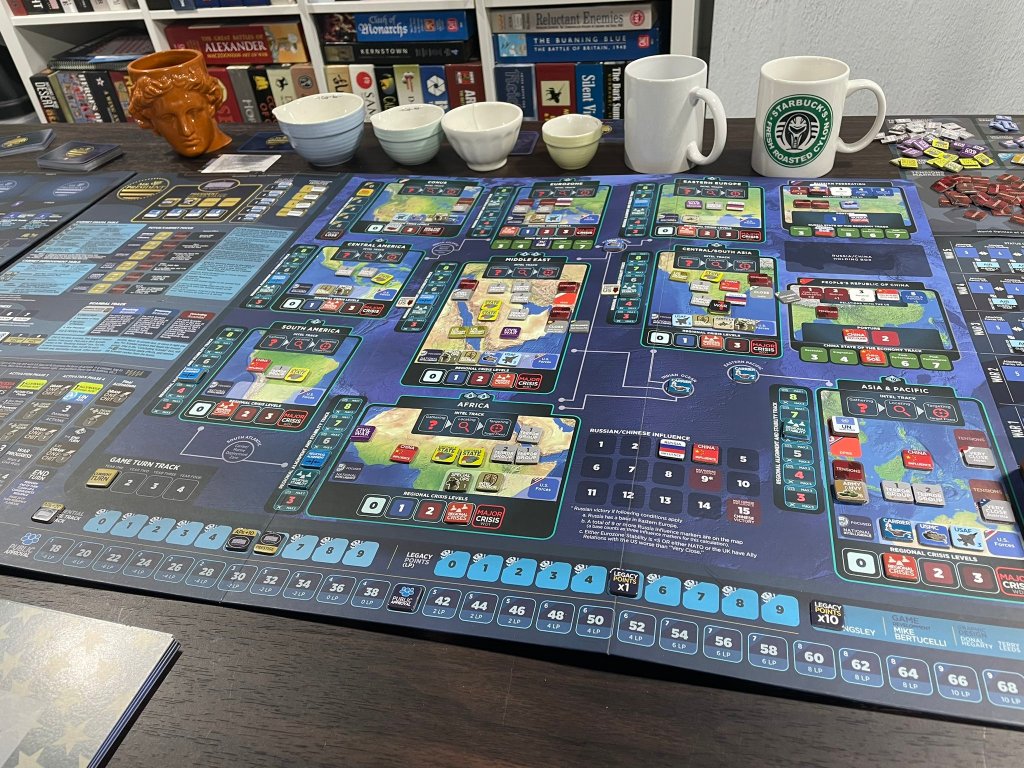
I want to put out there though that the setup is not overly burdensome nor even uninteresting because there is some element of role play with the construction of your cabinet members and their attributes. Don’t get me wrong, most of the setup is literally reaching into one of those 7 opaque containers shown in the picture above and pulling out chits randomly and then assigning them to their area on the boards. But we found the process of drawing the chits out a bit of a roleplaying exercise. What I mean by this is that when we drew out the Secretary of State Andy Lewis (they are each named individuals) for example, and his attributes were all 1, we knew that we were going to be able to be a bit more successful when dealing with foreign relations and negotiations because we would have the benefit of positive modifiers from his great attributes. Equally when we drew our Press Secretary, she had great attributes and would give us bonuses as well relating to issues with the press. But, several of our other choices were not as good and we knew that we would have to be luckier and work a bit harder in those areas of focus. This was a very interesting aspect of the setup and I don’t know that I expected that.
3 Different Focuses
Now aside from the number, size and scope of the contents found in the box, the game is made up of basically 3 areas of focus. These include the home front and domestic issues and crises, the world stage and the management of Congress. Each of these issues are equally important and can lead to your Presidency failing miserably or doing well. What I would warn the player about is that you cannot lose your focus on what really matters the most and that is the social and domestic issues and your agenda. If you are not making progress on these matters, you will find the crises at home will erode the public confidence in your abilities and decrease public opinion to the point that you will lose the game.
I think that as a wargamer, and as someone who has played dozens of games focused on the stamping out of terror groups and conflicts overseas with games such as the COIN Series, Labyrinth, Twilight Struggle and a host of other political intrigue wargames, it is very easy to lose sight of what really is important in the game. I have always subscribed to the philosophy of “carry a big stick and beat your opponents about the head and neck with it” and that approach will not necessarily work here. Yes you have to worry about Civil Wars, the propagation of Chinese and Russian influence into the sphere of Asian and European allies, and the rise of terror groups, and then send troops and support in the form of advisors and clandestine forces to these areas, but your real battles are going to be fought at home.
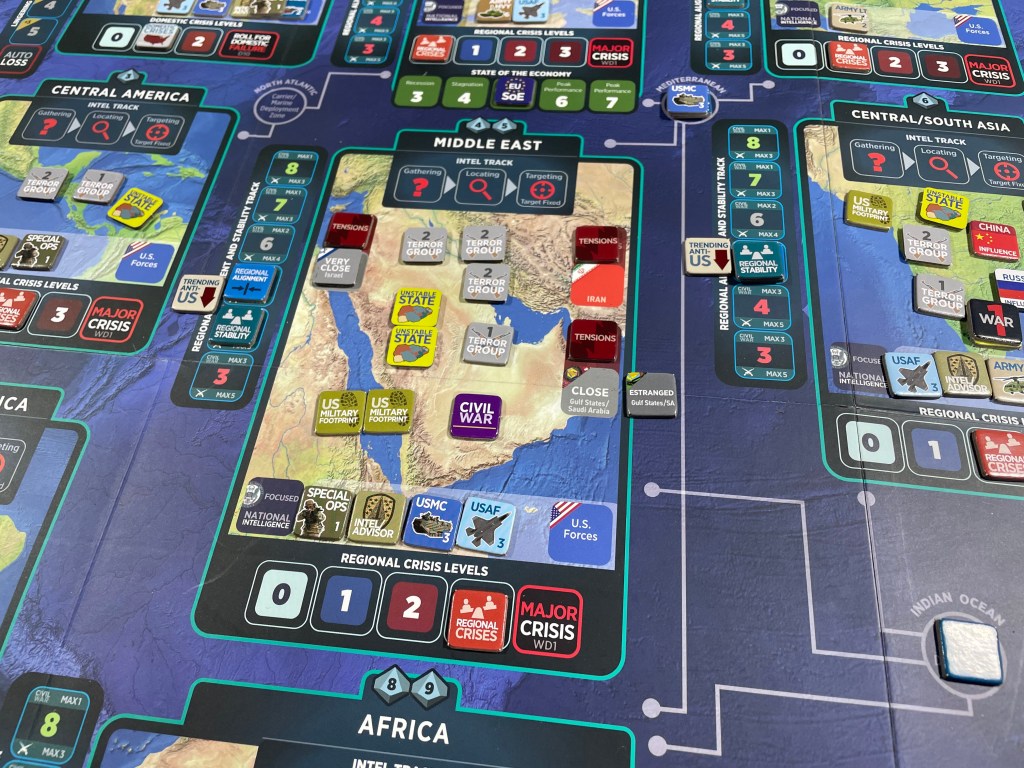
This means building your Cabinet and improving their effectiveness while also trying to avoid the negative effects of scandals, which are randomly drawn from the cards, developing various Strategic Capabilities and staying ahead of the international competition (I am looking at Russia here with cyber warfare), and establishing a good relationship with both members of Congress, who will support your legislative priorities, and also keeping the press on your side. These elements are dealt with very well by the game and become a ballet of subtle and minor victories here and there as you consistently make incremental progress. You will have setbacks and failures though as everything in the game boils down to die rolls on a 10-sided die and the chances on these rolls are always very low as you are required typically to achieve a result of 1-4 most of the times with nearly no positive Dice Roll Modifiers or if you do get one from a Cabinet member it is usually only +1. I guess what I am trying to say here is you will fail a lot more than you succeed so keep this in mind. Don’t give up though, this is a long game and as you become more skilled and understand what you need to do along with your Cabinet improving, you will begin to succeed.

Things Go Bad Quickly
Also keep in mind that the game is designed to be challenging. No gamer wants to have a cake walk and succeed at everything that they try. Making games a challenge, particularly solitaire games, is a requirement in my mind. Things will go bad and they will go bad quickly! The design includes the concept of Crisis Chits leading to Crisis Cards. These Crisis Chits and Crisis Cards lead to the various events, crises, challenges, and even some minor good news that will happen as you are doing the job of managing your Presidency. When the US Action counter is to be moved onto a Draw One Chit Segment of the Turn Sequence, the player will be instructed to randomly draw one Crisis Chit from the Crisis Chits Cup and then place it on the Draw One Chit segment and perform whatever actions that Crisis Chit mandates. This part of the game is very stressful and I found the tension to be real as we would pull the chits and turn them over to read very gingerly almost as if we were reflexively awaiting a gut punch! And more often than not, the Crisis Chits are bad news! That is why they are named Crisis Chits….it is to be expected.
If the Crisis Chit you draw has a + notation, when you finish resolving what the chit asks you to do, you then have to soak up more pain and draw another Crisis Chit (Thank you sir. May I have another?!?), if demanded by the Activation Segment. Keep in mind that Gene is a softy here and some of the Segments as noted on the Turn Sequence require you to only have to draw one Crisis Chit, whether the drawn chit has a + notation or not (Thank you oh magnanimous designer for your generosity!). You could end up drawing as many as three Crisis Chits if the first two Crisis Chits contain the + notation.
Then it gets even worse! Some of the Crisis Chits will require the player to draw Crisis Cards. According to the rule book, the “Crisis Cards are the raw material for Mr. President. They
present a particular world or domestic event that will either challenge you (usually) or help you (not that often!).” These Crisis Cards, while they suck, are what really give the game its spice and make each successive play its own unique and heart wrenching experience.
It’s a Chart Flipper so You’ll be Going from Chart to Chart
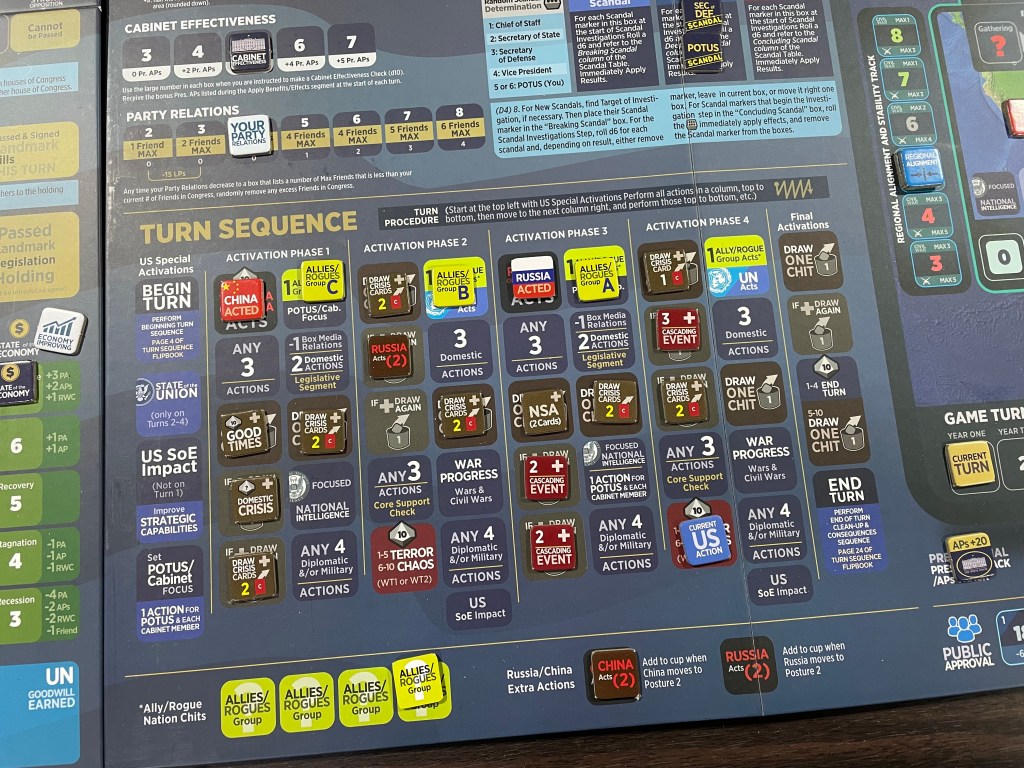
As I mentioned in the introduction to this piece, the game is a chart flipper and you will be required to go from booklet to booklet to find the appropriate chart to roll on depending on what is happening. While this can be burdensome for some players, you have to understand that it is what this game is built around. If you don’t like it, it is probably not a game for you and you need to move on to other solo games. I find the process to be interesting and don’t feel it to be burdensome. Yes it can be difficult to keep your booklets straight and make sure that you are doing it appropriately but this is the vehicle by which this narrative is woven and there really is nothing quite like the experience!

Because you will frequently be directed to make a roll or look up a result on a chart or table in one of the many booklets, the designer made this process a bit more manageable and I think this is a big help in playing the game. To make it easy for you to find the appropriate chart, each of the booklets has one or more prefixes shown on the front cover, and each of the charts found within that booklet is numbered. The most commonly used booklets are the Domestic Charts Booklet (D), the World Charts Booklet (WD, WM, WT, and WCT), the Ally and Rogue States Booklet (WA), the World Peer Russia Acts Booklet (WPR) and the World Peer China Acts Booklet (WPC). I know that seems like a lot and I also know that those abbreviations may not seem like they help but let me assure you that they do.
Have No Idea What I’m Doing
I am sometimes very bad at games. Normally I catch on pretty quickly, get an idea of what is important, formulate a strategy and then do fairly well in carrying it out. But, with Mr. President, I am not sure I really know what I am supposed to be doing. At least not well enough. Keep in mind though that we only played once, in a cooperative setting together (which was really quite good as we discussed lots of things and came to better decisions in the end because of it!), so we have to get it back to the table to give it another go. As the turns progress, things did become clearer and we began to see connections. I also appreciated that Gene threw in a few hints at what actions to take in the rules so new players can get eased into the game and understand some of their strategy. But, overall our experience with the game and its mechanics and systems was very positive and enjoyable.

Here is a link to our full unboxing showing off the beautiful components:
Here also is our initial impressions video:
I really enjoyed our play of Mr. President and as a solitaire game it ticks all the boxes for me. Meaningful decisions, chance to do whatever you like as a bit of a sandbox game, very challenging and a bit of structure that gives the player the chance to understand how to do the game. I feel that the game has been beautifully put together, with absolutely fantastic components and great player aids and charts, but also was really deep and supremely interesting. This one is a winner and will be a welcome addition to any serious solitaire gamer’s collection.
-Grant
 The Players' Aid
Great review! I tried this once and couldn’t even get throught setup. That’s ok. There was plenty of ice cream in the freezer.
LikeLiked by 1 person
While discussing the components, you note that “There are also a lot of cards, 180 of them, which are called Cascading Event Cards . . .” The Cascading Event cards, however, are only a small subset of the available cards, the vast majority of which are just styled “Event cards” (which are fully resolved and then either discarded or placed in the reshuffle pile). Cascading Event cards (of which there are about 20) are separated out of play and seeded into the Crisis deck along with the Event cards; they are distinguished primarily by the multi-stage nature of their resolution–one part upon first drawing them, at which point they’re placed in a “2 Deck” discard pile for later random draw with other “2 Deck” CE cards, and then into a “3 Deck” discard pile for another later random draw before final discard/reshuffle.
The game also separately tracks Terrorism and Natural Disaster cards for seeding into the Crisis deck, so you can probably make this simple by referring to all the foregoing as Crisis cards. Apart from this, there are a small number of cards that represent presidential assets (e.g., a popular First Lady or a crack NSC staff) that provide in-game benefits.
LikeLiked by 1 person
Thanks for the clarification. I was going from memory and was buried in cardboard. After a bit they all just should have been called cards.
LikeLiked by 1 person
It was a minor thing; I just tend to overexplain.
LikeLiked by 1 person
I always try to get mechanics and elements correct in these but after just a single play it sometimes becomes more difficult. Thanks for reading and commenting. Appreciate it!
LikeLike
Good article and you lay out the principles of enjoying these kinds of games very well. One of my favorites is “B-29” which bores some to tears. However I’m intimately aware of the history of the development of the B-29, the intricacies of a flight mission in the plane, and the campaign so it creates a great set of stories for me because of that.
I’d like to try Mr. President if I can ever get an opening on my play schedule.
Good job on the article.
LikeLiked by 1 person