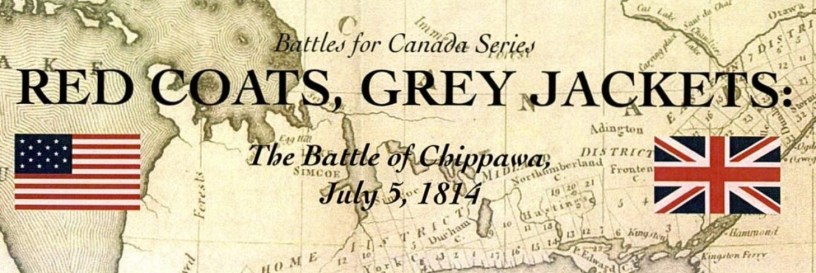
Paul Rohrbaugh is a designer I love to follow. He is always doing games on smaller or lesser known conflicts and I just find his work to be superb and really draws me into the conflict being covered. Recently, I became aware of a new series of games covering the War of 1812 with a focus on those battles fought in Canada aptly named the Battles for Canada Series. This series has 6 different games planned and the first entry in the series is called Red Coats, Grey Jackets: The Battle of Chippawa, July 5, 1814. We reached out to Paul and he was more than willing to share.
If you are interested in learning more about the game or ordering a copy you can visit the game page on the High Flying Dice Games website at the following link: http://www.hfdgames.com/chippewa.html
Grant: What historical event does Red Coats, Grey Jackets cover and what motivated you to design a game on this battle?
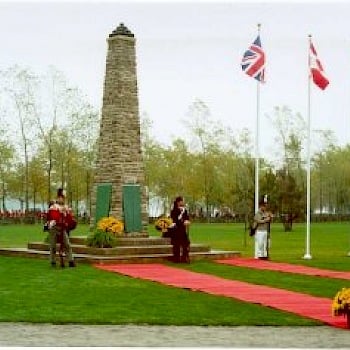
Paul: The game portrays the Battle of Chippawa that was fought on July 5, 1814. It is one of the pivotal battles fought in Canada during the War of 1812. My wife and I have visited Ontario nearly every year we’ve been married (1979), with only a few interruptions due to the Covid Pandemic. Over the years we’ve visited all of the battlefields that were fought in Ontario during that war. The Chippawa battlefield is very easy to visit, as it is only a “hop, skip and a jump” from the QEW Parkway after crossing over into Canada on the Peace Bridge that spans the Niagara River.
Grant: What is the focus of this new series called Battles for Canada Series?
Paul: The Battles for Canada Series portrays all of the major battles fought during the War of 1812 for control of Canada; Queenston Heights, Chrysler’s Farm, Chippawa, Lundy’s Lane, Fort Erie and Cook’s Mills. One other major battle, that of Chatham/Thames (where Tecumseh was killed), is part of the Battles for the Old Northwest Series of games. Between the two series, we have pretty much “covered most of the bases”.
Grant: What was your inspiration for the name of the series and this game?

Paul: I have always loved Canada, and we have made many friends and great memories over the years we’ve had the good fortune to be there. I have also studied Canada’s history a great deal over the years. As many already know, using games to learn and teach history is my forte, and sincerely hope these games help others to learn and appreciate more about the history portrayed in these games.
Grant: What was the historical result of the Battle of Chippawa?
Paul: The battle was a very violent and bloody affair. The Canadian Commander, General Riall, believed the US invaders were mostly ill-trained militia. However, he was very mistaken as much of the US force was made of well-disciplined regulars, and even the militia had been extensively trained. The US was NOT going to repeat the mistakes made the year earlier at Queenston Heights! Both sides fought hard, and the Americans were able to claim victory after Riall ordered a withdrawal when night fell. This victory would be short lived, however, as a much larger, and even more savage battle would be fought just a few miles away ten days later at Lundy’s Lane.
Grant: What elements from the battle did you feel were important to model? How did you do that in the design?
Paul: The game uses a very similar design to that used in the Battles of the Old Northwest Series. However, in the Battles for Canada Series of games, leaders and their formations, as well as artillery, play a much bigger role with new rules to portray the more “regular” type of warfare fought by these armies than those waged further west along the frontier, and where the Native/First Nation warriors and leaders played larger and more significant roles.
Grant: What is the scale of the game?
Paul: This varies slightly from game to game. In Red Coats, Grey Jackets each hex is approximately 50 yards across, a regular or militia infantry unit is 250-350 men, First Nation and Dragoon units are 80 to 100 men, and artillery units represent 2 or 3 guns. A turn represents one hour of time.
Grant: What units comprise each side?
Paul: The types of units in the game are Infantry (Regular, Militia, First Nation Warriors), Dragoons, Artillery and Leaders.
Grant: Where did you find the Order of Battle?
Paul: There are many, many sources available, both in print and online forms about all of these battles. The print sources are listed in each game’s bibliography. Folks will find no problems in finding many, many excellent online sources about these battles as well. From these sources, it was easy to glean the numbers and disposition of each of the battles units and their commanders. Assigning combat values is always a bit more tricky but involves some trial and error as well as drawing on experience with other similar games on the subject.

Grant: What were a few resources you consulted on the design? Which one would you recommend to anyone interested?
Paul: I highly encourage anyone who can to visit the battlefield sites, as the Canadian Government has done a great job in preserving all of them. Donald Graves’ Red Coats and Grey Jackets: The Battle of Chippawa, 5 July 1814. Toronto: Dundurn Press, 1994 is very good. Richard Barbuto’s Niagara 1814: America Invades Canada. Lawrence, Kansas: University Press of Kansas, 2000 is an excellent one volume work on the overall Niagara Campaign.
Grant: How does activation work?
Paul: Each player has a deck of numbered cards with one Joker card (red suits for the British, black suits for the US) to draw from. The player with the highest numbered card wins the activation, and the card number (even or odd) determines how many formations/leaders can activate. The first Joker to be drawn determines when to roll on the Random Events Table to see what event for the turn is in effect, and the second Joker that is drawn determines when the turn ends.
Grant: Why do you feel the cards are a good tool for this key part of the design?
Paul: The randomness and uncertainty of the card draw design is a great way to capture the chaos of battle without a lot of scripted rules that limit play. It is also a very easy to teach and learn game design mechanic that allows anyone to quickly get into playing the game.
Grant: What challenges can be presented to players if the activation cards are unkind?
Paul: Well, if on player has a run of winning cards then it will come back to bite them later when the opponent inevitably gets a similar run of cards in return. If the second Joker appears before a player has been able to activate, then both players roll a die and add 1. The modified result is the number of additional card draws that players make to continue play beyond the second Joker. Extensive play testing, as well as use with many, many other games that have garnered very positive feedback from customers and reviewers, have validated the card draw design approach.
Grant: What actions can players perform with an activation?
Paul: An activated unit can move, perform Combat (Fire or Assault) or attempt to Rally (remove Disruption or Low Ammo markers, or recover from Rout). Units can activate multiple times in a turn, but only once per card draw.
Grant: How does a turn come to an end?
Paul: When the second Joker card is drawn the turn normally ends. However, in some circumstances when one player hasn’t been able to activate then the turn can be extended.
Grant: What variable End of Turn conditions are there? What does this represent from the history?
Paul: As I mentioned, the card draw mechanism captures the chaos and uncertainty of battle. Having a set and determined sequence of play can be a very artificial and “gamey” aspect of wargaming. I think the card draw design does away with that, and places more emphasis on players’ choices and decisions (which is where the focus of any game should be, in addition to that of the history being portrayed, IMHO).
Grant: What area does the map cover? What key terrain of this battlefield do players have to keep in mind?
Paul: The hex map shows the Chippawa battlefield. Significant terrain features are woods, Sutter Creek, Chippawa and Niagara Rivers. A small bridge spans the Chippawa River. The area was not settled, and a small bridge over the Chippawa River is the most notable geographic feature.

Grant: How does combat work? What are the results of successful attacks?
Paul: Fire and Assault Combats are portrayed in the game. Players use a six-sided die to resolve both forms of combat. A DR that is less than or equal to the unit’s combat factor is a success.
Grant: How does a Fire Attack differ from Assault Combat?
Paul: Fire attack is less “risky” to the attacker, but a unit can be marked as “Low Ammo” with a DR result of 6 or more. An Assault combat can be deadlier, but also can result in the attacker taking losses instead of the defender if things go poorly.
Grant: What roles do Leaders play? How are they injured or killed on the battlefield?
Paul: Unwounded Leaders confer beneficial DR modifiers in combat for units they are stacked with, as well as providing similar beneficial DR modifier for units they are stacked with when they attempt to Rally. Anytime a leader of any type is in a hex with a unit that becomes Reduced, Eliminated or Routed, the owning player must roll a die to determine if the leader has become a casualty. If the DR is even, the leader is flipped to its incapacitated side. If the DR is odd, the leader unit is unaffected. There is an optional rule that reduces the DR range for a leader becoming a casualty to 5 or 6 (not 50/50 as in the regular rule). Being a leader on a battlefield during this era could be very, very dangerous…
Grant: Who were the historical leaders at the Battle of Chippawa?
Paul: For the British these were Chief Joseph Brant (First/Native Americans), General Phineas Riall and General Thomas Pearson. For the US there are Generals Winfield Scott, Peter Porter and Jacob Brown.
Grant: How does Rally work?
Paul: If a player rolls a D6 that is less than or equal to his/her Morale Level, the Rally activation succeeds and the unit’s Disruption or Low Ammo marker is removed, or the Routed unit recovers to Disrupted status. An unwounded leader that is stacked with a unit that is attempting a Rally activation has a -1 DR modifier.
Grant: What role does Morale Level play in the design?
Paul: As a player loses friendly units, or eliminates enemy units, his/her Morale Level will decline (former) or increase (latter). The higher one’s Morale Level the better, but it cannot be higher than 5 or lower than 1 during the course of the game. The US player starts the game with a Morale Level of 3 while the British Morale Level starts at 2. However, the British Morale Level will increase by 1 the moment any of the British Reserve units move south of the Chippawa River. Doing so will grant the US player 2 VP, so making that decision can be hard for the British player to make.

Grant: What special rules are included?
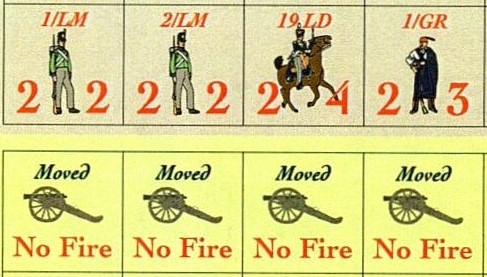
Paul: Rules for Low Ammo (mentioned above as a possible result for Fire Combat) and for artillery units. These units are marked “moved” or fired” depending upon what activation they make. They cannot do another activation until the marker is removed when the player next wins a card draw.
Grant: How is victory achieved?
Paul: Players win the game by earning more Victory Points (VP) by the end of the last turn than their opponent. VP are awarded for reduced or eliminated enemy combat units, wounded or eliminated enemy Leaders, or exiting units off of the south (British) or north (US) map edges. In the unlikely event of a tie VP result, the British player wins.
Grant: Which side has the more challenging path to victory?
Paul: It is a toss-up based upon play testing. The US has the higher Morale Level at start, but since that player bears most of the burden of attack, losses can be higher for that player. This is a slug fest, so timing, card draws and a bit of luck will be involved in any game’s outcome.
Grant: What are some strategic considerations for both the US and British?
Paul: The British must weigh carefully when and if to bring in any reserve units. The British player must also fight hard to keep the US from exiting the map. However, the British will most likely be making a stand along the Chippawa River, and there is not much room between it and the north map edge. The US player must exit the north map edge to get the most VP. However, running up a butcher’s bill to do it will hand the British a victory. The US player must also guard against Joseph Brant leading his warriors through the forest along the west map edge. This can result in the US having to divert forces to deal with his foray and prevent him from exiting the south map edge. If that happens, it will be that much harder for the US to have any chance of winning. Decisions, decisions…
Grant: What are you most pleased about with the design?
Paul: I’ve been wanting to do these games since we first started visiting Canada and touring these battlefields 40+ years ago. I’m very pleased with how easy these games are to learn and teach, and how balanced they are. Each one is a real nail biter for opponents of equal ability. I’m also very pleased with how Ilya rendered these games and the series card set. They are beautiful!
Grant: What other volumes will be included in the Battles for Canada Series?
Paul: As mentioned above, there are six games in the series on the battles of Queenston Heights, Chippawa, Chysler’s Farm, Lundy’s Lane, Fort Erie and Cook’s Mills.
Thanks for your time in answering our questions Paul and for your efforts in designing this interesting games.
If you are interested in learning more about the game or ordering a copy you can visit the game page on the High Flying Dice Games website at the following link: http://www.hfdgames.com/chippewa.html
-Grant
 The Players' Aid
Though I not yet tried this series, Paul and HFD have always produced games that I have enjoyed on topics and campaigns that are generally not well-gamed otherwise. Kudos to Paul and HFD. They have never disappointed.
LikeLiked by 1 person
Sounds interesting
LikeLike
I have noticed that my modest collection of games has sneakily started to accumulate some 1812-related titles over the past few years. Nice to see some new games continue to be released on what feels like an under-gamed topic. This article is appreciated, and I have followed the link to HFD to learn more about the games in both series.
LikeLiked by 1 person
These games are simple yet very thematic and fast playing. The card draw activation is also quite well done and keeps the tension high.
LikeLike