
We all have our favorite series in the wargaming world! Sometimes these are some of the first wargames that we played and they just feel comfortable so we keep playing them. Sometimes a respected member of the community has touted them so much that you dive in and feel an instant connection. And sometimes you are just lazy and don’t want to learn a new rule set and just want to play what it is that you know and understand. All of these things are reasons that we love Series Games. Recently, I wrote a Love/Hate Relationship post about Series Games that goes into a discussion about what I really like and dislike about Series Games and I wanted to share my 3 favorite Series with you.

3. Combat Commander Series from GMT Games
The Combat Commander Series designed by the late Chad Jensen is a sublime tactical series that focuses on squad level combat during World War II and has big box offerings for Europe, Pacific, Mediterranean and Partisans called Resistance! as well as 8 Battle Packs that deal with various fronts or battles including Normandy, Stalingrad, New Guinea and Sea Lion amongst several others. There are also extra scenarios that have been offered in a number of issues of C3i Magazine from RBM Studio.
Combat Commander is a card-driven strategy game (I love CDG’s if you didn’t know!) covering tactical infantry combat in the European and Pacific Theater of World War II made for 2 players, although there are several ways to play solo if you search on Board Game Geek. One player takes the role of the Axis (Germany, Italy or Japan) while another player is one of the major Allies, including the United States of America, Britain, France or Russia.
The players will take turns playing one or more “Fate” cards (each side has a deck of 72 available cards) from their hands in order to activate units on the map to perform military functions such as fire, move, request artillery support, recover, dig-in, etc. Each of these actions can be countered at the appropriate time with the playing of a card from your opponent’s hand that acts as an instant or interrupt, changing the conditions of the battlefield and affecting the results of the originally played card.
Players attempt to achieve victory by moving their units across the game map to attack their opponent’s combat units and occupy as many objectives as possible before the final time check is triggered or a “Surrender” condition is met which is typically a preset number of unit losses allowed. The degree to which a player succeeds or fails is measured by specific “Objective” chits (some that are known and some that are hidden), the destruction of enemy units (scores are given for the size of the defeated troops), and the exiting of friendly units off the opponent’s board edge.

I love Combat Commander! The cards in the game are what you rely on to take actions, and if you do not wisely manage those cards, you may not have the card you need, such as a fire or advance in your hand when you need it! Some would complain that this is randomness and doesn’t belong in a strategy game but I disagree. I have never been in the service nor had to participate in a battle, but I can only imagine that there is chaos. This chaos changes all of the best laid battle plans and there are certain factors that contribute to that chaos, such as running out of ammo, your guns jamming, being pinned down by a sniper or having your units morale drop leaving them hugging the ground and keeping their heads down, that make battle difficult. The cards represent this part of the chaos and is a genius addition to the game. I also enjoy the way the designer chose to address rolling using the dice printed at the bottom of each order card. This is a very solid way of handling this necessary random determination of combat.

The other favorite part for me is the narrative that is told as the battles unfold! As I have played Combat Commander, I imagine that I can feel what the squads felt in combat. I have felt as if I was Sergeant Kaminsky trying to inspire his men to move up on a well defended building to engage the enemy and knock them out of that fortification. I have experienced the disappointment of Sergeant Ganz as his troops were forced to retreat to try to repel the Russians who were threatening the German troops in the buildings. I have felt the disgust in my unit’s performance when a very powerful infantry gun or heavy artillery continues to miss its targets. The narrative is the best part and allows my mind to participate in the battle, even though I am not there. It is a similar feeling to a well written book that forces you to take the role of characters and experience their feelings as you read the pages. If a game can do all that, it is definitely good!

2.Valiant Defense Series from Dan Verssen Games
The Valiant Defense Series is a very interesting and well made solitaire series that tackles some of the most desperate defenses in the history of World War II. The system allows you to play as these defenders, more often than not hopelessly outnumbered, outgunned and with many things against them including time, ferocious charges and consistent air and artillery bombardment from a host of enemies. But, these games tell a great narrative of these stories. The games in the series focus on individual defenders with counters being named for the men who were there fighting and are deeply rooted in history. The games in the system play fairly quickly, usually in 60 to 90 minutes, and the rules are pretty easy to grock and pick up with great player aids.
Currently, there are 4 published games in the series including Pavlov’s House, Castle Itter, Soldiers in Postmen’s Uniforms and Lanzerath Ridge. There is a fifth volume covering the action on Guadalcanal that should be coming to Kickstarter this fall.

The games all have a series of tracks or axis of advance that enemy troops will be pushed down by the player of cards from an enemy deck to attack the defenders defenses and attempt to overwhelm them. In Pavlov’s House, it is the heavily fortified apartment building in 9 January Square, in Castle Itter it is an Austrian castle near the village of Itter where American soldiers fight alongside Wehrmacht infantrymen, an SS officer, an Austrian resistance fighter, and recently freed French prisoners of war. Truly the most odd of the series but truth is stranger than fiction! In Soldiers in Postmen’s Uniforms Polish postmen fight off the advances of the German army on the first day of World War II in 1939 in a 3-story post office building in Danzig and finally in Lanzerath Ridge an American I&R Platoon defends the town of Lanzerath, Belgium and delays the advance of an entire SS Panzer Division on the first day of the Battle of the Bulge.

As different as each of these situations sounds, the game system creates new and interesting mechanics and abilities that each of the defender counters possess to fight against new and even tougher enemy units as they advance toward their objectives. There are never enough actions to do everything that the player wants to accomplish but you have to make tough decisions to keep the advance at bay until you can be relieved. Managing your forces, keeping units fresh and ammunition distributed will be the toughest choices but what enemy units to attack and when is also vitally important. The proper and efficient use of your Actions in conjunction with your Unit Attributes each turn is the crux of the game and you will get better with their use through trial and error. You cannot afford to waste your Actions and have to use the synergistic compliments of the different Units and their Attributes to ensure their Actions succeed.
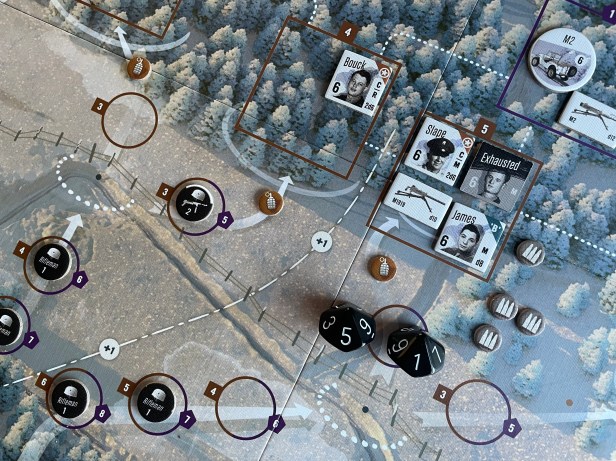
The final point that I wish to make about the Valiant Defense Series is that each game has new innovations and mechanics. While you can learn the system in Pavlov’s House and use that knowledge and experience through out all of the volumes, by the time you play Lanzerath Ridge you will have to unlearn some things and get up to speed with some new tricks. And to me, this is one of my favorite things about this series. The variety. The evolution. The familiarity in the overarching mechanics but with new twists. These things keep it fresh and worthwhile investing in and playing every game in the series.

1. COIN Series from GMT Games
So now onto my favorite series. The COIN Series from GMT Games.
The COIN Series is built on asymmetrical goals and factions meaning that each of the four factions in each game have different victory conditions (how do you play a game where not everyone is going for the same finish line?), different actions that they are allowed to take (what do you mean you can steal my resources and I can’t take yours?) and different means of obtaining them (what do you mean you can win by only having more villages/bases than me when I have to have more money and influence than every other player?). I believe that this assymetry and modeling of each of the historical factions is the systems biggest strength as you will have to become familiar with the other factions goals in order to know how to beat them but must focus on yours in order to win. This means that the game is infinitely re-playable and will feel different each time you play as you will be in charge of a different faction or factions. I also enjoy greatly figuring out what I should be doing with a certain faction and getting comfortable with their operations and special activities, only to turn around and play another game where I have to start all over again learning what to do.
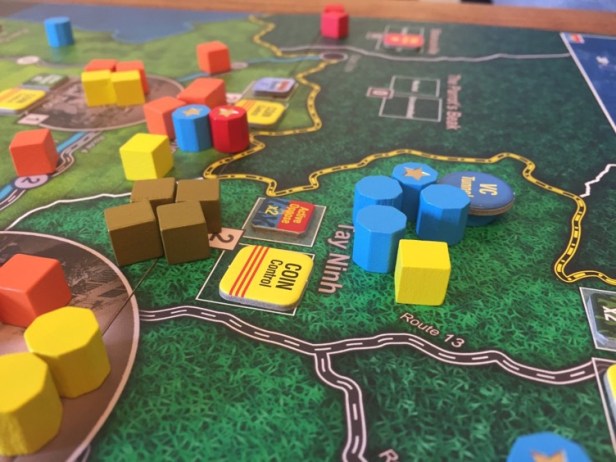
Similar to Twilight Struggle and other Card Driven Games (CDG), COIN Series Games rely on printed event cards that are used for several purposes. The first and most important purpose is to set up the order of play for each faction that round (if the factions are eligible). This is a very interesting design concept as you see the current active event, as well as the very next event in the sequence. This visionary advantage allows you to plan your next turn moves by passing, taking a Limited Op or other action thereby locking out your opponent from taking the current event or taking the current event yourself for its benefit. This is such a glorious part of the game design. It can both be maddeningly frustrating as well as extremely satisfying! Another aspect of the Event Cards that I truly enjoy is that the events are more often than not, very powerful. They either give you a continuing bonus on future Operations and Special Activities or allow you to take Operations and Special Activities more times that round than you would be able to had you not chosen the event and more often than not, at no cost or FREE! Also, because of the power of the cards and their ties to one or more factions, you can take the event which allows you a huge advantage, only to see that very powerful event reversed with the next event or with a regular operation. This is very frustrating but is one of the major reasons that I love the Card-Assisted element of COIN Series Games.

I also really like that the COIN Series has very different player counts from game to game and is more often than not a multi-player experience. Not many traditional wargames allow up to 4 players. While solo or 2 player games are great, it is sometimes difficult to find someone that is willing to invest 4-6 hours into a game, and it does make for some lonely gaming, especially if you are playing solitaire. One of the elements that I really enjoy about the hobby of board gaming is the interaction between many players and being able to see their strategies, learn from their mistakes and successes and make more friends. I am fortunate to have a great gaming group of 5 guys but it is hard for us to play traditional 2 player wargames as many are left out. This is where COIN Series games excel! They allow solo play or up to 4 players which makes them more playable with large groups. In fact, as I have played game such as Fire in the Lake more, I see that to truly appreciate the game and the complex struggle that the Vietnam War was, you need to have 4 players. This is where the true tension will come out! As in FitL, the US can spend ARVN resources! How dare you touch my money, said the ARVN player! And in Liberty or Death, the Indians can ask for resources but the British don’t have to give them! Great tension is set up in a 3-4 player game that typically won’t exist in a 1-2 player game. While I have had varying levels of success with the solo play using the “Bots” in COIN games, they are well planned out and the player aid cards provide a clear flowchart of decisions for the Bots. This setup allows for improved solo play over other games on the market.

I love the COIN Series and own all 11 of the published volumes. There are another 7 that have been announced and are in various stages of playtesting and fine tuning (including China’s War, Red Dust Rebellion, The Pure Land, A Fading Star, Sovereign of Discord: A Fire in the Lake Expansion, Resisting Revolution: A Cuba Libre Expansion and The Guerilla Generation) and at least 1 other that should be releasing soon (People Power). There is plenty of history to explore with this fascinating system and I am in it for the long haul!

That was a look at my 3 Favorite Series. There are many other series that I love including the Standard Combat Series from Multi-Man Publishing, Levy & Campaign Series from GMT Games and the States of Siege Series published by Victory Point Games, White Dog Games and Worthington Publishing just to name a few. What series are your favorites?
-Grant
 The Players' Aid
My 3 would be the Enemy Action series, Downtown series, and the DVG Leader series. Honorable mention for the first 3 games in the D-Day At series, though I’ve avoided the latest 2 (might have bought them if I had time).
LikeLike
Leader Series and D-Day at are great series! I would agree that the first few were great. I had a really bad experience with Iwo Jima and have not returned to the new games yet.
LikeLike
The one thing I despise about the Leader series is the Shopping. I don’t like spending my gaming time trying to purchase and optimize my forces. Also why I never got heavily into CCGs – deck tuning is not my idea of hell, but it is a component thereof.
For those who love that sort of thing – enjoy! But I won’t be joining you there…
LikeLiked by 1 person
Ironically that is one of my favorite things.
LikeLike
Oh, I can absolutely see why some like it. The aspect of getting to make meaningful decisions before the game even starts. Just not my taste. I do like deck-builders (like Dominion), where youre manipulating the cards within the game mechanics, though my wife doesnt even like that.
LikeLiked by 1 person
My 3 would be:
Great Campaigns of the American Civil War by Joseph M. Balkoski and Ed Beach (AH and MMP);
I agree with Grant on Combat Commander.
An a tip of the helmet to Squad Leader (AH and MMP). Yes, it has its problems, but since its introduction in 1976 it has expanded to cover all WWII participants and expanded the basic rules to cover all fronts worldwide .
rich j.
LikeLiked by 1 person
Alexander has played ASL a few times but I have yet to jump in. Someday!
LikeLike
My favorite series is Combat Commander by far.
Also love COIN series but I would have to go with OST for WW2 game and am in the process of deciding an ACW series between GCACW and the Blind Swords system.
Love the subject Grant and love watching your videos
LikeLiked by 1 person
Thanks. CC is very special. I fell in love with it the first time I played it and will never turn down a game!
LikeLike
Watching your video on series games last week sparked a very interesting discussion between me and a couple buddies. Mainly, what is the difference between a “series” and a “system”? For example, you briefly mentioned C&C in your video, but I would say that that is a system and not a series. There is no connection between them other than the mechanics (with some minor tweaks.) Valiant Defense, in our opinion, is a series. There are some overlapping ideas, but the mechanics are different. Plus, they are all by the same author.
So, where does that put COIN? There is definitely a “system” there (again, with some tweaks), but the games are unrelated. Of course, it depends on what you mean by “unrelated.” They are all about insurgency/counter-insurgency, but how broad can you make the relationship? Certainly, no one would argue that all WWII games are a series, right? Many COIN games even have different authors. So, is it truly a “series” of games? Or, do they just share a system?
It made for a very interesting discussion, one that I’m not sure we have yet to finish. I’d be interested in hearing your thoughts on “series vs. system.”
LikeLiked by 1 person
I get what you are saying. But to respond I would have to give it some serious thought and reflection.
LikeLiked by 1 person
Absolutely! I just dumped that in your lap! 🙂
When I was talking about it with my friends, the conversation went on for quite a while. It wasn’t just a “Here’s my opinion and I’m done.” There was a lot of back and forth. Is a system based on mechanics and a series based on theme? Maybe (we liked that idea), but I think there’s more to it than that. Heck, I even got ChatGPT’s opinion on “series vs. system in boardgames.”
We’d love to sit down with you guys over a and chat. (Maybe next time you’re in Columbus ;-)) It’s a thought provoking topic.
LikeLike
Worth mentioning alongside Combat Commander is Great War Commander (Hexasim), which takes the CC system and tweaks it for World War I.
LikeLiked by 1 person
my 3 favourite series are (in this order):
*GOSS (“Wacht am Rhein” and the like) by Decision Games
*GTS (e.g. “The Devil`s Cauldron”) by MMP
*OCS (e.g. “The Third Winter”) by MMP
seems I like units, many units.. 😉
LikeLiked by 1 person