
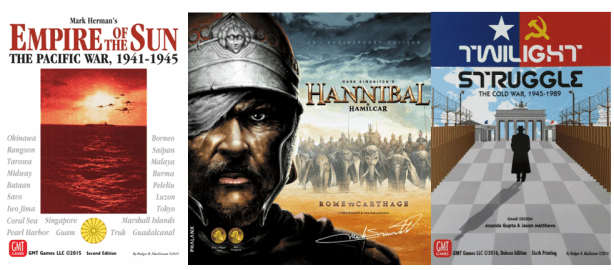
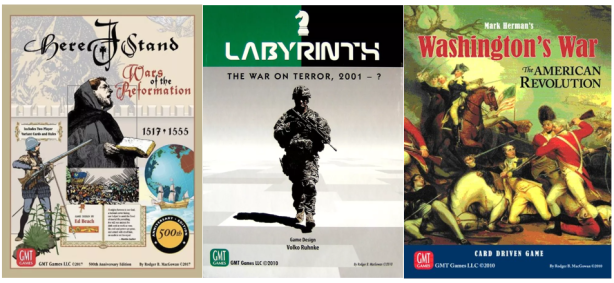
I very much enjoy Card Driven Games (CDGs’) and I think that many players also generally like them for many reasons including their strategic depth and replayability, as well as the tough choices players face each turn with the management of their hand of cards. However, this depth can come with some drawbacks and in this edition of The Love/Hate Relationship, I want to share what I love and hate about the CDG mechanic. Some of the first wargames that I experienced were Card Driven Games! Due to this fact, and because I really enjoy the mechanic, CDG’s hold a special place in my heart. So what is a Card Driven Game? It is more than just a game having cards or using cards. The CDG attempts to focus the players’ actions, and what they can ultimately do in the game, on the cards in their hand. Typically, performing some form of an action will use a single card and these cards will often be multi-purpose. This means they can be used for an action or to take the printed event on the card to do an action that typically either is more powerful but somewhat circumstantial. The medium also allows for historical events to be implemented in the game and allows various rules overhead or special instructions to be printed on the cards making the game a bit easier to play. Cards are simply fantastic and I have played many CDG’s. In fact, my first wargame was Twilight Struggle (yes I see it as a wargame!) followed by classics such as Wilderness War, Empire of the Sun, Washington’s War and others.
Love
The main focus of the Card Driven Game mechanic, and probably the aspect that I most love about it, is the constant, agonizing choices about how best to use your hand of cards. Do I use a card for its powerful unique event or for its Operation Points? You simply never have enough resources to do everything you want, forcing you to prioritize the use of your cards and the actions you take but also to force a decision upon you about when or if to take calculated risks. This makes every turn feel like a high-stakes puzzle and each time I draw a new set of cards to start a round, and as I thumb through them, formulating my strategy, I get either a sinking feeling in my stomach or a sudden burst of excitement. CDG’s are generally praised for their strategic depth and replayability, which stems from the tough choices players are faced with each turn and that will change from game to game as the cards come out differently.
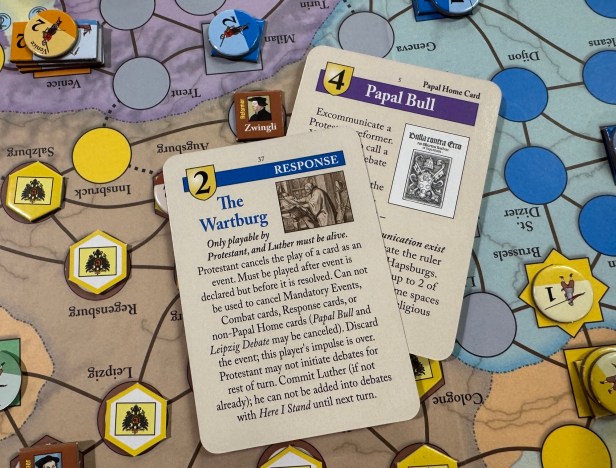
Also, unlike generic strategy games, CDG’s use cards to inject real-world flavor and historical events into the gameplay. Typically, in order to add these bits of chrome from history would require additional rules, exceptions or a whole new process being being added to the game. This tends to bog a game down and makes the almost unplayable. But, with CDG’s, each card represents a specific historical event that provides in-game benefits or difficulty for the players based on that history. These cards create a narrative as you play, where the sequence of cards can tell a unique or alternate version of history every time the game hits the table. This variety in outcomes and the way history in the game unfolds is one of my favorite parts!
There also is a real Fog of War aspect to CDG’s that I love as I just don’t know what type of hand my opponent has drawn. As players keep their hands hidden in the game, you and your opponent will be uncertain about the specific events and strategies available to the player based on their card draws. This really fosters a dynamic, back and forth, reactive gameplay that adds to the tense feeling of these games. I very much enjoy this aspect of the unknown and the process of trying to deduce what your opponent is trying to do based upon their card plays. When you are playing these CDG’s, you will have to think quickly and efficiently as a turn usually lasts 5-7 card plays and you will not have time to dawdle or you may find that you are in a real pickle.
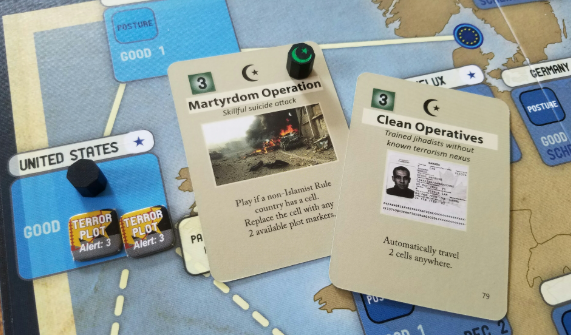
But I think that my favorite part of CDG’s is the planning of a turn and how best to use your hand of cards. As you first start to examine your hand of newly drawn cards each round, you should first ask yourself “What do I need to accomplish this turn? and “What would I like to accomplish this turn?”. Then simply peruse your cards identifying those that can help you in both of those identified goals. I like to then look at the opponent Event cards in my hand and determine which ones don’t have their conditions to set off the Event met on the board at the moment. If the condition could possibly change, I prioritize that card to play first as I don’t want that Event to go off for my opponent. I also then make sure I don’t have any of my events that have conditions that could change as well and I will prioritize those to play next, after I have culled the negative opponent events. To hemp with this process, I literally line the cards up in my hand according to an approved play order, from right to left, so that I don’t get distracted or sidetracked. If there is anything that can happen in this game, you will get distracted by what the other player is doing and sometimes quickly react without thinking, ruining your carefully laid plan. This approach has kept me organized, on task and most importantly in a position where I am able to minimize the negative damage from my opponent’s Events while simultaneously maximizing my own benefit.
Hate
Now that you see what I love about these CDG’s, let’s take a look at what I hate. Hate is such a strong word for me but there are many things that I don’t like about the mechanic.
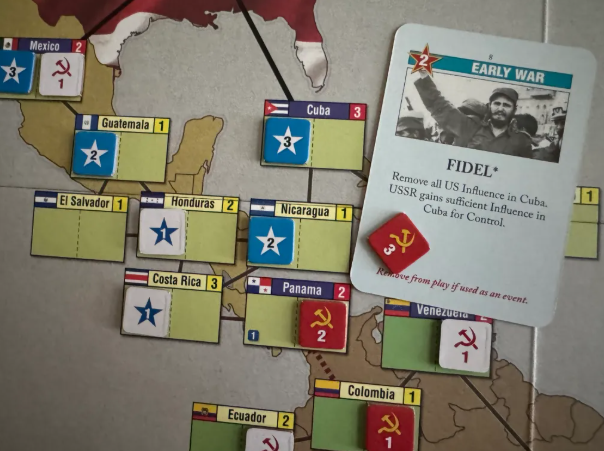
As with any new game or system, there is a learning curve with CDG’s. To play a CDG effectively, players often need to be familiar with and generally know all of the cards in the deck to be able to plan long-term strategies and mitigate potential risks and traps. This can be daunting for new or casual players of a CDG as the true strategy of the game will not be revealed for the first few plays but is something that needs to be developed through experience with the deck over several plays. An example of this is the Fidel Card found in Twilight Struggle. As I have played Twilight Struggle as the USA player, I have had to keep in the back of my mind the fact that this Fidel card is in the deck as it allows the Russian player to remove all US Influenced and directly place Influence into Cuba. Too much commitment in the early part of the game can be a waste of resources as it can all be removed with the play of this card and you must keep that in mind. Any card that allows for the placement of Influence into an area you cannot is worth its weight in gold.
Probably my most hated part with CDG’s is the “luck of the draw”. When you are dealing with a card based game where a deck is shuffled and randomized, you are bound to run into a bad hand now and again. While part of the fun with this mechanic is the concept of trying to do the best you can with the cards you are dealt, a bad opening hand or a streak of poor draws can sometimes feel game-breaking or frustrating, diminishing the sense of strategy and skill that the genre holds important. Nothing worse than looking at your hand and you have 2 – 1 OPs value cards, 2 – 2 Ops value cards and each event is that of your opponent. Just not a good way to start a turn.
The final thing that I dislike is that the mechanic does sometimes lead to a less realistic simulation and even a totally ahistorical outcome or timeline of events. To some wargamers, abstraction provided by cards lessens the game’s simulation value compared to more detailed and traditional systems, such as hex and counter games. The feeling of being unable to perform basic actions without a specific card can break immersion.
In summary, I personally love the CDG mechanic. It is a great method of design to ensure that you are injecting the history of the situation into the game while also creating a very stimulating and interesting play experience. What do you love and hate about CDG’s?
-Grant
 The Players' Aid