Last month, as I was trolling the internet, I came across a new solitaire game from the guys over at War Diary Publications called Battle of the Bismarck Sea designed by Allyn Vannoy. Battle of the Bismarck Sea is a solitaire wargame that uses individual ships and flights/squadrons of aircraft. The Player assumes the role of General George Kenney, Commander of the 5th U.S. Army Air Force, with the mission of intercepting the Japanese effort to reinforce its ground forces on the island of New Guinea. I am always into a good Pacific Theater of Operations game and I reached out to Allyn to get some inside information about the design.
Grant: Allyn welcome to our blog. First off please tell us a little about yourself. What are your hobbies? What’s your day job?
Allyn: I’m retired, having worked 18 years for Intel as a program manager. Presently, I work for a minor league baseball team in the summer, an affiliate of the Arizona Diamond Backs, and volunteer two days a week at the Evergreen Aviation and Space Museum in McMinnville, Oregon, both in the Archives and giving tours of Howard Hughes’ Spruce Goose; I also write (freelance) for a number of military history and gaming magazines.
Grant: What motivated you to break into game design? What have you enjoyed most about the experience thus far?
Allyn: During Covid, I started getting back into gaming, having become interested in Avalon Hill games in the 60’s and as an early subscriber to S&T Magazine. I enjoy the challenge of trying to turn history into a game—a teaching tool—in the process I learn more and hopefully, understand more.
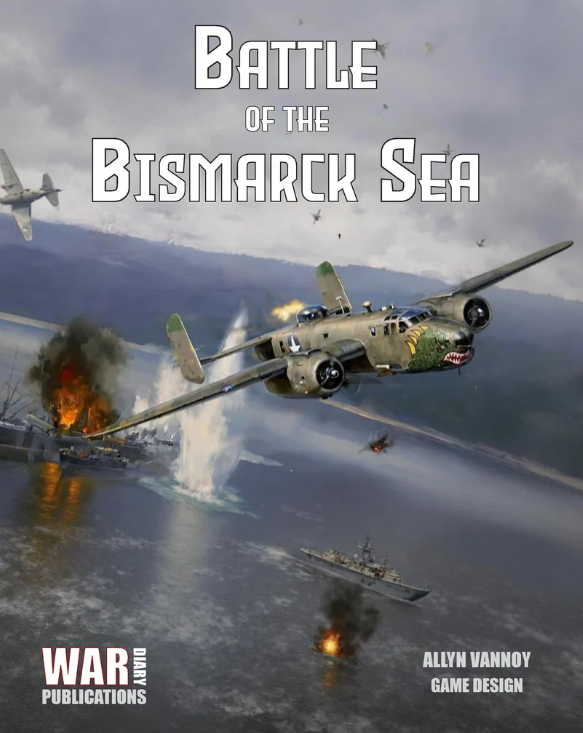
Grant: What is your new game Battle of the Bismarck Sea about?
Allyn: The Battle of the Bismarck Sea, 1943, was the 5th Air Force’s attempt to interrupt the Japanese effort to reinforce its ground forces on the island of New Guinea. The Player must utilize the limited resources available and determine their application over the 10-week period that operations are conducted. The results of these efforts will be borne out in the effectiveness of air operations.
Grant: What games gave you used for inspiration for your design?
Allyn: I hadn’t seen anything like this design; I wanted to make something new and hopefully unique.
Grant: What is important to model or include in a game about the Air Naval combat in the Pacific during WWII?
Allyn: The most important thing to understand is how to organize and implement an air strike force to accomplish the mission given.
Grant: What type of research did you do to get the historical details correct? What one must read source would you recommend?
Allyn: I tried to locate good and detailed sources:
Arbon, J. and Christensen, Chris. The Bismarck Sea Ran Red; Walsworth Press, Marceline, MO, 1979.
Birdsall, Steve. Flying Buccaneers: The Illustrated Story of Kenney’s Fifth Air Force; Doubleday, NY, 1977.
Henebry, John P. The Grim Reapers at Work in the Pacific Theater: The Third Attack Group of the U.S. Fifth Air Force; Pictorial Histories Publishing Company, Missoula, MT, 2002.
Jablonski, Edward. Outraged Skies; Doubleday and Co., Inc., Garden City, NY. 1971.
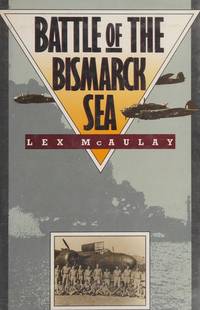
McAulay, Lex. Battle of the Bismarck Sea; St. Martin’s Press, NY, 1991.
Recommendation: McAulay’s book, Battle of the Bismarck Sea.
Grant: What challenges did the subject cause for the design? How have you overcome them?
Allyn: The design initially focused just on the single action that occurred on March 2-4, 1943, but there was a larger struggle that began in January 1943—that Allied commanders realized they needed to adapt and change their forces and tactics if they were to meet the challenge they faced. Once the design was expanded to a 10-week time frame it became more complex, but also more interesting. This also required more research into the changes that took place within the 5th Air Force.
Grant: What is the scale of the game?
Allyn: Unit scale: single ships and flights (3-10 planes) of aircraft.
Time scale: 10 Command/Support turns, each of one week; 13 Operational turns, over a two day period.
Ground units represent 200-300 personnel.
Grant: What are the different units that the player has control over?
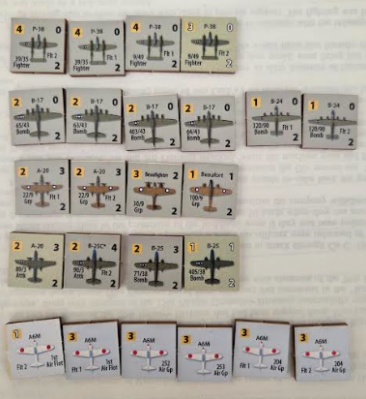
Allyn: The Japanese units include transport ships, destroyers, ground units (presenting the troops and equipment carried on the transports), and fighter aircraft. These are controlled by the Bot. The player controls the Allied units: a mix of aircraft—reconnaissance, heavy bombers, medium bombers, and fighters, and also PT boats.
Grant: What does the concept of Endurance mean for the player? What does this model from the 1943 campaign?
Allyn: Endurance is the amount of time that aircraft can remain airborne. This models the range of aircraft from their bases to the target area. In the initial design, a series of range arcs were used for the individual aircraft types. It was quickly realized this would make for a very complex game. To address playability, aircraft range was changed to consolidate to a single arc (a line on the map) for medium bombers and P-38 fighters, and set Operational turns to 3-hour periods.
Grant: What decisions do they have to make about their assets use and management over the campaign?
Allyn: The game is conducted in two parts: a Command/Support Sequence and an Operational Turn Sequence.
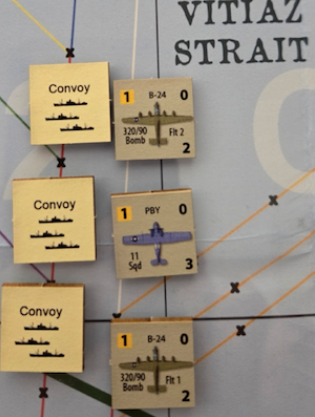
The Command/Support Sequence is a one week period that allows the Allies to receive resource points and reinforcements, then decide how to apply the resource points—rebuilding units, modifying tactics, and determining how to find a convoy at sea.
The Operational Turn Sequence is a two day period where the convoy is moving along convoy routes as the Allies attempt to identify it and then determine the organization of strike forces in an effort to sink it and prevent Japanese forces from reaching Lae, New Guinea.
Grant: As a solitaire wargame how does the Bot behave? What are its priorities and decision points?
Allyn: The Convoy, when dispatched from Rabaul, advances towards its destination (Lae), with random events impacting its progress. The rules introduce the Fog of War that the player must overcome in order to first find the Convoy and then disrupt and attempt to destroy it.
As for decision points, there are several. How are resource points to be spent? When and how to go after a convoy? What assets to use in a given sortie?
Grant: What type of an experience does the Bot create?
Allyn: Designing a solitaire versus a 2-player game presents a whole different set of challenges. Can you design a Bot that will maintain the player’s interest and also challenge them? It should create variety; i.e., when and where will a convoy attempt to make a run; as well as a certain level of anxiety as certain elements are unknown until they can be revealed.
Grant: What are Resource Points and what do they represent?
Allyn: Resource points are the player’s currency and represent personnel, equipment (aircraft), and training.
Grant: What are Resource Points used for?
Allyn: The Resource Points are used by the player to improve tactics, provide replacements for losses, strengthen forces with personnel and equipment, and to launch air attacks. They are the real currency of the game and the player has to use them wisely to do well.
Grant: What is the layout of the board?
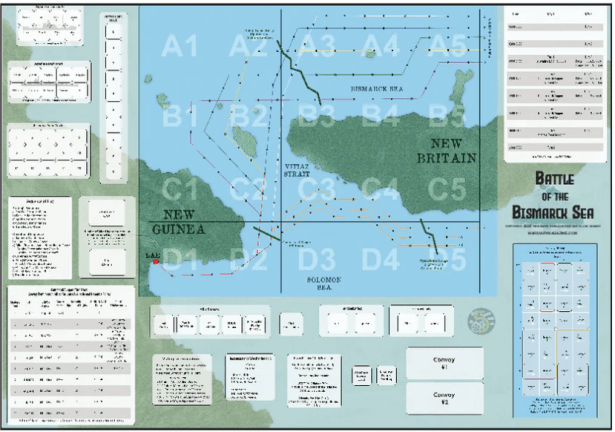
Allyn: The board includes the map (the area between New Britain and New Guinea); the turns tracks (for both Command/Support and Operational Turns); the Convoy Display (for air-sea combat); displays for the ships (transports and destroyers) and for tracking victory points and resource points.
Grant: How does combat work?
Allyn: Combat is based on the attack strength of the units for air combat, air-to-surface, and surface combat. The result of a die roll is compared to a unit’s combat strength, and if it’s equal to less than that number (combat strength), a hit is made on the opposing force.
Grant: How are bombers and fighters used in combat?
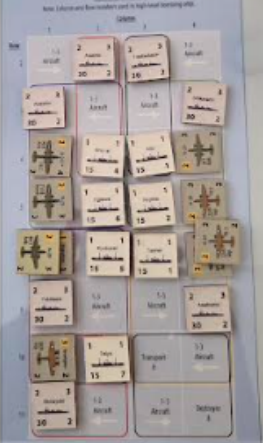
Allyn: Bombers are used to try and sink the ships of the Convoy. Heavy bombers operate separately from medium bombers, as they drop their bomb loads from altitude, with limited chance of success, while medium bombers engage Japanese ships at low altitude (mast-high approach). Fighters are used to engage the Combat Air Patrol aircraft that the Japanese dispatched to provide air cover for the Convoy.
Grant: How is victory obtained in the game?
Allyn: Victory is based on the number of Japanese troops that fail to reach Lae—by sinking the ships and their cargo of personnel and equipment, they are removed from participation in combat operations on New Guinea.
Grant: What do you feel the game models well?
Allyn: The fog of war; the challenge to figure out how to build and prepare the needed forces, and then how to employ them to accomplish the mission (sink the enemy shipping).
Grant: What has been the experience of your playtesters?
Allyn: Comments led to a major change in design—moving from a single mission to a 10-week campaign and all the elements associated with that larger picture/time frame.
Grant: What are you most pleased about with the design?
Allyn: That it offers two layers to the player experience – organizing and building forces, then utilizing them to execute missions.
Grant: What other designs are you contemplating or already working on?
Allyn: Operation Tidal Wave, the USAAF Ninth Air Force strike on Ploesti, Romania, August 1, 1943.
If you are interested in Battle of the Bismarck Sea, you can order a copy for $30.00 from the War Diary Publications website at the following link: https://wardiarymagazine.com/products/battle-of-the-bismarck-sea
-Grant
 The Players' Aid