With this My Favorite Wargame Cards Series, I hope to take a look at a specific card from the various wargames that I have played and share how it is used in the game. I am not a strategist and frankly I am not that good at games but I do understand how things should work and be used in games. With that being said, here is the next entry in this series.
#70: Mohawks from Wilderness War: The French & Indian War, 1755-1760 from GMT Games
One of my fondest memories of our wargaming journey was our initial experience with the full campaign game of Wilderness War from GMT Games. We were 2 very inexperienced wargamers and we slogged through a 9-hour marathon play over a few days that ended in a 0-0 tie of all things. That’s right, the game ended in a tie, even though we both had a card in hand, but I was unable to use mine to activate Levis, which was my only potential Victory Point scoring force, and Alexander’s forces were in too tenuous a position or too wounded to risk an open battle for VP’s. You would think that this would have turned us off to the game but on the contrary it made me fall in love with asymmetric wargames and the Card Driven Game mechanic with its use of Action Points and events to wage war on the North American continent. The end score of our game really followed the tension of the game, and the blunders on the side of the British that counter balanced their various successes.
All in all, this game was excellent to play and we both highly recommend it. The two factions play extremely differently which leads to many intricate and reactive strategic decisions. The British have many powerful forces with their Highlanders and cannon while the French have access to better leaders and mobile troops and Indian allies who can run around the frontier raiding and burning settlements for VP’s. Laying siege and assaulting really feels like it should, and avoiding battle until you are ready is something that is integral to maintaining a strong presence on the board. You cannot always get into every possible fight as you will not survive the attrition of these battles. The deck plays really well, and as you don’t have to worry about the opponents events in your hand going off, the management aspect is much simpler yet very engaging as there are always reaction cards you can play or cards that you want to hold onto for that perfect moment.
In previous posts in this series, we have discussed the importance of the players of both sides gaining the trust and services of the indigenous Indian denizens of North America in the fight. The French and British can both use the Indian recruitment cards, including cards such as Iroquois Alliance, Northern Indian Alliance and Western Indian Alliance, to recruit, restore, and move native allies to gain victory points through raids and controlling of territory. The French hold a significant advantage with more access to a greater number of Indian auxiliaries, and will be using these cards to launch early raids, while the British can recruit specialized units like their Mohawk or Cherokee allies.
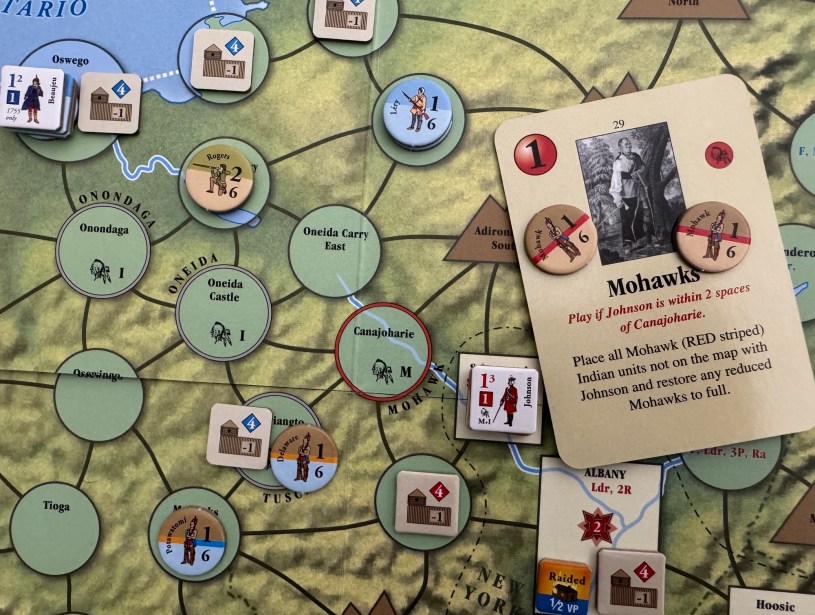
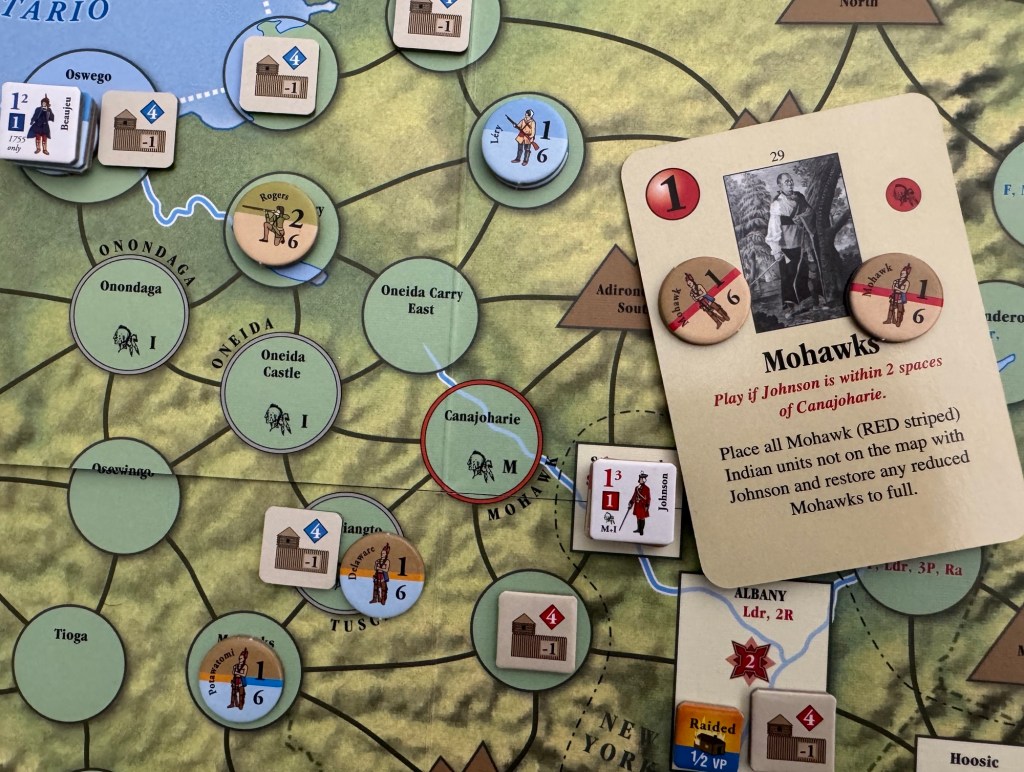
In this entry, we will take a look at the British card Mohawks. Mohawks is one of those cards that has a pre-requisite qualifying condition to play the card. In this case, the qualifier is that the leader Johnson must be located on the board within 2 spaces of Canajoharie, which was a Mohawk village located in upstate New York. As long as he is within the required 2 spaces, the card can be played to bring out onto the board the Red striped Mohawk Indian units. These must be placed with Johnson and the other added benefit is that any reduced Mohawks on the board can be flipped to their full side. These pro-British units can only be recruited by the British player and their arrival in New York can be a huge boon to the British as the French and their Indian allies will be raiding the villages and settlements up and down the frontier regularly during the game as one of their most dependable sources of Victory Points. These Mohawk allies can spread out around the area and intercept incoming raids before they can occur. Remember that Indian allies in Wilderness War are not powerful combat units and are best used to raid and prevent other tribes from raiding.
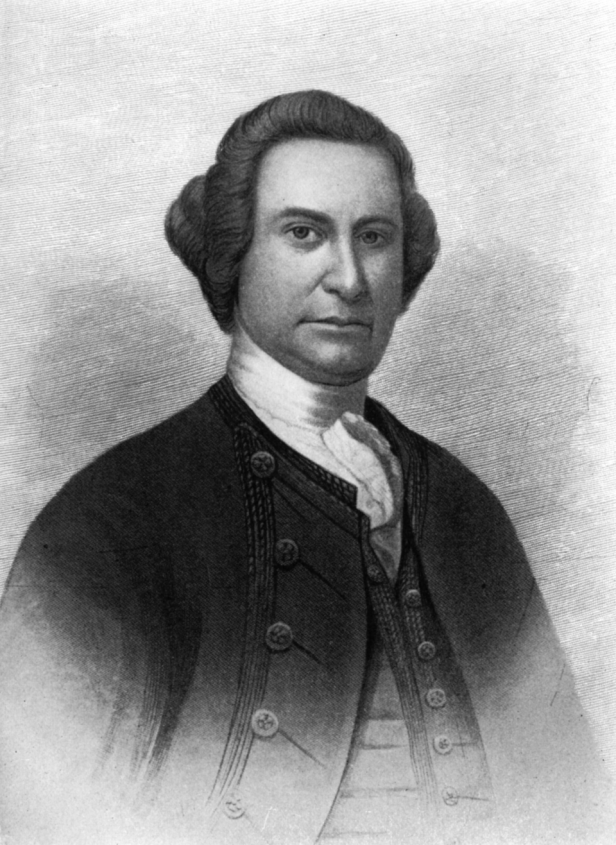
I very much love the thematic connection here as in order to attract the Mohawk Indians as your allies you must have someone that they trust in the area and this is Johnson. Sir William Johnson was a pivotal British superintendent of Indian Affairs whose deep integration into Mohawk society secured the crucial Mohawk Nation alliance for the British during the French and Indian War. By living among them, learning their language, and marrying Mohawk women, he maintained the Iroquois Covenant Chain and led Mohawk warriors in key victories. This is one of the great things about these Card Driven Games and their use of the cards to deliver the bits and bobs of history to enlighten our understanding and to expand our knowledge of the period.
As a young man, Johnson moved to the Province of New York to manage an estate purchased by his uncle, Royal Navy officer Peter Warren, which was located in territory of the Mohawk, one of the Six Nations of the Iroquois League. Johnson learned the Mohawk language and Iroquois customs, and was appointed the British agent to the Iroquois. Johnson commanded Iroquois and colonial militia forces against the French and their allies during the war and was later commissioned a major-general for his role in the British victory at the Battle of Lake George in 1755. His capture of Fort Niagara from the French in 1759 brought him additional renown. Throughout his career as a British official among the Iroquois, Johnson combined personal business with official diplomacy, acquiring tens of thousands of acres of Native land and becoming very wealthy.
In the next entry in this series, we will take a look at The Wartburg from Here I Stand: Wars of the Reformation, 1517-1555 from GMT Games.
-Grant
 The Players' Aid