While I have not played a bunch of games focused on the Punic War, the few that I have played are very good and I am always interested in a good Ancients combat game. Last fall, GMT Games announced a new 2nd Punic War game called Punicus: The Second Punic War designed by a newcomer in Carlos Oliveras. I have been very eager to learn more about this game and reached out to Carlos recently for an interview and he graciously accepted.
*Keep in mind that the design is still undergoing playtesting and development and that any details or component pictures shared in this interview may change prior to final publication as they enter the art department.
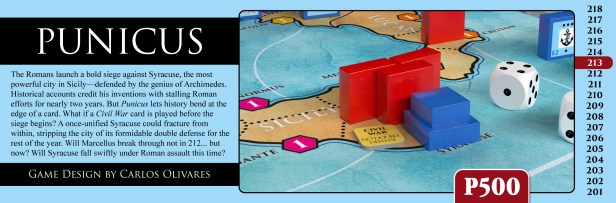
Grant: Carlos welcome to our blog. First off please tell us a little about yourself. What are your hobbies? What’s your day job?
Carlos: Thank you for supporting the hobby in these times. As for me, I’m a guy—well, more like a man with presbyopia now—who’s starting to struggle to read the counters without glasses. I’m into the same things most people of my generation grew up with: films, books, and music, plus a hobby that wasn’t nearly as widespread in Spain in the ’80s and ’90s: games—Eurogames, role-playing, video games, and above all, wargames. And to pay for all that, I work as a naval architect.
Grant: What has motivated you to break into game design? What have you enjoyed most about the experience thus far?
Carlos: I’ve been involved in wargames for quite a while. For instance, I was the rules editor for Mark Simonitch’s Stalingrad ’42, I put together the player aids for Craig Besinque’s Conquest & Consequence, and I translated Successors into Spanish—so I suppose the next natural step was this: designing my own game.
There are a lot of fun parts to creating a game, but there’s one aspect that may not be strictly “design” and yet is genuinely enriching: working with so many people from so many different places. You realize that despite differences in countries, cultures, and ways of being, people—if they want to—can understand each other, and we’re not as different as we sometimes think. If there were more wargames, there’d be less war. Coming away with that conviction leaves you with something genuinely positive.
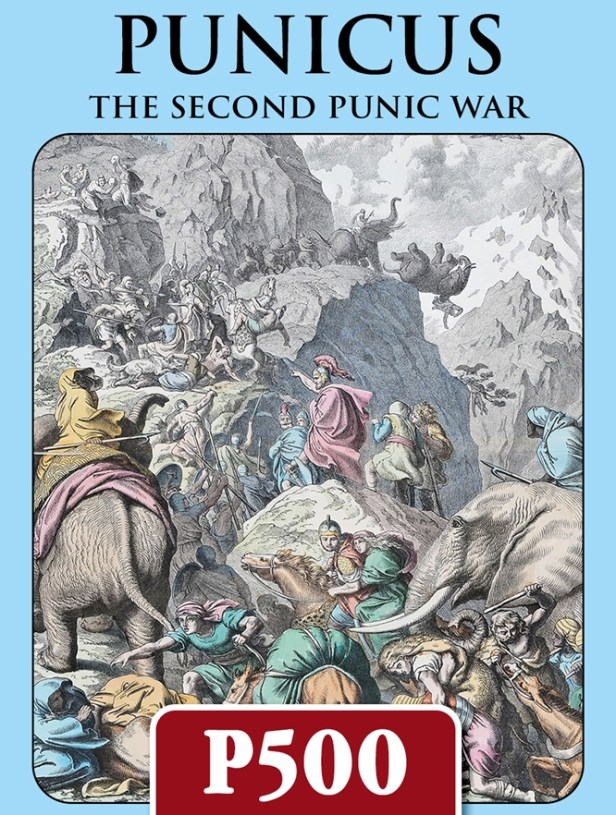
Grant: What is your upcoming game Punicus about?
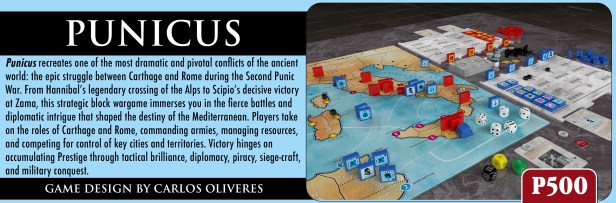
Carlos: I haven’t exactly found some untouched topic that no one has ever made a wargame about — honestly, I wasn’t that original. It’s another Second Punic War game: Hannibal, Scipio, and the whole cast. It’s a block wargame with cards of medium complexity, designed to be playable in an afternoon.
Grant: What games gave you used in inspiration for your design? Why?
Carlos: Punicus is built on Craig Besinque’s Hellenes System, one of my all-time favorite games—one of Craig’s real gems. I’ve played it so much that I always wanted to see it applied to other settings: the Second Punic War, the Gallic Wars…I kept hoping Craig would eventually design something along those lines. In the end, I got over my hesitation and decided to do it myself.
Grant: What is the scale of the game? Force structure of units?
Carlos: Because this war is so long, if I want the game to be playable in an afternoon it has to take a very strategic, high-level view. Each turn represents one year. As for the units, given how diverse (and sometimes contradictory) the sources are, I’ve adapted the order of battle to what produced the best balance during playtesting. For example, even though it seems Hannibal began the war with more elephants than his brother, in the game they both start with the same number of elephants.
Grant: How are the units represented? What is the layout of the blocks?
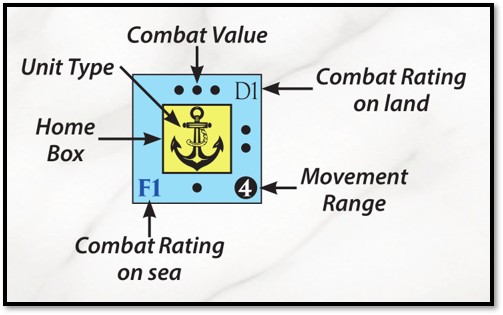
Carlos: The units are essentially wooden blocks with stickers. In short, the sticker shows the unit type (infantry, auxilia, cavalry, etc.); its Combat Value (the number of dice it rolls in combat); its Combat Rating, which determines when it attacks (in alphabetical order) and what it hits on or uses to cause routs; its Movement Rating; and, very importantly, its Home Box, which tells you where that unit can be recruited.
Grant: What advantage do blocks offer the design?
Carlos: Basically, it’s the fog of war. And not just because you don’t know what unit is in a given block—you also don’t know its exact strength state, since a single block can have up to four step levels. On top of that, there’s the physical feel of handling something solid like wood, which—without taking anything away from cardboard counters—is simply satisfying. I know that’s not strictly a design point, but it matters. If I have the choice, I’ll always prefer playing Punicus on the table rather than on Vassal.
Grant: Why was this a subject you wanted to create a game on?
Carlos: I love history, and I have to admit that when I was a kid, Hannibal’s campaign really blew my mind—elephants, crossing the Alps…to me it was like a movie, with the extra thrill that it had actually happened. Years later I was lucky enough to play Mark Simonitch’s Hannibal, and it made me feel like a kid again. So when I found myself with the chance to create a Second Punic War game using the Hellenes engine, I didn’t hesitate. And yes—designing it has been just as fun as discovering who the Carthaginians were back then, and as fun as playing Hannibal years later.
Grant: What are the unique features with the system used for the game?
Carlos: If we compare it to Hellenes, what sets Punicus apart is basically three things. First, the addition of non-combat units such as Generals and Catapults. Generals, for example, improve the units they are stacked with, and if that general also happens to be an active leader for their side, they can apply their special ability. For instance, Marcellus’s special ability improves the assault capabilities of the units with him. Second, new actions like production, piracy, and diplomacy—yes, you can take cities by sending ambassadors and persuading their citizens they’ll be better off with you. And third, the addition of a personal player board where each side can invest Supplies into researching projects, letting you shape your long-term strategy.
Grant: What unique elements of the Punic Wars did you want highlight in the game?
Carlos: I’d like the game to capture two things. First, the asymmetry between the sides. Carthage starts with tremendous striking power, but its enemy is far away. Rome is a sleeping giant: it loses battles, but it keeps standing—unyielding, impossible to discourage. You know it will wake up; how long it takes, and what form that awakening takes, will shape the rest of the war. Second, I wanted to reflect how the war evolves. Early on, players have fewer options, but as the campaign advances new possibilities open up to explore—investing in projects, diplomacy, piracy, and so on. The idea is that turns shouldn’t feel repetitive as the game goes on.
Grant: What various unit types are included in the game? What is unique about these units?
Carlos: There are three classes of units: Civians, Barbarians, and non-combat units. Civians represent the era’s city-based forces: Infantry, Auxilia, Cavalry, Elephants, and Fleets. Each unit type has something that makes it distinct. For example, Cavalry can perform a special attack called Harrying. Elephants are a powerful arm, but with the drawback that they can panic your own troops. Barbarians are slow but hard-hitting units, with the key trait that they dissolve in Winter—unless they are with Hannibal. Finally, there are the non-combat units: Generals and Catapults. They cannot operate on their own, but they can significantly influence battles.
Grant: How are cards used in the design? What are Action Points?
Carlos: The game is played in Years. At the start of each Year, each player is dealt six cards. In each of the seasons that make up the Year, players choose one of their cards face down and reveal them simultaneously. The card’s orientation determines whether the player will resolve its event or use its Action Points—one or the other. Each Action Point allows you to take one action, chosen from: Movement Actions (from standard Maneuvers to Piracy actions), Building Actions (recruiting and reinforcing), Production and Diplomacy.
Grant: Can you share a few examples of the cards?
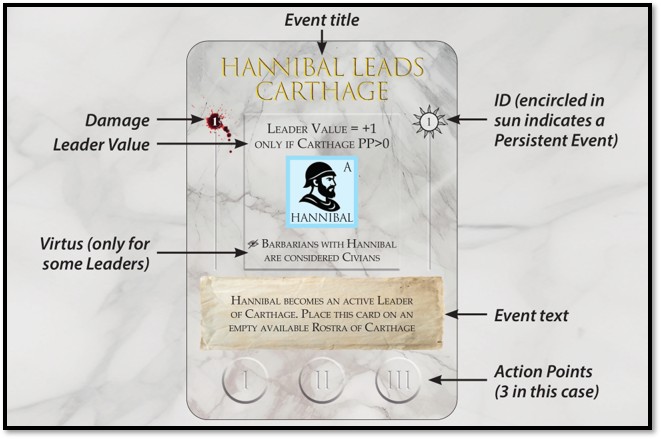
Carlos: Yes, of course. Here is the “Hannibal Leads Carthage” Card and its key features. This card starts on the Carthaginian player board. It is a Leader card: while it remains on the player board, it grants its player its Leader Value (additional Action Points) and also gives Hannibal’s block a Virtus, or special ability—in this case, it means that any Barbarians with him do not dissolve in Winter. You can also see a value labeled Damage. When a unit crosses a mountain border, or a Fleet runs into a storm, you draw a card to see whether it takes damage.
Grant: How are cards used for research?
Carlos: At the start of the Year, players still play their cards either as events or for Action Points, but in this segment those Action Points are not used to take actions. Instead, they are used either to make an offering to a god (which will allow future appeals to that god to do things like reroll dice) or to invest Supplies in projects. This is the only time projects can be researched. That means that if, in the previous Year, a player didn’t produce Supplies—or spent them on maintaining troops during Winter—they may have no opportunity to research at all.
Grant: What different research options are available and what are their benefits?
Carlos: There are basically three branches: one that boosts production, one that increases naval power, and one that benefits land forces. It’s also worth noting that the projects for each side are not 100% symmetrical, which further differentiates how Rome and Carthage play.
Grant: How does activation work?
Carlos: Units don’t activate on their own; players have to spend their cards’ Action Points to move them. In other words, if a player plays a card as an Event, they won’t be able to move their units that season—the only combat they might still carry out is siege attrition from sieges established in earlier turns. Likewise, if a player plays a card for Action Points but it only provides 1 AP and they spend it on something other than movement—for example, using that AP to produce—then their troops won’t move that season. So each turn you have to think carefully about what you do, because your Action Points are limited: if you do one thing, you can’t do another. It’s that Twilight Struggle feeling of always being short on points—more or less.
Grant: What is the layout of the player boards?
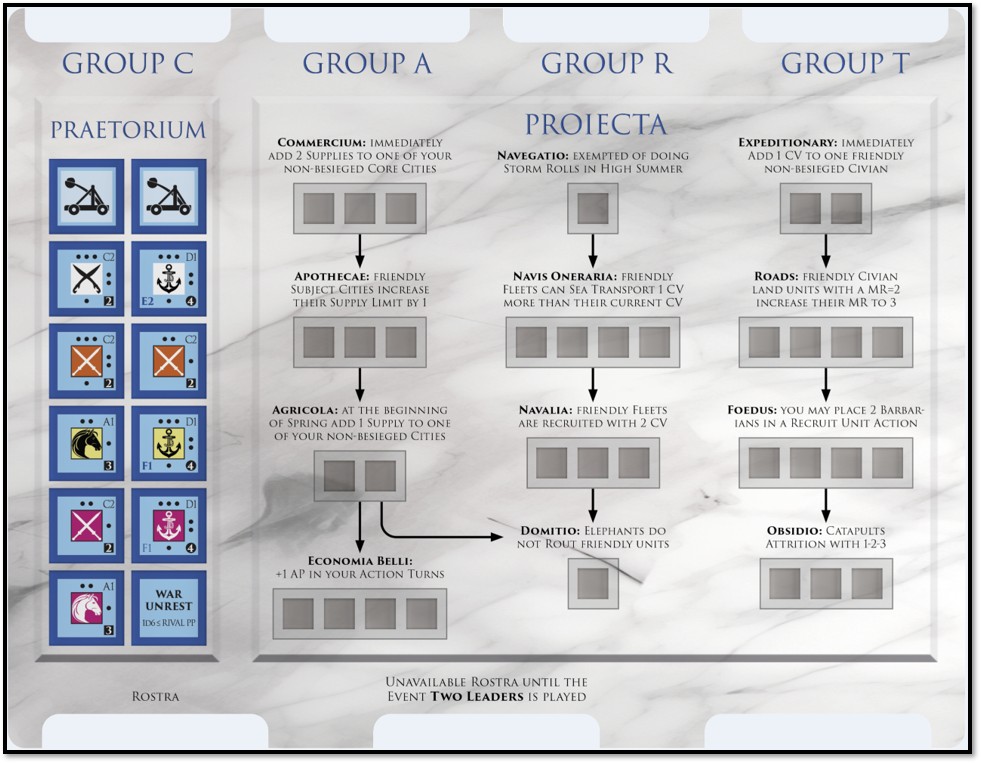
Carlos: The player boards are dual-layer boards, so units and Supply cubes can sit neatly recessed in place. Each player board has a Praetorium, an area that holds units the player cannot recruit at the start of the game; these units will enter play later through Diplomacy Actions or Events. There is also the Proiecta section, where players invest and accumulate Supply cubes while researching projects. At the top, there are slots to hold groups of blocks in case the stack becomes too large to keep on the main map. At the bottom of the player board are the Rostra, where each side places the cards of its active leaders.
Grant: What key choices are forced upon the players?
Carlos: Each season, the player has to ask themselves which card to use and how to use it: for Action Points or for the Event. On top of that, the decision must factor in that the number of Action Points has a direct impact on initiative—who will act first that season. In principle, you don’t know in advance whether you will go before your opponent or not, so even what you intended to do with your Action Points when you committed the card may have to change, because your opponent has altered the board situation. That card-use choice is a recurring one every turn, but there are more decisions. For example, when you are besieging a city and the battle phase arrives, you have to decide what to do: attrition or assault. And for the defending side, when you are assaulted you have the option to capitulate—you lose the city, but in a less dishonorable way than if you were to lose the assault. Also, in battles a side can always choose to withdraw at the start of its round to execute an ordered retreat and limit losses.
Grant: How does combat work?
Carlos: It’s fairly straightforward. In a battle, blocks are revealed and sorted alphabetically by their Combat Rating. Blocks attack in letter order (A/B/C/D…), with defenders acting before attackers when the letter is the same. A block attacks with a number of dice equal to its printed Combat Value, and it scores hits and routs according to its Combat Rating. For example, an A2 block would attack first because it’s an “A” unit, scoring hits on 1–2 and causing routs on 5–6. Each hit reduces the strongest opposing block, and each rout forces the weakest opposing block to leave the battle. When all blocks in the combat have attacked, the Combat Round ends. Combat Rounds repeat until one side is eliminated or retreats. Combat also changes depending on the battle type. For example, in an Assault, the forces inside the city are treated as A2 blocks and they also receive a defensive bonus.
Grant: How is victory achieved?
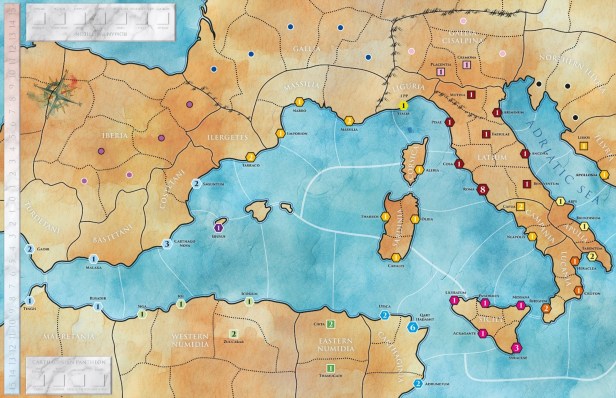
Carlos: There are different types of victory. A Decisive Victory requires reaching 15 points and controlling an enemy Core City. A Negotiated Victory can be achieved with only 12 points. If neither of those victory conditions is met and the game reaches the end of its campaign years (which, in principle, players also won’t know in advance), a final comparison determines who wins—or whether the game ends in a draw.
Grant: What do you feel the game models well?
Carlos: What I think the game models well is the overall course of the war. It’s not that it perfectly models individual battles or grand strategic movements, because the game is somewhat sandbox in that respect. It’s more about the feeling that, with the sides being so different, both players are under constant pressure to perform at their best—because one mistake can swing the whole game. It feels like a war, not just a series of skirmishes. For example, Carthage starts with an impressive striking force, but its native recruitment base is far away and the war is long, so there’s constant pressure: victory can’t rely on a single great general forever. Rome, on the other hand, knows its potential is enormous, but it has to survive long enough to actually bring that potential online before its opponent brings it down.
I have come to Italy not to make war on the Italians, but to aid the Italians against Rome. – Hannibal Barca
Grant: What has been the experience of your playtesters?
Carlos: I think they’re having a good time. The fact that they want to play it again means the game has them hooked. And beyond that, their help has been invaluable—adding rules that turned out to be fundamental, or even almost creating cards like Mutiny. We’ll most likely put out a call for a new round of playtesters in an upcoming GMT newsletter, so if anyone’s interested, keep an eye out.
Grant: What are you most pleased about with the design?
Carlos: What I’m enjoying most is that the playtesters (including the developer, Joe Dewhurst) have had very few questions about the rulebook wording. It also helps that I started from a very polished manual like Hellenes.
Grant: What other designs are you contemplating or already working on?
Carlos: Right now, almost all my time goes into Punicus, but I have rough outlines for a block game about the Spanish Civil War (something like Spain Front, maybe) and a solo game about a certain Julius Caesar.
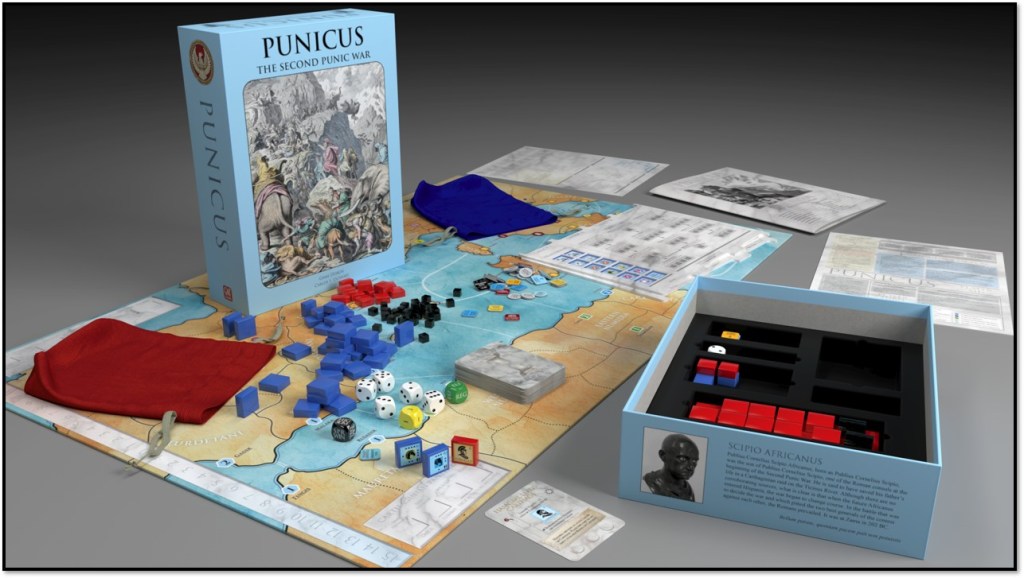
I love a good block wargame! And, in my opinion, this game looks extremely interesting and I am very much excited to learn more about it. I also very much like the idea of investing in technology and projects. Just such as neat addition to any wargame as you have to balance investing in replacements for your lost troops or new abilities and strength.
If you are interested in Punicus: The Second Punic War, you can pre-order a copy for $69.00 from the GMT Games website at the following link: https://www.gmtgames.com/p-1196-punicus-the-second-punic-war.aspx
-Grant
 The Players' Aid