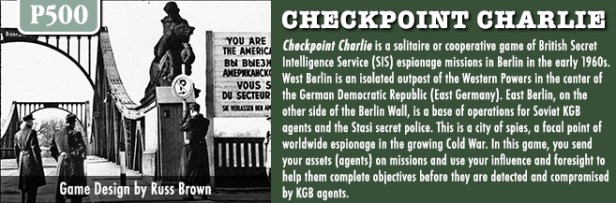
I love a different style and focus of wargame. A game that takes a look at an important but somewhat obscure or rarely addressed topic such as espionage or intelligence. And this past month, GMT Games announced such a game in Checkpoint Charlie, which is a solo or cooperative game focused on SIS espionage missions in Berlin in the 1960’s designed by Russell Brown. I have reached out to Russell and he was more than willing to provide some great insight into his design.
*Keep in mind that the design is still undergoing playtesting and development and that any details or component pictures shared in this interview may change prior to final publication as they enter the art department.
Grant: Russ welcome to our blog. First off please tell us a little about yourself. What are your hobbies? What’s your day job?
Russell: Happy to be here to talk about Checkpoint Charlie! My wife and I live in a lovely town called Waukesha, just outside Milwaukee. I retired a little early from a career as a software developer and went back to the University of Wisconsin to study creative writing. That led to my main hobby, which is writing science fiction novels. On most days, I leave my house, walk to downtown Waukesha, and write at a local university library or public library or down at my favorite coffee shop. Basically, I’m livin’ the dream.
Grant: What motivated you to break into game design? What have you enjoyed most about the experience thus far?
Russell: I’ve done a lot of freelance writing for tabletop RPG publishers, but what got me interested in historical game design was solitaire bots. A couple years ago, I found a bot for Command and Colors: Ancients created by Paulo Miranda, and I had a blast playing against it. I expanded it for Samurai Battles and had fun with that. I decided to create a full bot, with no decisions made by the player, for one of my favorite games, Here I Stand. It took months, but I ended up with deck-based bots for each power that had their own personality and did some basic negotiating with the players and the other bots. In my last game against them, as France, I came in fourth. After that, I made full bots for Talon and Combat Commander: Europe. The next step was to develop a solitaire game from scratch, and the idea of a game about espionage in Berlin had been bouncing around in my head for decades. What have I enjoyed most about the experience? The answer is strange, but I think I actually miss being a programmer. Game development uses those same parts of my brain. It’s very different than writing novels.
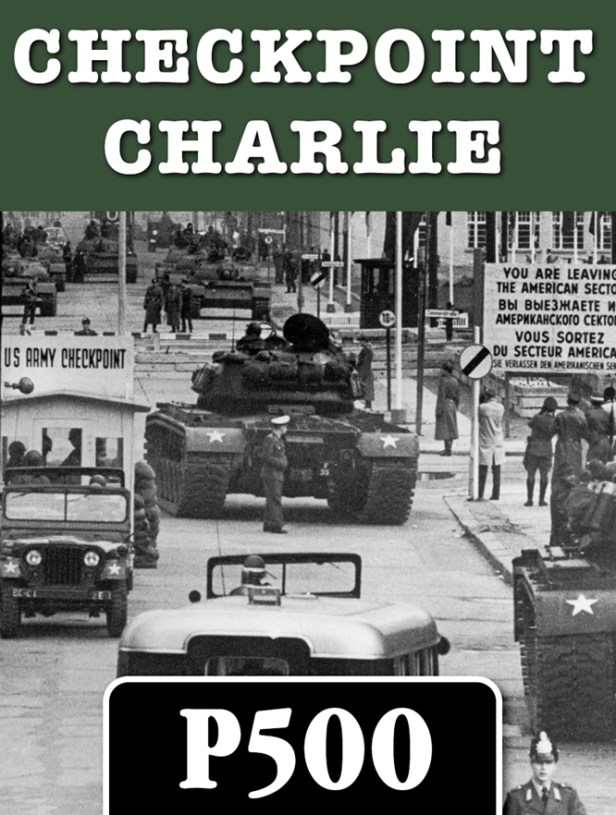
Grant: What is your upcoming game Checkpoint Charlie about?
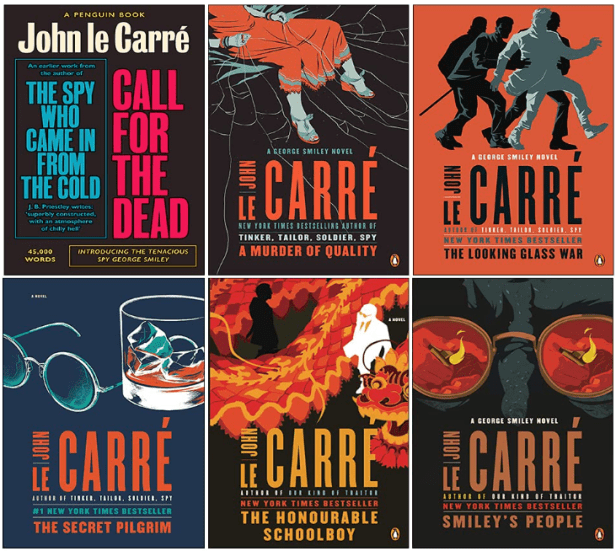
Russell: Checkpoint Charlie is about managing British Secret Intelligence Service espionage missions in early 1960’s Berlin. You play as a case officer, a mastermind if you will, not an individual agent. It’s inspired as much by the fictional works of authors like John le Carré as it is by accounts of actual espionage operations. If you’re familiar with le Carré’s novels, you play as George Smiley, not one of his field agents.
Grant: What games have you used as inspiration for your design?
Russell: That’s a tough one. I struggled to find a game mechanic that evokes the feel I want, a lack of complete control over agents and the situation. I’ve probably been more inspired by computer games with simultaneous movement, maybe something like RimWorld, than by any particular boardgame.
Grant: What is important to model or include in a game about the British Secret Intelligence Service?
Russell: The first question is, who is the player supposed to be? I didn’t want to model the experience of an individual field agent. What fascinated me most about accounts of these missions, including faithful fictional accounts, is the way all the assets work together and adapt to a changing situation. I want the player to experience that, all within the context of secrecy, of trying to not be discovered and compromised. To fully experience that, the player has to be a case officer, a person leading and coordinating the mission. What that means, however, is that the player doesn’t have full control of every individual action taken by every agent.
Grant: What challenges did the subject cause for the design? How have you overcome them?
Russell: I’ll limit my answer to what I think were the two biggest challenges. The first was creating a game in which the player doesn’t have complete control, but still has enough agency to successfully complete a tough mission and feel like they did something amazing. We’re working on an article about this for the Inside GMT blog, but the solution mostly comes down to the card draw movement mechanic. Most of the movement and actions that take place on the map of Berlin happen based on which card the player chooses from the draw area. That one choice triggers the movement of up to five assets and KGB agents and also affects where surveillance and intel appear on the map. The second challenge was making a game about missions taking place in secret over hours or days, with fictional agents, feel at least somewhat historical. I hope we accomplished this by using actual locations on the map and including historical events to anchor the missions in this period.
Grant: What type of missions do players undertake?
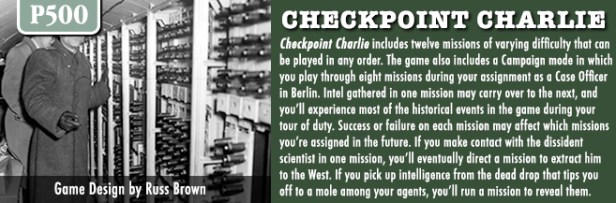
Russell: I hope Checkpoint Charlie will be perceived as a “toolkit” game. For me that means there are enough components there, and enough interacting mechanics to be able to create many different missions that feel unique. Specifically, there are missions that are basically pick up and deliver with a KGB agent on your tail, missions where you set a trap for a KGB agent by planting a piece of tempting intelligence, a mission where you have to cross the Berlin Wall to deliver instructions to a dissident Russian scientist, and a mission where you have to protect a Soviet defector and get him safely to the airport with identification papers in hand. If you play Checkpoint Charlie in campaign mode, you’ll uncover evidence of a mole in your station and run another mission to get them to expose themselves. Every mission requires you to worry about the basics of moving assets around on the map, but beyond that each mission is unique. There are twelve missions included, and so far, we haven’t run out of interesting ways to combine all the elements provided in the game.
Grant: How does the game work in its cooperative mode?
Russell: When playing solitaire, the player has four cards in their hand. With two players, each player gets three cards, and with three players, only two. However, each player contributes one of their cards to a shared hand available to all players. In this way, each player always has four cards to choose from. This also helps reduce the issue of a player holding a card that’s important for the mission, but it isn’t their turn when it’s needed. The game also includes optional secure communications rules, where players cannot discuss plans or strategy or future game states except when they exhaust a meeting token to pause the game and have a discussion.
Grant: How do players work together?
Russell: The players are all working toward the same mission objectives, taking turns going through the turn sequence. They work together by having the same plan so they’re not working against each other. They work together by being smart about which cards they contribute to the shared hand. In secure communications mode, players have to save their meeting tokens for those critical moments when they’re presented with a new challenge or it’s clear that the existing plan has gone off the rails. The cards contributed to the shared hand are even more important in secure communications mode, because they can signal basic agreement on a plan without having to call a meeting.
Grant: As a solitaire game how does the bot work? What are its priorities and how does it make decisions?
Russell: The opposition basically emerges from two mechanics in the game. The first is the surveillance pawns placed in locations around the map. These appear when a surveillance card is drawn from the mission deck and they are placed based on which cards are showing in the draw area. When an asset moves into a location under surveillance and fails a save roll, they become detected, along with any items they carry. The second mechanic is the movement of KGB agents on the map. They move around based on which card the player takes from the draw area, in the same way that the player’s asset’s move. Running into a KGB agent almost guarantees an asset will be detected. In addition, when an asset or item is detected, every KGB agent gets a free move every turn and converges on that asset or item. If a detected asset or item is ever in the same location as a KGB agent at the end of a player turn, they are compromised and removed from the mission. There are some very simple priority rules governing which location KGB agents will move to if they have a choice, but otherwise the logic of how they move is the same as for the player’s own assets.
Grant: What type of experience does the game create for players?
Russell: I think the word is “constrained,” or maybe “desperate.” The game is designed to make players feel like they don’t have much control of the situation, when in fact they do have enough to successfully complete the missions. Toward the end of a mission, when the players look at the cards in their hands and the draw area and see that there is a path to victory, despite the fact that their key agent has been detected and KGB agents are closing in, I want them to breathe out and realize they haven’t truly relaxed for thirty minutes.
Grant: What decision points face players?
Russell: Good question. Players will feel, with good reason, that the most important decision they make each turn is which of the two cards they take from the draw area. That decision effects so many parts of the game, and often involves making difficult tradeoffs. But players also make many other decisions each turn. When assets and KGB agents move, they often have a choice of two destination locations, and the player can usually decide between them. The player also must decide which card to play at the start of their turn, and this can significantly impact the outcome of everything that follows. The player can spend Intel cubes to look ahead at the next card, or to improve the odds of a detection save. They decide when an asset picks up or drops an item. In a multi-player game, they choose cards to add to the shared hand and decide when it’s necessary to call a secret meeting.
Grant: What is the layout of the board?
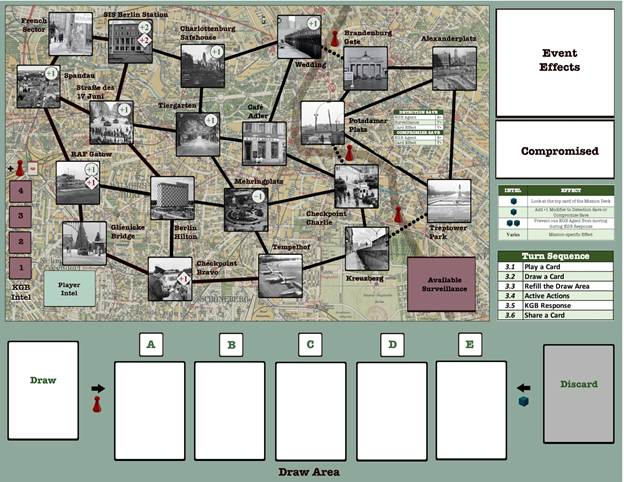
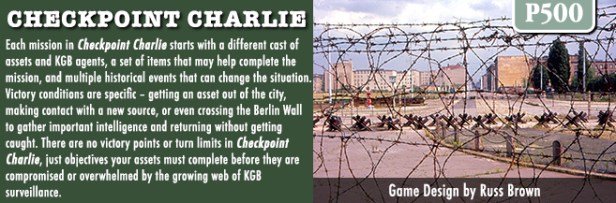
Russell: First, I need to point out that this is all just my own prototype artwork for playtesting. The two most important areas on the board are the map of Berlin and the card draw area. The map is roughly a five by four grid of iconic locations connected by travel lines. It’s made up of sixteen locations in West Berlin and four in East Berlin, on the other side of the Berlin Wall. The player’s assets will move around this map, gathering intel, interacting with items and other assets to complete the mission, and hopefully avoiding detection. The KGB agents also move around this map and are the players’ primary adversaries. Below the map is the card draw area, a row of five face-up cards representing locations, items or assets. Above each card location is a spot for a chit representing one of the moving tokens on the map – the assets and KGB agents. The draw area is the core mechanic of the game, determining where assets and KGB agents move, where surveillance and intel cubes are placed, and even where some historical events take place. In addition to these two areas, the board also contains locations for intel collected by either side, as well as unused surveillance pawns available to the KGB.
Grant: Why was a point to point layout of locations your choice for the board?
Russell: Checkpoint Charlie evolved from a smaller card game in which the player built up the map of Berlin by placing cards in a grid, so I think that led to a point to point map. It’s also important for the paths between locations to be immediately clear and easy to process for the players, since they’re often calculating which is the shortest path between two locations. Perhaps the main reason we’ve stuck with this layout, instead of say, going to an actual map of the city divided into regions, is that it allows us to highlight iconic locations Instead of entire neighborhoods. Assets move from Checkpoint Bravo to the Berlin Hilton, or from Café Adler to the Tiergarten. It allowed us to give the whole game a more narrative feel.
Grant: What is the purpose of the draw area at the bottom of the board?
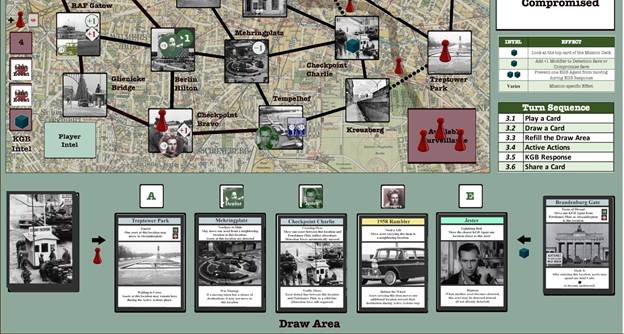
Russell: The basic mechanic is that players can only draw one of the two cards on the ends of this row of five cards, and then all the other cards shift before refilling the empty position. No card stays in the same location from turn to turn. This is important, because these cards are used to determine where tokens move on the map. Each card location can have a chit above it corresponding to an asset or KGB agent on the map, and every turn, after the cards shift, that asset or KGB agent moves toward the location, item, or asset depicted on the card below their chit. In this example, the Dentist token will move to Mehringplatz, because that’s the card below her chit. Jester will move one location closer to Checkpoint Charlie, and Svetlova, the KGB agent, will move one location closer to the 1958 Rambler item currently at RAF Gatow. In addition to their role in moving tokens on the map, each card also has an effect printed on the bottom that applies whenever that card is showing in the draw area. As cards are drawn and new cards replace them, these effects come and go and can have significant impacts on the mission. Finally, the five cards in the draw area are also used to determine where surveillance pawns and intel cubes are placed.
Grant: How does the game use cards?
Russell: Cards are used for a few different systems in the game. When they are showing in the draw area, they determine where assets and KGB agents move, apply special effects to their depicted location, item or asset, and are used to place surveillance and intel. When a card is in a player’s hand, or in the shared hand in a cooperative game, they are only used for the played effect printed at the top of the card. There are also cards in the mission deck used to trigger historical events and the placement of surveillance pawns and intel cubes.
Grant: What types of cards are included?
Russell: The three most important types of cards, and the only cards that will ever end up in the draw area or a player’s hand, are location, item, and asset cards. The draw deck for the mission, referred to as the mission deck, contains one card for each of the twenty locations on the map, plus one card for each asset and item involved in the mission. The mission deck will also include a variable number of surveillance cards, intel cards and event cards, depending on the mission.
Grant: Can you provide us with a few examples of the cards and explain their uses?
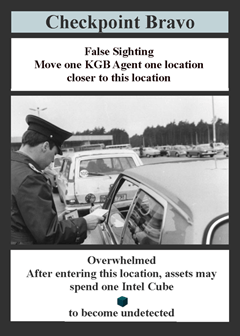
Russell: Certainly. Let’s start with the location card for Checkpoint Bravo. On the map you’ll find the Checkpoint Bravo location at the bottom left. In reality, this was the main entry point for road traffic coming into West Berlin from West Germany, and it was actually a much busier crossing than Checkpoint Charlie. The name and the image on the card make it easy to match it to its corresponding location on the map. At the top of the card is the played effect. This is what happens when the player plays the card at the start of their turn, and it generally isn’t optional. At the bottom of the card is another printed effect. This is the active effect and applies as long as the card is showing in the draw area. The Checkpoint Bravo card is actually quite powerful. It moves a KGB Agent of the player’s choice one location closer to Checkpoint Bravo. The active effect of this card is very good, as well. As long as the card is showing in the draw area, the player may spend an intel cube to make a detected asset entering Checkpoint Bravo become undetected.
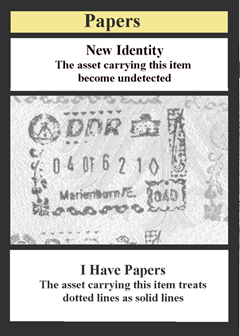
Next let’s look at the Papers card, arguably one of the most important items in the game. This card will only appear on missions that include the Papers item marker. If a detected asset has picked up this item and is carrying it, playing this card can make them undetected. For some missions, the active effect at the bottom of this card is even more important. Dotted travel lines on the map cross over the Berlin Wall and assets normally can’t traverse them, but while this card is showing in the draw area, an asset carrying this item can cross into East Berlin, or back.
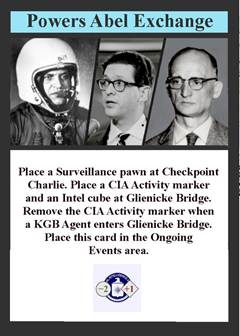
Finally, let’s look at an event card. This is the Powers Abel Exchange card. It represents the 1962 CIA prisoner exchange of Soviet spy Rudolph Abel for captured U.S. U-2 aircraft pilot Francis Gary Powers at Glienicke Bridge, as depicted in the movie Bridge of Spies. When this card is drawn, it has the printed effect and then is set aside for reference. Event cards never stay in the draw area or go into a player’s hand.
Grant: What types of missions confront the players?
Russell: I’ve mentioned a few, but others include transferring intelligence documents through a dead drop to throw off enemy agents, making sure a West German Stasi agent finds evidence that the KGB has infiltrated the West German secret police, using radio receivers and any means necessary to gather intel from East Berlin, and planting a bug on the other side of the Berlin Wall.
Grant: What happens when a mission fails or succeeds?
Russell: If you’re playing a single mission, completing the objectives of the mission means you’ve won. There are no victory points, just success or failure. If you’re playing through missions as part of the campaign, then whether you win or lose a mission may determine which missions you’re assigned in the future. If you successfully deliver instructions to the dissident Russian scientist, then at some point you’ll be assigned a mission to cross into East Berlin and extract him to the West. If you failed to deliver the instructions, you’ll be assigned a different mission. Most importantly, your score in the campaign game is based on how many of your eight missions you complete successfully. Losing a mission also typically implies that one or more of your assets were compromised, which may limit their availability for future missions.
Grant: How is victory obtained in the game?
Russell: Each mission has one or more specific objectives that must be completed. As soon as those conditions are satisfied, the players immediately win. Conversely, there are one or more conditions that immediately end the mission in failure. In the campaign game, the player is rated based on how many missions they completed successfully.
Grant: What role do intel cubes play? How are they acquired and what do they offer?
Russell: Intel cubes represent intelligence available in the city that is pertinent to the mission. This could be coded signals, special documents, or known informants. Missions typically start with a couple intel cubes already on the map, and every time an intel card is drawn from the mission deck, an intel cube is placed on the location represented by the rightmost card in the draw area. Whenever one of the player’s assets moves into a location with an intel cube, the cube is collected and can be spent by any player during their turn for various benefits. For example, spending a cube allows the player to look at the next card in the mission deck. When a KGB agent enters a location with an intel cube, that cube is placed in the next box of the numbered KGB Intel track, and mission-specific events are triggered when specific numbers are filled. For instance, a mission may specify that another KGB agent is added to the map when the KGB Intel track reaches space 3.
Grant: What role does surveillance play?
Russell: Each time a surveillance card is drawn during a mission, a location in the draw area is placed under surveillance, signified by a red surveillance pawn. This means KGB surveillance resources have been allocated to that location. Some card effects remove surveillance pawns, while others place locations under surveillance. Each mission has a limited number of surveillance pawns, so when surveillance is added in one location, it may be removed from somewhere else. When an asset moves into a location under surveillance, they must roll a 10-sided die and pass a save or become detected. Some locations improve this roll, as do some items, and some assets are just better at avoiding detection. Some event markers, like demonstrations, also affect this save. As I mentioned earlier, once an asset is detected, KGB agents will move toward them and they will soon find themselves compromised and removed from the mission.
Grant: How does the campaign system work?
Russell: Players undertake eight of the twelve missions and are rated based on how many are successful. The set of missions assigned depends on success or failure of some of the earlier missions. Some of the intel cubes gathered during one mission may carry over to the next, and compromised assets may have to sit out a mission or two. Any historical events that occur are also removed from the campaign so they’re not repeated in later missions.
Grant: What do you feel the game models well?
Russell: I think Checkpoint Charlie shows that the mission is going to move forward one way or another. You have to guide it and use what resources you have to nudge it back on track when it strays. You can try to force it by drawing cards that always move your favorite asset to their best location, but that probably means your other assets are going to stumble into a KGB agent, or the KGB agents are going to gather too much intel and trigger some unwanted event. This is a game about making intelligent tradeoffs and using what control you do have to mitigate the bad effects when there aren’t any good choices.
Grant: What has been the experience of your playtesters?
Russell: The pleasant surprise for me has been how quickly they adapt to the way their assets and the KGB agents move. Compared to other games with movement points or action points or an activation system, Checkpoint Charlie is very different. They’ve figured out the whole draw, shift, move process within a couple turns. It is different, but it’s actually fairly simple. It has also been fun to see them view the components of the game, and particular card events, as part of a narrative. The game is telling a story.
Grant: What are you most pleased about with the design?
Russell: I’ve played this game a lot, in all of its iterations. I’ve been through all of the missions many times, and then played through them all again to make sure we didn’t break them after we adjusted some rule or changed the effects on a couple cards. What pleases me most is that when I play this game, even after playing it all those times, I still really enjoy it.
Grant: What other designs are you contemplating or already working on?
Russell: I’m working on solitaire bots for Virgin Queen and for Combat Commander: Pacific. I have three board game designs in various stages. The first and farthest along is Allied Advance, a small, one-hour solitaire game where the player commands allied forces in Europe from the capture of Monte Cassino to the fall of Berlin. The second is Gilgamesh, a three-player game of Mesopotamia’s Early Dynastic Period, where the winner is the ruler whose reign inspires the most memorable epic. The third is Bletchley Park, a two-player game that spans all of World War II in Europe, with one player as the axis commanders encoding the details of large military operations, and the other as allied observers and codebreakers trying to undermine those operations without revealing which codes they’ve broken. It’s going to be a lot of fun figuring out the bot for that one.
Thank you. I’m grateful that I had this chance to answer your questions.
In my opinion, this game looks extremely interesting and I am very much excited to learn more about it. I am so glad that this topic is being covered here and look forward to playing this one day soon.
If you are interested in Checkpoint Charlie, you can pre-order a copy for $48.00 from the GMT Games website at the following link: https://www.gmtgames.com/p-1211-checkpoint-charlie.aspx
-Grant
 The Players' Aid
Looks intriguing! I’m as excited as you are for new perspectives in historical gaming. And 1960s Berlin is a great setting!
LikeLiked by 1 person
This looks particularly interesting. Cool.
LikeLiked by 1 person