Martin Melbardis began his design career with Campaign: Fall Blau from Catastrophe Games. This was a very interesting little dice chucking solitaire game on Operation Barbarossa during WWII. Since that time, he has started his own independent wargame company called Solo Wargame and has designed 13 different and very interesting roll and write wargames on a plethora of subjects including World War I (Trench Tactics), World War II (Operation Barbarossa, Lone Wolf: U-Boat Command and War in the Pacific), Napoleonic Wars (Siege Works), the Crusades (Crusade: Road to Jerusalem) and Ancient Rome (Rome Must Fall). His newest game called Fliegerkorps is focused on the airwar during WWII and looks really interesting and I reached out to Martin to get a bit more information about the game.
At the time of the posting of this interview, the campaign for the Kickstarter is active but time is running out and you can back the project at the following link: https://www.kickstarter.com/projects/105281170/fliegerkorps
Grant: Welcome back to the blog. What is your new game Fliegerkorps about?
Martin: Hello everyone, great to be back! Fliegerkorps, my newest game, is a solo operational air war game where you command a German Fliegerkorps (air corps) across one of three historical campaigns, The Battle of Britain, Barbarossa, or the Mediterranean. At the very beginning of the game you build your Fliegerkorps by choosing a commander to lead them and choose four aircraft cards to make up your air corps. During each of the fixed 12-turn campaigns, you manage your aircraft, fuel, and squadrons under mounting enemy pressure from air, land, and sea. You must complete enough missions to rack up Victory Points (VP) to influence the campaign before attrition grinds you down.
Grant: Why was this a subject that drew your interest?
Martin: I’ve always been in love with military aircraft for as long as I can remember, but honestly, it started with late-night YouTube rabbit holes on the Battle of Britain with those grainy clips of Spitfires vs. 109’s which got me hooked on the subject recently. After a few days, I came to the realization that I’ve never seen a wargame about managing an entire air corps. I’ve seen plenty of games about dogfighting or perhaps controlling a squadron of aircraft…but never at the corps level where you must deal with logistics, maintenance and planning sorties. I soon came to the realization that I wanted to design something that felt like you were commanding from a smoky ops room in 1940, watching your force slowly bleed out through attrition and sorties while high command demands more. One night I sketched a rough game design document on the idea and couldn’t sleep until I had the basics down.
Grant: What is your design goal with the game?
Martin: My goal was to create a light-to-medium operational solitaire air game that feels tense but stays streamlined and abstracted. I wanted players rolling dice, making meaningful decisions, and constantly weighing risk versus sustainability. Most importantly, I wanted to capture that operational rhythm of launching, suffering losses, refitting, and launching again.
Grant: What sources did you consult to get the historical details correct?
Martin: Core was the Rand McNally encyclopedia of World War II for consulting on general WWII aircraft histories, campaign overviews of the Battle of Britain, Barbarossa, and the Mediterranean Theater, as well as aircraft production and deployment timelines.
I’ll admit that I’m a total visual guy, and that shapes everything I design. YouTube documentary dives into Battle of Britain dogfights, early air war chaos, and Luftwaffe ops kept me fired up, motivated and increasingly informed on the subject throughout the entire Fliegerkorps development.
Grant: What battles are included in the game?
Martin: Battles in Fliegerkorps are more or less abstracted into missions rather than recreated tactically. For example, something like the potential invasion of Malta is represented through a Campaign Mission rather than a detailed operational scenario.
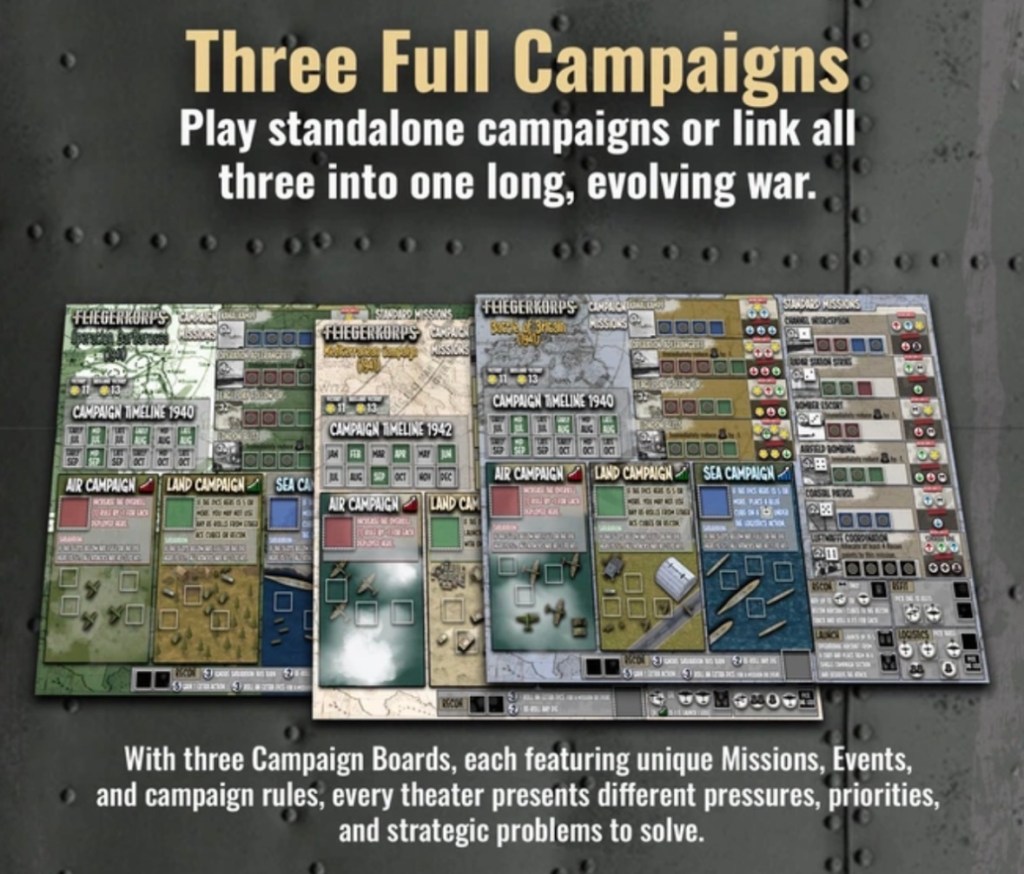
The game includes three campaigns: the Battle of Britain (1940), which focuses on an air supremacy grind, Barbarossa (1941), which blends air and land operations on the Eastern Front and the Mediterranean (1942), centered around convoy strikes, the siege of Malta and desert support. Each campaign has its own mission structure and pressure profile, so while the core system remains the same, the overall challenges change depending on the theater.
Grant: What elements from the early air battles of WWII did you need to model in the design?
Martin; I wanted this game to lean heavily into the simulation aspects of controlling an air corps in WWII and leave out much of the unit tactics involved in battles. Several key elements needed to be represented in the design were aircraft rotation between the Operational and Refit rows, logistical limitations, and escalating enemy pressure tracked through the Air, Land, and Sea Campaign Dice. I also wanted the game to reflect the reality that these campaigns were multi-domain efforts. Air operations rarely existed in isolation, they influenced and were influenced by events on land and at sea. It was important for me that the player could meaningfully affect the larger campaign across all three theaters: Air, Land, and Sea.
Grant: How does the player have to balance their missions, fuel, aircraft losses and worsening strategic conditions?
Martin: In the Mission Phase, all existing mission timers are reduced by one (if they reach zero, you fail the mission) and so missions can’t be ignored for long. If you allow timers to expire, penalties escalate with VP losses, Campaign Dice increases, or additional enemy cubes entering play. If you choose to engage those missions, it will cost fuel and you risk aircraft losses. Launching aircraft costs fuel and after attacking, you move the squadrons to the Refit Row on the aircraft card for maintenance. Larger aircraft like bombers take longer to recover than lighter fighters. So every turn becomes a balancing act. The tension builds steadily over the 12 turns, and that operational pressure is really what the game is about.
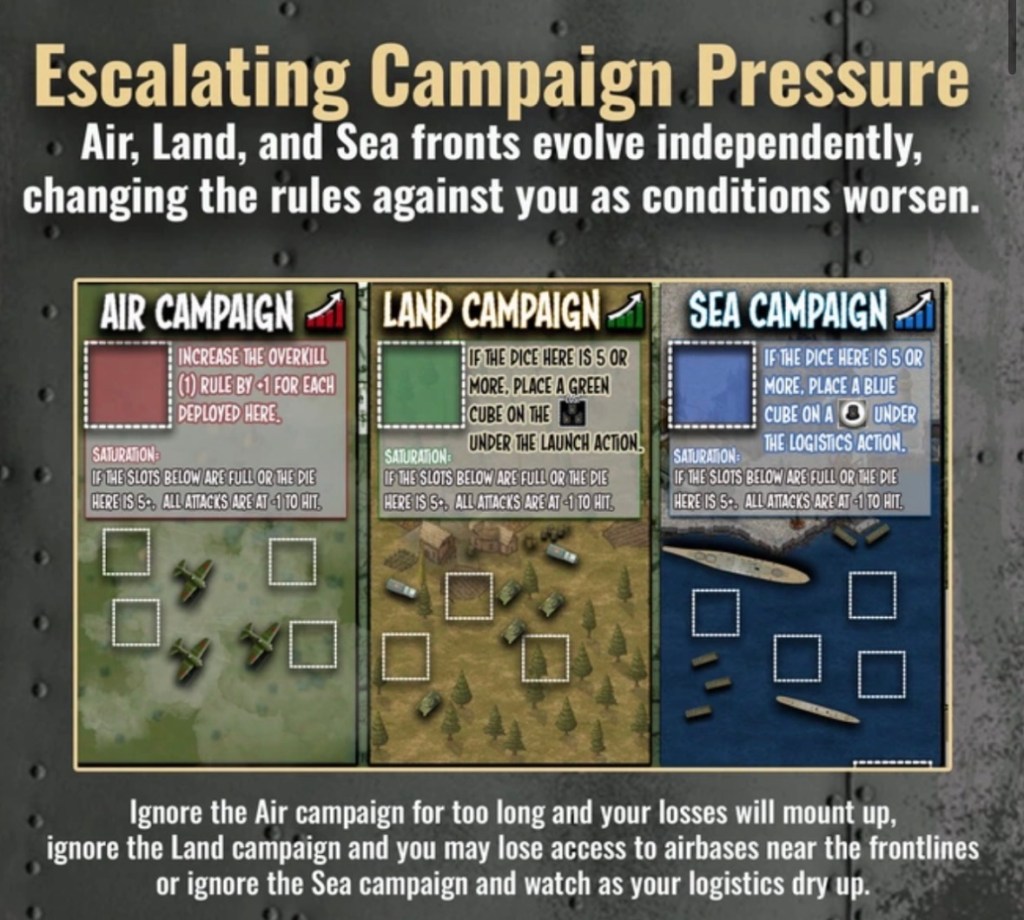
Meanwhile, Campaign Dice track strategic pressure in the Air, Land, and Sea sections. As missions and events accumulate, those values can possibly creep up. If a Campaign Die ever reaches 5+, Saturation penalties will apply and certain section-specific restrictions will come into play. This will reduce your options and make future attacks on that section even tougher.
Grant: How does campaign pressure from air, land and sea campaigns affect the player?
Martin: All Campaigns have on their gamesheet containing three Campaign Sections…Air (red for enemy fighters), Land (green for ground forces, AA, and infrastructure), and Sea (blue for convoys, naval logistics, and supply lines). Each one has its own Campaign Die that tracks how bad things are getting in that section. The higher the number, the worse conditions are getting for the Germans. Things such as more enemy pressure, tougher challenges, and nastier effects kick in. If a section becomes Saturated, it seriously lowers your effectiveness when dealing with that Campaign section. In addition, that sections’ specific penalty applies (like in the Battle of Britain, where the Land die at 5+ blocks any chance of rerolls.) Ignore any section too long, and the pressure snowballs across turns.
There is also the chance of a Campaign Collapse which happens if any two of those dice ever hit 6 at the same time (Air + Land, Sea + Air, whatever), the whole campaign falls apart and you lose immediately. No VP tally…it’s game over. It’s a tipping point where one front collapses and drags everything down with it.
Grant: What is the dynamic mission system? How does it work?
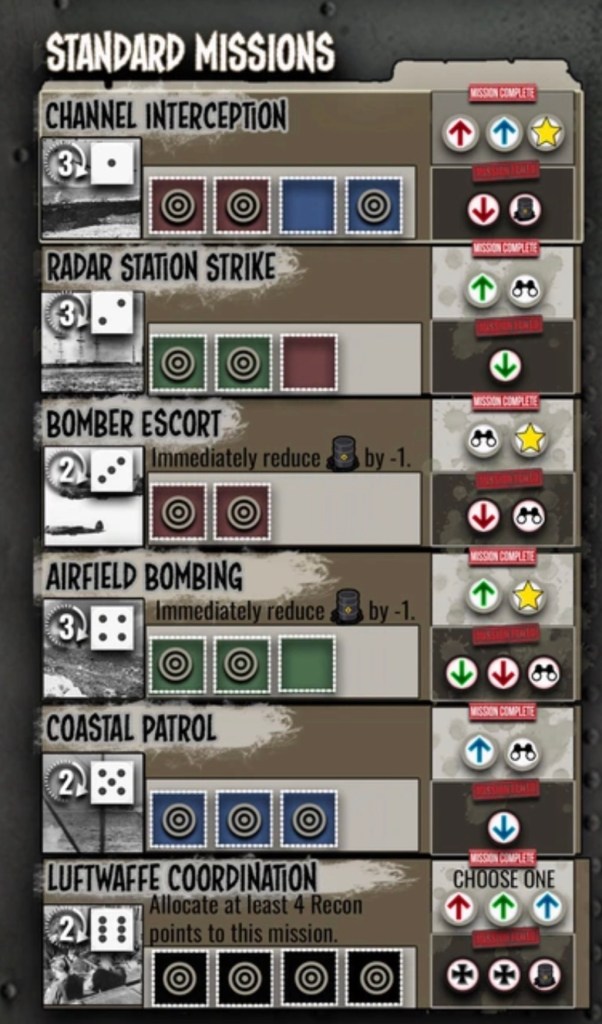
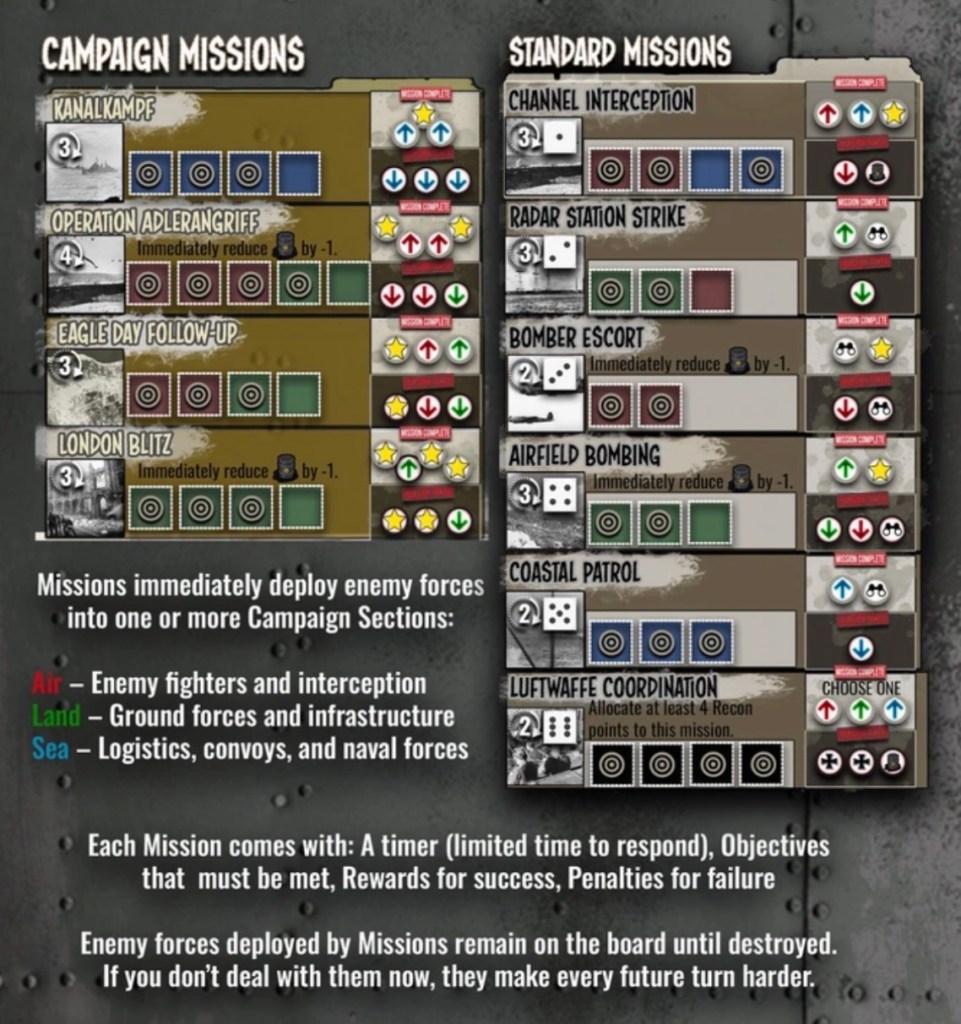
Martin: Missions are the central heartbeat of Fliegerkorps, popping up fresh each turn right in the Mission Phase. Each Mission has a die as a timer that you tick down by -1 each turn and meaning no mission lasts forever, and can expire if not completed in time. This does really well to reflect history by adding a sense of urgency to each mission.
Usually Missions are generated by rolling a 1D6 on the Standard Mission table for routine ops like fighter sweeps or convoy strikes and deploy enemy cubes in the section. However, if you land on a green spot on the Timeline? You Skip the roll and generate a Campaign Mission with bigger risks, but juicier rewards. Campaign Missions are unique, historical operations like the London Blitz or the Encirclement of Kiev.
Grant: What choices does the player have for building their Fliegerkorps?
Martin: I absolutaly wanted to include some sort of customization or army building mechanic in the game to allow players to build their own Fliegerkorps using a tight 25 Victory Point (VP) budget.
Before each game you start by choosing a Commander card and pay its VP cost. Commanders simply provide a single, but powerful, special ability. An aggressive option like Richthofen boosts offensive output, while others may reward efficiency or control. Always choose one that matches your style.
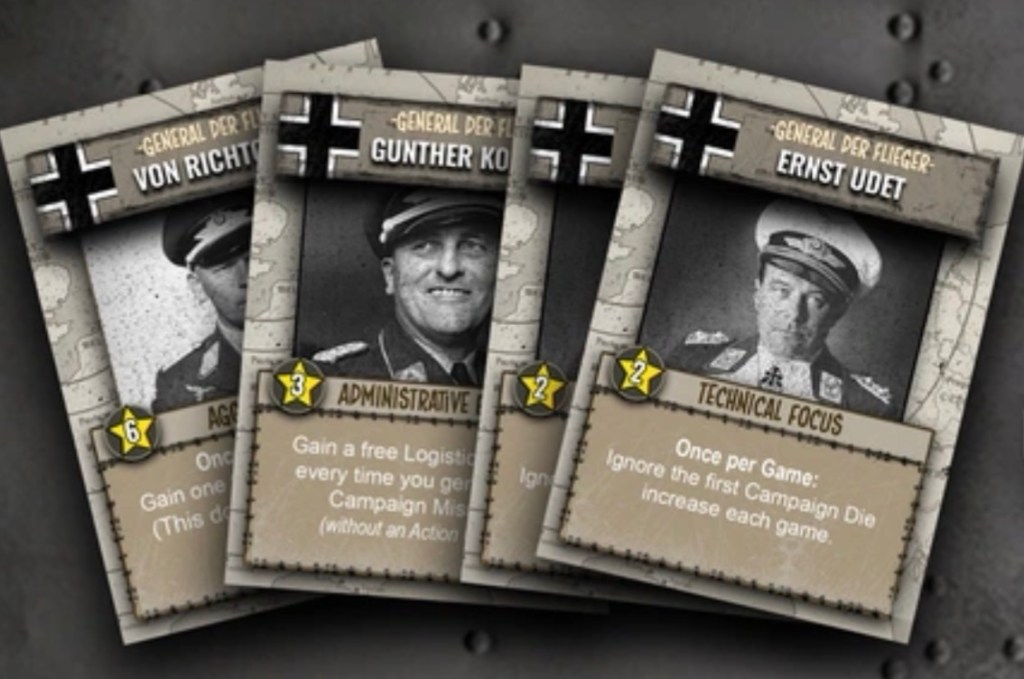
Next, choose exactly four Aircraft cards, keeping in mind theater and year restrictions. A mix of fighters, bombers and some Recon aircraft is usually best.
If you have unspent VP, you can always buy extra black Fuel cubes or white Iron Cross cubes (for clutch rerolls.) In Campaign-mode, after each Campaign, you get a chance to further upgrade your Fliegerkorps by buying upgrade cards, or exchanging aircraft cards as new aircraft become available in later campaigns.
Grant: What does an aircraft card look like?
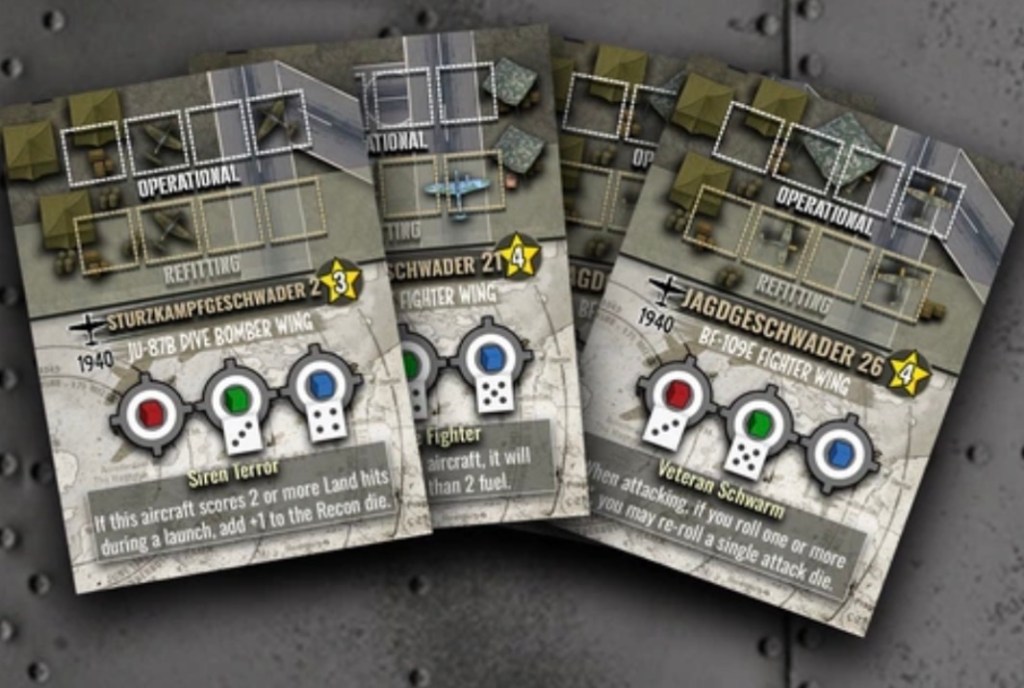
Martin: Aircraft cards are the real stars of Fliegerkorps, they include fighter, dive-bomber, recon, bomber, or even heavy fighter wings, with 2-4 grey cubes each to track the strength of the squadrons that make them up. I honestly think one of my best design decisions for the game was to have an airfield diaroma on the top half of each of the aircraft cards which is further divided into the Operational Row for launch-ready aircraft cubes and the Refit Row, just below, for beat-up aircraft nursing wounds, maintenance and parts.
Each card also has attack ratings vs. Air, Land, or Sea, plus a special ability that will help you during the Campaign. In addition, each card also lists if it’s a Large or Small aircraft type (which affects some actions, the reasoning behind this is that bombers are much more “hangar queens” than small fighters.) Finally, all cards have a VP cost to buy them in your 25 VP build, a year availability and sometimes icons for Recon.
Grant: What is the ultimate player goal for the game?
Martin: The goal is all about how well you balanced your aircraft sorties to complete as many important missions as possible before time runs out. At the end of an intense 12-turn campaign it really boils down to pushing aggressive launches and attack tempo, against refit, recovery and the logistical limitations of WWII Germany. At the end of the game, you tally up those hard-earned VP’s from mission completions and lowering Campaign dice enough and check them against the Victory threshold table on your game sheet.
Grant: What is the layout of the Game Sheet?
Martin: The Game Sheet in Fliegerkorps is laid out so everything’s visible at a glance. I always try to make it as easy as possible for solo play without over-complicated charts or even flipping pages. The top left has the Timeline with 12 slots or turns. Green spots on the Timeline for triggering those rare high-stakes Campaign Missions and with the VP thresholds just above the Timeline.
The center is dominated by the three Campaign Sections (Air: red fighters, Land: green AA/ground, Sea: blue convoys and naval forces) while the top right lays out the Standard Mission and the Campaign mission tables. Finally, the Bottom right has the all-important Action Boxes.
Grant: How are Action Cubes used by the player?
Martin: In the Luftwaffe Phase each turn, you grab four Action Cubes (think of them as your command orders), and allocate them one by one into any empty slot inside any of the Action Boxes at the bottom-right of the game sheet. Slots are limited on certain actions and some slots cost more Fuel or gives less options than others. For example, the Logistic action allows you to pick three options such as recover a loss aircraft or gain fuel. However, using the same action a second time limits you to picking only two options. I felt that adding diminishing returns for repeated use of the same action would help prevent players from spamming certain actions.
Grant: How is the number of Action Cubes available determined each round?
Martin: Action Cubes are fixed at four Action Cubes every Luftwaffe Phase. Campaign effects, Commander abilities or upgrade cards can sometimes alter the available actions in a turn, but for the most part you will always be given four Action Cubes per turn.
Grant: What different orders does the player have access to? How do they affect the game?
Martin: Orders, or Actions, are where the player get’s a chance to react to the evolving Campaign. Some actions require Fuel and each action resolves immediately once placed. The available actions are:
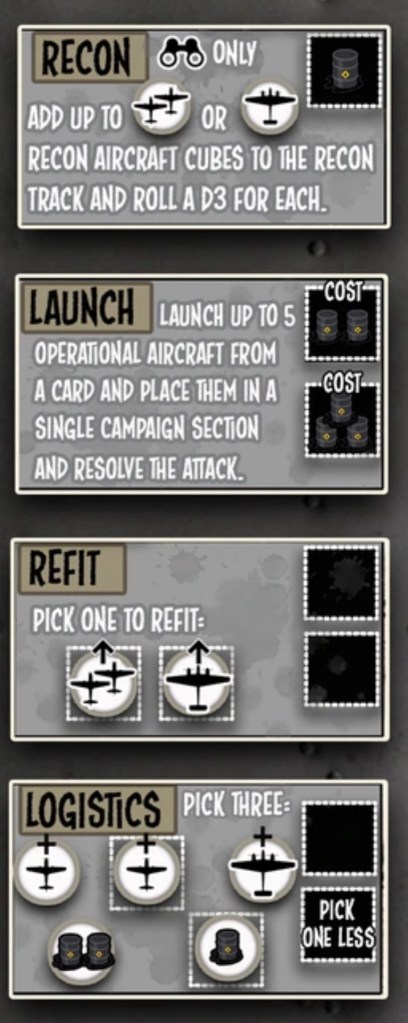
Launch/Attack: Launch aircraft from the Operational Row of one Aircraft card to target a Campaign Section. Successful rolls remove enemy cubes, which may be placed on Mission objectives if possible. After resolving the attack, those squadrons move to the Refit Row.
Recon: Use Recon-capable aircraft to gain Recon points, which can be spent to re-roll dice, ignore Saturation, gain an extra action, or adjust missions and events.
Refit: Moves squadrons from the Refit Row back to Operational status. Larger aircraft recover more slowly than smaller fighters.
Logistics: helps manage fuel and/or aircraft losses.
Grant: How is “victory” achieved?
Martin: At the end of the 12-turn campaign in Fliegerkorps, you simply total your VPs from completed Missions and any Campaign Die bonuses earned for keeping pressure under control. You then compare that total to the Victory threshold. Each campaign has its own required totals. The difference between Victory and Brilliant Victory is simply a matter of having a few extra VP’s to upgrade your Fliegerkorps at the end of the campaign (not to mention bragging rights)
In Campaign Mode (or Linked-Campaigns), any VP earned carries forward and can be spent on upgrades for your Fliegerkorps, such as additional Fuel or Iron crosses as starting resources, upgrade cards or exchanging aircraft cards .
Grant: What are the loss conditions?
Martin: You lose in one of two ways…First, if at the end of the 12-turn campaign your total VPs fall below the required threshold of Victory listed on the Game Sheet. For example, in the Battle of Britain you need at least 11 VP to achieve Victory. Anything below that is a loss.
Second, you lose immediately if a Campaign Collapse occurs. This happens if any two Campaign Dice reach 6 at the same time. For example, the Air and Land Campaign sections both maxing out. When that tipping point is reached, the campaign ends instantly. This reflects the idea that sustained pressure across multiple fronts can overwhelm theoverall campaign of your Fliegerkorps. Ignore one theater too long, and the consequences will cascade quickly.
Grant: What type of experience does the game create for the player?
Martin: I’ve always enjoyed fast-playing management-style games where you’re juggling resources and trying to prevent systems from spiraling out of control. That feeling was something I really wanted to reflect with Fliegerkorps. At its core, the game is a compact operational simulation themed around running a WWII Luftwaffe air corps. Each playthrough runs about 30 to 40 minutes. I also added options for different force builds and campaign theaters to try and create strong replay value.
Grant: What other topics are you planning to create games for in the future?
Martin: Firstly, some big news… Catastrophe Games will soon be launching a boxed edition of my game, Campaign: Bagration on Kickstarter. It’s the direct sequel to Campaign: Fall Blau, but this time you’re on the Soviet side in 1944.
I’ve also begun designing a new game called Shock & Awe, centered on the 1991 Coalition air campaign against Iraq’s integrated air defense network. I’ve also been exploring something completely different, a fast, arcade-style air combat experience centered on piloting a single Cold War-era fighter such as an F-15, MiG-29, or F-16. It’s still in the conceptual stage but the idea will evolve.
Beyond that…my solo print-and-play pipeline always remains active where I’m planning to continue my epic WWII Roll & Write series, focusing next on a North African campaign or possibly D-Day. Smaller games like this allow me to finish them relatively quickly while keeping the designs accessible and portable. I may also put out a voting poll to backers soon to help shape ideas for a future project. There are simply so many wars and time periods still worth exploring, and to me, community input is always valuable. As you can probably tell, I have far more game ideas than time to fully develop them all!
As mentioned above, the Kickstarter campaign has just a few days remaining so if you act quickly you can still back the project at the following link: https://www.kickstarter.com/projects/105281170/fliegerkorps
-Grant
 The Players' Aid