With this My Favorite Wargame Cards Series, I hope to take a look at a specific card from the various wargames that I have played and share how it is used in the game. I am not a strategist and frankly I am not that good at games but I do understand how things should work and be used in games. With that being said, here is the next entry in this series.
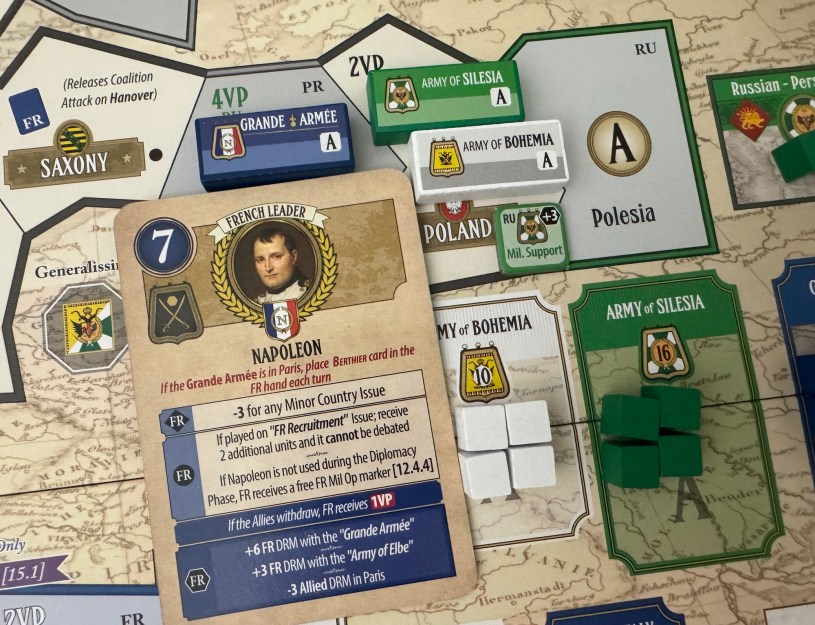
Card #60: French Leader Napoleon from Congress of Vienna from GMT Games
Congress of Vienna from GMT Games is a diplomatic card driven wargame based on Churchill and is the 4th game in the Great Statesmen Series. The game is set during the years of 1813-1814 and sees players take on the role of the main characters of the struggle between the Napoleonic Empire and the coalition of Russia, Austria, and Great Britain with their Prussian, Spanish, Portuguese, and Swedish allies. Congress of Vienna has two different but related phases including the conference table where players first debate over the control of issues germane to the factions and the period of the war and second these issues are then used on the battlefield to recruit units, attack and take overall command of battles. The players will be playing cards from their hands to “debate” over the various issues that were placed on the table, which include all types of things such as Military Operations, Recruitment, who will lead the combined Coalition forces (Generalissimo), Future of French Government, British Financial Aid, Liberalism vs. Absolutism, Austrian Neutrality and several other issues, and then later the players will use their accumulated Resources gained from the issues to enact action on the Military Map and do things like mobilize troops, place Military Support Markers and the ultimately to conduct warfare.
The game relies on cards and cards can be used to negotiate, i.e. move an issue to your National Track. Cards can provide a particular issue with positive and negative DRM’s depending on which nation plays them and can also be traded with another player during the Diplomacy Phase. Certain cards are better than others for debating an issue moved by another player; and finally, if they are saved for the War Phase, staff cards can be used to modify dice rolling in battles. These are very versatile cards and the players will have to learn them and their benefits in order to be effective at the game.
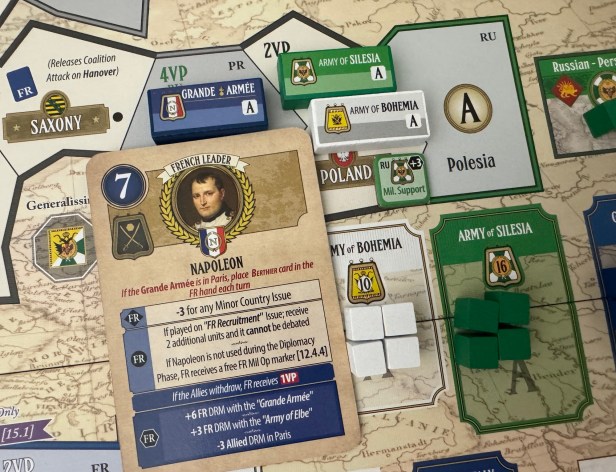
In this entry, we are going to take a look at the French Leader Napoleon card, which is one of the more powerful cards in the game. There is actually quite a bit of information found on the card but it all has a purpose and clearly explains when it provides bonuses when used on the various issues such as Minor Country Issues, French Recruitment as well as its various Dice Roll Modifiers during combat. This card is very powerful and must be used at the appropriate times for what the player is trying to do. Early in the game, the card can be used for its French Recruitment ability to gain new troops, the French will then gain 2 additional Units to use. When used during the Diplomacy Phase to effect the location of issues at the conference table, if used to move any issue it will provide a free French Military Operations Marker to be used on the battlefield to cause units to attack. The uses of Napoleon are many and players will need time to best understand when and where to use his abilities. But, his most impactful use is on the battlefield where he will grant various DRM’s depending on what French army he is commanding. If used with the Grande Armée, he will grant a massive +6 DRM while when being used for the Army of the Elbe he will only grant a +3 DRM. As the games wears on, and the Allies are at the gates of Paris, if used in defense he will grant a -3 DRM to the Allies attacking. These choices are very important and the correct choices will need to be made at the right time to be successful.
After playing now a few times, I am here to say that Congress of Vienna is probably my favorite game in the Great Statesmen Series. I believe that this game has matured the system and made it something that is more than where it started. Congress of Vienna is very much more like a true wargame and was extremely interesting. We are still learning and need to keep playing this one but I did enjoy what it was that we were doing.
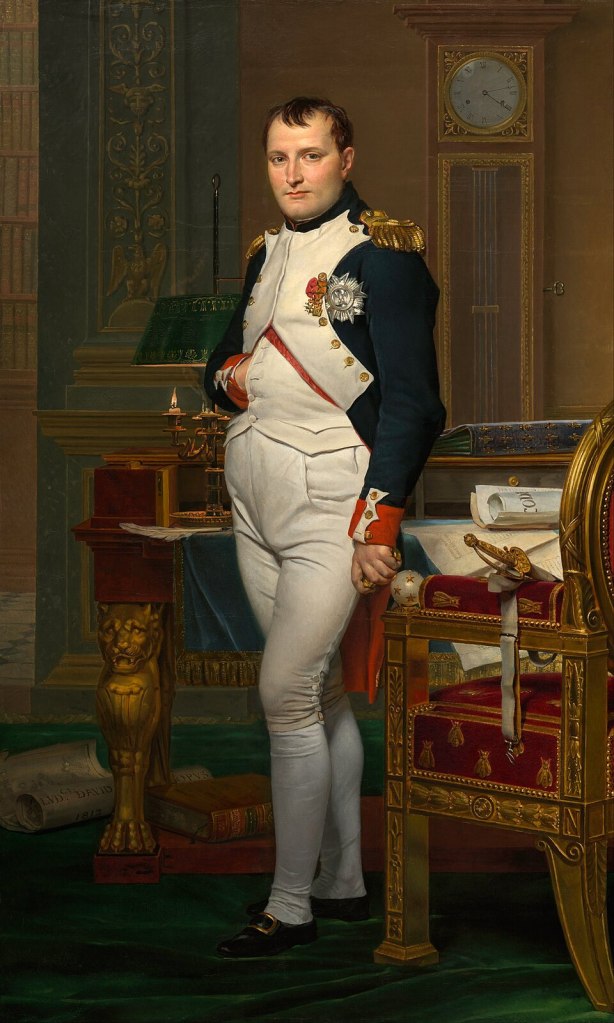
Napoleon Bonaparte (1769-1821) was a French military and political leader who rose to power during the French Revolution (1789-1799), became Emperor of the French (1804-1814/1815), and conquered much of Europe through brilliant, though costly, military campaigns, leaving a lasting legacy as one of history’s most famous and controversial figures, known for his strategic genius and ambition. He implemented significant legal reforms like the Napoleonic Code but ultimately faced defeat and exile, cementing his image as a complex figure of power and downfall.
Born on the island of Corsica to a family of Italian origin, Napoleon moved to mainland France in 1779 and was commissioned as an officer in the French Royal Army in 1785. He supported the French Revolution in 1789 and promoted its cause in Corsica. He rose rapidly through the ranks after winning the siege of Toulon in 1793 and defeating royalist insurgents in Paris on 13 Vendémiaire in 1795. In 1796, he commanded a military campaign against the Austrians and their Italian allies in the War of the First Coalition, scoring decisive victories and becoming a national hero. He led an invasion of Egypt and Syria in 1798, which served as a springboard to political power. In November 1799, Napoleon engineered the Coup of 18 Brumaire against the French Directory and became First Consul of the Republic. He won the Battle of Marengo in 1800, which secured France’s victory in the War of the Second Coalition, and in 1803, he sold the territory of Louisiana to the United States. In December 1804, Napoleon crowned himself Emperor of the French, further expanding his power.
We have done 2 videos on this game including the following RAW Video after out 1st play at Buckeye Game Fest in May 2025:
We then did the following full Review Video after our 2nd play at WBC last July:
In the next entry in this series, we will take a look at Mobile Vulgus from Time of Crisis: The Age of Iron and Rust Expansion from GMT Games.
-Grant
 The Players' Aid