With this My Favorite Wargame Cards Series, I hope to take a look at a specific card from the various wargames that I have played and share how it is used in the game. I am not a strategist and frankly I am not that good at games but I do understand how things should work and be used in games. With that being said, here is the next entry in this series.
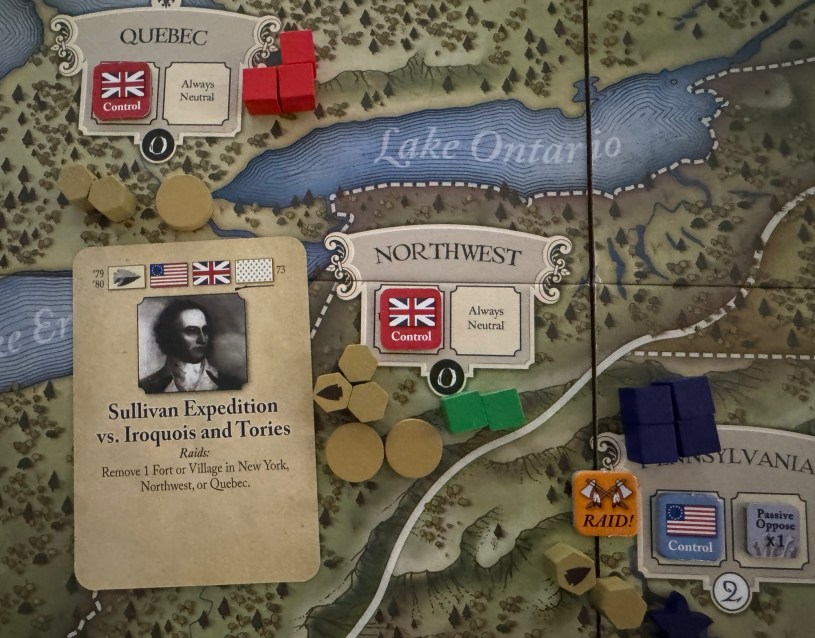
Card #59: Sullivan Expedition vs. Iroquois and Tories from Liberty or Death: The American Insurrection from GMT Games
In case you didn’t know, I love Liberty or Death: The American Insurrection! This is my 2nd favorite volume in the COIN Series and is such a fantastic game filled with the history of my favorite historical period the American Revolutionary War. Liberty or Death was the COIN Series’ first foray into non-modern warfare and takes us to the 18th Century and the days of the Brown Bess musket, the 18 pound siege cannon and nice and tidy formations better suited for a gentleman’s war. The focus of the game is the struggle of the American Patriots against their mother British government as they have made their intentions clear to become independent with the Declaration of Independence. The game is a multi-faction treatment of the American Revolution, which includes the Patriots and their allies the French against the British and their reluctant allies the Indians.
Liberty or Death is a 1 to 4 player game focused on all aspects of the struggle including financing operations with Rabble Rousing, infiltrating British held cities to Skirmish, blockading major cities with the mighty French fleet, Raiding the frontiers with the Indian nations, the spread of propaganda to build support for the revolution, fort building and small scale battles. So, with this short description you can see that this game is not a “traditional” wargame but does contain some armed conflict. So a game about the American Revolution that isn’t focused on battle you say? How can that be? Well, I will tell you that this game is probably a perfect representation of the multifaceted struggle that wasn’t necessarily decided on the field of combat, but by the little actions of many behind the scenes characters. Yes battle will decide the control of major areas of the board and decide the fate of troops as they must be concerned about being in supply through a network of forts but the game is so much more than just rolling some dice and consulting a CRT!
The battles of the frontier during the American Revolutionary War were brutal and continuous. The Indians of the time were concerned with the intrusions of and continual westward expansion of the colonists onto their sacred lands and could see that this was going to be a continual struggle for them and their people. The colonists long had disrespect and disdain for the primitive savage peoples of North America and their frontier settlements continually encroached on the Indian lands taking valuable forested area for hunting from them. This created lots of tension and lead to atrocities being committed by both sides as a means to stop the other side. The game is based on a continual struggle over winning the hearts and minds of the people to their cause and forcing compliance or swaying toward revolution. So for the Indians, they want the colonists to embrace their role as a colony of England and not want to become independent. This stance for the Indians is in response to the attitude of the crown toward westward expansion and interloping into the Indian homeland, namely that the crown didn’t want colonists going west. This is not because the Indians believe that the crown values them anymore than the colonists do. But, that they believe that the crown will not encroach on their land due to King George III’s Proclamation of 1763. I also feel that it represents a feeling by the colonists of their level of safety on the frontier and which side will better protect them from raiding and reprisals by the Indians for this encroachment.
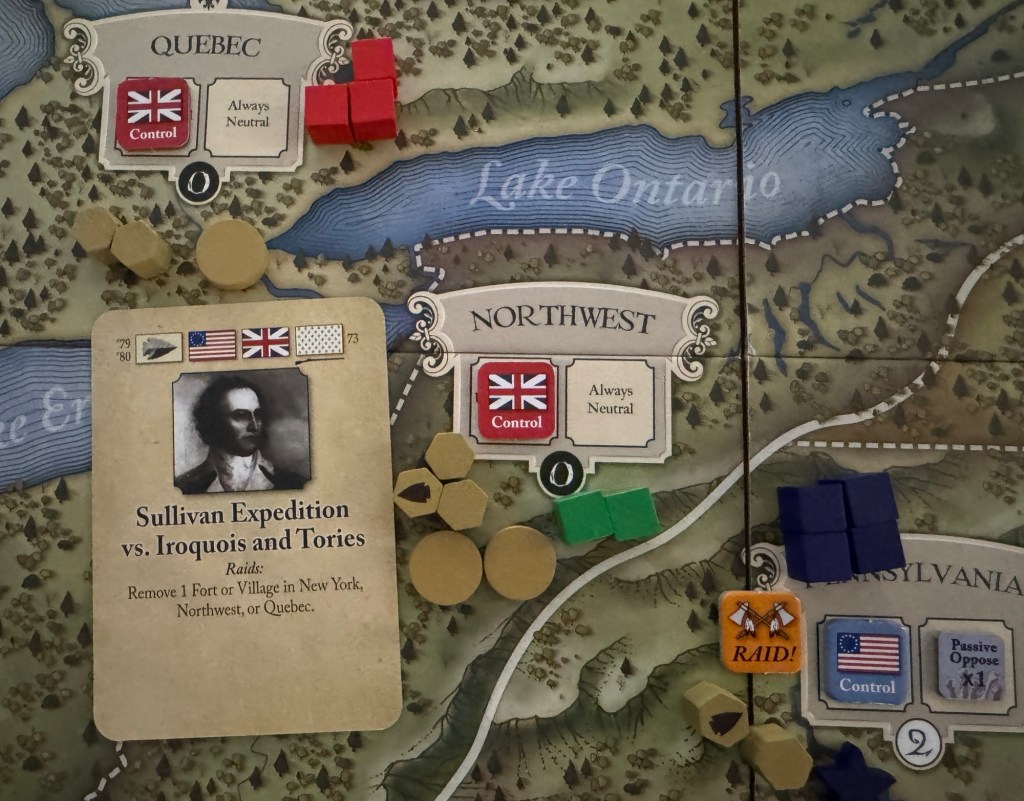
The Sullivan Expedition card in Liberty or Death is one that has the exact same effect for all sides; that of being used to remove either a Fort (if being played by the British/Indian side) or a Village (if being played by the Continental/French alliance). Actually, either side can use the card to remove a Fort and I have found that this is how it is mostly used but the power of removing one of these 2 items cannot be minimized. Normally, during battles, the last removed pieces in a space are the Forts or Villages as attackers must defeat all present pieces to remove their fortified locations. This can take multiple attacks and see lots of actions and resources invested into it when this simple card can do that work in one fell swoop. I have said this before but the really great part of these Card Assisted (or Card Driven) games is that rules can be broken or ignored by the play of certain cards and Sullivan Expedition is one of these rule breaking/bending cards. The card is tied to the history of the conflict and can only be used in 1 of 3 locations being either New York, Northwest or Quebec. These are areas where the Indian faction typically builds up their Villages as this is one of their Victory Conditions being the number of Villages that Indians have on the board as compared to the Patriot Forts. This is not a straight numerical comparison of the 2 sides total but involves some math. Not hard math but math nonetheless. The Victory Condition is actually Indian Villages (the tan discs) less 3 is greater than Patriot Forts. So, let’s say the Indian player has 7 Villages on the board and the Patriot player has just 3 Forts. The mathematical formula would be 7 – 3 = 4 > 3. This would equate to this part of the Victory Condition being met for the Indians. But, the designer and development team made it so you don’t have to do math. There is no great need to calculate the “+3” mathematically since the Indian Villages and Patriot Forts tracks on the map do it for you visually. The Forts Track is offset by 3 holding “boxes” (circles/stars) compared to the Villages track, so if the “lowest” (or “south-most”, or whatever you want to call it) empty Village circle on the Village track is “below” (or “south of”) the lowest empty Fort star on the Forts track the Indians are ahead in their victory condition.
On the surface, this Victory Condition seems simple. But, it is a bit deceiving as these Indian Villages are not easy to build, they actually take a multi-step process that will consume many rounds of turns to accomplish but it is mainly complex because you can only ever build 2 such Villages in any 1 Province. The protected Indian Preserves of Quebec, Florida, Southwest and Northwest can hold a total of 8 Villages for a total able to be somewhat safely built without great concern for attack and removal coming in at 8. The Indians have a total of 12 available Villages and generally start the game in most setups and scenarios with 0-6 Villages already built but this is cancelled out by an existing number of Patriot Forts being built on the board of between 4-7. Thus, this card is a really powerful situational card but an interesting card nonetheless.
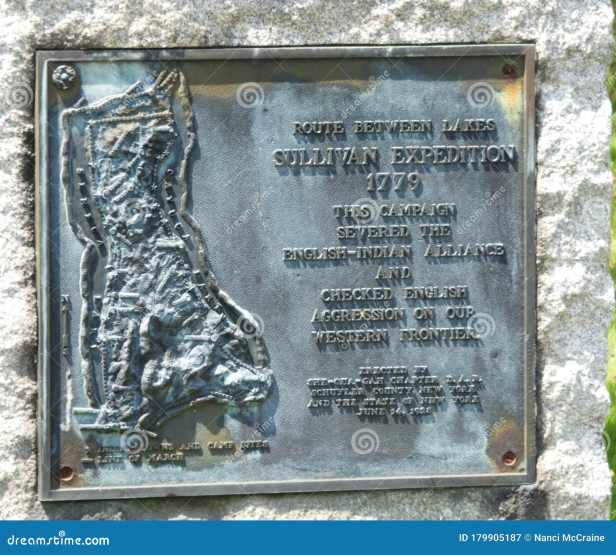
The Sullivan Expedition was a United States military campaign under the command of General John Sullivan during the American Revolutionary War, lasting from June to October 1779, against the four British-allied nations of the Iroquois (also known as the Haudenosaunee). The campaign was ordered by George Washington in response to the Iroquois and Loyalist destruction of American settlements in Wyoming Valley, Pennsylvania and Cherry Valley, New York. The military campaign had the aim at the time of “the total destruction and devastation of their settlements.” 4 Continental Army brigades carried out a scorched-earth campaign in the territory of the Iroquois Confederacy in what is now central New York.
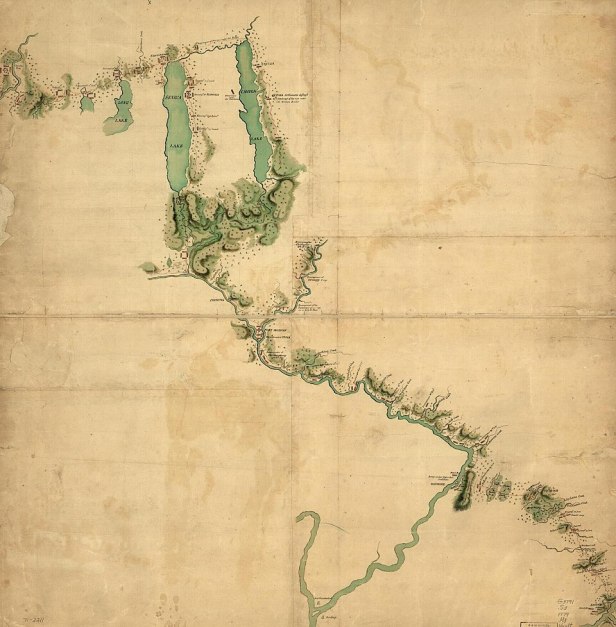
The expedition was largely successful, with 40 Iroquois villages razed and their crops and food stores destroyed. The campaign drove just over 5,000 Iroquois to Fort Niagara seeking British protection, and depopulated the area for post-war settlement. Some scholars argue that it was an attempt to annihilate the Iroquois and describe the campaign as a genocide, although this term is disputed. Today this area is the heartland of Upstate New York, with thirty-five monoliths marking the path of Sullivan’s troops and the locations of the Iroquois villages they razed dotting the region, having been erected by the New York State Education Department in 1929 to commemorate the 150th anniversary of the expedition.
If you are interested in learning more about the various Victory Conditions for the Indians as well as a bit about their Commands and Special Activities, you can read this entry in the COIN Workshop Series on the blog: https://theplayersaid.com/2023/01/17/coin-workshop-liberty-or-death-the-american-insurrection-from-gmt-games-indians-faction/
In the next entry in this series, we will take a look at French Leader Napoleon from Congress of Vienna from GMT Games.
-Grant
 The Players' Aid
Grant,
This is an excellent mini review of the game and the history behind the card. Bravo and thanks for doing this.
Matt
LikeLiked by 1 person