First off, this series is being done as a bit of a lark as wargaming has absolutely nothing to do with Christmas so if anyone is offended, please just stop reading now. Also, I know that traditionally the 12 Days of Christmas happen after Christmas Day (starting on December 25th and ending on January 5th also known as Twelfth Night) but I want to do this in a lead up to the holiday.
On the 4th day of Christmas War Gaming, my true love gave to me…
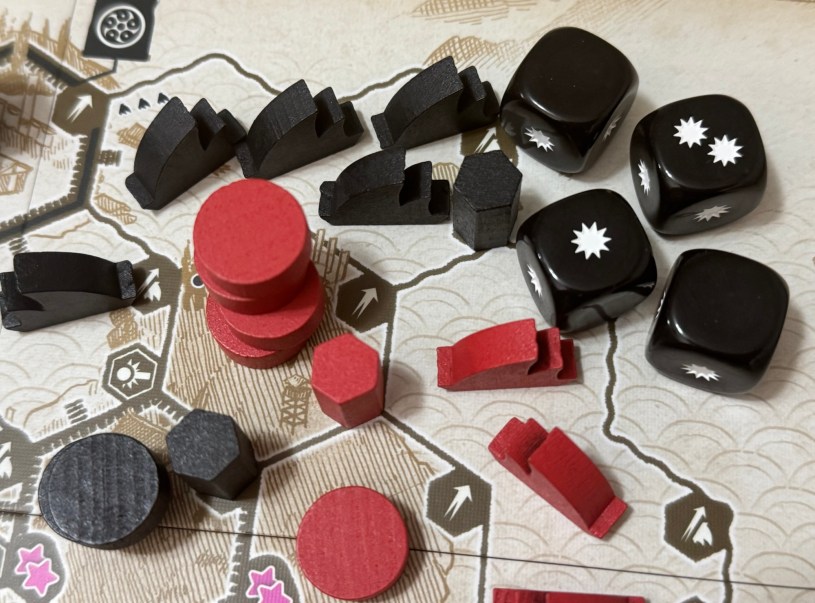
4 Ships Bombarding
A few years ago, I played the then new General Orders Series first entry called General Orders: World War II from Osprey Games. This game is a lite and abstracted area control wargame that uses the Worker Placement mechanic where players decide what actions to take and place out their Commanders to take those. Once actions are taken, the other player cannot take those specific actions. The 2nd entry in this series came out earlier this year and is called General Orders: Sengoku Jidai and uses the same system but is set in Feudal Japan. The Sengoku Jidai or Age of the Country at War, was a period of civil war and social upheaval in feudal Japan lasting from the mid-15th to the early 17th centuries. The conflict started with the Onin War (1467-1477) and ended with the Siege of Osaka in 1615 and during this time, the Ashikaga Shogunate lost control to powerful feudal lords called Daimyo, leading to frequent, violent conflicts among them for land and power. Names we all know from the period include Oda Nobunaga, Toyotomi Hideyoshi and Tokugawa Ieyasu.
As briefly mentioned earlier, the game involves deploying Commanders in the form of hexagonal shaped cylinders onto the board in order to control objectives but also to use actions that are printed in the spaces in order to advance on territories, bombard enemy units and control the various waterways on the board. Supply lines are very important in the game as you cannot control an area unless you can trace a line back to other friendly territories and your capital but don’t bog the game down with complex rules. There are a few new additions to the system in the form of ships and their control of waterways as well as special siege engines that are used when assaulting castles and the game was very fresh and interesting.

The focus on the naval aspect, and the ability to Bombard your enemies and their land based forces, is a very important part of the game and specifically ties back to the history of Japan and its focus on naval power. The Bombard action is designed to be able to soften up or whittle down the numbers of enemy units in the form of wooden discs in a specific area. The action is very simple and the player simply identifies a group of their ships in a specific sea area and then choose an adjacent land area as the target and than roll one dice for each ship in the linked water area. After rolling, the player will add up the number of pips showing on the dice and then the opponent must remove this many of their land units from the target land area and place them in their Reserve. In this example, the black Shogun has a total of 4 ships located in a sea zone and has targeted the land area that contains 4 of their enemy’s units. Because the attacker has 4 ships, they will get to roll 4 dice. Once rolled, we see that there are a total of 3 pips showing which means that the red Shogun must remove 3 of their land units in the space. These losses are not enough to take away control from the red Shogun but it definitely has weakened its position and allows for the adjacent land units to follow up the Bombard action with a future Conflict to eliminate the lone remaining red unit.
I very much have enjoyed our plays of General Orders: Sengoku Jidai and feel that it is a very simple yet strategically deep game that forces players to have to consider their options with their limited actions as you have either 5 or 6 depending on what side of the dual-sided board you are playing, how best to go about taking the areas you want to control, particularly the special bonus objective tiles that improve your basic actions of Advance, Sail, Bombard and Shell and when to take back the initiative to create a double move opportunity from the end of one turn to another. I feel that this game really takes into account the theme of the age, and includes lots of great art by the talented Tanner Staheli, to create a truly Japanese like experience with the game. For a fun and lite game on the Sengoku Jidai period, I would definitely recommend General Orders: Sengoku Jidai.
Here is a link to our video review:
If you are interested in General Orders: Sengoku Jidai, you can purchase a copy for $24.50 from the Osprey Games website at the following link: https://www.ospreypublishing.com/us/general-orders-sengoku-jidai-9781472869791/
You can catch up on the posts in this series to date at the following links:
2 Armored Trains Supporting – 1920: Nest of Eagles from PHALANX
3 Federal Agents in Hot Pursuit – The Pursuit of John Wilkes Booth from Blue Panther
-Grant
 The Players' Aid