First off, this series is being done as a bit of a lark as wargaming has absolutely nothing to do with Christmas so if anyone is offended, please just stop reading now. Also, I know that traditionally the 12 Days of Christmas happen after Christmas Day (starting on December 25th and ending on January 5th also known as Twelfth Night) but I want to do this in a lead up to the holiday.
On the 2nd day of Christmas War Gaming, my true love gave to me…
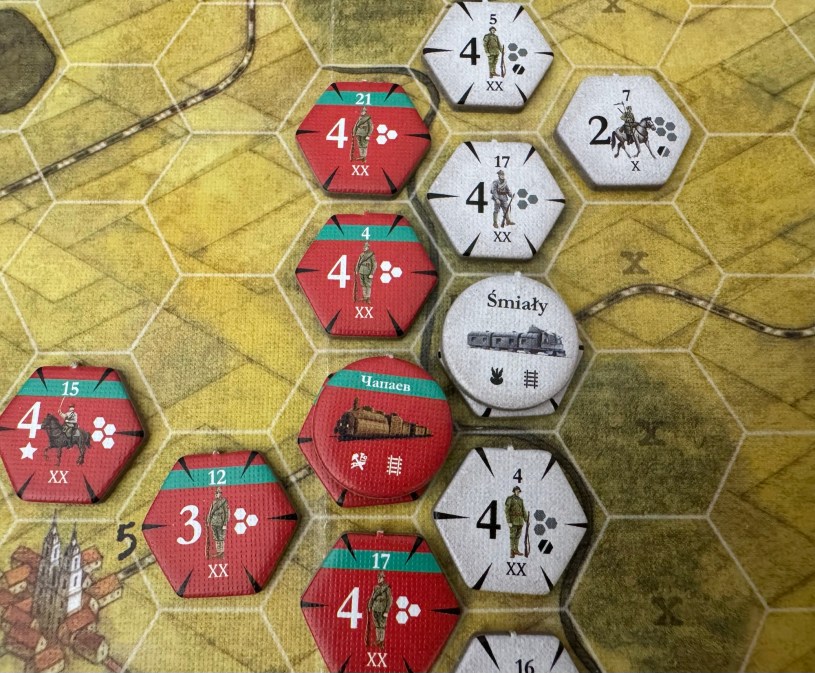
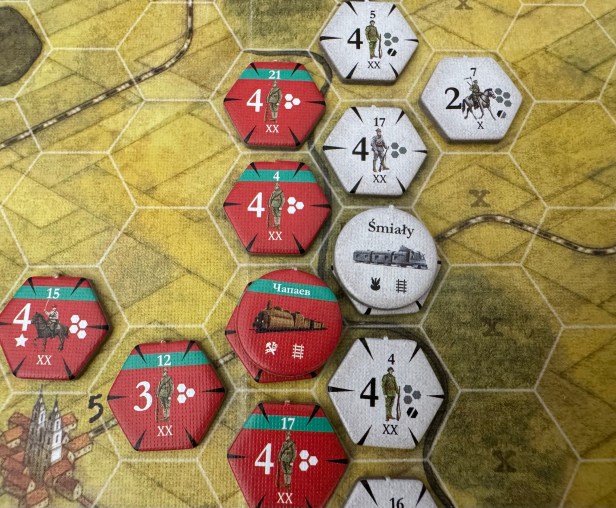
2 Armored Trains Supporting
1920: Nest of Eagles is a 2-player, intermediate complexity, strategic-level wargame covering the Polish-Soviet War, which involved the Soviet attempt to conquer Poland. Soviet and Polish forces fight on a large area stretching from Kiev and Smolensk in the east to Warsaw and Thorn in the west. This is a unique hex and counter wargame as there is a very interesting concept used called Lines of Friction, which mimic the effects of Zones of Control but are not sticky and units simply have to use extra movement points when they come in contact with enemy units. This system creates a lot of interesting maneuver and makes movement a very critical part of the game.
In the game, each side has a few Armored Train units, which were used in the fighting and served a support function. These Armored Trains were used to carry and transport troops and heavy weaponry and often had specialized features like gun turrets to provide artillery support for combat. The Armored Trains have a special Support Icon on the front of their counter, which identifies them as a Combat Support Unit. They do not have any Strength Points but do count toward the stacking limit. These Armored Trains grant a +1 modifier to Attack by adding +1 to the target number as you have to roll equal to or less than the numbers shown on the CRT. If a Combat Support Unit is aiding in Defense they will provide a –1 modifier to the target number for each Support icon in combat. Even thought these Armored Trains were designed for defense they still provide a benefit in defense. Support icons consist of Eagles for Polish units and Hammer and Ploughs for Soviet units.
Combat is simple and uses a CRT that compares Attacker vs. Defender Combat Strength and then where those columns intersect provides a specific to hit number that must be rolled less than or equal to on 2d6. This number is pretty typically a range of 2-12 and is tougher the lower that you go on the CRT. Attacking with out good odds is pretty much a death sentence here and you really cannot afford to waste your units on desperate and low odds attacks.
If you are interested in 1920: Nest of Eagles, you can order a copy for €55,00 ($63.38) from the PHALANX website at the following link: https://phalanx.co.uk/games/1920-board-game/
You can catch up on the posts in this series to date at the following links:
-Grant
 The Players' Aid