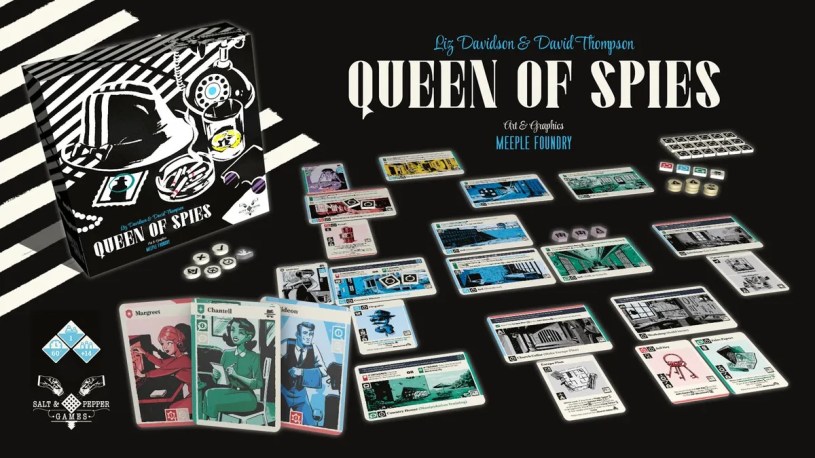
From the dynamic duo of David Thompson (Undaunted Series, Valiant Defense Series, General Orders Series and more!) and Liz Davidson (budding designer and operator of the Beyond Solitaire YouTube Channel), comes the second game in their collaborations called Queen of Spies. Queen of Spies deals with the operation of a spy ring during World War I set in occupied Belgium. It looks very interesting and I am very eager to see more of this one! But, in the meantime, I reached out to co-designer Liz Davidson to get a bit more information about the game.
If you are interested in Queen of Spies, you can read more about the project on the Gamefound page at the following link: https://gamefound.com/en/projects/saltandpepper/queen-of-spies
Grant: Liz welcome to our blog. First off please tell us a little about yourself. What are your hobbies? What’s your day job?
Liz: I’m happy to be here! My day job is Solo Games Specialist at Leder Games, and it’s a job I truly enjoy. Right now, we are finishing up the new solo modes for Oath: New Foundations, and then I’ll be moving to another project in the new year. I also have a solo gaming channel and a podcast called Beyond Solitaire. For fun, I like to read (and I’ve read some great books this year!) and go birding. I can tell I’m approaching middle age because I have gotten into WWII and started to notice birds.
Grant: What motivated you to break into game design? What have you enjoyed most about the experience thus far?
Liz: I used to swear that I would never go into game design, but I am good friends with David Thompson and we talked each other into starting a design project because we both become obsessed with the Night Witches. Although that game has had some serious art delays, we finished the design for it and moved on to our next project–Queen of Spies! I also have several other projects going both at work and on my own time. I love co-design because it’s fun to work with your friends and because it can really strengthen friendships. David is among my best friends now! I also enjoy historical game design because I get to research a topic I love and then figure out how to turn it into a game.

Grant: What is your new upcoming game Queen of Spies about?
Liz: Queen of Spies is a solo game set in a fictional town in WWI Belgium. You are the leader of a spy ring and you have a limited time to assign operatives in your network to various tasks, all while trying to evade arrest. It’s inspired by a book I got for Christmas a couple of years ago: Women in Intelligence by Helen Fry. I got so excited by the passages about La Dame Blanche that I messaged David about it on Facebook, and a project was born.

Grant: Why was this a subject you wanted to focus on?
Liz: David and I were really fascinated by the ways in which spy networks resisted German occupation outside of the more famous SoE activity that you hear more about. We also wanted to express how stressful and dangerous it would be to do this work.
Grant: What are the unique features with the system used for the game?
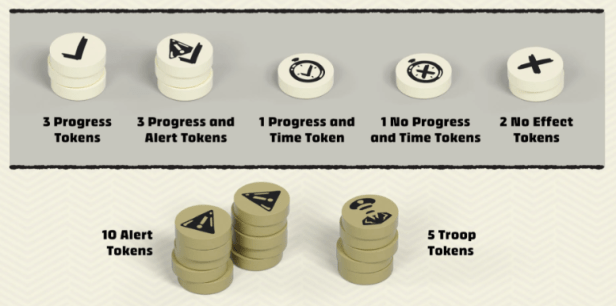
Liz: I think the most unique aspect of this system is what I would call our “bag management” system, which has evolved a bit from the version of it we tried in Night Witches. Skill checks are resolved by drawing tokens from a bag, and throughout the game, you add more tokens–but really none of them are good. So you have to manage the contents of the bag carefully over time to prevent trouble later. We didn’t know it at the start, but this way of doing skill checks has led to a lot of emergent storytelling as players get different results and cause each game to unfold very differently. The time tokens are also unique–once you send operatives to an assignment at one of the game’s locations, they remain there until the allotted time has passed, meaning you need to decide how much time to invest in different locations while also paying attention to how operatives get in and out of synch with each other.
Grant: What is your design goal with the game?
Liz: When we design, David and I think first about the topic we want to make a game about, then “where the game is,” i.e. the most interesting thing we can actually design about, and then what we want players to feel while they are playing. In this case, we wanted players to feel the stress of running a team of operatives who had difficult tasks to complete in a very limited period of time. We added even more pressure by including the jail: Operatives can get caught, be interrogated, and possibly give up the names of others in the organization. So, you’re supposed to feel stressed, but in a fun way.
Grant: What other games did you use as inspiration?
Liz: The Success Bag is a natural evolution from David’s and my first game, Night Witches. (I do not want to discuss the art delays that have made this one slower to get to print.) But honestly we didn’t think too much about our influences. Queen of Spies emerged from conversations about what we wanted players to do, and what kinds of things we hoped would be able to happen within the game system. Everything else emerged naturally from there.
Grant: What was it like to work with the David Thompson?
Liz: Working with David is always a joy. We were good friends when we started designing together, and now he is one of my best friends. Our co-design process works well because we meet together, only make design changes while together, and give each other “homework” between meetings. The game is truly a 50/50 split between us and our ideas and influences, but it’s also gotten to the point where you can’t separate out exactly who did what. We have a blast talking about possible next designs to work on, and we enjoy the whole process of design together from early ideas to final touches. I hope we co-design for the rest of our careers.
Grant: How does the game center around the Success Bag? What type of tokens are placed in the bag and how are they placed?
Liz: The Success Bag starts with ten tokens, which represent varying levels of progress. During a skill check, you might make progress, make no progress, waste additional time, and potentially generate Alert. You can also add additional Alert tokens to the bag as part of a number of different game effects. This is bad because if you draw too much Alert and don’t have enough Stealth to cancel it out…then you add a troop to the bag. Troops can cause operatives to go to the jail, which creates a whole new set of issues. So you need to manage that Success Bag very carefully.
Grant: What is the purpose of the Town? How is this board constructed?
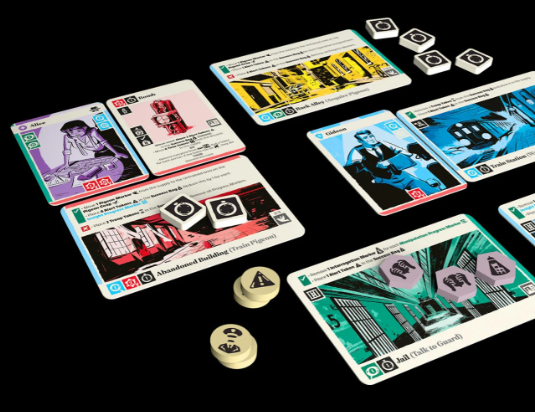
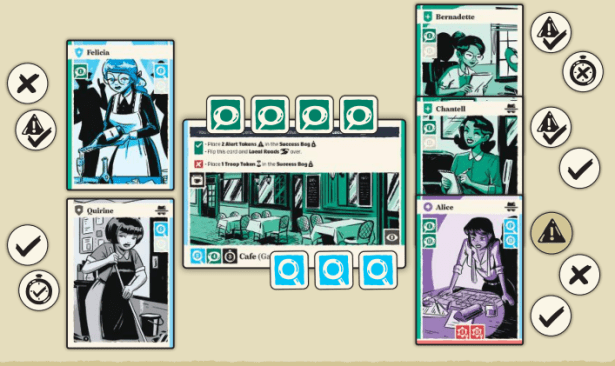
Liz: We talked about having a board, since so many of the town’s locations are consistent across game scenarios, but Salt & Pepper is noted for their small box sizes so we ultimately stuck with cards. The Town is basically a bunch of cards where you can send your operatives to complete assignments. This is where your operatives get just about everything done–it’s where you can train, recruit new operatives, handle situations in the jail, hide out in your safe house, and more. Additionally, unique locations are added for each of the game’s “stories,” and for individual chapters of those stories. So we used the location card system to help players immediately see new places to go and figure out what they might be used for.
Grant: What is unique about the various locations?
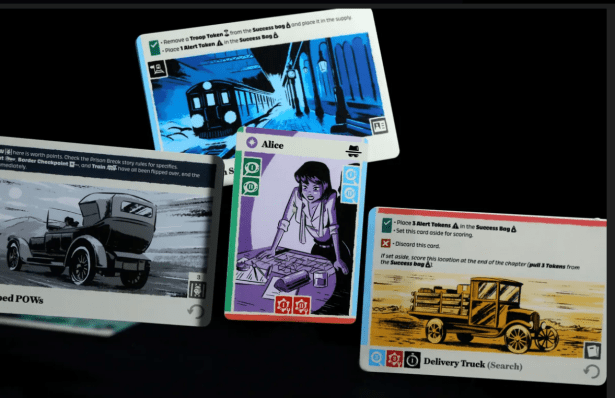
Liz: Each location does something different. Every location will either help you advance a mission, help you improve your network, or help you manage the contents of the Success Bag. They also have unique text letting you know what happens after operatives complete an assignment there, either successfully or unsuccessfully. Each is meant to evoke something slightly different–for example, during the story where you help POWs escape, they can escape through one of three location cards, each of which has slightly different skill and item requirements.
Grant: How does the game use cards?
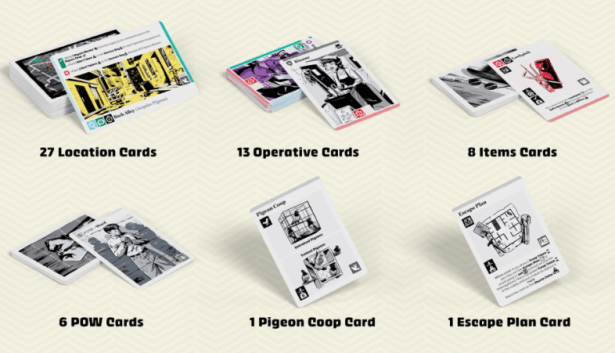
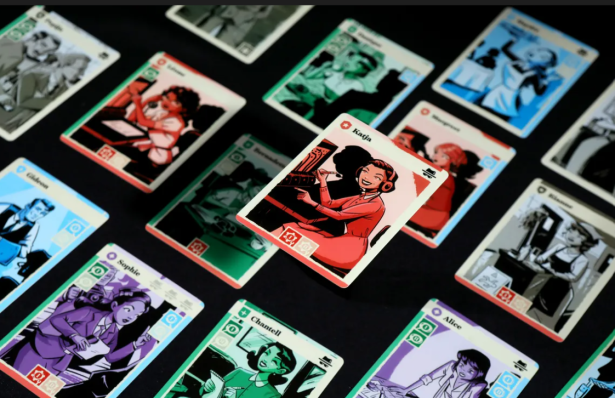
Liz: In Queen of Spies, cards are used to create the world of the game. There are cards for locations, for the operatives themselves, and for items the operatives can use.
Grant: What is the anatomy of the cards?
Liz: Each card in the game has information on it that you need to reference when assigning operatives, using items, and completing assignments. Location cards let you know which skills will be checked at that location, how long an assignment there will take, and the consequences of success and failure. Operative cards give you information about which skills the operative has, and what their level of training is. Item cards have information for crafting them (skill check and time requirements) as well as information telling you how they can be used.
Grant: What different type of cards are there? What are each types purpose?
Liz: Queen of Spies has three types of card, in general: location cards, operative cards, and item cards. Location cards represent places where you can place operative cards to represent operatives going on assignment. Item cards are tools you can craft at the workshop that assist you in completing key assignments.
Grant: What are the different types of Assignments available in the game?
Liz: Each location in the Town has an assignment associated with it. In every game, you will be able to train operatives, send operatives to make escape plans or lower alert, recruit new operatives, and build new items. You will also need to manage the situations of operatives who end up in the jail. Each story in the game also has unique locations associated with it, and on assignments at those locations, your operatives might find themselves eavesdropping outside an office, training a pigeon, infiltrating a chateau.
Grant: The focus is the narrative. How did you focus on this element to make sure it is integrated into the gaming experience?
Liz: I would say that narrative is the entire focus of Queen of Spies. In fact, each of the game’s scenarios is called a “Story,” and each story is divided into “Chapters.” We also wanted the cards to create a world for you to play in. You go to concrete locations to perform associated assignments, and the tokens you draw from the Success Bag tell the story of how you did and what happened. At every turn, David and I made design decisions that fit the theme of the game and that kept things moving so that players can immerse themselves in the stories as they unfold.
Grant: How is the concept of Time handled? What limitations does this place onto players?
Liz: You could say that time is the ultimate limitation. Everything you do in Queen of Spies costs time from a limited supply of time markers, and they can also be wasted during skill checks as operatives work to complete assignments and take a little too long on the job. Time impacts whether all of the operatives you want for a job happen to be available, and you can fail to meet your goals if you try to complete them at the last minute and don’t quite make it. This is supposed to make you a little stressed out, so don’t worry if you sweat a little over your dwindling supply of time markers.
Grant: How is success adjudicated in the game? What are the consequences of failure?
Liz: Success is determined by whether operatives make sufficient progress, indicated by check marks on tokens drawn from the Success Bag. If you don’t draw enough check marks across all skill checks, then you do not succeed at the assignment. Failure, however, looks different depending on the assignment an operative is attempting. Most of the time, you can leave accumulated progress on a location and send more operatives there to try again. Sometimes, however, that won’t be possible. And while sometimes failure has very minor consequences, it can also be catastrophic.
Grant: What happens to Operatives who are sent to jail?
Liz: Operatives who are sent to jail will have to wait there until either the end of a chapter, until their death, or until you manage to free them. (Exception: Alice herself. If the leader of your network is in jail at the end of a chapter, you will lose the game immediately.) While there, they are interrogated at the end of every round, and it’s possible they will break under pressure and give up the name of another member of your network. There are things you can do to help, such as talk to the guards to lower the heat of their interrogations, or smuggle messages into the jail that keep your imprisoned friends’ hopes up.
Grant: How does Interrogation work?
Liz: Interrogation markers will accumulate on the jail, and at the end of each round you need to do interrogation checks for each operative who is currently in jail. To do this, you draw tokens from the Success Bag. For each progress you draw, the operative holds up under pressure. For each token you draw that has no progress marker, the operative gains a despair marker. If an operative has three despair markers, they break, leave the game, and give up another member of the network. If you draw a troop token from the bag during interrogation, the operative is killed in jail and removed from the game.
Grant: How is the game won?
Liz: Queen of Spies is easy to lose, but it is very difficult to have a decisive victory. You can lose by adding too much alert or too many troop tokens to the bag, you can lose by ending a chapter with Alice in jail, or you can lose if Alice dies in prison. But winning is based on a score you earn based on a combination of how well you played and what tokens you draw from the Success Bag at the end. (If you don’t keep an eye on how messy the bag is getting, it can hurt your final score!) There is a range of results you could achieve for each story, depending on how you do. And if it doesn’t go well… you can always try again!
Grant: How many Stories are available? How do they integrate?
Liz: This game contains an Introduction, which is a quick tutorial, and then three stories that are divided into three chapters each. The stories are not meant to go in any particular order, and they are not integrated. Instead, each represents a separate adventure in the world of Alice and her network.
Grant: What do you feel the game models well?
Liz: I think we have created a system that can tell a number of stories very well. Each of the stories in Queen of Spies feels different from the others. In the first one, you are acquiring and training pigeons in hopes that they will bring back crucial intelligence. In the second, you immediately need to help POWs who are in the jail and whose lives are in danger. And in the third, you start with only one operative other than Alice, and you will need to recruit people to help you infiltrate an office building. I’m very proud of how much range the game can have while sticking to core mechanisms.
Grant: What has been the experience of your playtesters?
Liz: Our playtesters were wonderful, and really helped us smooth out aspects of the design that needed it. It has meant a lot to me to see them saying positive things about the game now that the campaign has started–we couldn’t have done it without them!
Grant: What are you most pleased about with the design?
Liz: My favorite thing about Queen of Spies is that it creates moments of tension that evoke strong responses from the players–including David and me. We’ve gotten to the point where we are particularly attached to certain operatives, and particularly frustrated with others. I cannot count the times when we have both shouted “GODDAMMIT GIDEON!” during a playtest. That’s what I want from my games, and I hope Queen of Spies brings the same feelings out of others.
Grant: What other designs are you contemplating or already working on?
Liz: I am working on several games, some with David and others not. One is about the Italian Wars, and another is about birding. I also have more than one project about love and dating in the works, which I will otherwise be coy about for now. I’m also in the research phase for several upcoming historical games, so I have been reading about Gettysburg and ruminating about Roman politics. We’ll see what comes out of it!
If you are interested in Queen of Spies, you can back the project on the Gamefound page at the following link: https://gamefound.com/en/projects/saltandpepper/queen-of-spies
-Grant
 The Players' Aid
What a great pair of design talents! I’m pleased to see more come from this duo. Still looking forward to Night Witches.
LikeLiked by 1 person
I always enjoy your designer interviews. I learn so much!
LikeLiked by 1 person
I’m glad. Thank you.
LikeLike
Dear Grant
I noticed in your piece of Dec. 8, 2025 “Interview with Liz Davidson” that she mentioned she is working on a
game on the Italian Wars. This is a period I’m very interested in at the moment. I have some previous
experience working with the designers of Khe Sanh (ATO) and Highway to the Reich on their 2nd editions.
I’d like to learn more about her project. Do you have contact information i.e. email so I could reach out to her?
Peter Stiller
LikeLike