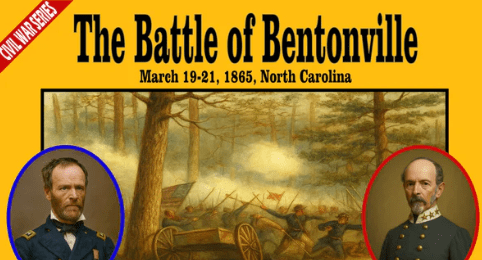
There is a need for introductory wargames in our hobby that can be used to teach the concepts of wargames to new players. Very few designers focus on this area but Bill Molyneaux is one of those as he has designed several very good introductory wargames over the years including Bloody Mohawk from Lock ‘n Load Publishing, Savage Wilderness from Lock ‘n Load Publishing, Battle of Brandywine from Fast Play Wargames, Horns of the Buffalo from Fast Play Wargames and most recently The Battle of Wyse Fork from Bill Molyneaux Games (with codesigner Kim Meints). Recently, he has decided to ratchet up his wargames and has designed a bit more involved game called The Battle of Bentonville, March 19-21, 1865, North Carolina. We reached out to Bill and as always he was willing to share with us about the game and its design.
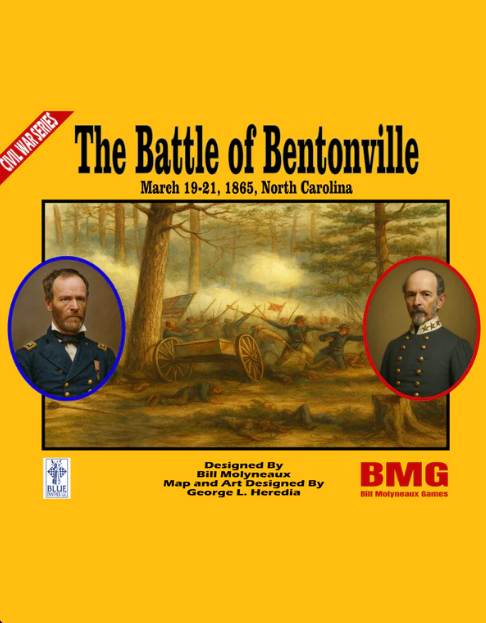
Grant: Bill welcome back to the blog. What is your upcoming game The Battle of Bentonville about?
Bill: The Battle of Bentonville was the largest battle fought in North Carolina during the American Civil War on March 19-21, 1865. Confederate General Joseph E. Johnston, and what remained of the Confederate army, attacked and were defeated by Union General William Tecumseh Sherman’s army at the battle, which was the last large-scale battle of the American Civil War.
Grant: Why did you choose this specific battle to focus on with this game? What about the battle is unique and interesting?
Bill: To my knowledge, only three games have ever been made about the Battle of Bentonville (this one and two others that are out of print). Compare that to say the Battle of Gettysburg, with dozens of titles and more released every year, Bentonville remains overlooked. Yet the courage and sacrifice of the men who fought and died there deserve to be remembered.
Also, as a result of the overwhelming Union strength brought to bear by Sherman, and the extremely heavy casualties his army suffered in the battle, Johnston was forced to surrender to Sherman a little more than a month later at Bennett Place near Durham Station, North Carolina. This battle was a very large and costly battle.
Grant: What sources did you consult for the design and what must read source would you recommend?
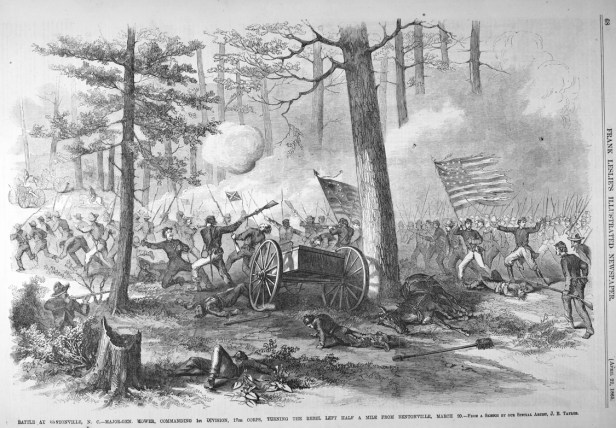
Bill: Historian Wade Sokolosky served as Historical Advisor, while George L. Heredia drew directly from an authentic period map preserved in the Library of Congress, bringing players closer to the battle than ever before.
Grant: What is important to model in a game about the American Civil War?
Bill: The most important part of modeling an American Civil War game is achieving the right balance between authenticity and playability.
Authenticity means accurately portraying the terrain, troop organization, and battlefield tactics that defined the era, while playability ensures the game flows smoothly, is easy to learn, and keeps both sides fully engaged. The result is a design that remains accessible to new players yet offers enough depth to challenge experienced wargamers.
Grant: What is the scale of the game and the force structure and makeup of units?
Bill: For game scale, we used Brigade and smaller formations and also 400 yards/hex (abstracted) and 1 turn = 2 hours (day) and 3 hours (night) with 9 daylight + 2 night turns per 24-hour cycle.
Essentially infantry and cavalry are brigade units based on the real brigade formations that took part in the battle. Artillery are also modeled, while the supply/medical units in the game are merely ad hoc units that affect their overall tactical use and VP’s.
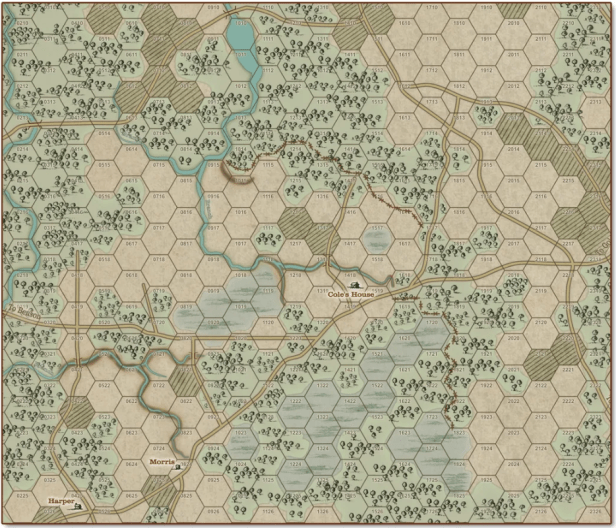
Map wise…the scale was about 400 yards per hex…I think that’s what it came down to… but rather than being a specific distance, you could say since we decided to base the game on the Library of Congress map, that the hex distance/scale is also abstracted but “about 400 yards”.
Grant: Who is the artist for the map?
Bill: George L. Heredia of GeoTactics.net was the artist directly involved with the designs of the map, counters, player aid cards, box art and rulebook.
He is a past contributor for Matrix Games maps and scenario designs, self-proclaimed map geek and collector, gamer, content creator (YouTube channel GeoTactics), designer, and creator of a FREE hex overlay app for map designers.
Grant: What strategic consideration does the terrain of the historic battlefield create?
Bill: The Library of Congress map, other period maps and topography were analyzed to create the best combination of a period inspired map along with terrain that provides tactical challenges with woods, swamps, ravines, creeks, crop fields, yet keeps the gameplay fluid.
Grant: What different terrain is included on the map and how does this effect movement and combat?
Bill: Terrain is kept simple yet period accurate that represents the battlefield conditions faced by the Union and CSA forces, such as swamps and woods that are common to this region, along with the roads, crops, ravines, and creeks that were present. Movement and combat is affected differently by the terrain and are detailed in an easy to understand Rulebook as well as a Terrain Effects Chart player aid card.

Grant: What is the general Sequence of Play?
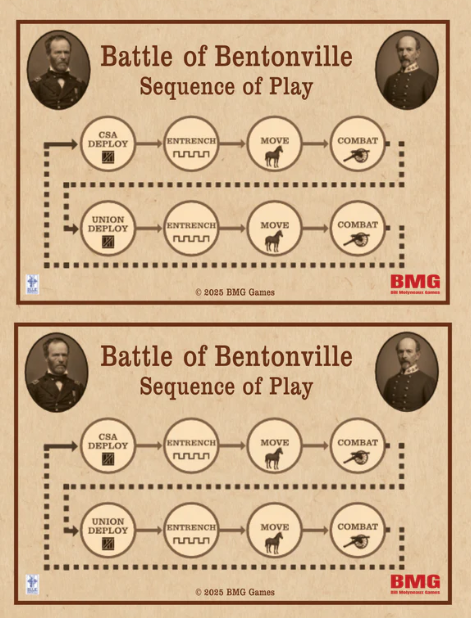
Bill: Play is straightforward with each side taking their turn, beginning with the CSA player, like a chess match. Each turn is further split into four easy to understand “phases” that are explained in the Rulebook and outlined in the Player’s Sequence of Play card.
Grant: What role do Leaders play in the game and how do they effect units they are stacked with? What leaders are included for both sides?
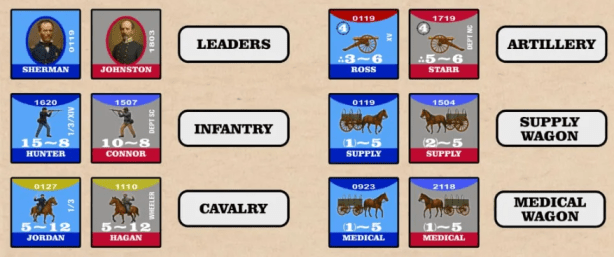
Bill: Leaders provide additional combat bonuses but can affect Victory Conditions if captured or killed. After initial game testing, it was that only the army leaders and their respective wing commanders would be represented in this game in order to keep the unit count manageable and game play fluid.
Grant: What is the anatomy of the counters in the game?
Bill: George created a unique yet simplified iconology, keeping each side and unit type readily identifiable for new players and experienced wargamers.
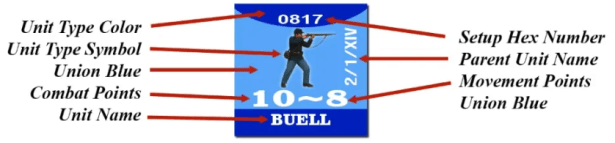
The rulebook dives deeper into the explanation of the iconology, such as CSA/Union colors, hex setup number, unit type, unit name + parent unit name for identification, combat and move points. Some units have additional icons (for example, artillery units have range icon and cannon ball symbols to remind players of their special double defense factor).
Grant: What different units are represented?
Bill: The game features four primary unit types: Leaders, Infantry, Cavalry, and Artillery, each with distinct roles on the battlefield.
Grant: What special units are included?
Bill: In addition to the regular combat units in the game, Supply and Medical Wagons represent the vital logistical and support elements that affect battles, while keeping their roles simplified.
While these units have no offensive power of their own, their loss can significantly impact an army’s effectiveness. In game terms, destroying an enemy’s Supply or Medical Wagon unit awards Victory Points, reflecting the tactical and morale value of disrupting enemy supplies or medical support.
Grant: How does combat work?
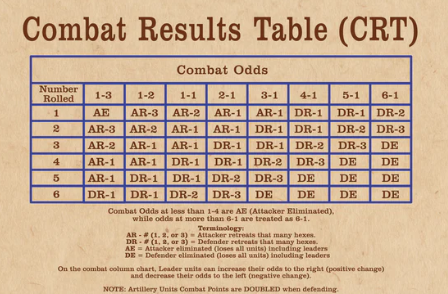
Bill: Combat results use a straightforward odds-ratio system similar to that found in classic Avalon Hill games. There are no “Exchange” results or sudden large-scale eliminations. Instead, outcomes are expressed as retreat results of one, two, or three hexes, creating a more dynamic ebb-and-flow battle rhythm rather than wholesale unit destruction.
Grant: How does this game ratchet up the complexity of your typical games?
Bill: This game introduces a higher level of depth and detail than my previous designs. The Combat Results Table (CRT) has been expanded to provide more nuanced outcomes, and units no longer use reduced-strength values on their reverse sides, placing greater emphasis on tactical positioning, timing, and support. Overall, the system offers a richer, more deliberate style of play and one that rewards planning and coordination without sacrificing accessibility.
Grant: What type of experience do these changes create?
Bill: These changes made to the rules and map create a more immersive and tactical battlefield experience. Players will find that every decision: when to attack, when to fall back, and how to position supporting units, carries real consequences. The expanded combat system adds tension and realism, while the streamlined rules ensure the game remains approachable for newer players. My goal was to deliver a game that challenges experienced wargamers yet still invites newcomers to appreciate the ebb and flow of Civil War combat. Working with George to design the map and counters really helped strike that balance between depth and accessibility.
Grant: How is victory achieved?
Bill: Victory is determined by a scenario-based point system that awards Victory Points for achieving many different objectives, eliminating or capturing enemy leaders and units, and destroying Supply or Medical Wagons. A major swing in points occurs if Sherman is killed or captured.
However, individual skirmishes or engagements don’t always translate into lasting success. Players must think strategically about where and when to attack or when it’s wiser to withdraw. Careful long term planning and timing are often more decisive than any single battle, rewarding players who manage their forces with both aggression and restraint.
Grant: What do you feel the game models well?
Bill: The game does an excellent job of modeling the real Bentonville battlefield, its terrain, road network, and natural obstacles that shaped each side’s movement and tactics. The map captures how difficult it was for commanders to coordinate attacks across broken ground and dense woods, giving players the same challenges the historical leaders faced.
Beyond the map itself, the game models the ebb and flow of Civil War combat, the uncertainty, the importance of timing, and the need to balance aggression with caution. Players must read the terrain, anticipate the enemy’s intentions, and decide when to press an attack or pull back to regroup. That constant tension between opportunity and risk is what brings the historical experience to life.
Grant: What has been the experience of your playtesters?
Bill: I think that the most common response was shock and surprise from my playtesters as this was not a typical BMG game.
Grant: What are you most pleased about with the design?
Bill: Truly, the Map, counters and artwork George did on this game was incredible and his help in the development will make this my best game yet.
Grant: What other designs are you contemplating or already working on?
Bill: As I am working with the Blue and the Gray Education Society and my profits from this game will go to the battlefield, I think working on more battles that are not covered. My last two games Battle of Wyse Fork and Battle of the Hook, they are the only games on these two battles. I like to see about the Major Gilmor Raid of 1864 right near my house in Baltimore, Maryland.
I need to say George was instrumental in bringing this game to life. Even his edited Rulebook was found to be well written and flawless by Steve at Blue Panther Lastly, I can’t thank Steve at Blue Panther enough for getting this game printed and ready. They’re also awesome!
Thank you!

If you are interested in The Battle of Bentonville, March 19-21, 1865, North Carolina, you can order a copy for $50.00 from the Blue Panther website at the following link: https://www.bluepantherllc.com/products/the-battle-of-bentonville
-Grant
 The Players' Aid
Hello,
thank you very much for the interview!
Bill Molyneaux
LikeLiked by 1 person
Thanks for being willing to do it.
LikeLike