Sound of Drums who has made some really great looking games over the past few years including their History of the Ancient Seas Trilogy (HOTAS: HELLAS, HOTAS: DIES IRAE and HOTAS: MARE NOSTRUM), 1793: Patriots & Traitors, Eylau 1807 and a few others. Sound of Drums really has a great approach to game design and they also are committed to high quality production with great components, fantastic art and really sharp graphic design. They are definitely a publisher to keep an eye on and you should give their games a try! Recently, they announced a new game set in the Renaissance period called Neither King Nor God – Ltd Pilot Edition that is the precursor to a larger and more robust game coming out sometime in the near future. I reached out to Uwe to get a bit of information about the game and he was more than willing to share.
Grant: Uwe welcome back to the blog. What has Sound of Drums been busy with over the past few months?
Uwe: Happy to be back on your blog. We have been busy organizing our structure and staff and preparing for 2026 and 2027. We are preparing several games for distribution and there are titles currently on the water and in the warehouse ready to ship including Battles of Napoleon Volume II – Quatre Bras 1815, Battle Commander Volume I – Napoleon’s Italian Campaigns and more. We also just returned from the SPIEL Essen convention where we had a very successful opportunity to share our games and play them with many attendees.
Grant: How do you feel your mission for publishing is going? What would you like to do more of?
Uwe: It feels like being at the right moment at the right spot with the right type of games. We feel a lot of enthusiasm around Sound of Drums Games. When starting SoD I didn’t expect to grow so fast and I would like to design more but can’t as I need to build the business side including staffing, distribution, marketing, production and shipping.
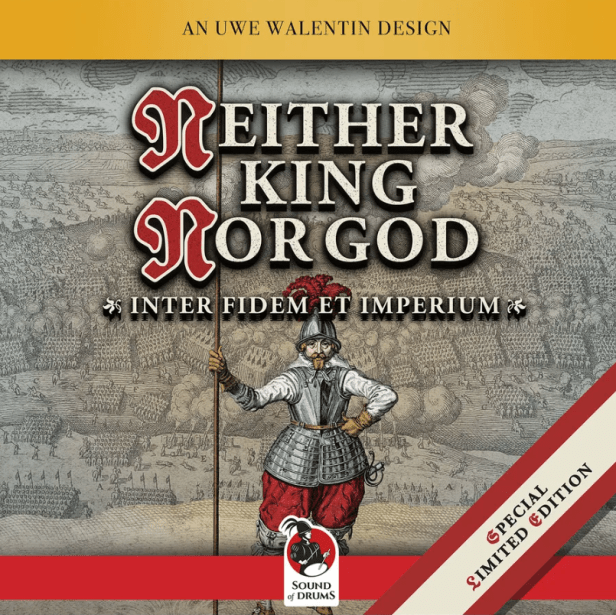
Grant: What is your new game Neither King Nor God about?
Uwe: Neither King Nor God is a strategy game for 4 players set in Europe during the Age of Renaissance. The players find themselves in the midst of a power struggle between various factions and nations as they vie for power and influence during the time of the Protestant Restoration.
This version of the game is a “pilot” for the huge and epic 5 player version that will be published in 2026. You lead one of four factions that played an important role in Central Europe including England, France, the Papacy and the Italian City States in its vicinity and the German Holy Roman Empire.
To win the game you need to control a certain number of regions and need to maintain or convert a certain number of centers to the confession of your faction. Victory conditions for each faction are different and as some factions aim for a certain confession in the centers, they help their opponents fulfilling their victory conditions. In addition to that the English player may win the game if the continent is overrun by the troops of the Ottoman Empire.
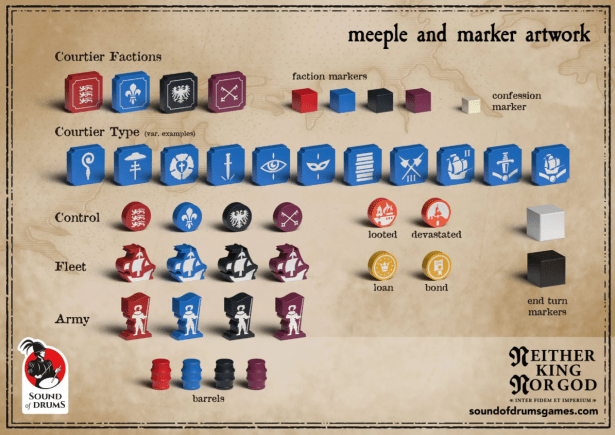
To achieve your goal of the game you send out at the beginning of a turn members of your court to various centers in Europe where they fulfill tasks in your name. These Courtiers represent your diplomats, generals, admirals and spies. These will affect the possibilities of your actions in the regions of Europe. Your merchants will try to ensure your share of the market potential in a region, your bishops will try to convert a Center’s confession.
At the game start, players will draw victory condition cards for their faction. There are different types of objectives like converting a center to a certain confession. Some objectives overlap between factions, therefore pursuing your own goals may also bring an opponent closer to theirs.
Grant: What is the meaning behind the name? What should it inform the players about the setting and history?
Uwe: Mercenaries in the 16th century lived by restlessness and calculation. They pledged themselves to neither their creed nor crown, for faith and allegiance shifted with the winds of war. Whoever promised the richest pay, commanded their blades. So, the name of “Neither King Nor God” seemed to fit with these creed and suited the focus of the game.
Grant: Why was this a subject you wanted to focus on?
Uwe: I was always looking for a playable and accessible epic game about the era of the Renaissance in Europe. There are several games out there on the subject but they have extremely long playtimes and I wanted to create something that was more approachable and playable that would get to the table more often.
Grant: What are the unique features with the system used for the game?
Uwe: The feature that is most unique and that I am really proud of is the mechanism of selecting, placing and revealing the “Courtiers”. In the coming epic version of the game, we will have a very nice diplomacy layer, a non-player Ottoman Empire faction, more asymmetrical factions and more types of Courtiers.
Grant: What is your design goal with the game?
Uwe: I wanted to follow very strictly the design philosophy of Sound of Drums Games: high degree of interaction, close to zero downtime. Straightforward mechanisms that are linked and make decision making a tough task. As in our History of the Ancient Seas Series, everything is important. Rules that need an exception are skipped. These are not good rules.
Grant: What other games did you use as inspiration?
Uwe: To be honest, I wanted to achieve the same design result as in HOTAS and see if was again able to create a unique game mechanism. I wanted to have a more accessible and playable game than Here I Stand or Europa Universalis. Therefore, there was kind of a competitive inspiration that drove me in my pursuit of this concept.
Grant: What is important from the Renaissance and Reformation to model in the game?
Uwe: On the economic level, I wanted to model that the world at that time was an open market, first kind of globalized market in a way. This era saw the emergence of important trading houses such as the Fuggers and the Medicis. Another very important aspect of this period was the Reformation and Counter-Reformation, and the departure from Catholicism in many regions, or the rediscovery of it.
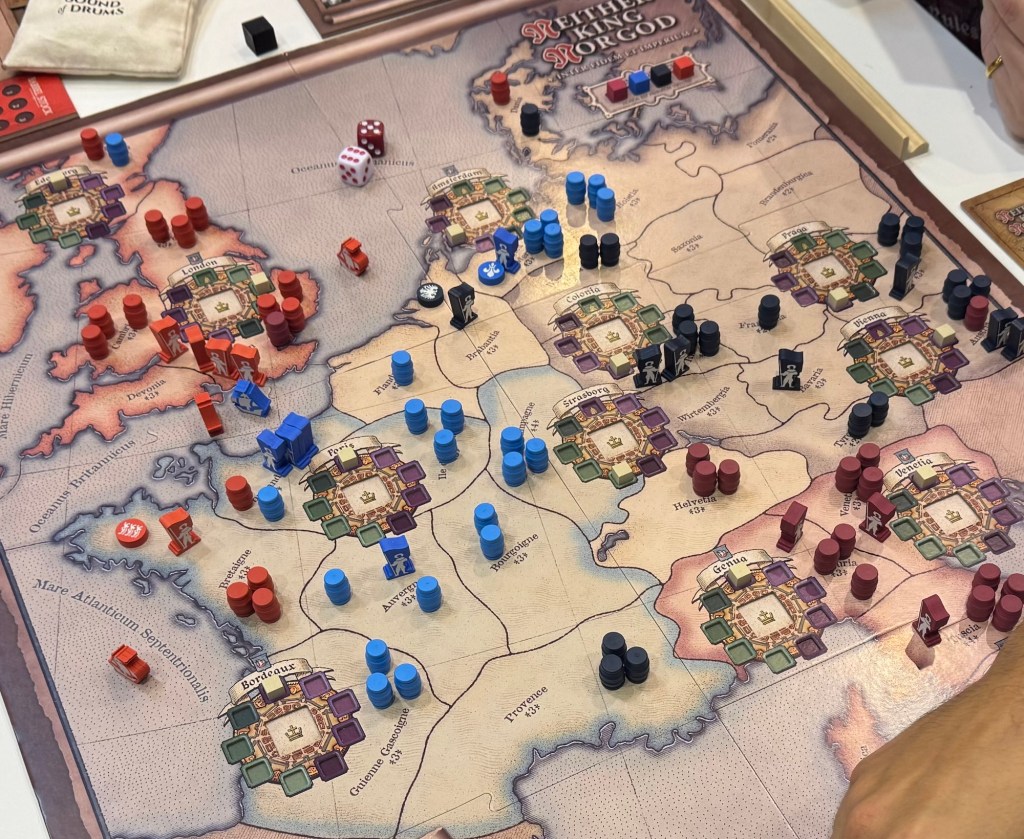
Grant: What is the concept of the Courtiers?
Uwe: I spent quite a long time thinking about a mechanism that is interactive and has a bluff factor. And while reading a rather entertaining historical novel, I came up with the idea that the leaders of the powers in the game send “envoys” to different cities to perform certain tasks there. I then expanded on this basic idea by developing and testing a variety of different “types” of “Courtiers.” This process was incredibly fun. Over time, this mechanism became very tactical and really exciting to play.
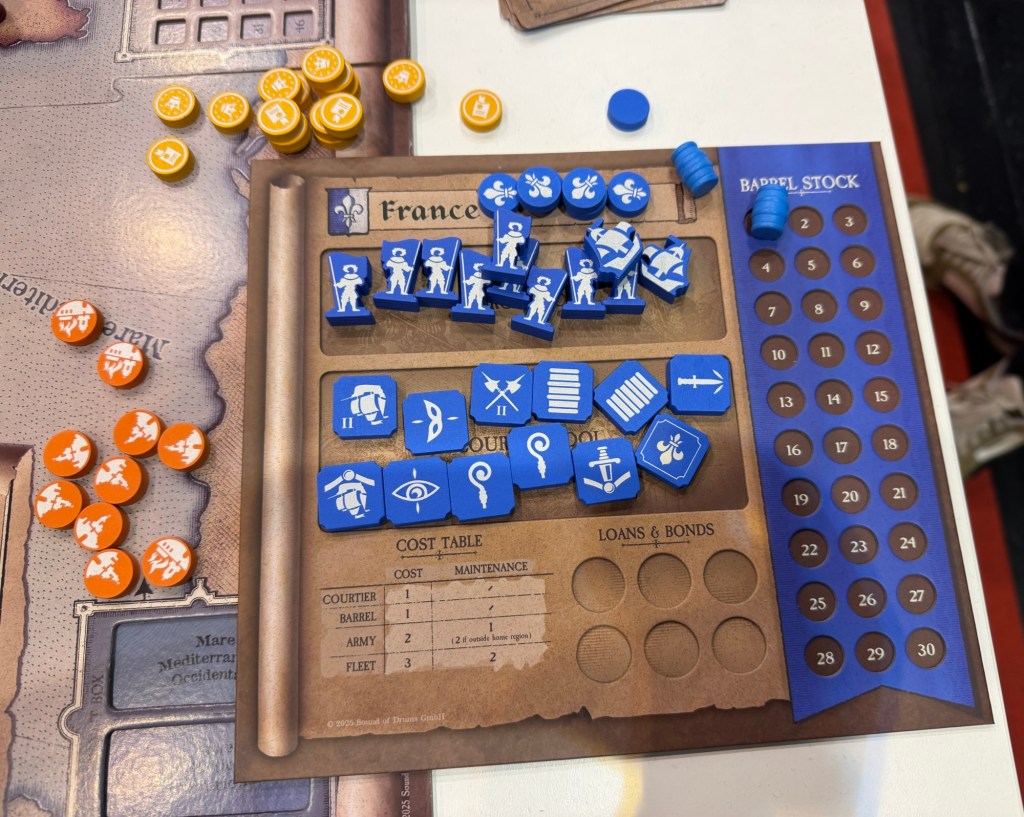
Grant: Why was this so important to your vision for the narrative of the game?
Uwe: I’m not a fan of scripted gameplay at all; I want an open story that’s highly interactive and requires me to make big decisions. The use of the Courtiers creates a lot dynamism and tactical game play in the way they are placed out on the board and in what order as the stacks of Courtiers are hidden from the players and resolved from the top (the last one placed) to the bottom (first one placed).
Grant: What type of experience does this create?
Uwe: This “engine” gives the game a sandbox character and is extremely story-driven. Players will experience some nice surprises as the game progresses and things are never guaranteed as you simply don’t know what Courtiers may have been placed by your opponents and how they will effect your efforts.
Grant: How does the game model economic growth and expansion and competition amongst the playable nations?
Uwe: As mentioned above, this phase was characterized by untapped and open markets, and the development of shipping enabled the discovery of new continents and resources. The powers and their associated trading houses knew no boundaries. In the game, this is represented by the fact that the Courtier type “merchant” can be sent out to occupy market potential for their own faction by placing Barrels out on the board.
Grant: How do players affect the religious struggle between Catholicism and Protestantism?
Uwe: One of my favorite aspects of the game. The players’ goal is to convert a certain number of centers/regions to one of the two confessions. Since the players keep their victory conditions secret, it is always possible to unwittingly help an opponent achieve their goals.
Grant: How are the various nations asymmetric?
Uwe: On the one hand, the factions pursue different goals, and on the other hand, each faction has a different composition of Courtiers with different abilities, and the number of available armies/fleets also varies.
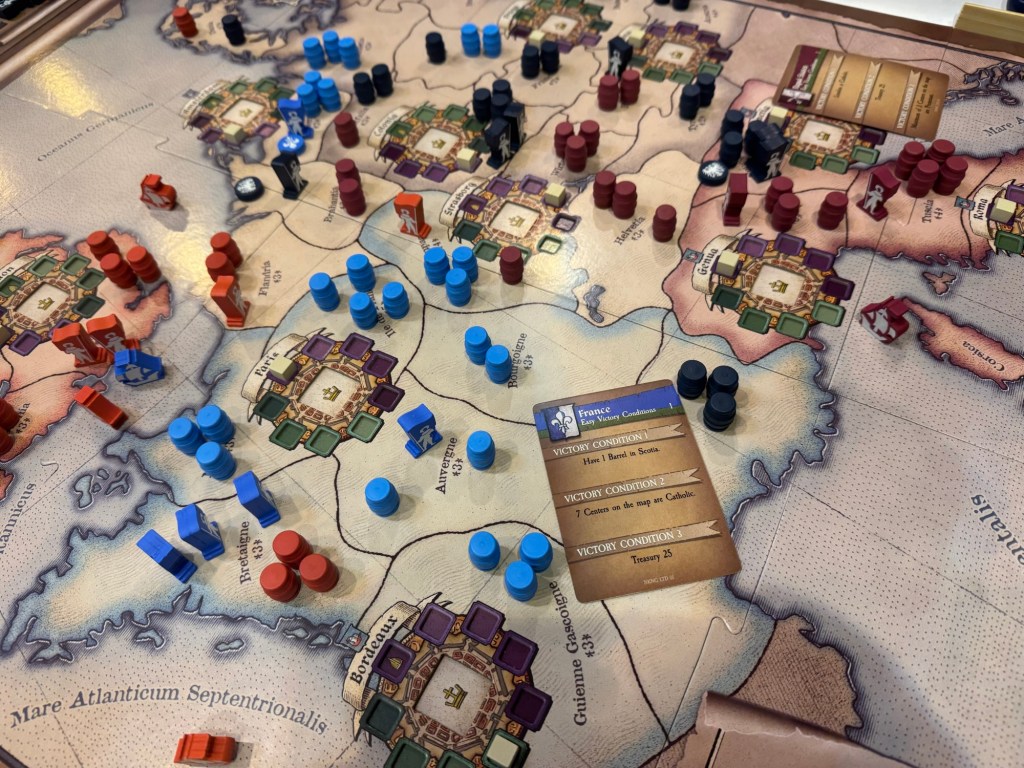
Grant: What general strategies does each nation need to keep in mind?
Uwe: Keep your finances under control. Don’t reveal your goals to early. Have a solid army. Learn how and when to place your Courtiers. Timing of placement is critical and can be the deciding factor in your outcome.
Grant: How does combat work?
Uwe: Combat is rather traditional. Players of HOTAS said they appreciated the deterministic combat system but prefer to roll dice. Therefore, we have accommodated that in the design of the game. There is a simplified CRT that takes into account your army strength while DRM’s come from various things such as leaders, being on your home territory or other things and then 2d6 are rolled and a certain amount of losses are inflicted upon both sides.
Grant: How important is the military aspect of the game to the overall design?
Uwe: It is quite an important layer in the game. As military will be needed to protect your trade network and controlling regions on the map are part of the victory conditions. Also, keep in mind that military can be used to remove the economic influence of your competition from regions so that you can capture those markets.
Grant: What are the various Victory Condition Cards? Where did you get this concept from?
Uwe: Players do first agree on the difficulty level of the Victory Conditions. I really like the aspect that you don’t know what your opponents are heading for and if they are close to victory. Each player has their own Victory Condition Cards that are drawn at random and these are the ways the player will win the game. If a player fulfilled their victory conditions at the end of a turn they reveal their Victory Card and are declared the winner. These victory conditions include several different types of things such as controlling specific regions or centers, having a certain amount in their treasury, having a certain number of Barrels out, etc. The point of these cards are different ways to win each game which adds a lot of variety and the unknown.
Grant: How does this play out between the factions?
Uwe: As you know, reducing down time is important. Therefore, you will always need to take a very close look on the action of your opponents.
Grant: Ultimately how is victory achieved?
Uwe: Either by fulfilling the conditions on your card or when the Plague happens to control the most regions and have a solid treasury.
Grant: What type of experience does the game create for the player?
Uwe: Very tense, it is a lot about bluffing, planning, being able to change your plans and accept surprises.
Grant: What are you most pleased with about the game?
Uwe: Frankly, Alexander and Grant sitting down and playing the game before the show started in Essen 🙂 – no, seriously. I am totally happy that the Courtiers mechanism works the way it does, the short playing time and the buzz for more that this game is creating. We published this game some weeks ago and we get a lot of inquiries about the coming epic version. We will try to involve the community as much as we can. That is the nice thing about that sandbox concept and the period we are portraying. Endless possibilities in one game. A dream.
Grant: What is the plan for the future of this system and the expanded game?
Uwe: As you know, this LTD Pilot Edition is strictly putting out a marketing concept to prepare the hobby for the Epic version :-), which we have heavily discounted through October 31st. My hope is that the engine will be so well received that players will be eager for a deeper gaming experience, with an additional diplomacy layer, more types of Courtiers, two additional factions (one of which is an NPC), and even more sophisticated abilities.
Grant: When can we expect that design to debit?
Uwe: Spiel 2026 is the goal. Is that a reason for you to embark on the journey again? 🙂
Grant: What other games are you working on?
Uwe: I am working on a whole series of my own designs: ROMA VICTORIA SEMPER: Caesar in Gaul. We are bringing the engine from the HOTAS Series to ancient Gaul. It will not be a Civ Building game, but a campaign game with a large element of diplomacy. And I am currently collecting data and preparing the framework for an innovative WWII operational series. I have a very exciting collaboration here with military historians, who, interestingly, have little to do with ConSims because they have so far thought little of the model and character, as essential aspects are either completely ignored or incorrectly modeled. External developers are working on transferring our Battles of Napoleon Series to the American Civil War. Here we have numerous exciting ideas for new approaches.
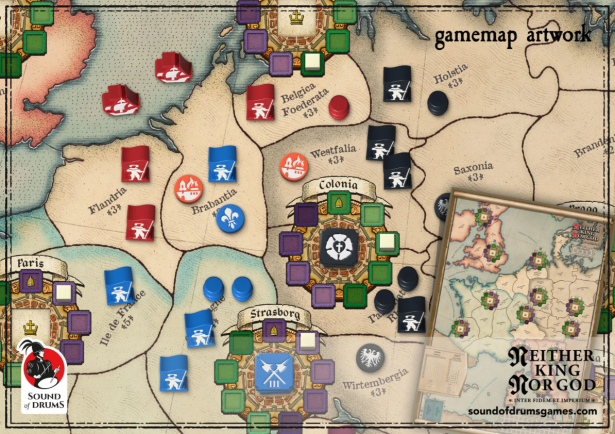
We had a great time with this one and it played in about 90 minutes. It is very good and I am very excited to give this another go and to see how the game evolves in the more advanced version.
If you are interested in Neither King Nor God – Ltd Pilot Edition, you can order a copy for €69.00 (roughly $79.21 in US Dollars) from the Sound of Drums website at the following link: https://soundofdrumsgames.com/shop/neither-king-nor-god-ltd/
-Grant
 The Players' Aid
I had a great time with this at Essen! Is there any information on the fifth and sixth faction which will be included in the epic version? The sixth, non-player faction will be the Ottomans, I presume… but what about the fifth?
LikeLike