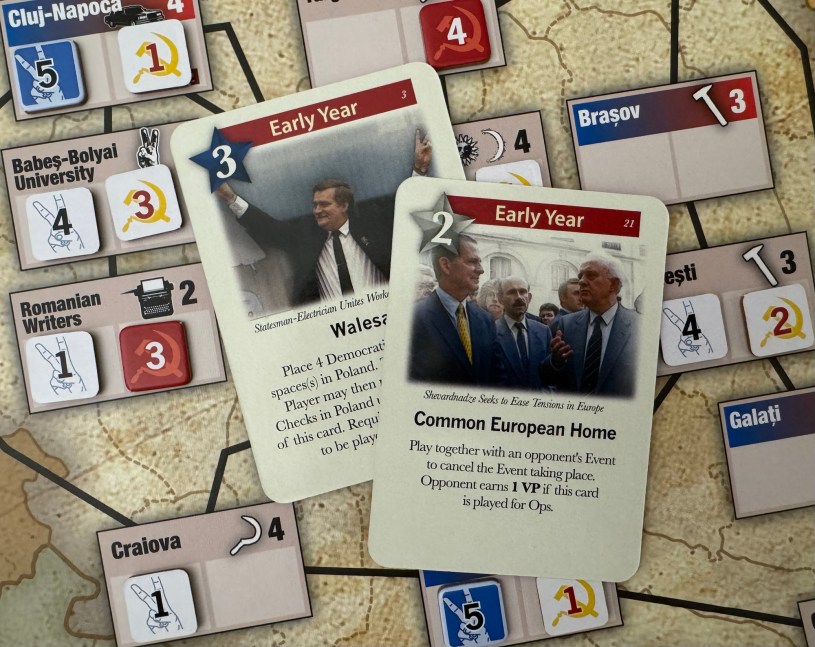
With this My Favorite Wargame Cards Series, I hope to take a look at a specific card from the various wargames that I have played and share how it is used in the game. I am not a strategist and frankly I am not that good at games but I do understand how things should work and be used in games. With that being said, here is the next entry in this series.
Card #55: Common European Home from 1989: Dawn of Freedom from GMT Games
1989: Dawn of Freedom is a fast paced game simulating the end of the Cold War in 1989 as the Berlin Wall fell under pressure from the people as during this year a series of democratic revolutions ended the 40 year Soviet empire in Eastern Europe. 1989 simulates the political, social and economic aspects of these revolutions using a card-driven system similar to Twilight Struggle. I have really very much enjoyed my plays of 1989 and those plays are increasing as the game has been placed on the very cool and user friendly online platform Rally the Troops!
Any game that has cards is focused somehow on attacking those cards or at least minimizing access to them or to taking a turn away from your opponent by causing them to have to discard one of their cards or to do something else with that card. In fact, conflict and wars are usually made up of these type of intelligence and counter intelligence “games” where one side tries to get the other side to believe something that isn’t true and spend their time and resources chasing that down while something else is going on. One of best cards that do this type of thing in 1989: Dawn of Freedom is General Strike. It ends up being somewhat of a trap that the player cannot get out of and it is delightfully cruel to play this on an unsuspecting Communist player.
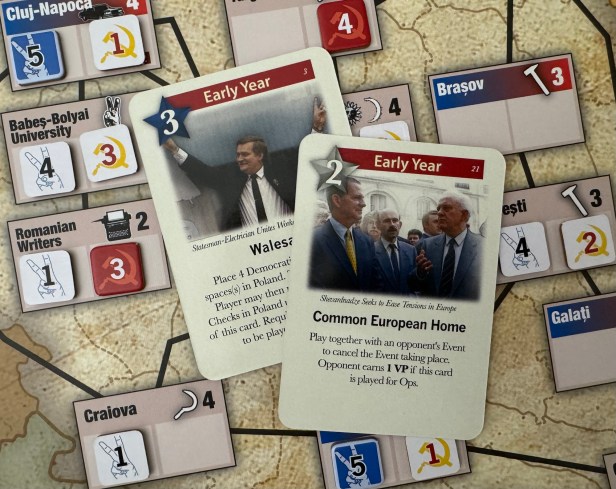
One of the best Neutral Aligned cards in the game is that of Common European Home. Common European Home is an Early War 2 Ops card that allows the player to play the card along with an opponent’s Event to cancel the effects of the event and remove it from the game thereby denying the opportunity for it to be played. Common European Home is a clone of the infamous UN Intervention from Twilight Struggle. Remember, that in this system, when you play an opponent aligned card for Ops during your turn the Event will go off for the other player. This is always a concern when playing a Card Driven Game as certain cards in your hand are very powerful for your opponent and there typically are very few ways to avoid these negative effects. Common European Home is an invaluable card for both players and will be one of those that is sought after each turn when cards are being drawn. The other part of the card is a major incentive to use it for the Event as if it is played for the Ops Value, your opponent will be awarded 1 VP.
The saying, or concept of “Common European Home” was popularized by former Soviet leader Mikhail Gorbachev in the late 1980’s. It was a metaphor for a new pan-European system that would unite the continent’s diverse nations, moving beyond Cold War divisions to create a single zone of security and cooperation from the Atlantic to the Urals. The idea aimed to facilitate disarmament and foster closer economic and political ties between the Soviet Union and the rest of Western Europe.
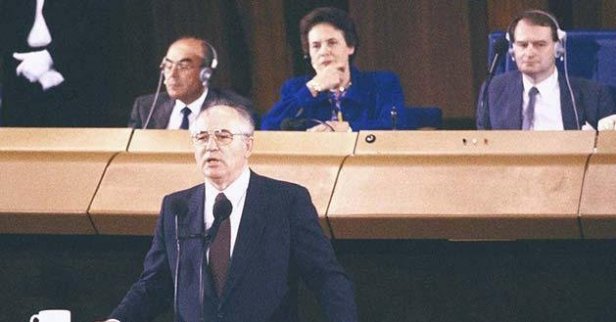
The concept envisioned a Europe without traditional military blocs, where all countries, including the Soviet Union, were part of a single, cooperative “house” that understood that all nations are connected and tied together and that greater cooperating and partnership would lead to a more prosperous Europe. This was meant to be built on principles of mutual security, economic cooperation and ultimate respect for and embracing of international laws. The ultimate goal was supposed to overcome the division of Europe into opposing military and ideological camps, fostering a new era of peace and stability.
“The day would come when you, France, you, Russia, you, Italy, you, England, you Germany — all of you, all the nations of the continent — will, without losing your distinguishing features and your splendid distinctiveness, merge inseparably into some high society and form a European brotherhood.”
The concept included a shared foundation of the Helsinki principles, collective security through disarmament, and the free movement of people and ideas within a united Europe. Concepts that had been fractured and repressed during the Cold War Era as each nation built up their militaries and their nuclear arsenals to see who could get to and cause mutually assured destruction through global thermonuclear war.
I very much enjoy the thematic connection of this card with the event. I can see the ability here and its connection as you are using it to break down barriers, overcome differences and in many ways diffuse the other side by challenging their way of thinking and strategy. This one of my most favorite parts about any CDG as I try to make sense of the in-game text and how it connect with the historical event.
We posted a full review video and you can watch that at the following link:
In the next entry in this series, we will take a look at SA-2’s from Fire in the Lake: Insurgency in Vietnam from GMT Games.
-Grant
 The Players' Aid