Over the past few years, while attending the World Boardgaming Championships, we have met with Gregory M. Smith and discussed many of his ongoing designs. One that we have chatted about a couple times has been his upcoming Insurgent Tide: Counter-Insurgency in Iraq 2003-2008 from Compass Games. Insurgent Tide deals with the Iraq War from 2003-2008 and if you didn’t know, Greg was a tanker and in Iraq during that time and knows a few things about the landscape and politics. The game uses the popular Tide Series and is a 2-player card driven game. Even this is a bit early, and the game has a while before it will be released, we reached out to Greg and he was more than willing to share about the design.
*Keep in mind that the art and layout and graphics on the components and material shared here are not yet finalized and as the game is still going through the design and development process it is possible that there will be changes introduced prior to final publication.
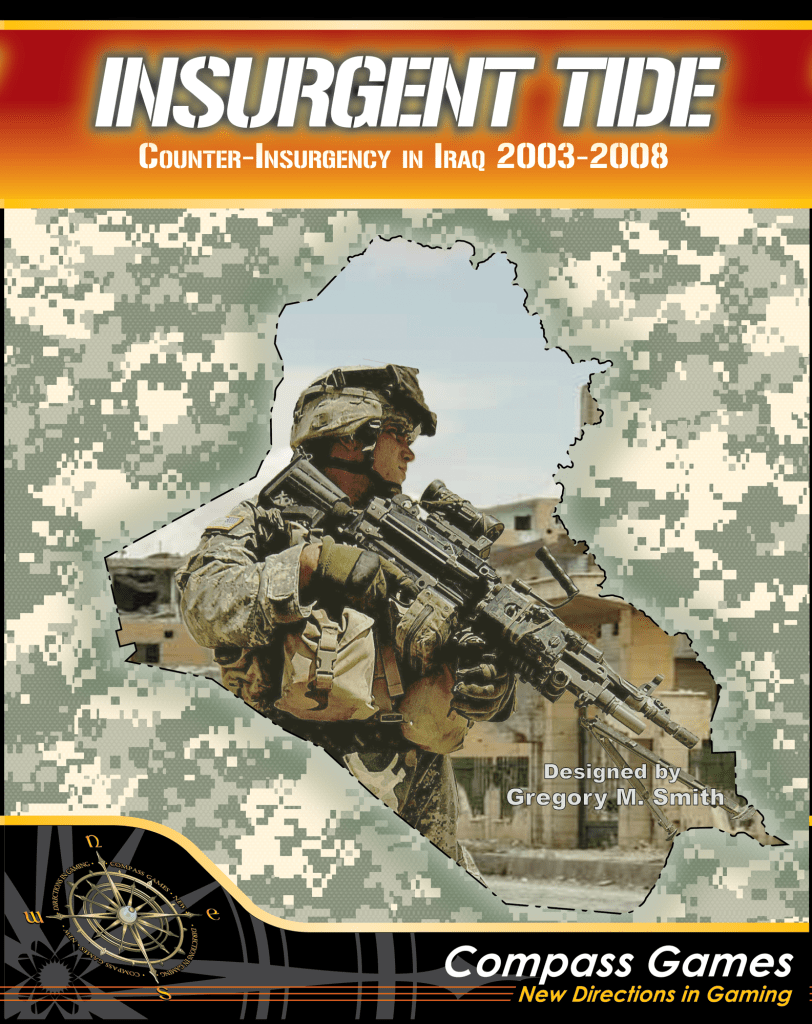
Grant: Greg welcome back to the blog. What is your new upcoming game Insurgent Tide about?
Greg: Always a pleasure, Grant and Alexander. Insurgent Tide is a game about the Iraq War from 2003-2008 and uses the Tide Series as its base.
Grant: Why did you feel inspired to make this game?
Greg: Well, I was there, for one thing, but also there really hasn’t been a game covering this conflict (at the operational/strategic level, anyway). So it seemed to me there was a void there and that it would fill that.
Grant: What sources did you consult to get the details correct?
Greg: Very few, for the first time ever, but mainly because I didn’t have to. I did some research, but since I was an Information Operations Officer in Balad at the Special Forces HQ, I leveraged that information into this game. I was privy to conversations between most of the General officers in Iraq on a daily basis, and as the “fly on the wall” it painted a pretty good picture for me of the operations and challenges we had. Obviously, this game is completely unclassified but I feel out of all my games, it is probably the most historically accurate.
Grant: Was this game personal for you to make having served there at the time? Is this therapeutic for you?
Greg: It would be impossible for me to not have some personal feelings, I suppose, given that it was a year of my life and my best friend was killed in Fallujah. But he was a gamer himself and I can’t help but to feel he would have liked the game.
Grant: How do you feel your emotions have affected the design?
Greg: I really don’t think they have, as the game is operational, and at times fairly strategic. It’s a “big picture” game. I think it’s fun to play from both sides. Unlike 1991, I didn’t personally participate in any direct combat so I think that allowed me to stay more objective.
Grant: What is the players goal in the game?
Greg: It really mirrors what the sides were trying to accomplish in reality. The Coalition goal is to stabilize Iraq and establish a functioning Iraqi government while the Insurgent goal is to gain control of Iraq and establish their own government.
Grant: What does a victory look like in the game?
Greg: There are several paths to victory for the Insurgent player: heavy Coalition casualties, control of Baghdad at the end of the game, or by having the Coalition control 9 or less provinces. The Coalition player needs to control 10-11 provinces for a draw, and 12 or more for a “win” by the end of the game, assuming he hasn’t suffered too many casualties or lost Baghdad.
Grant: As a game in the Tide Series, how much does it resemble the previous games?
Greg: Well, there’s a reasonable overlap, mainly in the area movement, card rebuy system, and annual turns. But there’s some significant differences as well.
Grant: What is new to the system that you have added to fit with the war in Iraq?
Greg: The core of this game is counter-insurgency, so we’ve got cells (basically hidden units) along with police stations, airstrikes, Special Forces, Intel networks, UAV’s, Civilian Unrest, etc. All of these things are new to the core Tide System but they integrated very well and the game feels similar with some new elements.
Grant: What was your greatest design challenge to overcome?
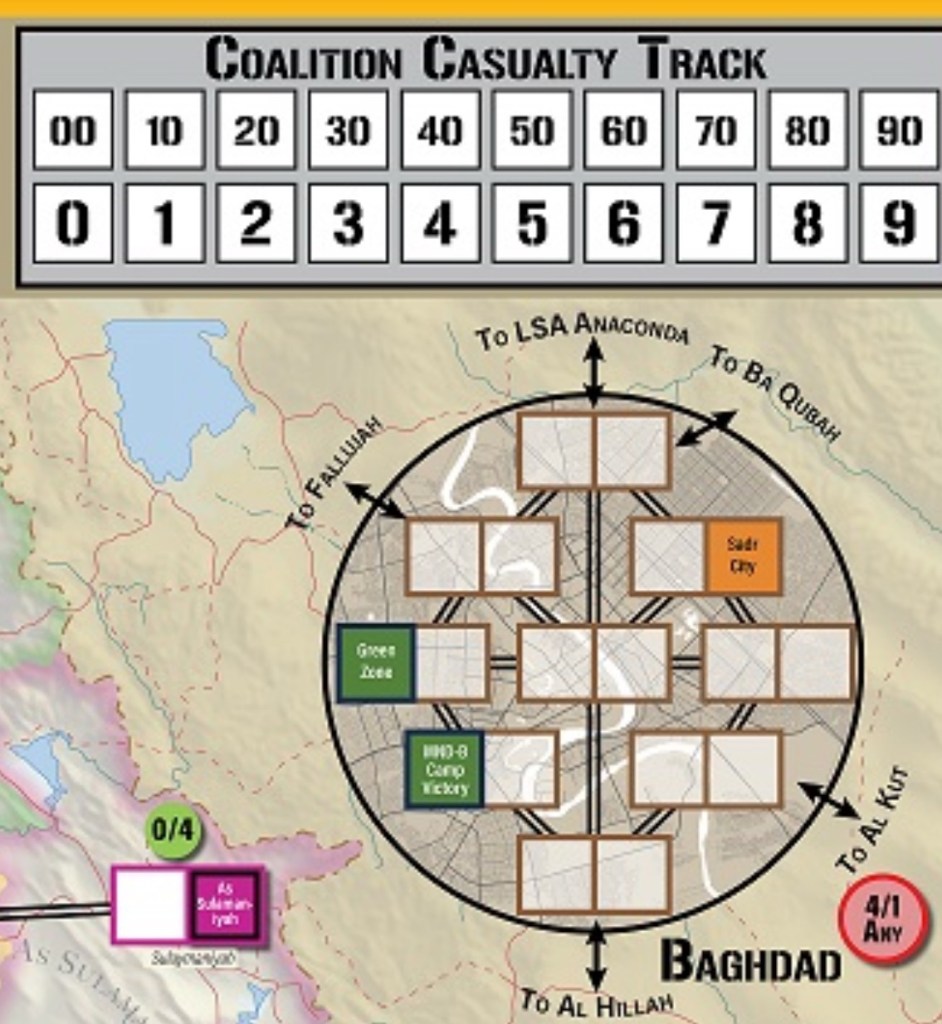
Greg: I think having the “sweeps” and operations that come out of each base camp make sense, in that we had forces that were basically tied to the logistical tails, for the most part. I had to limit your move distance from where you were based (the division in Tikrit can only move a maximum of 3 areas from Tikrit, the brigade in Mosul only 3 from Mosul, and of course the Baghdad forces stayed in Baghdad). We had big areas of operation, but the forces basically stayed in their areas of operation. Another problem was how to represent Baghdad (as it is its own province) but I finally solved that by having an inset map with areas in it.
Grant: What are the different types of cards?
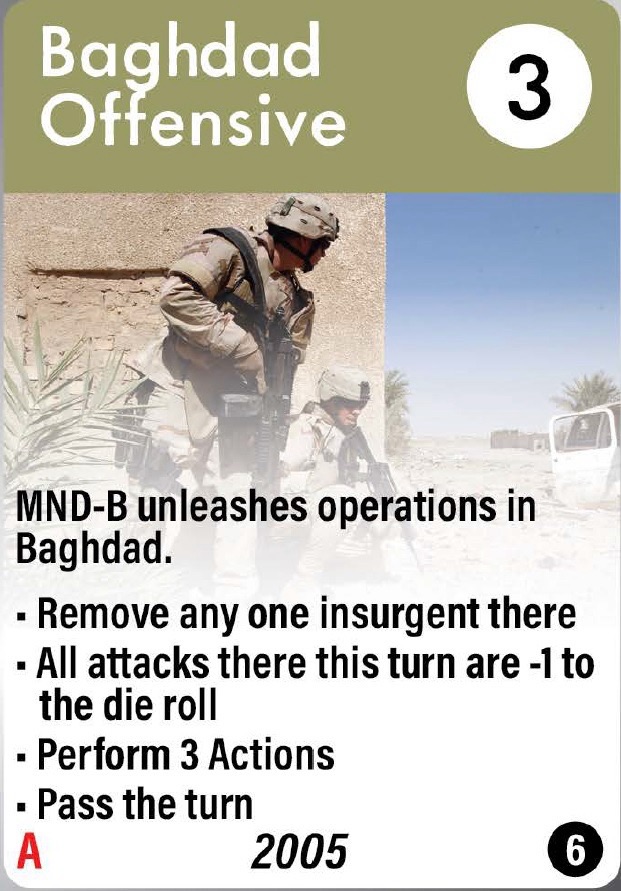
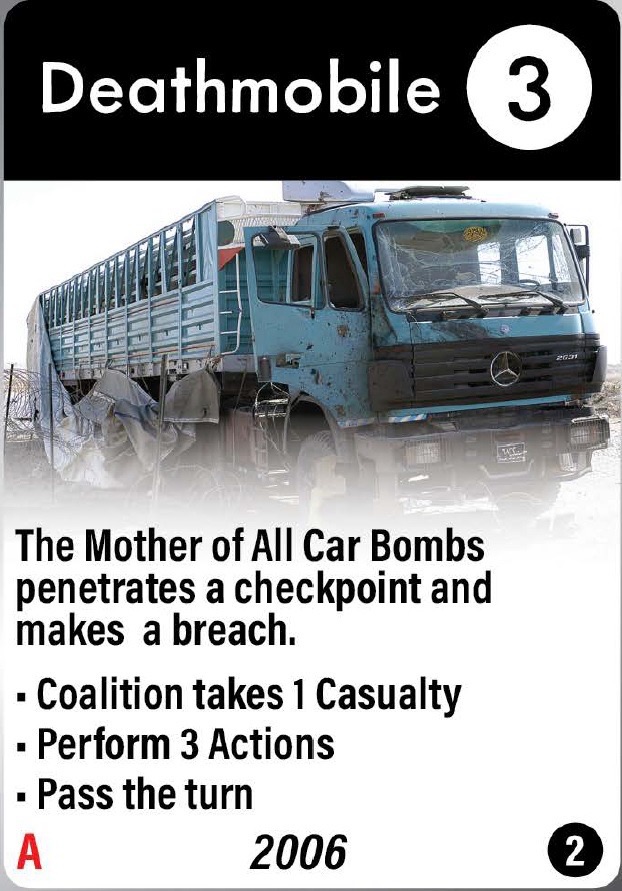
Greg: There’s three main types: The Year Cards (which serve as the “Game Turn” marker, basically), the Insurgent Deck and the Coalition Deck. The play deck cards are all the same format: An event or capability combined with a number of Actions that allow you to perform different game functions.
Grant: Can you share a few examples of these cards with us?
Greg: Here are a few cards.
Grant: What is the general Sequence of Play?
Greg: Players determine who is the First Player (which is set for some years, but usually variable). Card play commences, with each player playing a card (or spending a Resource Point, which counts as a card) then passing play to their opponent. During card play, MANY different actions can be taken, depending on what the player wants to do. When both players pass the turn without having played a card (or without spending a Resource Point) the year ends.
Grant: What different unit types that are available to each side?
Greg: The Coalition player has combat units (Multi-National Divisions and Brigades) along with Iraqi Police and Iraqi Army. There is also a UAV marker, a Joint Fires (think airstrikes, mainly) marker, and a Special Forces marker. The Insurgents, on the other hand, mainly just have cells (hidden) which can only be detected via patrolling. The cells can be flipped over to units, which have combat capabilities and which contest control. So, the options are stay hidden and safe (but non-contributing) or come into the open and fight.
Grant: What are the Special Forces unit for the Coalition? Are there similar units for the insurgents?
Greg: The Special Forces unit represents the SF ODA’s and, to a lesser degree, Delta Force. It can be used in a variety of roles, from searching for and destroying insurgent cells to conducting direct action and combat augmentation. The Insurgents really don’t have anything along these lines, although the Iraqi Army has the 36th Commando Brigade, which we formed and trained.
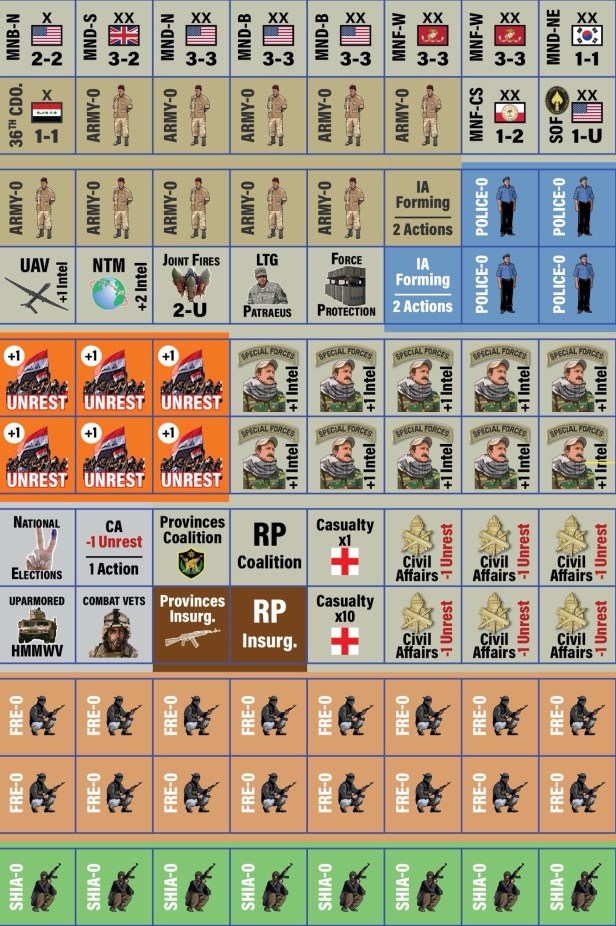
Grant: What is the anatomy and layout of unit counters?
Greg: The combat units are laid out in a fairly standard fashion, with a size formation at the top, combat strength on the left, and movement on the right. Some markers simply state their game effect (such as Civil Affairs, which give -1 Unrest to a province.)
Grant: How does combat work in the game?
Greg: Iraqi Army, Police and Insurgent Units take step losses, while Coalition Combat Units only take casualty point losses at worst. There are no advances and retreats as in most combat oriented wargames.
Grant: What actions does each player have access to?
Greg: The Insurgent Player can try to upgrade cells to units, move, conduct combat (and “Martyrdom” operations) as well as conduct “intimidation” operations against Iraqi Police and Iraqi Army. The Coalition Player conducts sweeps (patrols) and combat, as well as build intel networks, conduct Civil Affairs operations, and Special Forces operations. In a basic sense, you’re trying to improve your situation with actions, while degrading the enemy’s position.
Grant: What is the layout of the board? Who is your artist?
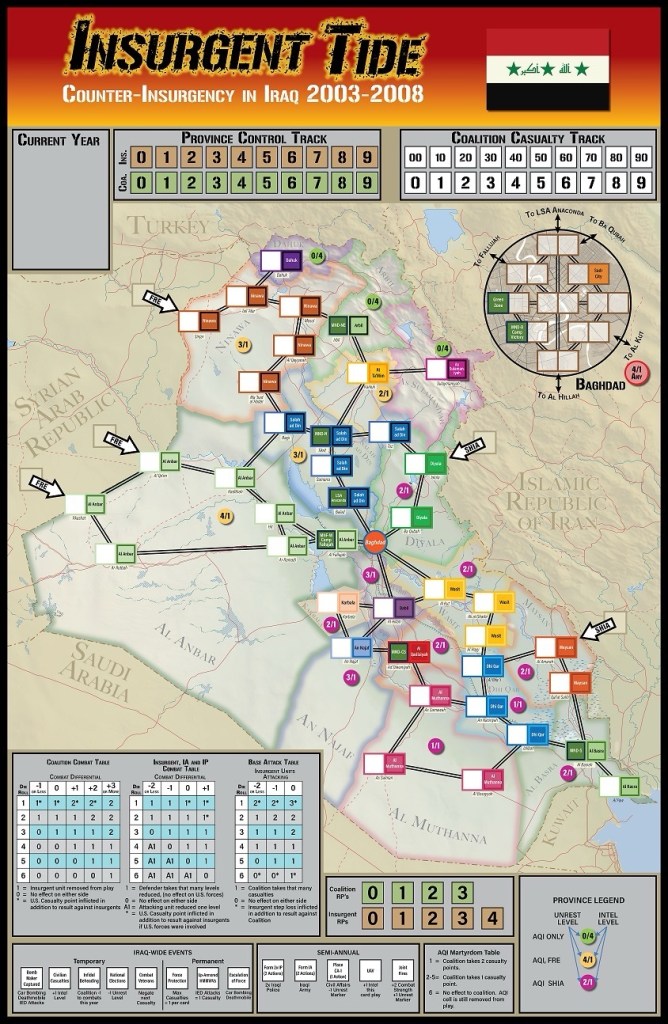
Greg: The board has most of the charts at the bottom and a full map of Iraq in the center, with an inset map for Baghdad operations. A small bit of Syria and Iran is shown. The map (and indeed, all of the artwork) was done by Nadir Elfarra.
Grant: How are intel markers used? What benefit do they offer?
Greg: These are pretty key in patrolling operations, as each point of intel in a Province gives you a greater chance to discover cells.
Grant: How does a player use their Resource Points? How are they gained?
Greg: Resource Points are listed on each year card for each player, although they can be augmented by “1” by spending a card rebuy point if you have one left over. They are used similar to “Actions” on cards, for converting cells, upgrading police or Army units, placing Civil Affairs markers, etc. Basically, they are your “Swiss Army Knife” resource, just like in other Tide Series games.
Grant: What purpose does unrest serve? How is it created and managed?
Greg: Unrest of the population is a key (probably THE key) value of a Province. Each Province starts with a listed unrest level. To activate a cell, you have to roll higher than the current unrest level, so it directly impacts on the Insurgent Player’s ability to create combat units. Certain cards may impact the unrest level for a short while (or even the rest of the year) in a province (and sometimes, in all of Iraq). The Coalition can mitigate unrest by placing Civil Affairs -1 Unrest markers, and sometimes will increase unrest by using kinetic strikes (as may be imagined, folks don’t like having their neighborhoods bombed.)
Grant: What leaders are represented? What abilities do they bring to bear?
Greg: General Petraeus is brought in via the MNSTC-I card, and he starts the process of rebuilding the Iraqi Police and Army. Abu Musab Al-Zarqawi (or “AMZ” for short) is the main leader for the Insurgents, and his most dangerous ability is that he increases the unrest of any Province he is in for AQI and FRE factions. Finally, I couldn’t help myself and included Saddam, even though he’s completely immaterial (he is “captured” with the first card play.) Mainly, I felt it was nice to include him to remind players of how the whole thing kicked off in 2003.
Grant: What type of experience does the game create for players?
Greg: As with most card play games, there’s a huge amount of decision making (which card do I play next, which do I save, etc.) and so there’s a back-and-forth component to the game. It is counter insurgency, but having said that, it does contain a decent amount of conventional combat.
Grant: What are you most pleased about with the design?
Greg: Well, other than I think the map is gorgeous, I think it represents a long war in a very compact, playable method. It just works, it’s fun to play (in my mind, anyway) and you can do it in an evening.
Grant: What has been the feedback of your playtesters?
Greg: Very positive, actually, so that was encouraging. I had a retired Colonel play it and give it an enthusiastic thumbs up, which was a new experience for me (pleasing an O-6 right out of the gate. Heh.) All joking aside, the testers were a big help, especially with suggestions on keeping it playable. For one example, initially I had six different insurgent factions which was just not adding a lot to play or “realism” but a lot to playtime. So we boiled that down to the three major factions (Shia, FRE (Former Regime Elements, i.e. Sunni) and AQI (Al Qaeda in Iraq).
Grant: When can we expect to see the game released?
Greg: I hate it when you ask me that 😊 It’s -done-and past final proofing. Might even be at the printers. So…next year? It really depends on when Compass has a slot for it. I hope sooner rather than later, I think it’s one of my best efforts.
Grant: What other designs are you currently working on?
Greg: I have a lot of irons in the fire, but currently I’m reworking Gotha Raider for issue #117 of Paper Wars, that is kind of a top priority. I have Western Desert Ace (40-42) in the works, along with Soviet Tank Ace, Israeli Tank Ace, a Vikings game somewhat loosely patterned after the old SPI Conquistador and some others. I promise I’m busy.
Thank you Greg for your time and efforts with answering our many questions. We always appreciate your designs and discussing and sometimes playing them with you.
At this time, the game hasn’t been officially announced by Compass Games nor added to their website for pre-order. Once they do, I will update this entry.
-Grant
 The Players' Aid