With this My Favorite Wargame Cards Series (I used to call this “new” but now after doing it for well over a year and now coming to the 49th post in the series, I have removed the new), I hope to take a look at a specific card from the various wargames that I have played and share how it is used in the game. I am not a strategist and frankly I am not that good at games but I do understand how things should work and be used in games. With that being said, here is the next entry in this series.
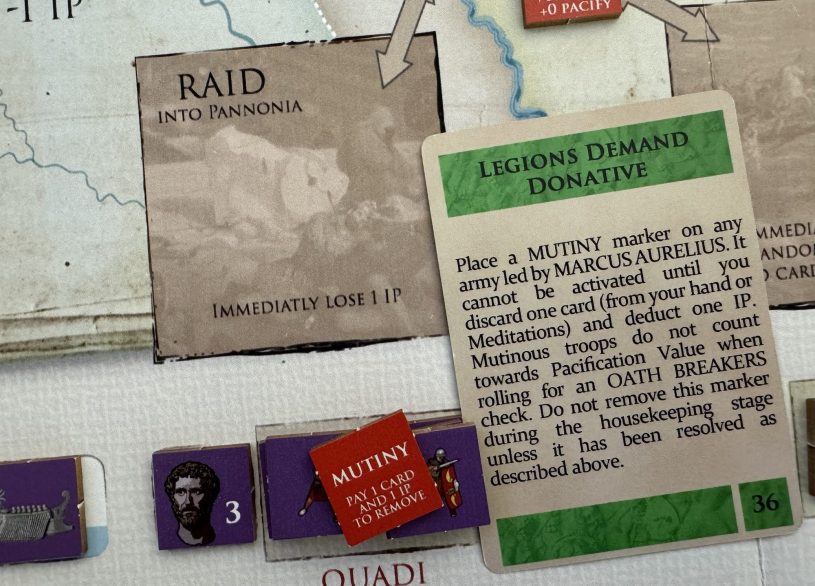
#49: Legions Demand Donative from The Wars of Marcus Aurelius: Rome 170-180CE from Hollandspiele
The Wars of Marcus Aurelius: Rome 170-180CE is a solitaire only game that uses cards similarly to a CDG to simulate the strategic level struggle of the Romans led by Marcus Aurelius to stave off the invasions of Germanic tribes and Sarmatian raiders as they encroach on Roman territory across the Danube River. That’s the history. And it is really well integrated. The game play is very fun, strategic, with lots of decision points about what to do and what cards to use, and it is really challenging.
In the game, the Roman player has a deck of Roman Cards that can be used for the printed events for various effects or that can be discarded to take any number of actions such as attack a Barbarian army or Off-Map Conflict enemy, advance the marker on the Imperium Track, add two Level 1 Forts to any eligible map spaces, flip one Level 1 Fort to a Level 2 Fort among several other actions. Sometimes the printed events in the game are just more powerful than discarding a card for just 1 action so you have to pay attention to this economy and make sure you get the most out of your cards. Now, keep in mind, sometimes discarding a good card whose ability is not right for the current situation you find yourself in is part of the game but you have to use these cards wisely to do well in the game.
The game uses two separate decks of cards including the Barbarian Deck (Green) and The Roman Deck (Red). Both of the decks are made up of 50 cards each but each have very different purposes. The Barbarian Deck is used to determine the actions of the invading Germanic tribes as well as events that effect the war effort including mutinies, plague and the will of the people. While the Roman Deck provides the resources and events that are used by the Roman player to mount a defense against the invasions and to fight back each of the different barbarian tribes. There are unique cards called Late War Cards in the deck that will be held out until the start of the 175CE turn at which time they will be mixed in with the cards to form a new Late War Deck. There are also special cards that are marked with an asterisk that if played for the event will be discarded from the game to form what is called a History Pile.

In this entry, we are going to take a look at one of the Barbarian Cards that causes havoc and inconvenience for the Roman player in Legions Demand Donative. In the Barbarian Deck, there are several cards which cause the Roman player to have to spend their scarce actions or resources toward taking care of a standing problem that arises. These problems are associated with all types of situations as mentioned above but one that is solvable. Legions Demand Donative creates a Mutiny marker to be placed on any army lead by Marcus Aurelius himself. This causes that army to be unable to be activated and used to fight back the advancing Barbarians. But, more importantly, it causes the loss of 1 Imperium Point or IP. Imperium Points are a way to measure the authority of Marcus Aurelius and the confidence in him of the people of Rome. This Imperium Track can go up or down with events from cards or down due to poor battles (bad dice rolls with an army led by Marcus Aurelius). When you lose an IP, players will move the marker down and when they gain an IP it will move up. But you must pay attention to this Track as if the marker ever reaches the bottom space, Marcus Aurelius is considered to have been usurped and the player will automatically lose.
The card also requires the player to have to discard a card from their hand to remove the Mutiny Marker. This is a big deal as you only have a few cards in hand each turn and these cards are your available actions for that turn. With lots of fires to stamp out and few resources to rely upon the loss of one of these cards can really make that turn suffer. But while it hurts your offensive capabilities, if you are relying upon that army to keep a Pacified Tribe in check and to defeat any Oathbreaker Checks, you will not get to count that army toward your benefit and the check will most likely pass and that Tribe will reenter the conflict.
These type of “resource sink” cards are plentiful and you have to be prepared to deal with them or they can be the cause of your doom! That is why I love them. The game is already extremely difficult and the addition of these cards, along with the Off-Map Conflicts, really keep you on your toes and your blood pressure elevated.

The phrase Legions demand donative refers to ancient Roman soldiers, or legions, requesting or receiving a donative (a sum of money or gift) from their emperor or leadership, often to secure their loyalty or to show gratitude for their efforts and hard fought victories in wars. As you know, the life of a legionnaire was a long and gruesome ordeal where the soldiers were away from home for years at a time, with some terms being mandated as high as 20 years, subsisted on gruel and bread and lived in poor conditions on the frontier suffering the effects of harsh climate, disease and the continual attacks of Barbarian tribes. These donatives were a way to express gratitude, but they also served as a form of bribery to keep the support and loyalty of the troops, especially during turbulent periods. This practice became particularly significant in the 2nd and 3rd centuries AD, as many soldier-emperors relied on the Praetorian Guard’s support to stay in power.
I shot a playthrough video for the game and you can watch that at the following link:
I also followed that up with a full video review sharing my thoughts:
In the next entry in this series, we will take a look at Ambitus from Time of Crisis: The Age of Iron and Rust Expansion from GMT Games.
-Grant
 The Players' Aid