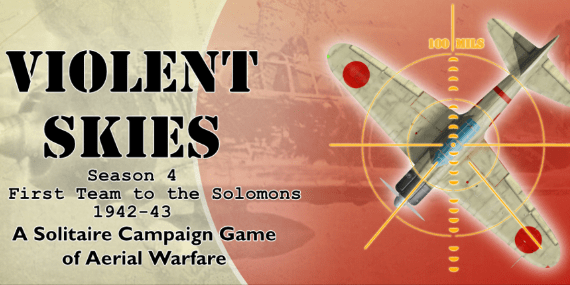
In the category of new and small publisher I knew nothing about, over the past few years I found a new game series called Violent Skies from Pocket Warfare Publishing. These games are Print ‘n Play games and are available on the Wargame Vault website. We did an interview with the designer Ben Rawlings on the first and third games in the series called Violent Skies: Season 1 1940 – Dynamo to the Blitz and Violent Skies: Season 3 The Desert War 1940-41. The 4th volume in the series is called Violent Skies: Season 4 – 1942/43 – The First Team to the Solomons and looks really good. I reached out to the designer Ben Rawlings and he was more than willing to discuss his design and the future plans for the series.
If you are interested in Violent Skies: Season 4 – 1942/43 – The First Team to the Solomons, you can order a copy for $9.50 from the Wargame Vault website at the following link: https://www.wargamevault.com/product/528878/Violent-Skies–1942-43–The-First-Team-to-the-Solomons?
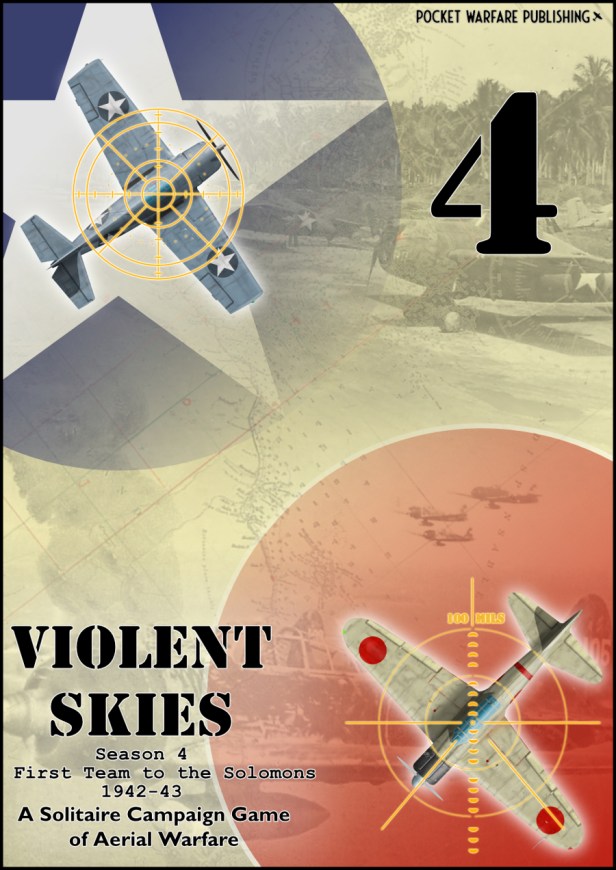
Grant: What is your new release Violent Skies – 1942/43 – The First Team to the Solomons about?
Ben: This release takes players of Violent Skies to the Pacific Theater of Operations and introduces the Japanese and Americans to the system. You’ll play famous engagements such as Battle of the Coral Sea, Battle of Midway and then find yourself thrown into the awful conditions of the Solomon Islands flying a host of the most famous aircraft of the period, along with a few surprises.
Grant: Why was this a subject that drew your interest?
Ben: It is hard not to be interested in the Pacific Theatre if you love aviation history. The conditions of carrier fighting were completely different from how the fighting was happening in Europe. The aircraft also have their own legends: Wildcats and Zeros, Oscars and Lightings. You also have a daring long range assassination in Operation Vengeance, the killing of Yamamoto that players can try their hand at. So for someone who has played the game system it offers some exciting new stories to tell. I also have a lot of books on this period of the Second World War and it was something I knew I wanted to do when I first started designing the game.
Grant: What is different about the Pacific Theater of Operations and air warfare that you had to take into account?
Ben: Firstly the carrier aircraft when operating from the carrier have to face the inherent danger of those flight decks. Snapped cables, bad approaches and in some cases no carrier to land on. Another aspect was fighting in the region itself. The weather and supply conditions led to awful illness and gastrointestinal problems that would hinder pilot performance. Whereas in Europe the supply lines were short, here there was the whole Pacific Ocean to traverse before you even got to the operational bases. There were also huge operational differences in how the US and Japanese fought around Cactus (Guadalcanal). The Allies had their Coast Watchers and Early Warning Radars, while the Japanese had to use trial and error to try and get the “jump” on the US forces. Moreover, the Japanese were operating at the maximum possible range for their fighters, needing welded-on external tanks which also hindered the Zero’s previously unmatched performance.
Grant: What is your design goal with the expansion?
Ben: My goal was to introduce the United States and Imperial Japanese forces into the game system, and a whole new theatre. I also wanted to get carrier operations into the system.
Grant: What elements from WWII and specifically the period of the PTO are most important to include in the design?
Ben: Around the Solomons, the Japanese were often attacking a fully alert and ready American force, warned by Coast Watchers and radar. This meant that there had to be design differences between the A6M2’s of the carrier battles compared to those at Rabaul at this time to model the disadvantage of these pilots and airframes. I also wanted to have an illness event to model the stresses put on the bodies of these pilots. The events are also a way to give each theatre “flavours” as it were. So for the P-38 you have the risk of compressibility from its high potential dive speeds, the Ki-43 might have a round prematurely detonate in the barrel of its MG, or in an F1M2 Pete you are on a long range lone patrol with no wingman actions to help you.
Grant: What research did you do to get the details correct? What one must read source would you recommend?
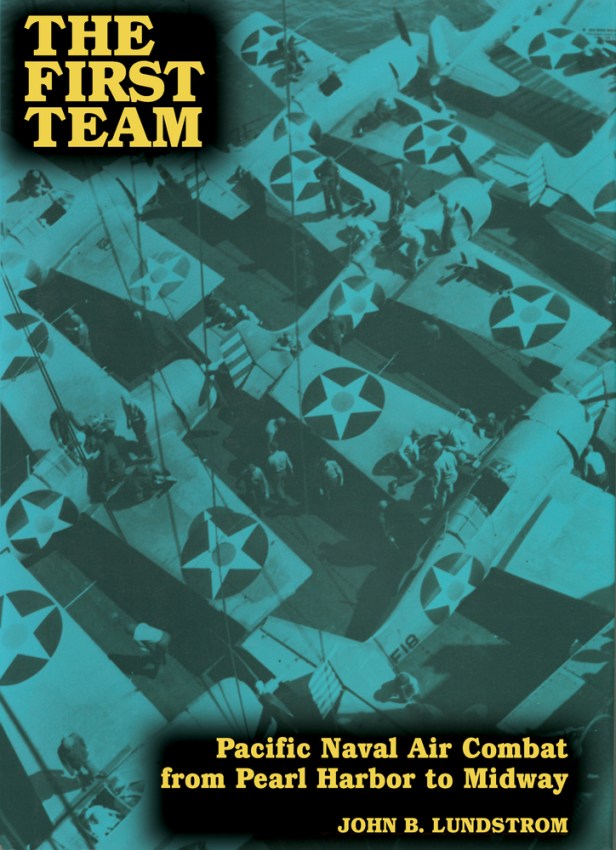
Ben: Well one source is a hard ask with a subject as varied as Pacific Theatre aerial warfare. For the United States, John Lundstrom’s The First Team: Pacific Naval Air Combat from Pearl Harbor to Midway is a must read! There is a follow-on for the Guadalcanal Campaign which is equally as good. For the Japanese Eagles of Mitsubishi by Jiro Horikoshi goes into design of the A6M Zero and the life of its designer. It is an amazing read and well worth tracking a copy down. I also used Japanese Naval Aces and Fighter Units in World War II, and the army companion Japanese Army Air Force Fighter Units and Their Aces 1931 – 1945. These offer a general history, unit histories and ace biographies. They are full of information and a great help to anyone researching this period. The usual Osprey books are also a great series and I recommend them to anyone. The last books are any books by Barrett Tillman, he is THE historian on US Navy aircraft and Wildcat, Dauntless and Corsair all by him were used to bring a lot of the sortie cards to life.
Grant: How does the game use a game card that acts as your cockpit?
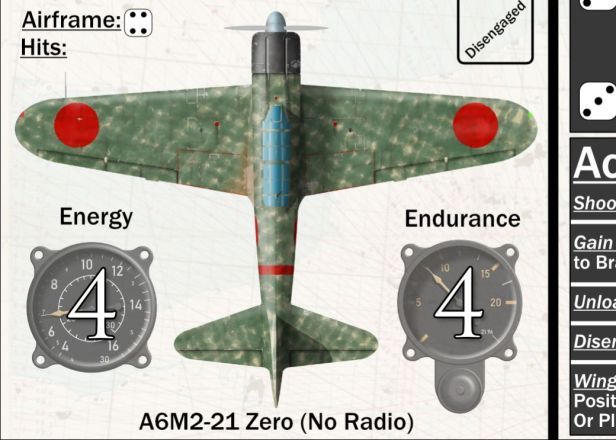
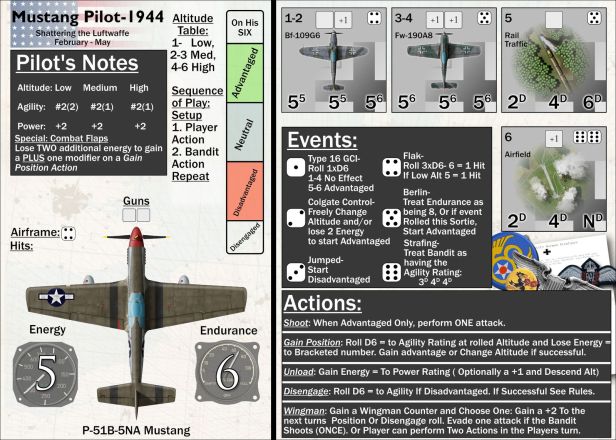
Ben: The main part of the game is played on a card that has a top-down picture of your aircraft and all the information needed to fly it and track that information. You have an Energy and Endurance Track, using one D6 for each. Energy is your life. It lets you Gain Position to hopefully shoot down your Bandit. Endurance is the game’s turn marker. When it gets to one, that is your final turn. The Endurance is a reflection of your aircraft’s fuel capacity, fuel burn and basing location. You also have an Altitude Track which will affect your performance when performing certain actions. It is through the Endurance, Energy and Altitude Tracks that the player makes their decisions on what action to perform. Much like a real aircraft, you won’t be undertaking any maneuvering while sitting at stall speed!
Grant: What is the layout of the game cards?
Ben: The game cards are laid out with the left side of the card being the player’s “Cockpit” with the Energy, Endurance, Altitude and Advantage Tracks. The aircraft’s performance, guns and special rules are also on this part of the card. The right side of the card is where you have the non-player controlled elements, such as four Bandits to be randomly selected, and the six Events. There is also a “Checklist” for all the player actions on this side of the card.

Grant: What different elements of the plane are tracked during a mission?
Ben: The aircraft’s Energy is the most critical thing to be tracked during missions. This is the “currency” which you exchange to Gain Position. If you would have to reduce the energy to below one, you cannot perform the action. The player will have to balance gaining Energy through other actions, and losing it to maneuver.
Grant: How also does this game card double as a mission generator?
Ben: The Sortie Card also has a selection of four Bandits (enemy aircraft) and six Events. During the setup the Player will roll for Altitude, Bandit and Event. From this a mission is generated. A typical Sortie from these relatively simple systems will allow players to get a rich narrative with plenty of decisions to make to win or lose.
Grant: What different planes are available to fly? Any that are your favorites?
Ben: Wildcat F4F-3 & -4, A6M2-21, A6M2-N, A6M3-32, Ki-43b, P-38G, P-40F, F1M2, F4U-1, P-39D. As for my favourite it changes every time that I play. I really enjoy the P-38G and the Ki-43b. They couldn’t be more different in their design philosophies but with some thought they probably are the “best” two aircraft in the game.

Grant: How did you differentiate each plane?
Ben: The starting Energy and Endurance of each aircraft are the most obvious individual characteristics depending on their speed and fuel performance. Then it would be the Agility ratings for each Altitude band. Low, Medium and High all have different Agility and Power ratings to model some of the strengths and weaknesses of WWII designs. Then there is the Special rule which gives the plane a positive or negative change, depending on the aircraft’s characteristics beyond the scope of Agility and Power. Some aircraft get bonuses to Agility, while for others their climb rate allows them to disengage at will. Some have defects that negatively affect some things.

Grant: What was this differentiation process like?
Ben: It normally starts in a notebook making a table of the top speed, cruise speed, never-exceed speed, climb rate, wing loading and range. From there, comparisons are made with other aircraft and that is how the statistics are done. Anecdotal evidence also may swing a statistic as well.
Grant: What is the general Sequence of Play?
Ben: In a standard campaign game you will first roll for weather. The weather result will then determine the Takeoff and Spotting roll. Once the Spotting roll is done you move onto the Sortie Card. Rolling for Altitude, Bandit type and the Event. The Player then takes the first action and then the Bandit will take theirs. Some Events may let the Bandit take the first action making the Player lose a turn. At the end of the Bandit’s turn, Endurance is reduced by one. At the end of the turn where the Endurance reaches one, the Sortie is over, and a Landing roll is made. Players then record any successes or events of note in the Player Logbook.
Grant: What is the Advantage Track and how does it work?
Ben: The Advantage Track is the heart of the system. A player or Bandit gains position as the player can only shoot when advantaged and a Bandit may only shoot when the player is disadvantaged. This scale represents maneuvering aircraft. A Gain Position action, using the Agility and Power ratings at the current Altitude determines the position on the Advantage Track.
Grant: What different skills do players have access to choose from?
Ben: Skills come in two types: Ace Skills and Pilot Skills. Ace Skills are gained using points earned from shooting Bandits down, while Pilot Skills are gained by number of Sorties flown. The Ace Skills give Players combat bonuses, such as recording two hits a turn rather than one, or giving a bonus on the spotting table. The Pilot Skills give the Player re-rolls on the Takeoff and Landing Tables, chances to begin with higher Endurance or Energy depending on the Player’s flying style and even getting “on his six” which grants a powerful bonus to Players who have survived multiple campaigns.

Grant: What was the greatest challenge in the design you had to overcome?
Ben: In this expansion making each variant of the same aircraft “feel” different enough despite marginal differences in performance. This mainly was expressed by the events modelling any vices or perks that each variant had, while the Agility and Power stats stayed the same.
Grant: What changes have come about through play testing?
Ben: This was simple tweaks to the aircraft stats and advice on some of the aircraft special rules. I have really great playtesters and it normally is making sure the stats don’t creep and instead stay true to the aircraft as more releases come.
Grant: What do you feel the game design excels at?
Ben: I said in the interview I did for the Dynamo to the Blitz release that you can get plausible and fun results in a very quick-playing game, while occupying very little space. For a small footprint print-and-play it offers a huge range of different scenarios which is only growing the with aces, skills and different theatres that are still coming. The game is accessible so that it can be played as a small, brief sortie or a whole campaign giving flexibility to the player.
Grant: What new subjects or theaters are you contemplating for this system?
Ben: Right now I am putting the finishing touches on a 4th Fighter Group pack that will follow a single fighter group in the Eighth Airforce from Spitfires to P-51’s. After that, I have requests for Malta, the Eastern Front and taking the series into the Missile Age with Vietnam and beyond. So I have plenty to be getting on with!
Thanks so much for your time in answering our questions Ben. The game looks great and I am glad that we have been able to share this interesting looking little game with our readers. Hopefully, we will have you back on the blog again for future interviews.
If you are interested in Violent Skies: Season 4 – 1942/43 – The First Team to the Solomons, you can order a copy for $9.50 from the Wargame Vault website at the following link: https://www.wargamevault.com/product/528878/Violent-Skies–1942-43–The-First-Team-to-the-Solomons?
-Grant
 The Players' Aid