With this My Favorite Wargame Cards Series (I used to call this “new” but now after doing it for well over a year and now coming to the 48th post in the series, I have removed the new), I hope to take a look at a specific card from the various wargames that I have played and share how it is used in the game. I am not a strategist and frankly I am not that good at games but I do understand how things should work and be used in games. With that being said, here is the next entry in this series.
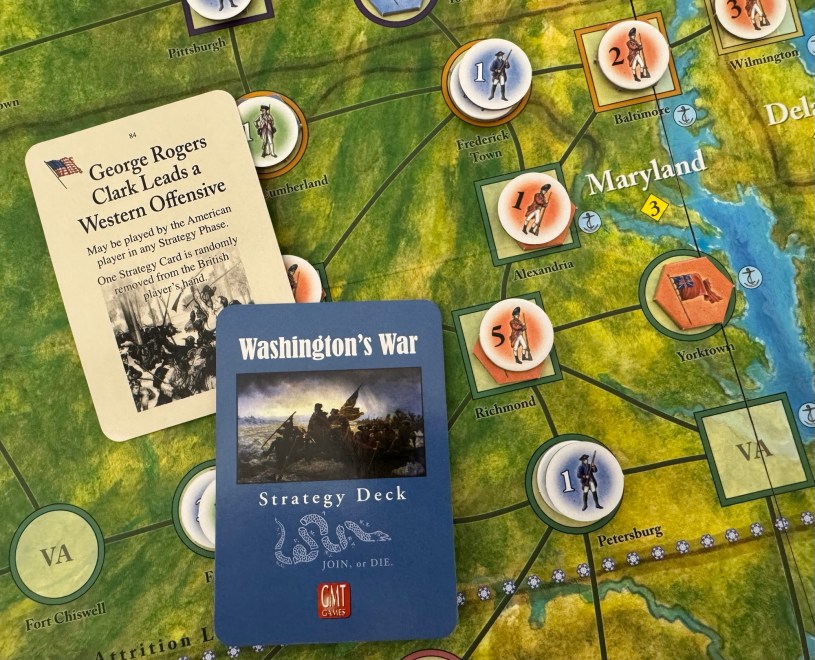
#48: George Rogers Clark Leads a Western Offensive from Washington’s War from GMT Games
Washington’s War is a war game, make no mistake about that. But, it is virtually impossible to win the game by focusing only on the field of battle. For that to happen, the Patriots need to completely drive the British forces out of the 13 colonies or the British need to wipe the American forces off the map. Both are extremely difficult and I would be surprised if any more than 1 out of 30 games ended in such a way. Rather, the ultimate goal of the game is to have political control of the colonies. If at the end of the game the Patriots control 7 colonies, while holding the British to control of less than 5, they win. If not, the British win. Simple as that. So, you can see that battle is not the main goal but control is. And more importantly political control.
I really like this about the design and feel that the real core of the American Revolution was the groundswell of patriotism and the desire to live free from the shackles of an overseas monarch who cared little for the American way of life. This desire led great men of the time to sacrifice themselves, their livelihood and their families to further the true cause of liberty and build a truly free and democratic nation where individual liberty and freedom was prioritized over anything else. And yes, I realize that this nation was not perfect, not without contradiction but the concept of liberty helped to form a country that would lead to the ultimate freedom of all people.
Washington’s War is a Card Driven Game, and as such, relies on cards to provide to players the actions needed to play the game. The cards contain OPS Points which can be used to drive various actions, including such things are activating leaders, who in turn will then move with forces to attack, and also contain written text in the form of events. These events can be played only by the side they are intended for and if drawn and played by the opposing side, they can only be thrown away while granting a few possible actions, such as placing or removing Political Control markers.

In today’s entry, I have chosen this card more for the historical aspect than the game play. The card for today is called George Rogers Clark Leads a Western Offensive and is focused on taking away British actions via forcing them to lose a card. The card text reads “May be played by the American player in any Strategy Phase. One Strategy Card is randomly removed from the British player’s hand.” Remember, that each player will draw 7 cards at the beginning of the Strategy Phase and then will play all of those cards until their hand is empty. Taking one of those cards can really hurt and especially with a solid plan, the Patriot player can hold this card until the end of a turn and really make their final card plays impactful leaving the British player with no way to respond. Not necessarily the most impactful card, but when used properly has the ability to really hamper the British and their efforts. I very much enjoy the thematic connection of this card with the history as well. George Rogers Clark spent most of his time in the war on the frontier and was fighting the war in the bush. With each of his victories, including such wins as at Kaskaskia in 1778 and then in Vincennes in 1779, his efforts caused concern for the British who had to divert at least a portion of their men and materiel to the frontier to shore up the front or risk losing it to the Patriots. This is well represented in the game with the British losing a card, or think of it as having to adjust a plan for a major Campaign and diverting those resources, in order to react to the losses on the frontier.

George Rogers Clark was an American military officer and surveyor from Virginia who became the highest-ranking Patriot military officer on the northwestern frontier during the American Revolutionary War. He served as leader of the Virginia militia in Kentucky throughout much of the war. He is best known for his captures of Kaskaskia in 1778 and Vincennes in 1779 during the Illinois campaign, which greatly weakened British influence in the Northwest Territory and earned Clark the nickname of “Conqueror of the Old Northwest.” The British ceded the entire Northwest Territory to the United States in the 1783 Treaty of Paris.
As the American Revolutionary War began in the East, Kentucky’s settlers became involved in a dispute about the region’s sovereignty. Richard Henderson, a judge and land speculator from North Carolina, had purchased much of Kentucky from the Cherokee by an illegal treaty. Henderson intended to create a proprietary colony known as Transylvania, but many Kentucky settlers did not recognize Transylvania’s authority over them. In June 1776, these settlers selected Clark and John Gabriel Jones to deliver a petition to the Virginia General Assembly, asking Virginia to formally extend its boundaries to include Kentucky.
Clark and Jones traveled the Wilderness Road to Williamsburg, where they convinced then Governor Patrick Henry to create Kentucky County, Virginia. Clark was given 500 lbs of gunpowder to help defend the settlements and was appointed a major in the Kentucky County militia. Although he was just 24 years old, he led much older and more experienced but lesser ranked settlers such as Daniel Boone, James Harrod and Benjamin Logan.
In 1777, the Revolutionary War intensified in Kentucky. Lieutenant-Governor Henry Hamilton, based at Fort Detroit, provided weapons to his Indian allies, supporting their raids on settlers in hope of reclaiming their lands. The Continental Army could spare no men for an invasion in the northwest or for the defense of Kentucky, which was left entirely to the local population. Clark spent several months defending settlements against the Indian raiders as a leader in the Kentucky County militia, while developing his plan for a long-distance strike against the British. His strategy involved seizing British outposts north of the Ohio River to destroy British influence among their Indian allies.
Here is a link to our full video review of the game:
In the next entry in this series, we will take a look at Legions Demand Donative from The Wars of Marcus Aurelius: Rome 170-180CE from Hollandspiele.
-Grant
 The Players' Aid