Not often does a game get a 3rd Edition printing! But, sometimes the classics are given this treatment and the games are well received and even much anticipated. Well, the classic NORAD designed by legend Dana Lombardy has been recently given a 3rd Edition treatment in the Japanese language wargame magazine Banzai. This new 3rd Edition game can be purchased from the Lombardy Studios website minus the magazine. I reached out to Dana to get some information about the new 3rd Edition and what might be different.
Grant: What is the news with the new edition of your NORAD game?
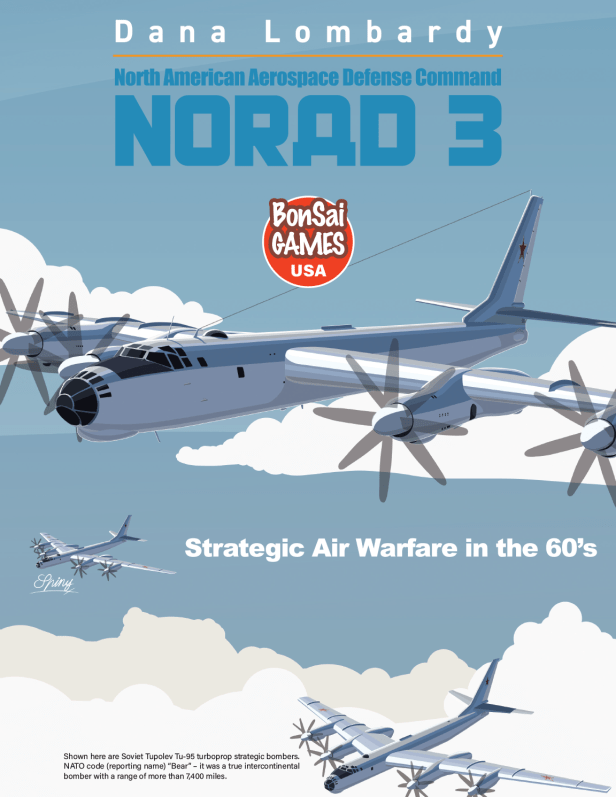
Dana: The first version of NORAD was published in 1973 along with my Conflict Magazine Issue #4. In 1977, a friend reprinted the game for his Mishler Company using the same artwork and a few rule edits. NORAD 2 was planned by Victory Point Games adding cards, chits, and major rules changes but it was never published. Banzai Magazine’s NORAD 3 is a greatly expanded version based on the original design that adds the USA attack on the USSR and NATO forces. The new art shows how much better graphics have become in 50 years.
Grant: What is being updated in the 3rd edition game?
Dana: A larger game map that shows the USSR and Europe, although you can play with just the map of Canada-USA or USSR-Europe. NORAD 3 has more playing pieces, more variety of aircraft types, better organized rules, new solitaire rules, optional rules such as rolling dice for fighter combat, and an expansion game – designed by the publisher of Banzai Magazine Yasushi Nakaguro that features American bombers (B-52’s) and Soviet defensive fighters and SAM’s (Surface to Air Missiles).
Grant: What has been your experience working with Banzai Magazine?
Dana: Yasushi Nakaguro has been a pleasure to work with. He is not only a very creative game designer, but also a successful magazine publisher with many fans in Japan as well as the USA and Europe. NORAD 3 appeared in Banzai Magazine #22 – now sold out, but I am reprinting the game in the USA.
Grant: Can you show us the new game map and outline what is different?
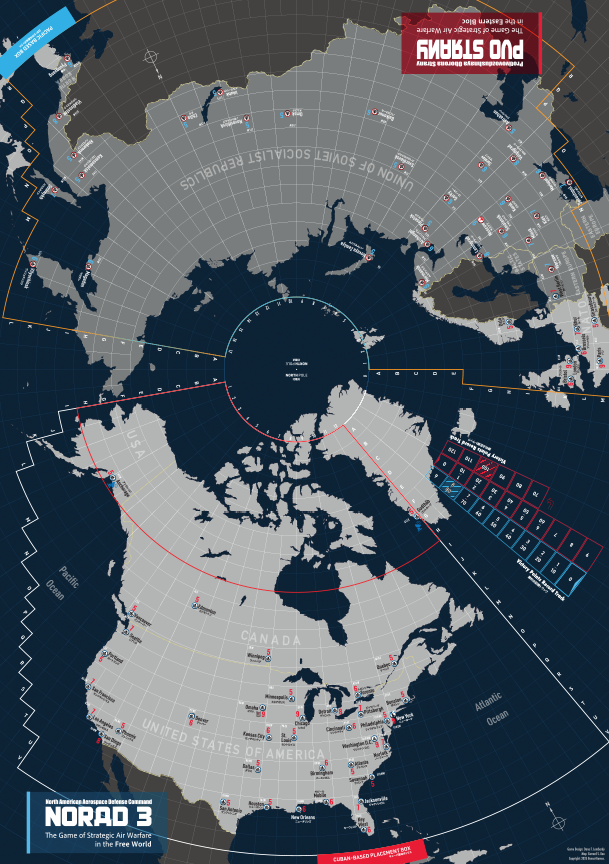
Dana: The photo shows the original map area of North America greatly expanded with the USSR and Europe. There are now victory point tracks and unit counters to keep score. I cannot say enough nice things about how much visually improved the map and counters by Gerard S. Koo look.
Grant: Why did you feel these game map changes were necessary?
Dana: The expansion to include the USSR and Europe necessitated a larger map. The victory point tracks were bookkeeping player aid improvements and have made playing the game and tracking this information much simpler.
Grant: What new playing pieces are being added?
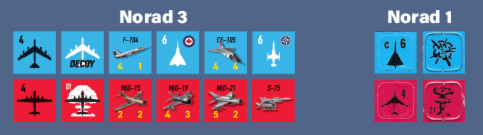
Dana: The NORAD 1 Russian Tupolev Tu-16 Badger jet bombers were replaced in NORAD 3 with Tu-95 Bear turboprop bombers with a much longer operational range – both of these were available in large numbers in 1962. The original NORAD 1 playing pieces for the US F-102 and F-106 delta fighters are now supplemented with F-101 Voodoo and F-104 Starfighter, CF-105 Arrow (Canadian made), NATO Mirage III and Lightning fighters and Hawker Hunter bomber. Totally new playing pieces include Soviet MiG 15, 17, 19, and 21 fighters and SAM-75 anti-aircraft missiles.
Grant: What are the new rules for the Soviet Home Defense forces?
Dana: The rules for PVO Strany (Soviet Homeland Air Defense Forces) are minimal – description of the new map, how to setup the Soviet and US forces, and victory conditions. It otherwise uses the same rules as for NORAD 3. This expansion uses the new map that shows the Eurasian continent with the Soviet Union, Eastern Europe and North Korea – the so-called “Eastern Bloc.” The other additions are the Soviet fighters and Surface to Air Missiles (SAM’s), and the US bombers and submarine-launched ballistic missiles (SLBM).
Grant: What is the backstory about the design of NORAD?
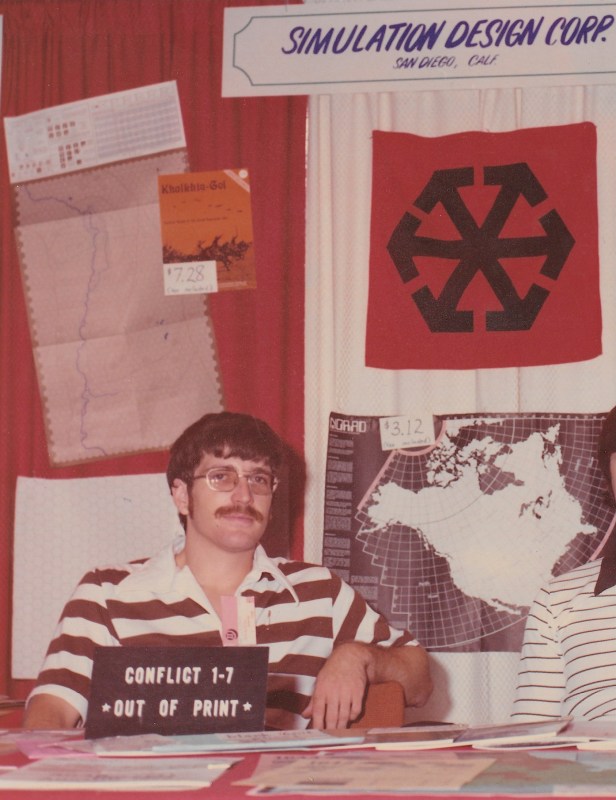
Dana: NORAD was my first modern era (1962) design, published in 1973 with my Conflict Magazine Issue #4. The reaction was extreme: readers either loved it or hated it. NORAD used a polar projection map where the movement spaces were smaller at the North Pole and became wider as they moved South. To the best of my knowledge, this was the first wargame to use this type of map.
Combat did not have standard combat factors on each counter that was resolved using a customary Combat Results Table (CRT). Instead, if a Russian bomber or submarine missile reached a Canadian or United States city it was immediately flipped over to show a nuclear mushroom cloud. This designated that the city was destroyed and the Soviet player received the victory points for that city. If the Canadian / U.S. fighter aircraft could reach the Russian bomber before it could nuke the city, both counters were removed. There were also anti-aircraft missile counters placed on some cities that were last-ditch defenses. Both sides had a few decoy (blank) counters to confuse their opponents.
In 1977 a friend reprinted the game for his Mishler Company using the same artwork and a few rule edits. NORAD 2 was planned by Victory Point Games adding cards, chits, and major rules changes but it was never published. Banzai Magazine’s NORAD 3 is a greatly expanded version based on the original design that adds the USA attack on the USSR.
Grant: What optional rules are included?
Dana: There are 8 optional rules, including:
DEW (Distant Early Warning) Line became operational in 1957. It was a joint Canada-U.S. radar network built in the 1950s across the Canadian and Alaskan Arctic to provide early warning of Soviet bomber and, later, intercontinental ballistic missile (ICBM) attacks. If the two cities representing this line are destroyed, the Soviet bombers may start on the map further into North America below this row.
Other options include: Soviet setup coming in from Cuban bases (limit of 3 bombers) – or from Siberian bases instead of over the artic polar ice cap (unlimited).
Also, Submarine-launched Ballistic Missiles (Soviet SS-N-4 “Snark”) from Z-V class submarines, Royal Canadian Air Force fighters, fighter combat using dice to resolve combat, increased movement cost per square for moving diagonally instead of vertically or horizontally, and a Target Assignment Sheet (page 8 back cover of rules folder).
Grant: What is the expansion? What does it add?
Dana: The game now includes a map of the USSR and Europe along with the playing pieces and rules covering these additional forces.
Grant: I have heard that the game is affectionately referred to as “nuclear checkers”. What merit does this name have?
Dana: When NORAD was published in 1973, wargame rules were growing into longer and longer rules with dozens of pages. The original rules for NORAD were printed on the game map: much simpler to learn, and the playing pieces numbered only 60 total. Most new wargames in the 1970’s and 1980’s had hundreds of unit counters. My Streets of Stalingrad was published in 1979 with nearly 2,000 playing pieces! I believe the name “nuclear checkers” was a compliment as well as description to the simplicity of the game that can be a great introductory wargame – that is still true today.
Dana: Are there plans to continue reissuing these older games of yours?
Dana: Yes! Second, expanded and graphically enhanced versions of my 1972 release Dunkerque 1940 (featuring hidden movement), and the 1973 Khalkhin-Gol (1939 battle in Mongolia and Manchukuo between the Soviet Union and Imperial Japan) are both in various stages of development. I also have a regiment-brigade level playtest version of Streets of Stalingrad 4 based upon the historical research for the 1979-1980 “monster” company-level simulation (3 editions). I hope to launch the crowdfunding campaign for Streets of Stalingrad 4 in 2027 – the 85th anniversary of the battle.
Grant: When can players expect the 3rd Edition of NORAD to be available?
Dana: I just sent the print-ready artwork provided from Banzai Magazine for NORAD 3 to the US-based printer, and the publisher of Banzai Magazine shipped me about 100 copies of the game still left in his inventory (issue #22 of Banzai is no longer available). I anticipate the US edition to be printed, assembled, and shipped in October, and the Banzai edition of NORAD 3 to arrive at my California warehouse in late October.
Grant: What other projects are you working on?
Dana: Everything I was working on stopped back in November 2024 when I, my domestic partner, and her daughter were forced to suddenly move from our live-work space. Fortunately, we found a new apartment nearby in Oakland (California), but we are still unpacking and sorting through boxes that were hastily moved to the new location. At the same time, my younger brother was diagnosed with bladder cancer and his wife (my sister-in-law) fell and then died from complications in August. My brother is stable but my older brother and I continue to travel to San Diego to stay in touch.
Our hobby also lost two great people and my dear friends in 2025: Hall of Fame graphic artist and publisher of C3i Magazine Rodger MacGowan in February, and Hall of Fame wargame designer and author Jack Greene in March who helped develop my early wargames for Conflict Magazine in the 1970’s.
These tragedies have left me shell shocked to say the least. And have seriously interrupted two crowdfunding projects I began in 2024:
- I am almost finished with Bloody Omaha, a solo and 2-player game of the June 6, 1944 D-Day invasion that I hope to print, assemble, and ship in October; and
- My collaboration with Hall of Fame designer Steve Jackson on a second edition of his 1980 One-Page Bulge game that will also be printed by a US-based printer when the Chinese printers were no longer viable.
I have lots of ideas for future second editions and completely new designs, but these two crowdfunding projects are at the top of my list and I hope to announce their availability this fall.
Thanks so much for your time in answering our questions Dana and for putting such an interesting and beautiful product as this back on the market. I am very much looking forward to seeing more on this in the near future and definitely want to add this game to my wargame collection.
Here is a link to an overview video from the designer Dana Lombardy:
If you are interested in NORAD 3 (3rd Edition), you can order a copy for $40.00 from the Lombardy Studios website at the following link: https://lombardystudios.com/norad-3/?srsltid=AfmBOoo17bBzcRl2Qg4-g2MsKex5l-xEfxUkv4DGvDnA8z6ot_qGPNHe
-Grant
 The Players' Aid