
Martin Melbardis began his design career with Campaign: Fall Blau from Catastrophe Games. This was a very interesting little dice chucking solitaire game on Operation Barbarossa during WWII. Since that time, he has started his own independent wargame company called Solo Wargame and has designed 10 different and very interesting roll and write wargames on a plethora of subjects including World War I (Trench Tactics), World War II (Operation Barbarossa, Lone Wolf: U-Boat Command and War in the Pacific), Napoleonic Wars (Siege Works) and Ancient Rome (Rome Must Fall). His newest game called Crusade: Road to Jerusalem is focused on the First Crusade and looks really interesting and I reached out to Martin to get a bit more information about the game.
At the time of the posting of this interview, the campaign for the Kickstarter has concluded but you might be able to late back the project at the following link: https://www.kickstarter.com/projects/105281170/crusade-road-to-jerusalem?ref

Grant: Welcome back to the blog Martin. What is your new game Crusade: Road to Jerusalem?
Martin: Firstly, thanks for inviting me back for the blog. It’s great to be back!
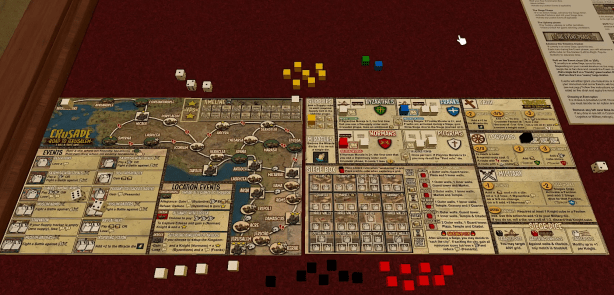
Crusade: Road to Jerusalem is my newest Print & Play solo wargame, and it throws you right into the First Crusade, 1096–1099. The player commands the Crusader army, a coalition of Franks, Normans, Byzantines, and Pilgrims, as they march from Europe to the gates of Jerusalem.
You must manage supplies, maintain fragile alliances, and conduct sieges through a 4×4 Siege Grid system that turns every fortress into a tactical puzzle. The design goal was to capture the sense of undertaking a long and difficult journey through hostile terrain while balancing faith, logistics and military.
Grant: Why was this a subject that drew your interest?
Martin: I have always been a history nerd, and most historical war periods interest me. However, The actual spark for the project came from a suggestion by a Kickstarter backer, who asked if I had ever considered designing a Crusades game. Once I began researching, I realized that few games cover the actual journey from Europe to Jerusalem. What sets the First Crusade apart for me is that it was not defined solely by battlefield encounters but by the immense challenges of sustaining a march across hostile lands, holding alliances together, and surviving hunger and disease. It is a story of faith, politics, and endurance. That challenge was compelling, and it motivated me to translate the historical narrative into a solo wargame.
Grant: What is your design goal with the game?
Martin: The primary goal was to capture the tension of the long march toward Jerusalem. Players are constantly pulled between advancing, resupplying, rallying morale, or preparing for sieges. Those competing priorities mirror the difficult choices faced by the leaders of the Crusade.
Equally important was showing that the Crusade wasn’t one neat army with a single leader. It was a coalition, with factions that had their own egos and agendas. By giving each group its own morale track and abilities, the game forces you to manage not just logistics and battles, but fragile relationships too.
So, in short, I wanted to give players a game that feels historically grounded but still fast and fun, where every playthrough is basically you writing your own First Crusade story.
Grant: What sources did you consult to get the historical details right?

Martin: Books, documentaries, and a lot of late-night YouTube rabbit holes. The real backbone was Riley-Smith’s The Crusades (1995), which is basically a gold mine for understanding not just the events, but why people even signed up.
On the visual side, channels like Kings and Generals and Epic History TV were invaluable. I’m a very visual learner, so seeing battles and campaigns broken down graphically helped me figure out how to better understand the subject and later translate them into mechanics, like why sieges mattered so much, or how alliances could crack at the worst possible time.
I’m not aiming for a hardcore simulation here, but I wanted it to feel right. Enough historical texture to ground the game, but streamlined enough that you can play a full campaign in under an hour without needing a medieval studies degree.
Grant: What elements from the First Crusade did you need to model in the design?
Martin: Several features were absolutely essential to get right in this design. First and foremost was siege warfare as the real turning points of the First Crusade happened at Nicaea, Antioch, and Jerusalem. The Siege Grid system captures that grind, turning each fortress into a tense tactical puzzle.
Next came factional rivalries. The Crusade wasn’t a single army, it was essentially a fragile coalition of Normans, Franks, Byzantines, and Pilgrims. To reflect that instability, the game uses morale tracks and desertion rules, forcing the player to juggle politics as much as battle.
The third pillar was logistics and supplies. Starvation and shortages often killed more Crusaders than combat, so managing food and resources is central. If you let supplies run out, morale will collapse, and entire factions may abandon the cause.
Finally, there’s faith and relics. Belief was the glue that held the Crusade together, and relics were seen as divine signs. In-game, miracles and relics can provide just enough of a boost to turn the tide at a critical moment.
These four pillars of sieges, rivalries, logistics, and faith became the foundation of Crusade: Road to Jerusalem. Together, they help create the sense of hardship, improvisation, and determination that defined the First Crusade.

Grant: How does the player control and coordinate the different factions?

Martin: Each faction, Franks, Normans, Byzantines, Pilgrims, has its own morale track and special ability. You’re not moving them separately on the map, they’re all part of the army. But when a siege kicks off, you choose which factions to activate, and that decides what siege dice you get: catapults, battering rams, or ladders. In addition, politics, bad decisions, or even random events can lower morale in a heartbeat or increase one faction’s morale at the cost of another’s, so holding the coalition together and happy is basically half the game.
Let morale fall to zero, though, and they storm off home (like the Byzantines historically did). That means losing not just their ability but also their siege dice and any possible knights.
Grant: Why was it important to represent these factions?
Martin: From what I read and learned, the First Crusade was very much a coalition of leaders, each with their own egos and ambitions, not a single unified army. The Franks brought numbers and leadership, the Normans contributed initiative and diplomacy, the Byzantines offered supplies and support, and the Pilgrims provided morale and religious zeal. However, each faction had it’s own agenda and they didn’t always align perfectly and that’s why I strongly believe that if I had streamlined them all into a single unified army, it would have simplified the story too much. These factions are not just a thematic detail, they play a large role in the game’s challenge.
Grant: How does the player navigate politics and supply shortages?
Martin: Politics are generally represented by Diplomacy cubes which can be spent to avoid battles, settle disputes or even weaken fortress defenders (bribing guards). Events also introduce alliances with the Armenians as well as political complications such as forcing players to choose sides which may create friction with another faction.
Supplies are tracked with cubes and must be paid each turn to feed the army. Shortages cause morale loss and desertion. Players can plunder, resupply, or even sack a captured city after a siege for food, but each action has drawbacks. The player is constantly weighing whether to march forward, resupply, or invest in diplomacy, knowing they cannot do everything.
Grant: For those that don’t know, what’s a Roll & Write game?
Martin: A Roll & Write game is one where players roll dice and record the results on a sheet, often filling in boxes or tracks. A classic example is Yahtzee, though modern Roll & Writes add far more strategy and theme.
In Crusade: Road to Jerusalem, dice determine your ratings in Faith, Logistics, and Military, which you then spend on orders such as marching, resupplying, or preparing for sieges. Unlike traditional Roll & Writes, the game replaces the “write” element with cubes, making it more tactile, easier to reset, and closer to a wargame in feel.
Grant: Why is this system a good fit for the Crusades?
Martin: The First Crusade, the subject of this design, fits well into this system because it was shaped by scarcity and constant trade-offs. Dice allocation captures those same dilemmas for the player. The system is streamlined to avoid heavy bookkeeping, but it still produces real tension. In addition, using cubes rather than writing keeps the game tactile and immersive while remaining accessible.
With that said, I’ve been working to carve out a niche within a niche by giving solo wargamers an alternative to the $40–80 boxed games that dominate the market. Those titles can be rewarding, but they often require large tables, taking hours to play, piles of tokens, and long rulebooks. My goal is different: to create smaller, more affordable wargame systems that are quick to learn, play in 20–60 minutes, and still deliver meaningful decisions and intensity. That’s why I believe streamlining any theme down to a more simpler Print & Play or Roll & Write can be a good thing for any theme.
Grant: What different orders do players have access to?
Martin: All player actions are organized into three main categories of orders: Faith, Logistics, and Military. These reflect the major pressures on the Crusader army, maintaining belief, sustaining the march, and fighting battles and sieges.
Faith Orders represent the spiritual side of the campaign. They allow the player to inspire troops, raise the morale of different factions, or search for relics believed to hold divine power. Miracles can also be invoked, offering powerful one-time effects that may turn the tide at critical moments. Faith highlights how essential religion and belief were in holding the Crusader host together during hardship.
Logistics Orders cover the practical realities of the march. They include moving the army across the map, resupplying, or conducting diplomacy to avoid conflicts or secure advantages. Logistics were often the true challenge of the First Crusade, as shortages of food and political disputes caused as many problems as enemy armies. Managing this resource well is often the difference between success and failure.
Military Orders focus on force of arms. Players can prepare siege works to activate factions for assaults, plunder for resources when desperate, or deploy knights in crucial moments to swing battles or sieges in their favor. It is also important to have a decent military rating each turn to have your army prepared for battles or ambushes triggered by events.
All of these orders tie into the command dice system. Each turn, you roll three dice and allocate each dice to determine your ratings in Faith, Logistics, and Military. Because the dice never give enough to cover every need, the player must constantly make trade-offs, boosting morale may mean delaying a march, and preparing siege works could come at the cost of vital supplies. This tension between limited resources and competing priorities is the heart of the game, echoing the real dilemmas faced by the Crusaders on their march to Jerusalem.
Grant: What is the Siege Grid and how does it work?
Martin: The Siege Grid is a 4×4 system that models fortresses such as Nicaea, Antioch, and Jerusalem. Players begin at the outer walls and must capture specific grids to achieve victory and every stronghold has unique siege conditions you must meet. For example, at Tarsus you’ll need to capture one Outer Wall, one Inner Wall, one Guard Tower, and one Market before the city finally falls.

You begin at the bottom row (the outer defenses) and fight your way upward, grid by grid. Each grid is marked with dice icons, and you’ll roll siege dice from whichever factions you’ve activated that turn. These dice aren’t all the same: Catapults let you bombard any grid on the map, even ones you haven’t unlocked yet, “softening” them for later assaults. Battering rams smash through walls and gates, and can even combine their strength to break the toughest defenses. Ladders give you flexibility to scale fortifications, and they become even more powerful when backed by Knights.
Capture all the icons on a grid and you place a cube there, opening the way to the grid above or adjacent spaces. To add to the tension, every siege runs on a timer. If it runs out before you’ve captured the required grids, the Crusade is forced to retreat. The timer can also trigger hunger or unexpected events, which pile even more pressure onto your shoulders.
Grant: What type of experience does the game create for the player?
Martin: Besides putting the player into the shoes of leading the first Crusade, I believe the experience is one of endurance and mounting tension. At the beginning, progress feels steady, but as the campaign advances, supplies dwindle, factions quarrel, and every decision feels critical.
It is not only about rolling dice but about making difficult choices under pressure, choosing between advancing, resupplying, or sustaining morale, often with imperfect information. The goal is for players to finish with a unique narrative of their own Crusade, shaped by their decisions and the roll of the dice.
Grant: What other topics are you planning to create games for in the future?
Martin: Looking ahead, I usually have several designs I’m working on at once. The next one will likely be based on the Battle of Thermopylae, where 300 Spartans and their allies held off a massive Persian army at a narrow mountain pass. This idea actually came from the community, and like many of my projects, suggestions play a big role in shaping what I work on next.
I also have a concept called Urban Blitz, a solo Roll & Write game about commanding an American battalion in the brutal urban combat of France in 1944. Beyond that, I’m considering revisiting Siege Works with a new expansion that focuses on a campaign from the French perspective, or perhaps finding other ways back to my long-standing interest in the Napoleonic Wars, which I definitely want to explore again in the near future.
My overall goal is to keep producing accessible solo wargames that let players step into different moments of history without a barrier of cost or complexity.

Thank you for your time in answering our questions Martin. I have very much enjoyed playing 2 of your other games in Siege Works: A Napoleonic Siege Roll & Write Game and War in the Pacific: A WW2 Roll & Write Game and very much look forward to more from your design kitchen.
If you are interested, and to get a feel for the games offered by Solo Wargame, you can check out my videos on War in the Pacific on our YouTube Channel. Here is my playthrough of the game:
And here is my review on the game:
I wish that I had acted quicker but if you are interested you might be able to late back the project at the following link: https://www.kickstarter.com/projects/105281170/crusade-road-to-jerusalem?ref
-Grant
 The Players' Aid