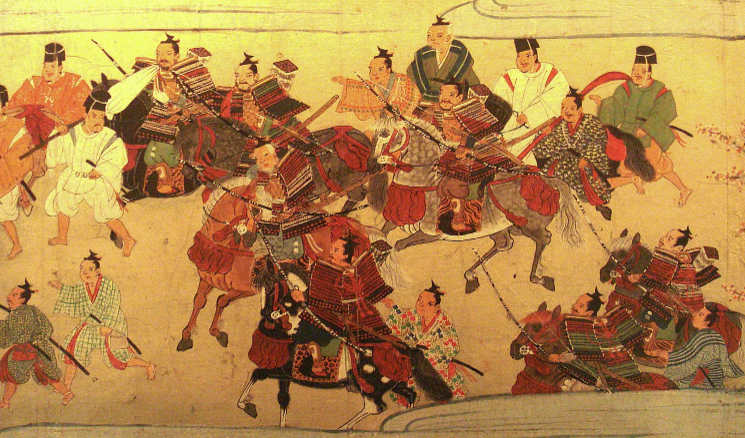
The Sengoku Jidai or Age of the Country at War, was a period of civil war and social upheaval in feudal Japan lasting from the mid-15th to the early 17th centuries. The conflict started with the Onin War (1467-1477) and ended with the Siege of Osaka in 1615 and during this time, the Ashikaga Shogunate lost control to powerful feudal lords called Daimyo, leading to frequent, violent conflicts among them for land and power. Names we all know from the period include Oda Nobunaga, Toyotomi Hideyoshi and Tokugawa Ieyasu. I have played several games on the subject and actually have a few that I have not played as of yet but wanted to share my thoughts on the Best 3 Games with…Sengoku Jidai!
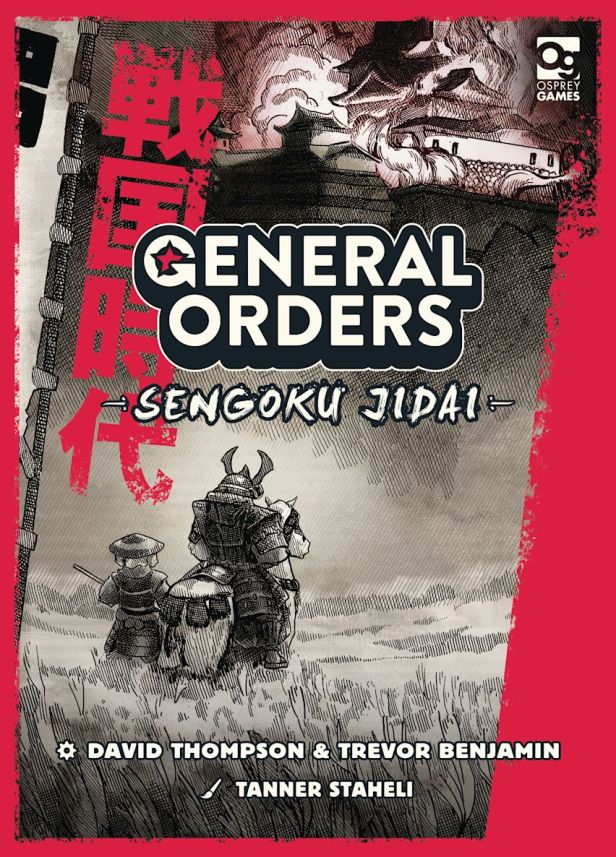
3. General Orders: Sengoku Jidai from Osprey Games
The first game on the list is a bit different from the others that I will highlight here as it is a Worker Placement Wargame designed by the dynamic duo of David Thompson and Trevor Benjamin. The first game in the General Orders Series was called General Orders: World War II. The game system uses very interesting mechanics like worker placement to take actions and deny them from your opponent. The game is fairly simple but is very well done and creates an interesting and tense struggle over a short 30 minute playtime.
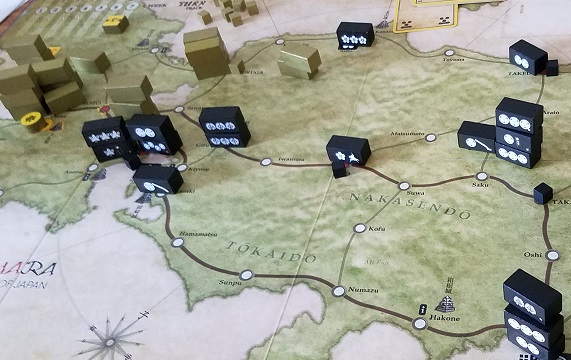
I played that game with my wife Paisley and when the follow-up was announced, and it was set during the Sengoku Jidai of Feudal Japan, I was immediately interested. Recently, Alexander and I played General Orders: Sengoku Jidai together and had a great time with it. The game involves deploying commanders in the form of hexagonal shaped cylinders onto the board in order to control objectives but also to use actions that are printed in the spaces in order to advance on territories, bombard enemy units and control the various waterways on the board. Supply lines are very important in the game as you cannot control an area unless you can trace a line back to other friendly territories and your capital but don’t bog the game down with complex rules. There are a few new additions to the system in the form of ships and their control of waterways as well as special siege engines that are used when assaulting castles and the game was very fresh and interesting.
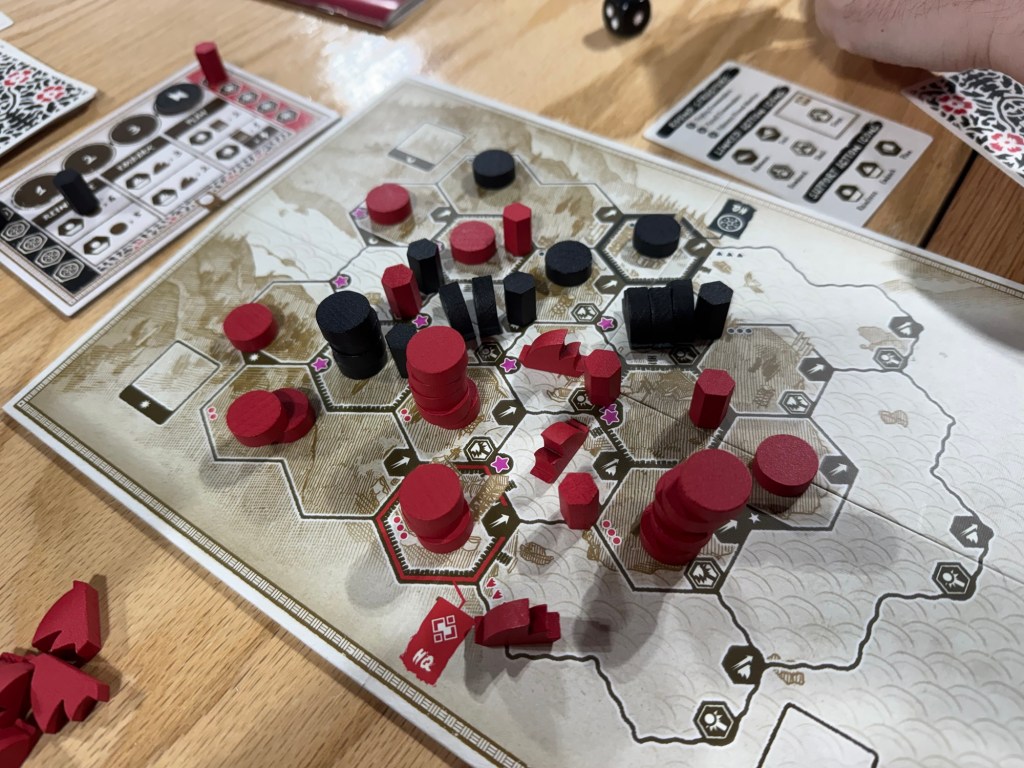
The game is very simple but has some strategic depth to it as you have to consider your options with your limited actions as you have either 5 or 6 depending on what side of the dual-sided board you are playing, how best to go about taking the areas you want to control, particularly the special bonus objective tiles that improve your basic actions of advance, sail, bombard and shell and when to take back the initiative to create a double move opportunity from the end of one turn to another. I feel that this game really takes into account the theme of the age, and includes lots of great art by the talented Tanner Staheli, to create a truly Japanese like experience with the game. For a fun and lite game on the time period, I would definitely recommend General Orders: Sengoku Jidai.
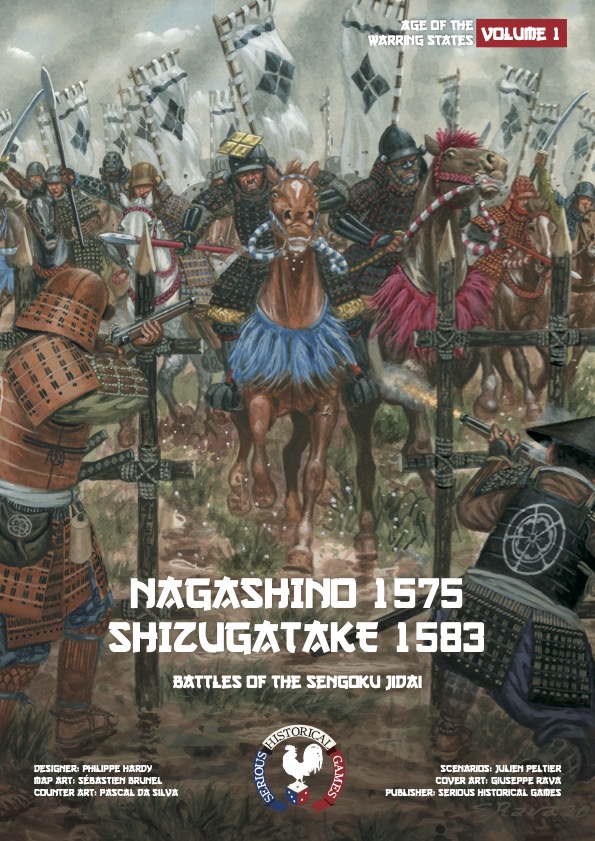
2. Nagashino 1575 & Shizugatake 1583: Battles of the Sengoku Jidai from Serious Historical Games
A few years ago, a new company called Serious Historical Games released the first in a new series of games focused on the Sengoku Jidai period and the battles of the time. This game is called Nagashino 1575 & Shizugatake 1583: Battles of the Sengoku Jidai and it is part of the Age of the Warring States Series.
Nagashino 1575 & Shizugatake 1583 has 2 different scenarios with the Shizugatake scenario being smaller and shorter while the Nagashino scenario is pretty large with lots of units. Each of these battles though force harsh decisions on the players as they have to decide what areas to move to and when to initiate combat. These choices are ingrained in the design and I truly got the feeling of being an overall commander in the game as I was making assignments to my subordinates in the chain of command.
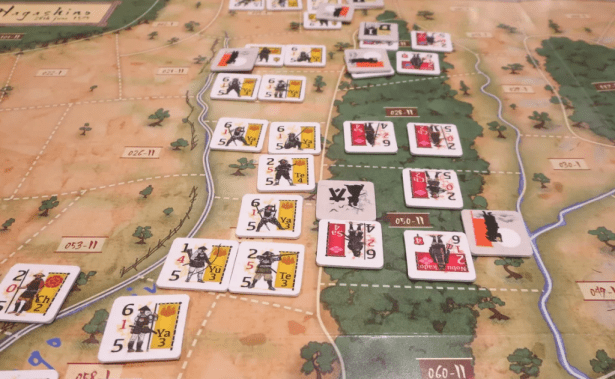
One of the more interesting parts of the game was the concept of troop Quality Level which is a representation of the discipline, training level, and morale of the troops. This Quality Level is used to perform Quality Checks during combat to decide whether a unit becomes disordered or as you are maneuvering and changing formation with those units. I feel that this item’s inclusion in the game was very important as it truly represents the advantage that certain troop types, namely Ronin and Samurai, had over your typical Ashigaru troops. I also very much enjoyed the use of Formations in combat as a hidden chit at the start of the game. There are a total of 7 formations that range from extremely aggressive to extremely defensive, and one that is more flexible and can be changed after choosing. These Formations modify combat and applies to the entire army for that turn. The other interesting part of the game is the concept of combined arms as an attacking army consisting of a mix of different type of troops including cavalry, gunners and heavy troops will gain significant advantages. Without this concept, the game would have felt one dimensional and when combined with the Quality Level creates a very interesting experience.
Overall, the quality of the game and its production is amazing, especially the counters and the colors used for the various clan banners. This truly assisted us to get into the topic and the time period and enhanced our play.
Here is a link to our first impressions video:
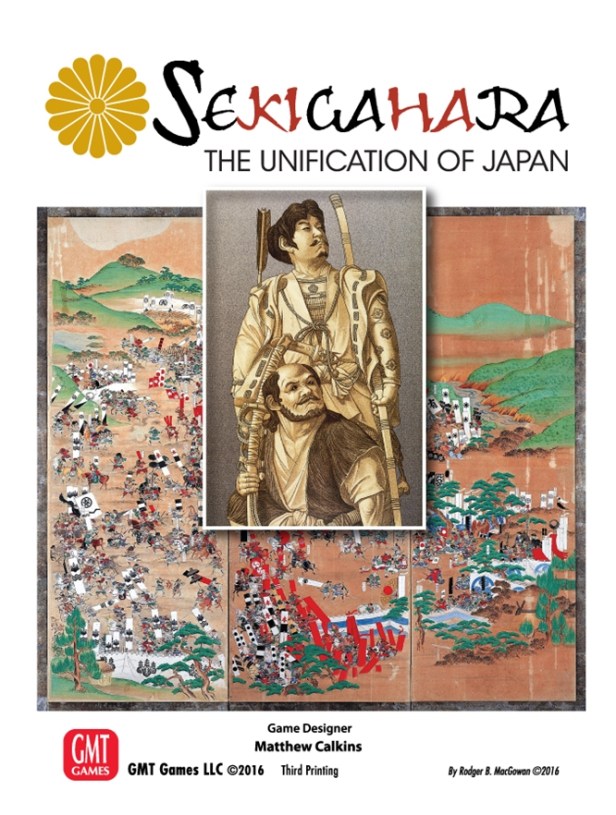
1. Sekigahara: The Unification of Japan from GMT Games
Sekigahara: The Unification of Japan is a game that gained a lot of traction and hype through the P500 system several years ago, and I we were one of those that were fully on board. The idea of a block wargame with the fog of war excited me, as I hadn’t ever played one at the time we signed up for the P500 years ago. I really love the block style of game and the different challenges that these games provide. The theme and the historical period of the game is also spot on for this post and I was truly impressed with the level of detail that the designer included in the notes at the back of the rulebook as they truly gave us greater insight into the period and the motivations of the the warring sides.
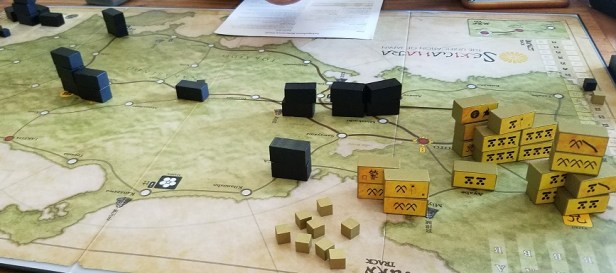
Sekigahara is an extremely popular game for a few reasons and its simplicity is one of the main reasons for its appeal and reception. What I mean by that is the mechanics themselves are relatively easy to grasp. The actual rules of the game are quite short, something like 8 actual pages of rules. There are excellent examples for movement, combat, etc. included in the rules to illustrate the game to new players. The back of the box has the complexity rating set as 2, and I would say that’s a fair assumption. But having read the rules and played several times, I can happily say that yes, this game is mechanically simple.
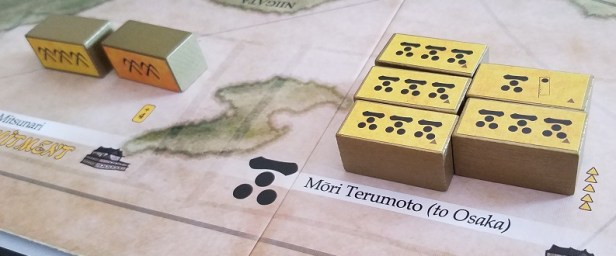
The cards used in the game display a number and an allegiance, and sometimes a special action icon. You just match the icons to the pieces on the board in order to deploy them in battle, and in doing so you keep a running combat total of all deployed pieces. Losses are inflicted on both sides of battle and the player with the lower overall score retreats. Movement is divided into four categories and you just pay a number of cards [0-2] in order to buy into that category, so to speak: 0 cards – move 1 stack, 1 card – move 3 stacks, 2 cards – move all your stacks. That’s really the crux of the game. The simplicity of the mechanics allows for diverse tactics and strategy, but also make it really accessible for new, or even non-wargamers.
Sekigahara is a lot of fun! This game is a different type of animal, and you just have to understand that if you draw a bad hand, you can’t do a lot effectively, or you have to pray that your opponent doesn’t do combats in areas that you don’t have loyalty for. This is where the bluffing comes in to play. You might have a terrible hand, but putting a bunch of units together and moving them can look very scary and might turn your opponent off, just the threat of a large force can sometimes be enough.
The loyalty challenge cards are also a blast and probably are the best part of the game. They totally swing a battle and make you really weigh up the risk of going into battle with ‘just enough’ loyalty cards. I love this game because there’s no number crunching and there’s few minutia to get hung up on, you just kind of have to be gutsy and go out there and fight, and run across the board to capture the resource points. Turtling does you nothing, because you will not have enough points at the end to win. I know this one from experience.
This game is 100% awesome. It’s light enough, really fun, but also still gives you feel of a much deeper complex strategy game. Even if you have no connection to the theme there’s plenty in the rule book to bring that alive, if that’s a hang up for you. The game pieces and stickers are top notch and the players’ aids are in typical excellent GMT fashion.
Well there you have it….my list of the Best 3 Games with…Sengoku Jidai! Please let me know what your favorite games are on the subject.
-Grant
 The Players' Aid
Hi Grant,
Great article. Have you guys tried GMT’s “Commands & Colors: Samurai Battles”? How does it compare to these in your opinion?
LikeLiked by 1 person
We have indeed and very much enjoyed the game. It has some very unique elements that don’t appear in the other volumes in the series.
LikeLike
Years ago, my friend introduced me to ‘Kawanakajima’ from Hexasim. Later, just on the basis of the impressions from those times together, I acquired ‘Tenkatoitsu’. Once the third volume, ‘Tenkafubu’, will be released… I will buy it too. I really like the “tactical” system in those games – solo friendly, enjoyable with a live opponent.
LikeLiked by 1 person