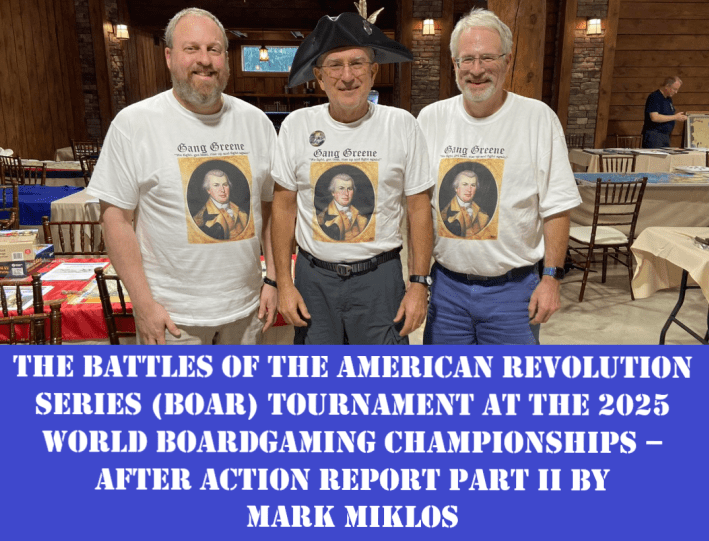
Part II of the extensive AAR provided by Mark Miklos of the battle for supremacy at the Battles of the American Revolution (BoAR) Series tournament at the 2025 World Boardgaming Championships!
If you missed Part I of the AAR, you can read that at the following link:
Prior to the start of play, it was recommended to the GM that he take a few minutes to review the rules for the scenario. White Plains is a big game and can be complex, especially for those less familiar with it. Mark gathered all quarterfinalists and spent approximately 20 minutes reviewing key elements in the scenario including retreat priorities, the many effects of rain on the game, opportunity cards and the sequencing of combat cards, Patriot Militia considerations and impacts, certain special units, and Ruse de Guerre. The latter was especially emphasized and this part of the rule was quoted, “At the end of the game the American player must reveal his secret information to the British player confirming the secret die roll number and the location of all Ruse de Guerre hexes. If the American player is found to be in default because he misidentified the correct results on the Ruse de Guerre Table or he incorrectly located the required Ruse de Guerre hexes, or if he failed to reveal a Ruse de Guerre hex when the British player attacked it as described above, he will forfeit the game.”
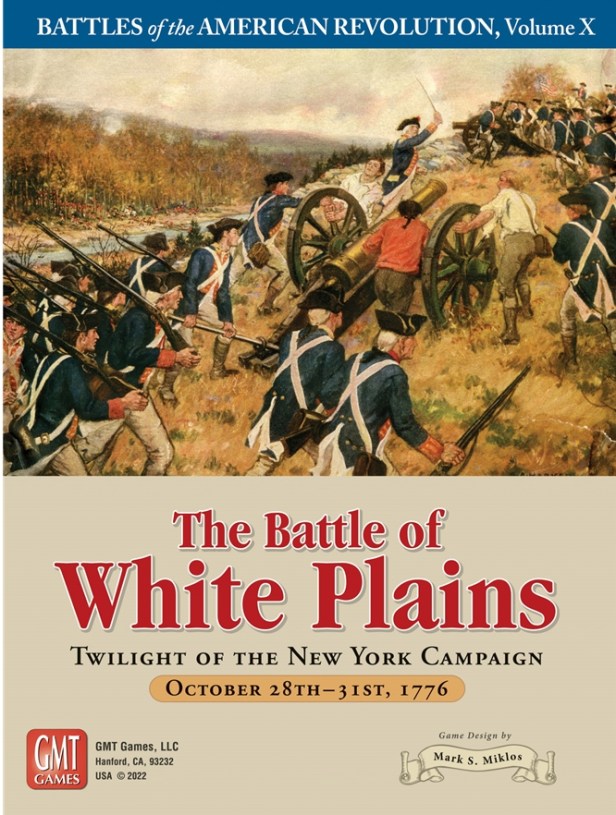
Regrettably, two players were found to be in violation of Ruse de Guerre protocol during the course of play. To their credit, each of them voluntarily came forth to point it out. In the Miklos-Miller match, Tim Miller honorably revealed that while his die roll required him to identify five Ruse de Guerre hexes, he had only identified four. One hex number was written down twice on the Ruse de Guerre template sheet and thus a fifth hex was never specified.
In the Cota-Tracy match, Bruce Cota honorably admitted that when Jim’s British had crossed over three breastwork hexsides, and paid the +1 movement point cost to do so, he had failed to call them out as Ruse de Guerre hexes. Doing so would have revealed those hexes as clear terrain, facilitating Jim’s movement across them and enabling those British units to move farther in the turn. Bruce, like Tim at the other table, forfeited their matches and while disappointed, neither complained since the rule was not only reviewed but also emphasized during the pregame review. Thus, on a technicality, Mark and Jim moved on to the semi-final and awaited the results in the other two quarter final matches.
Eight hours was allowed for this scenario. The Todd-Musella match went very nearly to time, ending in an upset marginal win by Marty Musella’s Americans over top-seeded Father Todd. At the other table, the final combat dice were rolling as time was called. Here, Dave Stiffler’s British won marginally thanks to effective artillery fire and an unsuccessful American close combat in the final half turn of the game. Until then, Don’s Americans were holding on to a narrow victory. It was a nail biter.
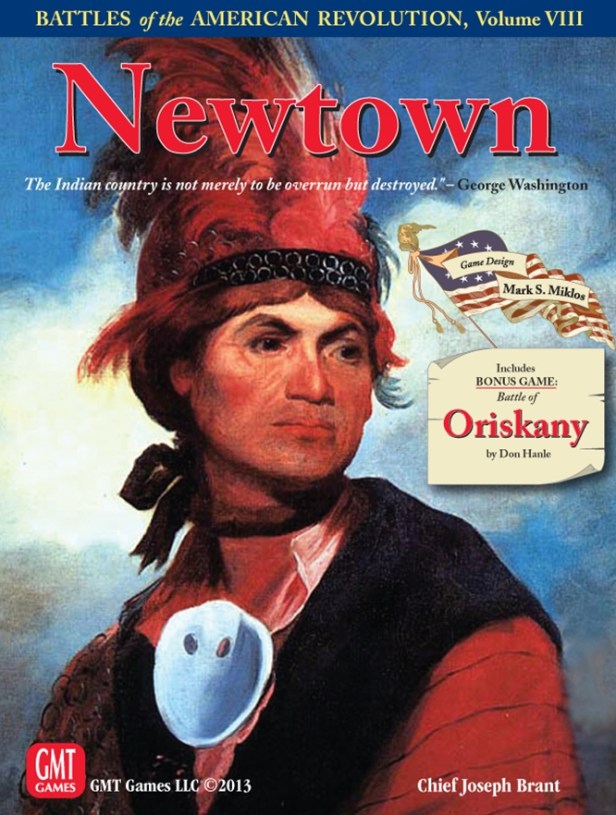
The semi-finals were now set. The war against the Iroquois in western New York was the setting for the historical scenario from the Battle of Newtown, volume 8 in the BoAR Series. In the recently released Tri-Pack II, the Indian player has a new Player Aid Card that organizes all of the special Indian capabilities on an easy to use matrix. No longer does the player need to commit these to memory or hunt for them in the rule book. It makes playing the asymmetrical Indian player easier then heretofore. Having just played for eight hours, the semi-finalists now faced a three-hour Heat with less than a one hour break in between.
In the matchups, Dave Stiffler won an Indian marginal victory over Marty Musella, while Mark Miklos won the only decisive victory in this year’s tournament with an Indian victory over Jim Tracy. In thirty-seven tournament games of the Newtown campaign game there have been nineteen American and eighteen Indian victories. In the historical scenario, which has been played seven times in tournaments to date, the Indian players have won all seven times marginally. This year’s results tracked according to the statistical norm.
Remember me saying in Part I of this AAR that Marty’s elevation from alternate to quarter-finalist would prove to be ironic? Marty’s strong play against Father Todd in the quarter final and his marginal loss in the semifinal was good enough to earn him a third place finish in this year’s BoAR tournament, along with a WBC plaque, a GMT merchandise coupon, and his choice from the extra prizes provided by GM for all finalists in this year’s tournament. Congratulations Marty!
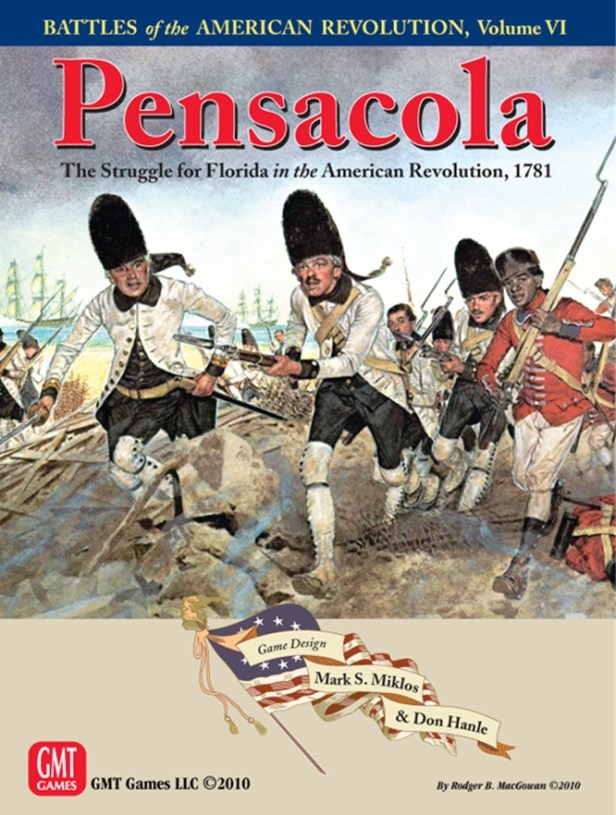
With pun intended, the die was now cast for Dave Stiffler to meet Mark Miklos in this year’s Final at the Battle of Pensacola. It would not be the first time these two past champions would face one another in a BoAR final, having done so at SDHistCon East, RevCon at Prezcon, and at WBC in the past.
Each finalist preferred to play the Spanish and so a secret bid was conducted to see how many Army Morale Points the winner would be willing to surrender from his at-start allotment. Dave bid two while Mark bid three and with that, the Army Morale Track was lowered three points for the Spanish and the players settled in for their match. The game opened with British fire from the Red Cliff’s Fort failing to hit any of the Spanish fleet as it rounded the headland into Pensacola Bay. Spanish army morale was immediately increased by one.
Dave’s British played a masterful delaying game in which he took advantage of four consecutive turns of bad weather (storms on turns 5 & 6 and rain on turns 7 & 8.) This, coupled with the threat of an Indian raid in the Spanish rear and a strong sortie from the British forts, served to harass, intimidate, and generally delay the Spanish approach and the construction of the vital Corduroy road that is necessary to supply Spanish siege artillery.
The British raiders eventually struck at Spanish stockade #2 on the beach at Sutton’s Lagoon where most of the Spanish landings had taken place. All of Spain’s quality units were forward while only a handful of militia and mediocre Regular troops were stationed to guard the stockade. Among these, the Spanish-Allied Choctaw Indians who sport a minus two unit morale. On the upside, they were the only unit classed as light infantry that Spain had left in the rear and as such, the only unit that could exert a zone of control into the Palmetto scrub which is the dominant terrain on the Pensacola battlefield. British raiding Indians on the other hand, while also classed as light infantry, have superior morale and were supported by their war chief Franchimastabe. These raiders were bolstered by the crack, rifle-armed King’s Florida Rangers and a company of British Light infantry as well.
The raiders struck at the Spanish Choctaw, eliminating them and with them, any ability of Spanish units in the rear to pin down or surround the raiders. This action occurred a mere four hundred years from the stockade causing the Spanish to form a cordon around it. Dave considered a renewed attack on his next turn but as his men were no longer “raiders” and had now lost the element of surprise and an extra DRM in combat, he pulled them back. These units never again threatened the stockade which came within a hair’s breadth of being captured and burned. Nevertheless, the former raiding party stayed on the board and hovered just out of reach across the north edge of the map representing a perpetual threat that the Spanish could not ignore for the rest of the game.
The tempo of the game turned a bit when the Spanish were able to encircle the British sortie at the edge of the Palmetto grove in hex 3023. Dave had overlooked that the Spanish forces gathering there contained two light units, the Spanish Light Infantry and the rifle-armed Luisiana [sic] Rangers. After the ensuing combat, the British lost their Howitzer, the British Marines, and another infantry unit, all for failure to retreat. Those VP’s and the harvest of Spanish army morale points gave Dave pause, but he passed his personal morale check, and played on.
I will add that Dave’s sortie was tactically sound because it contained the Howitzer which was taking two shots of harassing fire per turn at my Spanish units, once during “Offensive Howitzer Fire,” and again during “Defensive Artillery Fire.” I carelessly overlooked to gather a Momentum Chit due me for the capture of the Marines with their plus-two unit morale. I noticed it several turns later so nothing could be done. C’est la guerre. Indeed neither player had Momentum during the entire game, which is certainly rare in BoAR play.
Once the sortie was cleared the Spanish were able to drive upon Queen Anne’s Redoubt, the northern-most of the three British forts. Following a methodical approach the Spanish declared Coup de Main. When Coup de Main is declared, the game, along with the prevailing weather which was clear at that time, transfers from the strategic game turn track to the tactical game turn track. This is a required step before the Spanish can actually attack the British works. In addition, by declaring Coup de Main prior to turn 16, I was able to harvest three more Random Event cards as a bonus for declaring an early assault while denying any more cards to the British.
It should be noted that none of my siege artillery scored any hits during several rounds of bombardment and thus none of the British works were breached when Coup de Main was declared. This caused an immediate drop of Spanish army morale by two points. I wanted to reconsider, but as I had moved the turn track and weather markers from the strategic track to the Coup de Main track, Dave’s position was that I couldn’t rescind my decision. This opinion was supported by Don Hanle who, as the designer of Pensacola and a tournament AGM, was serving as the GM for the Final.
A Spanish mortar shot was successful in causing a breach to one of the earthworks flanking Queen Anne’s and with that the redoubt fell to an overwhelming Spanish attack. Capturing all three British works is the key to decisive victory for Spain so it was now one down, two to go.
Coincidental to the attack on Queen Anne’s, and ever wary of those lurking former raiders who were always around my flank waiting for an opportunity to pick off a straggler or take advantage of an opening, I decided to occupy and burn the Indian village. This necessitated an immediate morale check for each Indian unit on the map. If they failed it, they would desert the British and leave the game. Despite the exertions and incantations of Franchimastabe, two Indian units abandoned their British allies. While not completely eliminating the threat, this outcome definitely made the Spanish feel more relaxed about the magnitude of a potential Indian attack.
My next target was the Prince of Wales Redoubt where another fortunate mortar shot caused a breach. The British lines were constricting into an ever narrower front as they withdrew south along Gage Hill. This line now provided direct support of the Prince of Wales Redoubt on its eastern flank. My attack would have to be made carefully so as to avoid British point blank artillery fire where possible, as well as fire from the 10-SP artillery unit in Fort George. It was hard-fought, but in the end the Spanish prevailed and a second objective was taken, and with it another VP and another army morale penalty for the British.
Coincidental with these attacks in the north, late arriving Spanish reinforcements, now free from the obligation to defend their stockade, successfully captured the British well adjacent to Fort George after storming the earthworks there. Loss of the well lowered British morale. Meanwhile, the Luisiana [sic] Dragoons made a dash for the Governor’s Plantation and burned it, dropping British morale yet again. By this point in the game, Spanish morale was high while British morale was solidly in the Fatigued zone, and dropping.
The final act in the game was an encirclement of British forces just outside of Fort George. The fort itself was at maximum stacking and these British units, while providing a forward defense of the fort, had no room to maneuver. The resultant attack caused the loss of another several British units and their Loyalist leader and British Army Morale fell to six, one point above Wavering. With no room to maneuver, with their army commander also out of the game, and with another three and a half game turns still remaining, Dave assessed the situation, offered me his hand, and conceded the game. It was an honorable surrender.
Dave mounted one of the best British defenses of Pensacola that I can remember seeing. During the mid-game he had me feeling as if I would never gain any traction. Congratulations to Dave Stiffler for a well-played tournament, a competitive Final, and a well-deserved second place finish.
As always, I am grateful to everyone who helped make this year’s tournament a success. Dave Stiffler and Don Hanle did journeymen’s duty as my AGMs. Don, in particular, subbed-in on short notice when Rob McCracken ended up not coming to WBC due to family obligations. Many others, too many to name, stepped up as well to help in ways large and small. Thanks also to the new players who joined us for the Demo and then came to play. Among them, David Gates played in three Heats and earned a prize for being the new player who scored the highest in the tournament. Dave selected his prize from among those provided by the GM.
I invite all friends of the Battles of the American Revolution Series to put a placeholder down for 2026, the 250th anniversary of American Independence. We will have many special offerings at next year’s tournaments to mark the occasion. At WBC next year in particular, we will have our own, dedicated room where we will be able to decorate, play music, listen to a lecture, play a team Rev War game for fun, enjoy celebratory refreshments, and have special giveaways and prizes. Mark your calendars today!
And, a most-fitting final thank you to Ken Guttermuth at BPA/WBC for enabling us to celebrate in these special ways next year.

Congrats to Mark Miklos for his hard fought victory and also thanks to Mark for allowing this two part AAR to be posted on our blog. We appreciate the work he puts into this tournament each year and for his grace in meeting with Alexander and I while we were at WBC this year and playing a friendly game of Germantown from the new Tri-Pack II.
To take a look at the various games included in the BoAR Series, please check out the following game site on the GMT Games website: https://www.gmtgames.com/m-2-gmt-games.aspx#[PageNumber(0)|PageSize(50)|PageSort(Name)|DisplayType(Grid)|Category(3)]
-Grant
 The Players' Aid