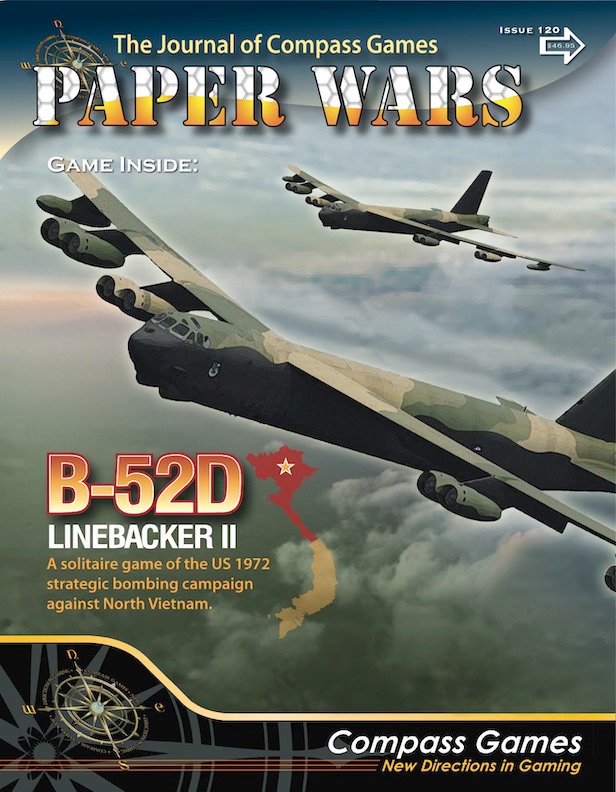
Our friend Gregory M. Smith is a solitaire game designing genius and has done many of these solo, narrative driven style wargames that we have all enjoyed for hours on end while we have been unable to find an opponent or just because we want to play a game on our timeline. We have interviewed him many times for his games such as Zeppelin Raider, Interceptor Ace, The Hunted, Western Front Ace, Amerika Bomber, Defending America, American Tank Ace, British Tank Ace and most recently for another magazine wargame called Sinking Yamato. Greg always has something cooking in his game design kitchen and recently I saw mention of an upcoming game that will be appearing in Paper Wars Magazine from Compass Games called B-52D Linebacker II. I reached out to Greg and he was more than willing to talk with me about this new game.
Grant: What is your new upcoming game B-52D Linebacker II about?
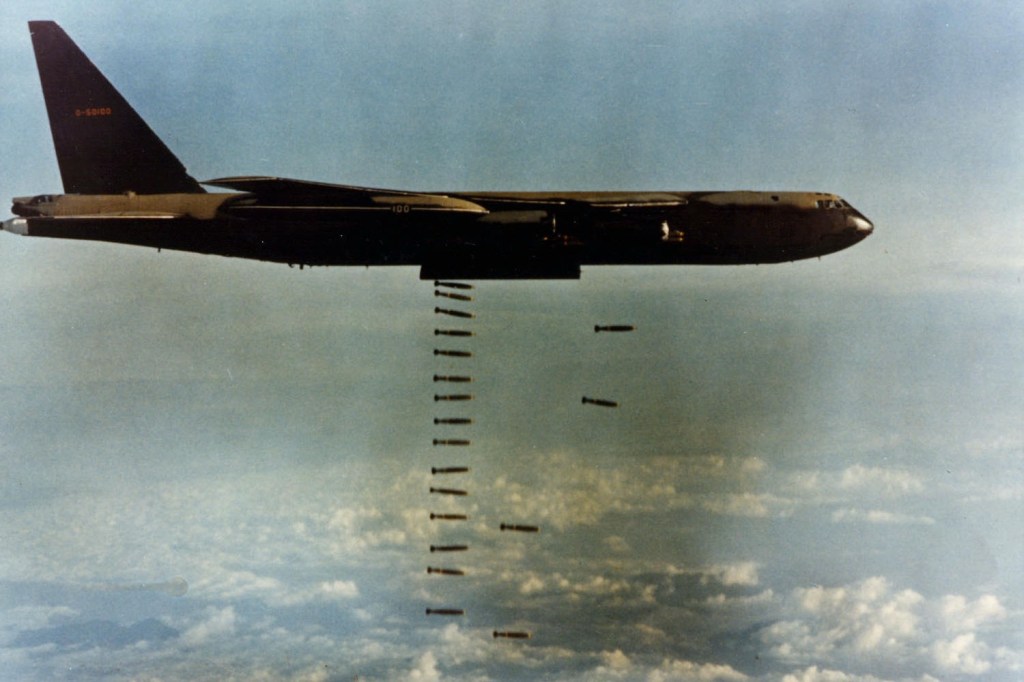
Greg: Linebacker II was the 1972 Christmas bombing campaign designed to bring North Vietnam back to the Paris Peace Talks negotiating table featuring huge B-52 bombing raids against Hanoi. As a player you will pilot one of these B-52 bombers and inflict as much damage as possible on strategic infrastructure against the North.
Grant: Why did you feel inspired to make this game?
Greg: It has been requested multiple times over my career as a designer, I guess I just finally got around to actually doing it. My Australian friend, Paul O’Grady (who assisted me a decade ago with Silent Victory) was also a motivating force.
Grant: What sources did you consult to get the details correct?

Greg: Unlike battles which happened hundreds of years ago and without the benefit of modern technology, the Linebacker II campaign was extremely well documented. I drew from many books, but I’d have to say the best of the lot was Operation Linebacker II 1972: The B-52s are sent to Hanoi by Marshall L. Michel III (Osprey Books, 2018). The author flew in the campaign, but as an F-4 pilot. Getting technical details on the B-52D’s was not that hard, and I drew from a dozen books there.
Grant: As a magazine game, how did this change your usual approach to the design?
Greg: As a designer I like to have “all the tools in the toolkit” available, so to speak. Cards, tokens, charts, player aids, you name it. I don’t necessarily USE all of them in any one design, but I like having them available if needed. I like the freedom that boxed games give me and the options I have when designing. Well, I thought after my first magazine game that I’d not do any more, but then I started looking at it as a challenge. With that in mind, I had to work on ways to make everything fit on one map, with only 8 pages of rules and just one counter sheet. What this really did was force me to focus on Linebacker II and not get into Rolling Thunder or other bombing campaigns, such as the Gulf War. I had to stay focused and just tell the story of this campaign. But, if this game is successful and well received, that doesn’t mean that the other topics are out of reach.
Grant: What is the player’s goal in the game?
Greg: I used overall aggregate “bombing accuracy” as measured by the percentage of bombs that hit near the target, somewhat similar to the old B-17: Queen of the Skies game that we all know and love. There are only 10 turns (missions) so one or even two bad missions doesn’t mean you’ve necessarily lost.
Grant: What does a victory look like in the game?
Greg: Your personal survival, for starts 🙂 as these missions were very dangerous as the North Vietnamese had a combination of Soviet-supplied SA-2 surface-to-air missiles, MiG fighter aircraft, and extensive anti-aircraft artillery. But 351%+ accuracy is a marginal win, and 551%+ is a decisive victory.
Grant: Why is accuracy of bombs the main criteria for determining mission success?
Greg: Obviously if you’re just dumping bombs into empty parking lots, or worse, the jungle surrounding Hanoi, then the North Vietnamese are not going to be motivated to attend the Paris Peace Talks. So it seemed like the obvious and most appropriate metric for “success.”
Grant: What is the layout of the B-52D Bomber Display Mat?
Greg: The center of the “map” is the B-52D Bomber Display. It has boxes for any damage that might be taken from either SA-2 missiles or rarely, a MiG. It also contains various status boxes for the crew, the onboard electronics and flight controls, which can all be damaged by the defenses.
Grant: What is the general Sequence of Play?
Greg: The Sequence of Play is pretty simple really and has 3 steps. First, the player will check for the raid target, decide on the route of ingress to the target, decide whether to be lead cell (or not) and choose the support aircraft (if leading). Second, the planes will move toward Hanoi and then check for interception by enemy defenses and then complete the bombing run. Finally, the player will check again during egress and then go through the landing procedure. The game play is really pretty simple and straight forward.
Grant: What starting preparation decisions does the player have to make?
Greg: The decision to be the lead cell allows the player to choose their support aircraft (instead of randomly being assigned) but then the mission is slightly more at risk from SA-2 missiles. The other key starting decision is the route to the target.
Grant: What is different about the various target types?
Greg: There are none, in a game play sense, as the bombing is reasonably abstracted. The targets are all assumed to be key infrastructure such as vital military and industrial complexes in the Hanoi and Haiphong areas of North Vietnam. These included radio stations, railroads, power plants, airfields, and missile sites. However, ten different actual bombing targets are given, just for historical flavor.
Grant: How does combat work during interceptions?
Greg: It’s a very simple system for the SA-2 Guideline missiles – they either hit you, near miss you, or miss you. The die roll for this, however, is heavily modified by your current ECM (Electronic Countermeasures) level, your position in the raid, and whether you’ve already dropped (the bombers were slightly more vulnerable after drop due to the bomb bay doors having been open and the post-drop bank which affected the jammers). During the actual campaign, 266 SA-2 missiles were fired, downing 15 B-52’s with an almost equal number damaged. SA-2 hit probabilities in the game reflect this. MiG interceptions, while very rare, did occur a couple of times, and any MiG’s you might encounter get one shot at you. They are assumed to approach from behind left, behind right, or dead astern.
Grant: What tools does the player have at their disposal to deal with attacking aircraft?
Greg: As stated, MiG attacks were very rare, but if one happens, you do have a quad .50 mount in the tail. This gun can be used to down the MiG’s and clear the way for a successful ingress or egress to the targets.
Grant: How are escort aircraft used?
Greg: There are six escort aircraft types, but basically they are in two categories: ECM support, and ARM (Anti-Radiation Missile) support. The ECM aircraft (EB-66 and the EA-6B) provide a constant ECM bonus, while the ARM aircraft can only be used before or after bombing to suppress the Fan Song radar and the SA-2 launch sites.
Grant: What type of damage can the plane take? At what point does it become dangerous to continue a bombing mission?
Greg: You can take a lot of damage, as they were very large and reasonably sturdy, but probably the worst damage you can take is to your ECM jamming systems (you have five on board). The loss of one or more jammers before the drop might be a reason to immediately abort.
Grant: How does the landing procedure work?
Greg: A simple die roll, but it can be modified (perhaps heavily modified) based on damage to ailerons, flaps, the landing gear itself, pilot wounds, and other factors. Typically this is not even remotely an issue.
Grant: What happens post mission?
Greg: You will (rarely) replace any wounded or killed crew, and check damage – if badly damaged you’ll have to miss a mission. You record your bombing and move the turn marker ahead to the next mission box.
Grant: What optional rules are available?
Greg: There are rules for variable MiG pilot quality, awards for your crew (such as the Bronze and Silver Stars, Air Medal, etc.) and a rule for an historical game start (you have to fly the first four missions using the exact same route.)
Grant: What type of experience does the game create for players?
Greg: It’s quick, easy, reasonably historical and teaches players a lot about the situation of Linebacker II. Plus it gets pretty tense when those SA-2 “telephone poles” are streaking up toward your bomber.
Grant: What are you most pleased about with the design?
Greg: Jokingly, I’d say that I actually got it all to FIT on that map, lol. But I think I’m happiest about it being easy to play, while still having historical detail. I like that it’s quick with a small footprint.
Grant: What has been the feedback of your playtesters?
Greg: Feedback was very positive, and most importantly, told me the victory conditions were about right, with only a small adjustment. Each turn was about ten to fifteen minutes, and an entire game could be played in less than two hours.
Grant: When can we expect to see the game released?
Greg: B-52D Linebacker II is slated to appear in issue #120 of Papers Wars Magazine, which is the Compass Games house magazine. That’s roughly a couple years down the pike as they release quarterly.
Grant: What other designs are you currently working on?
Greg: As is usual, I am a busy boy! I have nineteen other titles currently in various stages of design, BUT since you asked :):
Panzer Ace, Yamato, Insurgent Tide, Carrier Ace, Viking Dawn, Sensuikan, Rebel Tide, Gladiators, Iberian Tide, Western Desert Ace, Gotha Raider, Soviet Tank Ace, Israeli Tank Ace, Luftschiff Raider, Plausible Denial, B-36, Ground Attack Ace, Mekong Tide and Vietnam Armor Ace.
Thank you Greg for your time and efforts with answering our many questions. We always appreciate your designs and discussing and sometimes playing them with you.
-Grant
 The Players' Aid