A few years ago, we became acquainted with Andrew Rourke through his Coalitions design from PHALANX that went on to a successful crowdfunding campaign. He has since been a busy guy with starting his own publishing company called Form Square Games and also publishing the first 3 designs in a new series called Limits of Glory that will take a look at the campaigns of Napoleon and other contemporary conflicts. In Campaign I, which is called Bonaparte’s Eastern Empire, the game is focused on the campaign of the French in Egypt between 1798 and 1801. Campaigns II, III and IV are Maida 1806 and Santa Maura & Capri. Recently, an announcement came out about the fifth campaign and it is set during the French Revolution and the Civil War in the Vendée in 1793 and is called Donning the Sacred Heart. We reached out to Andrew and he was more than willing to answer our questions.
If you are interested in Limits of Glory Campaign V: Donning the Sacred Heart, you can back the project on the Gamefound page at the following link: https://gamefound.com/en/projects/form-square-games/donning-the-sacred-heart-limits-of-glory-campaign-v
Grant: How do you feel about the success of your first few entries in the Limits of Glory Series? Has it gone about as you expected?
Andrew: I’ve been overwhelmed by the positive response I’ve had to this new design. I wanted to produce something different, a game that contributed something new to the hobby, but obviously new ideas often take a while to be accepted. The different artistic and graphic design look of the games has meant that many people immediately write the games off, as not for them, before they even try them. But slowly more and more people have given them a go and found that the challenges faced by players are actually quite interesting and more in-depth than first appearances imply. So yes, I’ve been very pleased by the success of the first few titles, more than I could have hoped.
Grant: What have you learned about the design process from this series and from now publishing your own games?
Andrew: Limits of Glory has been designed as a series of games from the start, I wanted to create a system that could be used for multiple scenarios, covering different time periods. This has taught me the absolute importance of consistency in terminology, mechanisms, graphic design and above all clear and accessible rule books.
Grant: What is your upcoming game Limits of Glory: Donning the Sacred Heart about?
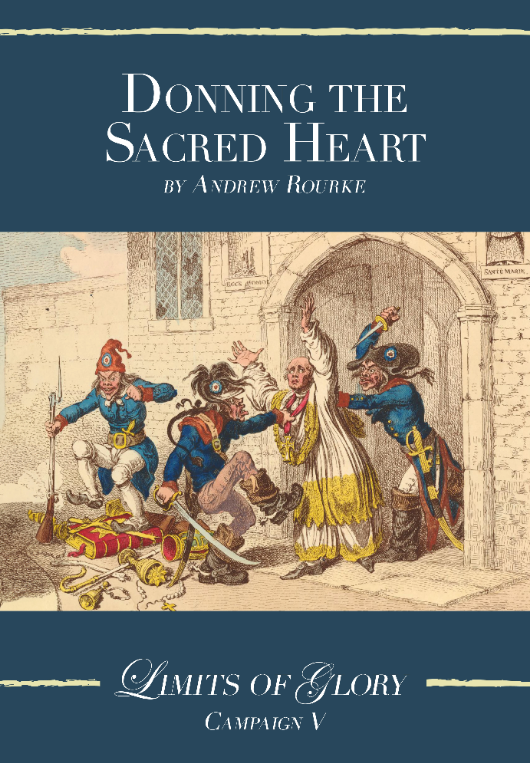
Andrew: Donning the Sacred Heart covers nine months of the Civil War, from March to December 1793, in the Western region of France that became known as the Vendée Militaire. The game includes the major commanders from the Republic and the Catholic & Royal Armée and allows players to recreate the situation that existed in this pivotal moment of the French Revolution, with each side having a chance to emerge victorious.
Grant: What is your overall design goal with the game?
Andrew: I want to give players multiple, simple, but important decisions. Every turn, players are faced with choices of what’s important and what can wait. There is no right or wrong, but the eventual outcome of the campaign will depend on all the small decisions made along the way. For example, if a player uses much of a commander’s Glory to move across the map, they may not have enough Glory left to fight the decisive battle that they have so eagerly marched towards, therefore timing is crucial!
Grant: What was it about the French Revolution and the Vendée that made you believe the Limits of Glory Series would work well modelling the campaign?
Andrew: Limits of Glory is designed to model asymmetric campaigns. Any campaign that includes regular and irregular troops, armies of different qualities, militia, guerrillas and uprising is a perfect candidate for representation with this system. The Civil War in the Vendée fits perfectly into this category. Limits of Glory is not designed to recreate individual battles or even campaigns between two standing armies.
Grant: What changes have been introduced to the system to take in to account the change in scenery?
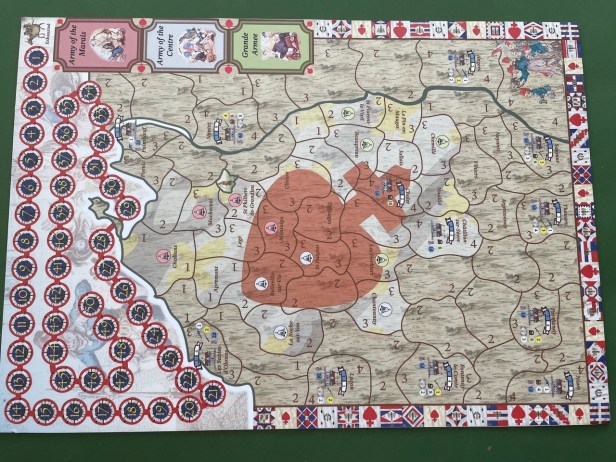
Andrew: The Civil War in the Vendée has some very peculiar aspects, the central area of the region was covered with Bocage, with very few roads. The coastal region was covered in salt marshes and the flanks were bordered by large towns and the River Loire. In the Limits of Glory System, difficulty of movement within an area is represented by the space value of the space you are in. The map therefore reflects these difficulties in movement by the number of dice allocated to different spaces for activation attempts.
Grant: What is the scale of the game and the force structure of units? How has this changed from the other volumes?
Andrew: Figure scale in Limits of Glory is purposely designed to be variable according to the campaign being represented by the game. In Donning the Sacred Heart, a single infantry element represents approximately 100-200 men, while an artillery element may represent a single gun to a battery of eight guns. Ground scale is represented by the space value of a particular space; a low number space value might represent a longer distance or a more difficult terrain type.
In Bonaparte’s Eastern Empire and Maida 1806, an element of infantry represented 1,000 men, while in Santa Maura and Capri one element represents 100 men.
Grant: What different units are represented in the game and what advantages do they bring to the battlefield?
Andrew: The Republican player has regular troops and National Guard; the regulars fight better on the Combat Table. The Royalist player has musketeers and peasants, the difference being that all peasants return home after they capture a major town, where as musketeers (who are just peasants that have been armed with muskets) stay with their commander after capturing a major town. This is a significant difference as one of the main problems the Royalist army faced was peasant soldiers simply returning home after a major success, leaving commanders vulnerable and plans of campaign almost impossible to coordinate. Both sides have artillery, which has a combat strength of 3, rather than 1 for infantry and, for the first time in Limits of Glory, artillery can be captured from the opposition. There is no cavalry represented in Donning the Sacred Heart as it played only a very minor role in the campaign.
Grant: What was important to model from the campaign in the Vendée against the Citizens of the New French Republic?
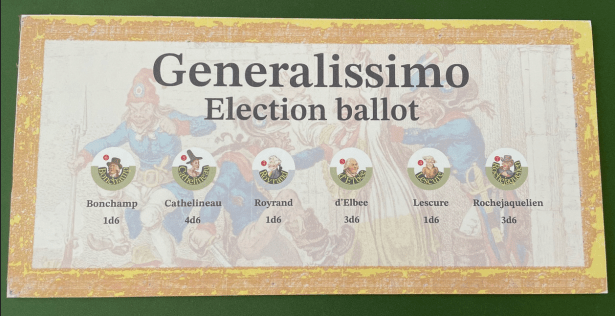
Andrew: The unique make up, lack of structure and command hierarchy, of the Catholic & Royal Armée needed to be represented. For example, a noble might command the army in one battle, then be commanded by someone who he had previously commanded in another battle. The constant vying for authority eventually led to the election of a Generalissimo, even though the Generalissimo was often simply a figurehead that other commanders chose to ignore, if it suited them.
Grant: What challenges does this campaign bring to the system? How did you address them?
Andrew: Mustering of peasants and National Guard had to be considered in the design and both had to be different. The Republicans controlled major towns and could raise the National Guard when threatened by Royalists, but the variable nature of the mechanism we’ve used means a successful muster is never guaranteed. The Royalists can ring the Tocsin in their heartland to muster peasants to the army, but these troops are often needed far away, leaving commanders at the front, exposed with few resources.
Grant: What is the makeup and differences between the Royalists and the Republicans?
Andrew: The Royalists have many excellent commanders and start the game in the strongest position with access to large forces. However, as time goes on, fewer new recruits are available and their commanders become exhausted, without many new commanders stepping forward to replace them.
The Republic starts very weak with only a handful of National Guard commanders and insufficient troops to stem the Royalist onslaught. However, time is the friend of the Republic, as events will introduce more and more Republican commanders accompanied by regular troops, while, at the same time, the Republic can keep calling on more citizens of France to bolster the National Guard to defend the revolution.
Grant: Why do the Royalist Commanders and peasants start hidden? What does this represent from the history?
Andrew: Religion and the right of worship with a priest that hadn’t sworn allegiance to the Republic was one of the key motivators of the Royalist side. Non-constitutional priests, as they were called, refused to swear an oath to the Republic, instead staying loyal to the Pope, causing the government in Paris to ban them from practicing. Many non-constitutional priests went into hiding, holding secret and illegal communion with their congregation within their parishes. The game uses this idea to hide all Royalist commanders from Republican forces with Non-constitutional priest markers, until the Royalist player is ready to reveal them.
Grant: What area does the map cover? Who is the artist and how does their style assist in creating theme and immersion?
Andrew: The map covers the area of Western France known as the Vendée Militaire; this covers roughly four departments in France and is bordered by Nantes, the Loire River to Saumur, South to Parthenay then back to the coast at Les Sables-d’Olonne. The art is inspired by satirical cartoons of the time as this was the medium that was most accessible to the average person of the day, who mainly received their news through printed pamphlets and paper articles.
Grant: What is the Tocsin symbol and what roles does it play?
Andrew: The Tocsin is a bell, usually the church bell and was rung by the Royalist leaders to gather the peasants from the local fields. In Donning the Sacred Heart, the peasants are held in different muster boxes associated with the three main Royalist armies. Commanders in a space with a Tocsin can be activated to ring the bell and gather troops from the corresponding muster box to create an army in that space.
Grant: What purpose do the various numbers appearing in each space on the board serve?
Andrew: The numbers in each space are the space value, this is the number of dice a player rolls to activate the space for movement, mustering National Guard or ringing the Tocsin.
Grant: For those that are not familiar, what is a Glory Rating? What role does it play in the game?
Andrew: Glory represents a combination of a commander’s historical skill and how lucky they appear to have been in the campaign. As glory is used up, the marker of the commander is moved down the number track to indicate their reduced rating. The glory of a commander is reduced to re-roll dice during the game at the rate of one glory point per single re-roll. Any dice can be re-rolled once by the owning player and any successful combat dice of an opponent can be required to be re-rolled once.
Grant: What is the purpose of the Events Clock? How does it work?
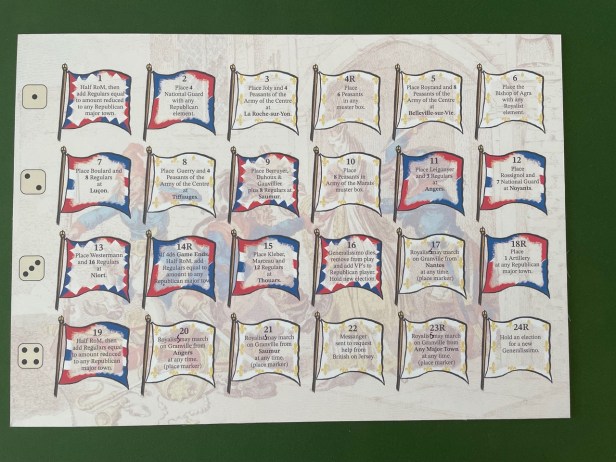
Andrew: The Event Clock drives the game; events occur randomly, neither player being able to influence which events occur. As the game progresses more events are introduced in a roughly chronological order, eventually the Event Clock will bring about the end of the game, but neither player knows how many turns the game will last or when it might suddenly end. I have made a short six-minute video explaining how the Event Clock works. Here is a link:
Grant: What is the makeup of the Combat Table?
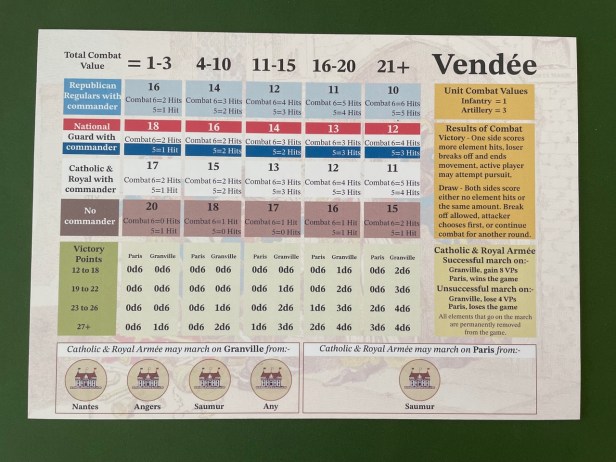
Andrew: The Combat Table is a matrix where you compare the combat strength, leadership and army type of each combatant, resulting in a numerical value that must be matched or exceeded before your force can inflict casualties on your opponents. It’s very simple to use and uses the same basic mechanic as everything else in the game.
Grant: How does combat work in the design?
Andrew: When one player’s elements enter a space containing elements from the other player, a combat must take place. Both players calculate the combat strength of their elements in the space, then consulting the same combat table they find the column that corresponds to that combat value. Looking down the rows until they find the army type and command status that corresponds to their situation, they then place their combat marker in the intersecting box. This tells them the total they need to score with four dice, and if they do, how many hits they will inflict for each 5 or 6 rolled. To make it more difficult, both players can re-roll their own dice once, at a cost of one Glory point from the most senior commander involved in the combat, then both players can require their opponent to re-roll any successful dice once, again at a cost of one Glory point per re-roll. After the final re-rolls, if there are any hits, casualties are removed, a winner is decided and the loser must break off.
Glory is the most important part of the game, as an exhausted commander, with no Glory left, becomes very vulnerable.
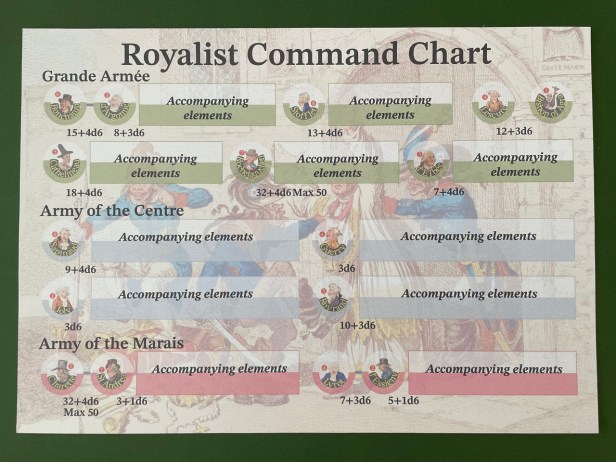
Grant: What is the Command Chart? How does this work?
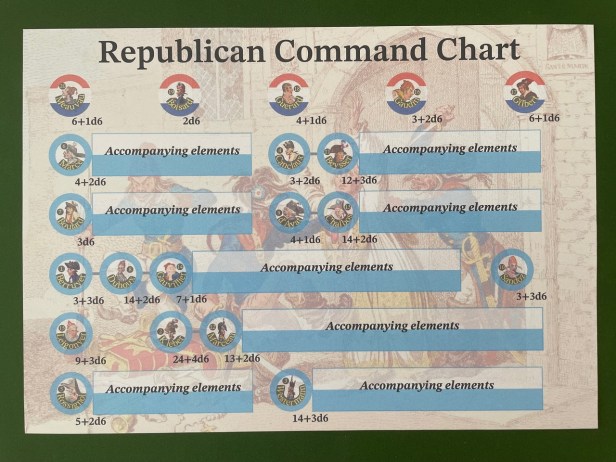
Andrew: Both players have their own Command Chart and during set up the two position and Glory markers for each commander are placed on the Command Charts. This tells the players the Glory Rating of each commander and their seniority over other commanders.
Grant: Can you show us examples of several different Command Charts?
Grant: What is the general Sequence of Play?
Andrew: A turn consists of an event being rolled for, on the Event Table, which is immediately carried out. Both players then simultaneously roll to obtain momentum markers, up to a maximum of four, and, if desired, re-rolling using the glory of their most senior commander. The player with the most momentum gets the initiative and acts first, alternating initiative as each momentum marker is placed. Once all momentum markers have been placed on the map, the turn ends, the momentum markers are removed and a new turn begins with an event.
Grant: What multiple strategic decisions are presented to the player every turn?
Andrew: Players are constantly faced with the dilemma of either re-rolling failed dice or saving glory for later. Failed dice can be re-rolled when activating for movement, mustering National Guard or ringing the Tocsin. During combat, your own and your opponent’s dice can be re-rolled, or when gaining momentum markers and marching on Paris or Granville. So many demands and often so little Glory, makes for some interesting decisions. There is no right or wrong; the game is designed to examine the effect of luck on destiny.
Grant: How is victory achieved?
Andrew: The Republican player must attempt to kill or capture as many Royalist commanders as they can, by fighting the Royalist armies and attempting to defeat them militarily. Each enemy commander removed from the board will gain the Republicans victory points, as well as each major town they control. If they reach 40 VPs they instantly win the game.
The Royalist player must capture the major towns on the map, representing the region of the Vendée Militaire and the surrounding area, displace the Republican’s from the region and defeat any Republican forces sent against them. Each combat they win against an enemy commander and each major town they capture, will gain them victory points. If they reach 40 VP’s they instantly win the game. Alternatively, victory may be gained by a successful march on Paris by a Royalist army.
If neither player reaches 40 VP’s, one player must have more victory points than the other player to win the game when event number 14 is rolled with four dice. This signifies that the Committee of Public Safety in Paris has run out of patience and ordered the infernal columns to finally destroy the Vendée uprising and end the game.
Grant: What are you most pleased about with the outcome of the design?
Andrew: The fighting in the Vendée was very peculiar to the region and set quite a few challenges for the Limits of Glory System to replicate. I feel the final design has achieved its goal in bringing a very thematic feel to the game. Both players are faced with the same problems the commanders on the ground had to cope with and both players will have to overcome these frustrations to win through.
Grant: What type of experience does the game create for players?
Andrew: I want players to feel all types of emotions when playing, I’ve tried to design the game so that at different times a player may feel that it is hopeless or, that they are certain to win. The emotional roller-coaster is caused by events being out of their control. I strongly feel that luck is what happens and skill is how you manage it.
Grant: What other designs are you currently working on?
Andrew: The next game in the Limits of Glory Series will be a change! We are moving back in time, 16 years, to the American Revolution. Jersey New Jersey will again be two games in one box, however they will be bigger than Santa Maura & Capri, having full size maps and four dice, instead of three. Jersey covers the French invasion of the island of Jersey just off the French coast, as part of the American Revolutionary Wars. This game has been designed by an excellent new designer called Peregrine Nicholls, who grew up on the island. New Jersey covers the ten days of Washington’s Trenton and Princeton campaign following his epic crossing of the Delaware.
Hopefully, Jersey New Jersey will be going to Gamefound at the end of the year, along with a new game I’ve signed by American designers Mark Kwasny and John Kwasny, called A Strong War. This is not a Limits of Glory game, instead it’s a new design by the brothers modelling the French & Indian War in a very exciting and fast paced way. More to come about this one soon…..
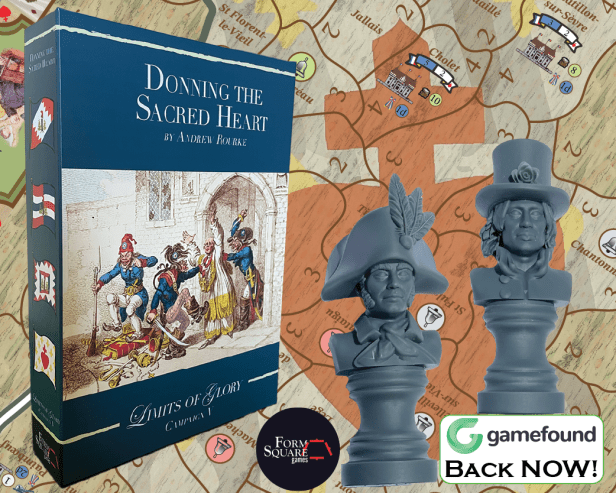
If you are interested in Limits of Glory Campaign V: Donning the Sacred Heart, you can back the project on the Gamefound page at the following link: https://gamefound.com/en/projects/form-square-games/donning-the-sacred-heart-limits-of-glory-campaign-v
-Grant
 The Players' Aid