We picked up Churchill back in 2014 when it first was printed. From what I could tell at the time was that it wasn’t getting a lot of buzz amongst board gamers on BGG and there were only 2 YouTube videos about the game where we could learn a little more (one from Mark Herman and his wife, the other from Stuka Joe). I realize now that I was wrong to a large extent about the presumptive popularity of the game. First, we had bought it while it was brand new so the buzz was just getting started in a major way. Secondly, Churchill is viewed by many as a wargame and as such many euro gamers are hesitant to give it the try it so rightly deserves. But the game system and what it is trying to do is just fantastic with its debating over issues, seeing those issues translate to action on the board in the further prosecution of the war and then the way that people work to coordinate their actions. Just a really solid system.
A few years ago, after playing all of the games in the Great Statesmen Series, we heard of a new game in the series from a designer not named Mark Herman and I was immediately interested and intrigued as we have had so much fun with Churchill, Pericles and Versailles 1919. Congress of Vienna from GMT Games is a diplomatic card driven wargame based on Churchill and is the 4th game in the Great Statesmen Series. The game is set during the years of 1813-1814 and sees players take on the role of the main characters of the struggle between the Napoleonic Empire and the coalition of Russia, Austria, and Great Britain with their Prussian, Spanish, Portuguese, and Swedish allies. We played the game recently while attending Buckeye Game Fest and then played a full campaign again while attending the World Boardgaming Championships and absolutely were amazed at the changes and innovations to the system introduced by the designer Frank Esparrago. I want to share my First Impression thoughts with you on the game in this post.
First off, Congress of Vienna has two different but related phases including the conference table where players first debate over the control of issues germane to the factions and the period of the war and second these issues are then used on the battlefield to recruit units, attack and take overall command of battles. The players will be playing cards from their hands to “debate” over the various issues that were placed on the table, which include all types of things such as Military Operations, Recruitment, who will lead the combined Coalition forces (Generalissimo), Future of French Government, British Financial Aid, Liberalism vs. Absolutism, Austrian Neutrality and several other issues, and then later the players will use their accumulated Resources gained from the issues to enact action on the Military Map and do things like mobilize troops, place Military Support Markers and the ultimately to conduct warfare.
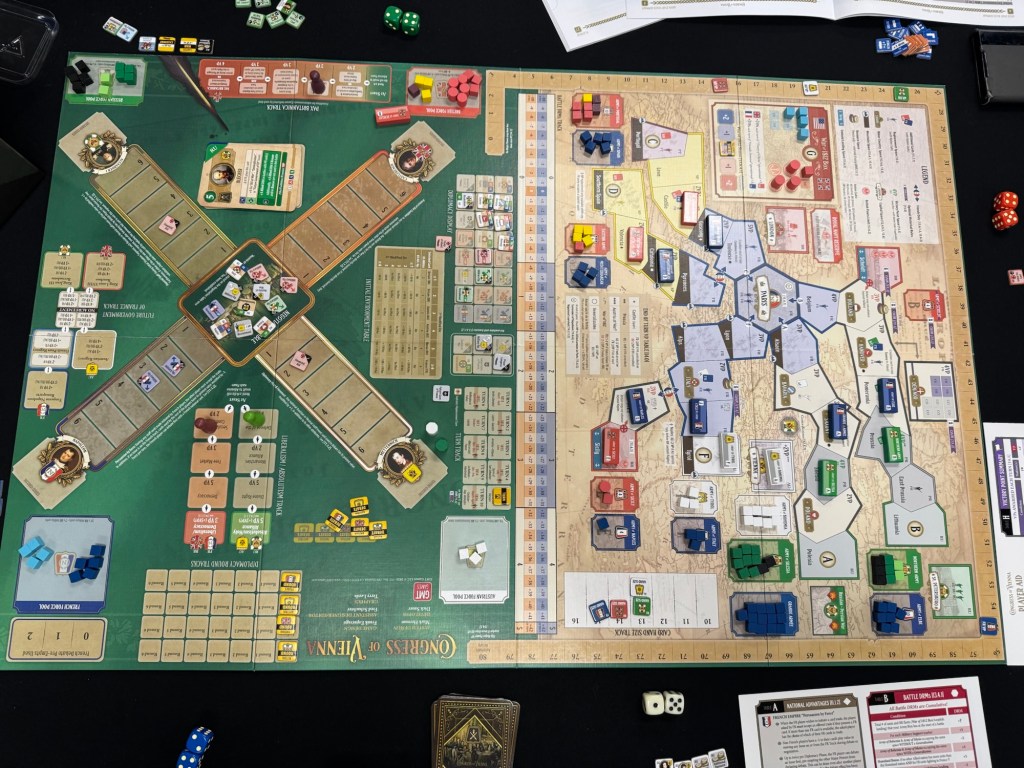
The interesting thing about this mechanic is that sometimes the other players will win your issues by having them rest on their side of the conference table at the conclusion of the phase. In this case, the winning player will gain control of that issue and then will get the opportunity to choose where the issues will be placed on the Military Map, but the owner of the issue will still pay for it and must do where the placement is telling them to do, such as attack on a certain front. There also is a small area on the board where the Russian player must turn their effort to fight in Asia. This action has no real in game effect or benefit other than causing Russia to lose the choice of what they wanted to do in favor of doing something else. This can be a great tactic for the French player, or even for other Coalition players to spoil the plans of the Russian player and possibly box them out of gaining VP for military victories on various tracks.
The game relies on cards and cards can be used to negotiate, i.e. move an issue to your National Track. Cards can provide a particular issue with positive and negative DRM’s depending on which nation plays them and can also be traded with another player during the Diplomacy Phase. Certain cards are better than others for debating an issue moved by another player; and finally, if they are saved for the War Phase, staff cards can be used to modify dice rolling in battles. These are very versatile cards and the players will have to learn them and their benefits in order to be effective at the game.
But even though the game relies on cards and has an important Diplomacy Phase, without a doubt CoV is a wargame with DRM’s for units and military leaders, terrain, military support, a Casualties Table, retreat and advancing after battle, etc. However, both Phases are inversely related and if players use their Character Cards in the form of generals and military leaders for the Diplomacy Phase you will not have them available for the Military Phase. If you do not win enough issues during the Diplomacy Phase, you will not have recruiting or military operations where they are most important to your power.
The Military Phase is very much a wargame like process where the players will make choices about where to place their Military Operations, whether to support those with Military Support Markers which add +3 to the battle, or whether to save cards from their initial hand of cards that are Battle Cards to use in the battles which also provide DRM’s to the totaling of military strength. If both players have placed 1 of their Military Operations issues on the same track, then the winner of the battle there at the end will then get to advance their army block on that track if they win the battle.
So how does this compare to the Military Phase in Churchill? In my opinion, the Military Phase in Congress of Vienna is much more involved and allows the players the opportunity to make multiple choices about what they want to do and how they wish to use their support. I really love Churchill, and will be ready to defend it against any form of slanderous attack, but feel that the process in CoG is better and less abstracted and makes the game feel very much more like a true wargame. I just think that the impact of the negotiation element and the integration with the military portion of the game is much more connected and impactful. I wouldn’t say that one is more important than the other, as players can and must score VP from both phases, but the Military Phase is where most of the VP’s will be scored and where the game will be won or lost! There are also some optional historical rules, that we didn’t play with, such as the Tactical Chits that will deepen and expand the military focus of the game. This again allows for greater customization and player choice in the game itself and choice is always a good thing in my mind.
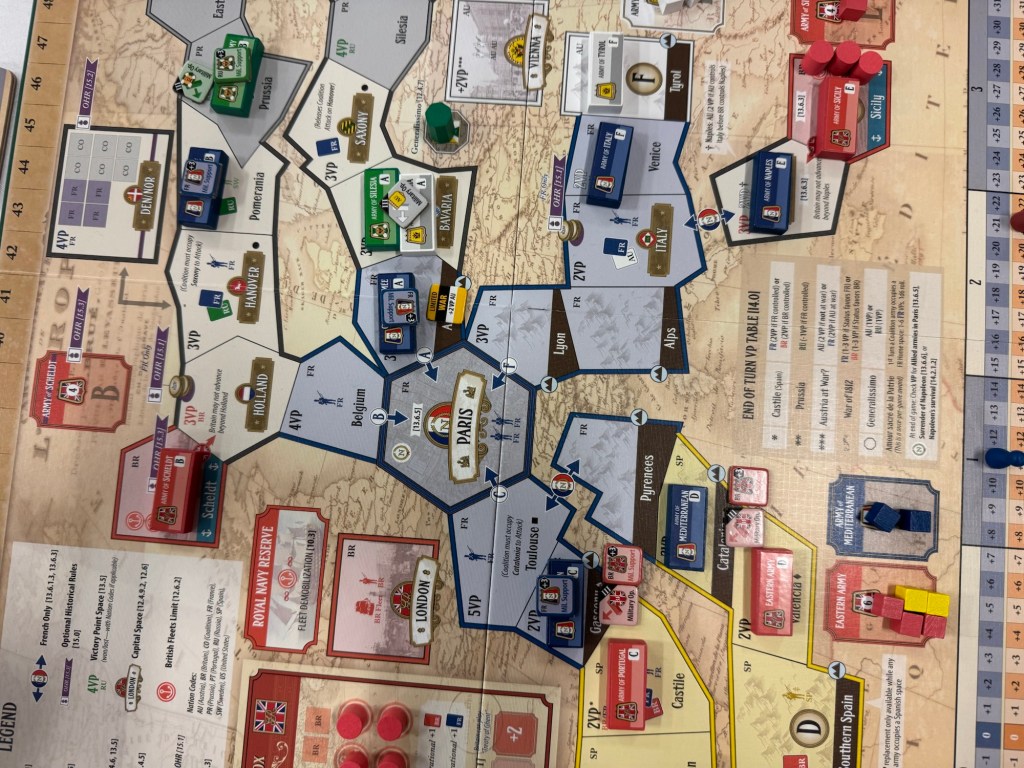
France has got to fight off the Coalition and their attempt to move on Paris. France cannot win the game if the Coalition forces enter the gates of Paris as Napoleon will surrender and the members who enter the space will gain anywhere from 5-8VP, which is a big swing near the end of the game. I also don’t feel like the Coalition can win the game is they do not mix it up and fight.
The game relies on a Situation Card being played at the beginning of each turn. These Situation Cards play the same role as in Churchill by placing issues on the negotiating table or upon the National Track of a player to situate them closer to historical reality. These issues really make the Diplomacy Phase very competitive and intense and is very much as good as it was in Churchill.
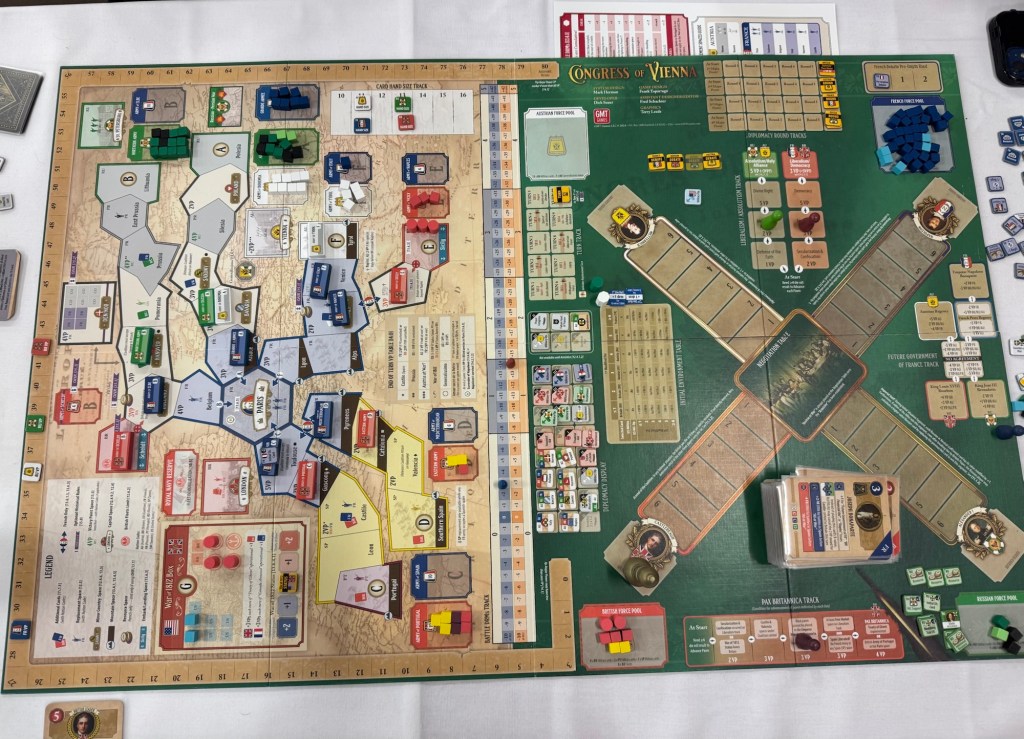
The Combat system is also very good and really fits with the design theory and approach. Combat involves various factors including how many military units are involved, the presence of terrain such as mountains, an amphibious landing, defending a home space, the presence of military support markers that represent fortifications, local militia, cavalry, artillery, various auxiliary/specialized units, and for the Allies, their Generalissimo, did an army choose a strategic retreat or to stand fast if using the tactics chits and then there are the combat cards which give important decisions about whether to increase your own DRM or decrease the opponent’s DRM, a dice roll of 2d6 for each side and then reference to the track to calculate losses. Losses are then used to determine the battle’s winner, loser or if the result is a stalemate with possible VP won or lost including an armies retreat or advance. All of these aspects are pretty standard for a Napoleonic wargame!
I really feel like the combat system is very easy to use and takes into account everything a wargamer expects from a Napoleonic battle at a grand strategic level. This includes the influence of the overall military and the effects of a generals’ performance with ground, auxiliary, cavalry and artillery, including coordination between corps. But this is just lumped together and doesn’t include a lot of unnecessary detail or calculations to complete to finish a battle. Its just add up all of the DRM’s and then each side rolls 2d6 and adds them together to determine the number of losses that are printed on the battle chart.
I would say that the game is very involved and will take a few plays to really get comfortable with. I don’t want anyone to take this to mean that the game is overly complex and difficult to play. That is not the case. It is a very approachable system and game once you get the basics down through the play of a few turns. I would also say that there is a ton of differences and asymmetry with the nations and learning all of them well and understanding their tactics will take some time. But that is a good thing in my opinion and means that there is depth to the game and replayabilty is huge.
One other aspect that really surprised me was the game end and how it possibly changed history. In our 2nd play recently at WBC, I was playing as the British and during Turn 9 really worked hard with the French player by trading him his best combat cards and other French cards to help him out all the while trying to get what I needed to move up on the fronts. I was most concerned about the prospect that both Russia and Austrian with their combined central front forces would easily break into Paris and gain a significant amount of VP’s. We also both negotiated hard to keep the Generalissimo issue from landing on either Russia or Austria’s track as we wanted to deny them the opportunity to combine their forces to crush Paris. It worked and France was able to win a battle driving the forces back and keeping them from being able to enter Paris. To this end, as we worked together, I really thought about what that meant for the game and the history and decided that it makes perfect sense as we picked over the dying carcass of the French Empire. I loved this aspect of the game and our combined efforts and if we dug deep enough, or better yet, were in those rooms during the negotiations would find that those type of back channel deals were being floated out there but not necessarily being recorded for history’s sake.

After playing now a few times, I am here to say that Congress of Vienna is probably my favorite game in the Great Statesmen Series. I believe that this game has matured the system and made it something that is more than where it started. Congress of Vienna is very much more like a true wargame and was extremely interesting. We are still learning and need to keep playing this one but I did enjoy what it was that we were doing.
-Grant
 The Players' Aid
I was having a similar chat with friends about game complexity/difficulty earlier today. In our case Paths of Glory. There are different levels of the learning curve – the rules and basic mechanics aren’t bad, but there are some learning items you can’t understand until you play:
Same sort of thing with Twilight Struggle or COIN games – the mechanics aren’t bad, but there is almost no way to understand the flow of the game without just playing it a few times.
With Churchill (and three newbs) and I think we got a handle on the game pretty quickly/easily after getting through the rules – some games are complex when learning, some when playing (some are both).
LikeLiked by 1 person
Thank you for some useful details and opinion. It is helping me decide to seek out the game.
LikeLiked by 1 person
Congress of Vienna is an enjoyable game, and you give some sense of what it’s like to play. Sadly though, everything you say about the history is straight from your imagination!
LikeLike