
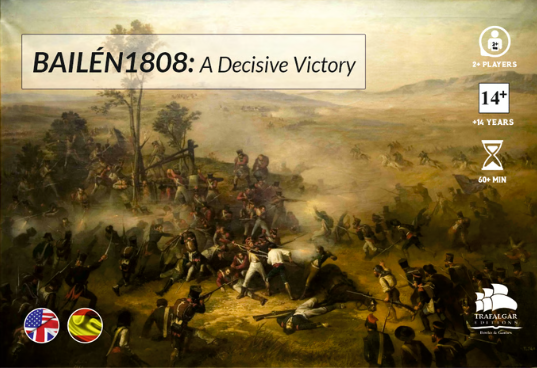
Recently, I noticed a new game from Trafalgar Editions that was being offered on Kickstarter called Bailén 1808: A Decisive Victory. The game covers the clash between the French and Spanish in 1808, which saw a defeat of Napoleon during the Peninsular War. We reached out to the designer Crisanto Lorente Gonzales and he was more than willing to speak with us and answer our questions about the game.
If you are interested in Bailén 1808: A Decisive Victory, you can back the project on the Kickstarter page at the following link: https://www.kickstarter.com/projects/1615432558/bailen-1808?
Grant: Welcome back to the blog, Crisanto! How have you felt about your 2 recent crowdfunding campaigns for Afrika Corps ’41 and Poland ’39?
Crisanto: Thanks for having me! We’re incredibly pleased with the reception of both Afrika Korps ’41 and Poland ’39. Although Afrika Korps didn’t quite fund, we’ll be re-launching it in a few months as the initial reception was genuinely positive. These games allow us to bring these historical conflicts to life for wargamers. The support from our backers was fantastic, and it validates our commitment to creating immersive and accurate historical games. We learned a great deal from both campaigns, which has informed our approach to Bailén 1808, aiming to make it our best project yet.

Grant: What is your new upcoming campaign Bailén 1808 about?
Crisanto: Bailén 1808 transports players to the scorching summer of 1808, right in the heart of the Peninsular War. It’s a historical wargame that meticulously recreates the pivotal Battle of Bailén, an unexpected clash that marked a significant turning point against Napoleonic dominance. Players will command either General Dupont’s seasoned French divisions or the determined Spanish forces, a mix of regulars and patriotic militiamen, as they vie for control of the undulating hills and ancient olive groves.
Grant: What does the tagline “A Decisive Victory” refer to?
Crisanto: The tagline “A Decisive Victory” refers directly to the historical outcome of the Battle of Bailén. It was a truly significant and unexpected Spanish victory over a major French army, leading to the first large-scale surrender of a Napoleonic force in open battle. This victory had immense strategic and psychological impact, boosting Spanish morale and inspiring resistance across Europe against the French Empire.
Grant: Why was this a subject that drew your interest?
Crisanto: Bailén drew my interest precisely because of its historical significance and its often overlooked nature in English-language wargaming. It’s a classic underdog story—a combined force of regular Spanish troops and passionate militia achieving a major upset against a seemingly superior Napoleonic army. The tactical challenges presented by the terrain, the unique characteristics of the opposing forces, and the dramatic narrative of the battle itself made it an incredibly compelling subject to explore.
Grant: What is your design goal with the game?
Crisanto: My primary design goal for Bailén 1808 is to provide a highly immersive and historically accurate simulation of the battle, while keeping the rules accessible and easy to learn. We want players to feel the tension, have to make tough strategic decisions, and experience the ebb and flow of a Napoleonic-era engagement without getting bogged down in overly complex mechanics. We aim for a game that is deeply strategic, reflects the historical nuances of the Peninsular War, and offers high replayability.
Grant: What from the Peninsular War was important to model in the game?
Crisanto: Several key aspects of the Peninsular War were crucial to model:
- The varied quality of forces: Reflecting the disparity between elite French units, seasoned Spanish regulars, and fervent but less disciplined militia.
- The impact of terrain: The rolling hills, olive groves, and streams around Bailén played a significant role, so their effects on movement, combat, and fire are essential.
- Fatigue and morale: The Spanish heat, extended marches, and the psychological toll of battle were critical factors, hence the importance of our Fatigue and Initiative mechanics.
- Command and control: The ability of commanders to influence and rally their troops was vital, which we represent through our HQ mechanics and command range.
- Combined arms: The interplay between infantry, cavalry, and artillery, and their strengths and weaknesses against each other.
Grant: What sources did you consult about the details of the history?
Crisanto: For historical details, I consulted a wide range of primary and secondary sources. Key works included:
- A History of the Peninsular War by Charles Oman: A monumental and highly detailed classic.
- The Peninsular War: A New History by David Chandler: Provides a modern perspective with excellent analysis.
- Spain’s First Great Victory: The Battle of Bailén, 1808 by Adrian J. M. Hill: A specific focus on the battle itself, offering crucial tactical insights.
- Spanish historical archives and military treatises from the period, whenever possible, to gain local perspectives and specific unit details.
Grant: What one must-read source would you recommend?
Crisanto: If I had to pick just one, for specific insights into the battle, I would highly recommend Spain’s First Great Victory: The Battle of Bailén, 1808 by Adrian J. M. Hill. It offers a focused and detailed account that is invaluable for understanding the intricacies of the engagement.
Grant: What other games did you draw inspiration from?
Crisanto: While Bailén 1808 builds upon our established system from Waterloo 1815 and Austerlitz 1805, it excels with clear, unobstructed gameplay on the map and quick resolution. Games that successfully combine historical detail with streamlined mechanics have always been a benchmark for us.
Grant: What has been your most challenging design obstacle to overcome with the game? How did you solve the problem?
Crisanto: The most challenging design obstacle was accurately modeling the Fatigue system and its interaction with Initiative in a way that felt historically authentic without becoming overly burdensome to track. We wanted fatigue to truly represent the cumulative effects of marching, fighting, and the summer heat, impacting unit effectiveness and morale, especially for the Spanish forces who were often less supplied.
We solved this by iterating through several different versions. Initially, it was too granular, making bookkeeping a chore. We simplified the application and removal of fatigue markers, tying them directly to unit actions and command influence. For instance, the Spanish player’s unique ability to remove fatigue from any unit (representing local support) was a solution to ensure their historical resilience was modeled effectively without making them overtly powerful. This balance allows fatigue to be a crucial strategic element that players must manage actively.
Grant: How does the game use blocks?
Crisanto: The game uses 51 wooden blocks of different sizes to represent various unit types (infantry, cavalry, artillery, and HQ’s). These blocks are placed directly on the map, which is not divided into areas or hexes, offering complete freedom of movement. Adhesive labels are applied to the blocks to display essential unit information like type, formation, and values.

Grant: What different types of units are included?
Crisanto: The game includes four main types of units:
- Infantry: The backbone of armies, including Line, Light, Guard, and Elite (French Elite) Infantry.
- Cavalry: Mobile units for scouting, charging, and pursuit, including Light, Medium, and Heavy (French) Cavalry.
- Artillery: Provides long-range fire support, including Foot and Horse Artillery.
- Commands (HQ): Represent leaders and their staff, crucial for morale and coordination.
Grant: Do any of these units provide special abilities or attacks?
Crisanto: Yes, several units and unit types provide special abilities or attacks:
- Artillery can perform Canister Shot at close range for devastating effects.
- Cavalry has special Charge rules and modifiers but also specific restrictions against certain formations (like squares) or terrain (like towns/forests).
- Elite units (e.g., French Elite Infantry) often have enhanced combat capabilities.
- Commands (HQ’s) are crucial for morale checks and fatigue recovery, providing a vital support role. The Spanish faction also has a unique ability related to fatigue removal due to civilian support.
Grant: How does combat work in the game?
Crisanto: Combat in Bailén 1808 is resolved through a series of distinct phases:
- Declaration of Combat/Charges: Charges are declared at the beginning of the Movement Phase, while general combats are declared at the end of it. Units move into contact or are already in ongoing combat.
- Musketry Phase: Infantry units within range conduct fire, with the defender firing first.
- Combat Phase (Close Combat): Units in contact engage in close combat. Each side rolls 1d6. The attacker applies all relevant modifiers (unit type, formation, terrain, received fire, etc.). The defender only applies their base combat modifier. The results are compared, and the loser consults a combat results table based on the difference, applying effects like morale checks, disorganization, or elimination.
- Continued Combat: Engaged units remain marked with a combat marker and are obligated to continue fighting in subsequent turns unless they successfully disengage in the Reorganization Phase.
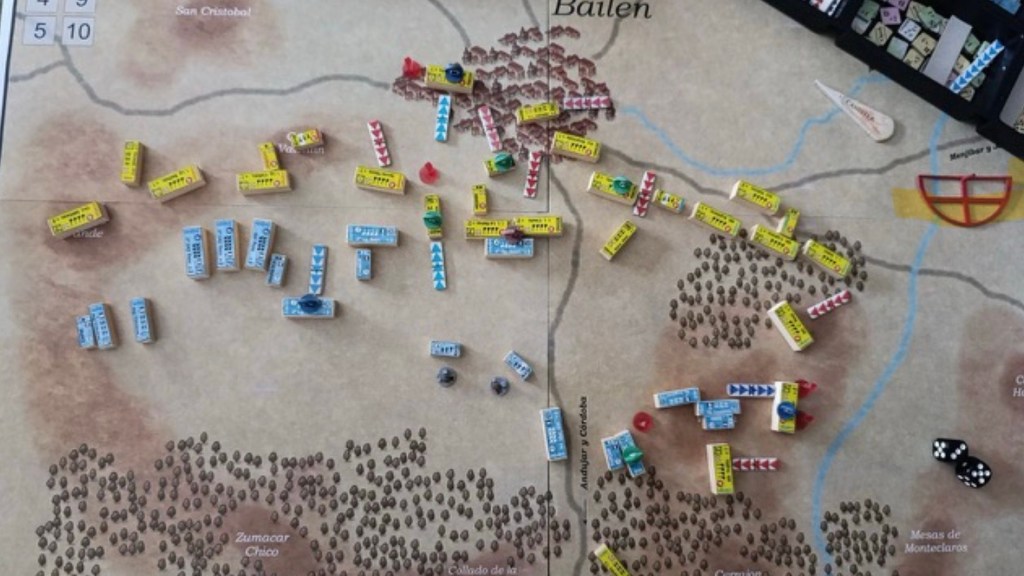
Grant: What is the role of the Leaders and what benefits do they provide?
Crisanto: Leaders, represented by Headquarters (HQ) units, are crucial for command and control. Their primary roles and benefits include:
- Morale Influence: Units within an HQ’s command range benefit from their presence during morale checks, often making them more resilient to adverse events.
- Fatigue Recovery: During the Fatigue Recovery Phase, HQs can attempt to remove fatigue markers from units under their command, keeping troops fresh and effective.
- Activation/Coordination: While not explicitly a “move all units in range” mechanic, their positioning is vital for coordinating attacks and ensuring units are supported.
Grant: What is the concept of Fatigue and why is it important to the design?
Crisanto: Fatigue is a core mechanic representing the accumulated exhaustion and weariness of units due to marching, prolonged combat, exposure to heat, and lack of supplies. It’s important to the design for several reasons:
- Historical Realism: It accurately models a critical factor in Napoleonic warfare, especially in the harsh conditions of the Peninsular War.
- Strategic Depth: Players must manage their units’ fatigue levels, deciding when to push them and when to rest them, adding another layer of strategic decision-making. Overly fatigued units become less effective in combat.
- Asymmetrical Gameplay: It allows for nuanced differences between factions; for example, the Spanish historical ability to resist fatigue due to local support.
Grant: What is the General Sequence of Play?
Crisanto: A full game turn spans two individual player turns (Attacker then Defender) and simulates approximately 60 minutes of real time. The general sequence of play for each player’s turn is:
- Initiative Phase (Optional): Determine which player has the initiative for the turn.
- Reorganization Phase: Units attempt to recover from disorganization or disengage from combat.
- Artillery Phase: Artillery units from both sides fire (Defender’s first, then Attacker’s).
- Movement Phase: The active player moves their units; charges are declared at the start of this phase.
- Musketry Phase: Infantry units conduct ranged fire (Defender’s first, then Attacker’s).
- Combat Phase: Units in contact engage in close combat.
- Fatigue Recovery Phase (Optional): Commanders attempt to remove fatigue from units.
Grant: What is the objective of each player? How is victory achieved?
Crisanto: The specific objectives can vary slightly depending on the scenario, but the overarching objective is to control key strategic locations on the map and/or eliminate a certain number of enemy units.
Victory is typically achieved by:
- Controlling designated victory locations at the end of the game or for a specified duration.
- Inflicting a certain amount of casualties or eliminating a specific number of enemy units (often represented by morale points or unit strength).
- Sometimes, specific historical objectives, like preventing an enemy breakthrough or holding a vital line, will determine victory.
The game encourages aggressive maneuvering and decisive engagements to secure objectives.

Grant: What different scenarios are included? How do they differ?
Crisanto: This time, we aren’t including multiple scenarios in the game. The map’s size and the nature of the battle itself somewhat limit the possibility of different scenarios.
Grant: What do you believe the game does really well in modeling the battle?
Crisanto: I believe Bailén 1808 does an excellent job of modeling several key aspects of the battle:
- The brutal impact of fatigue and heat: The optional Fatigue system truly captures the toll the Spanish summer took on both sides, especially the French.
- The decisive role of terrain: The clear, unencumbered map allows for organic movement and makes the rolling hills and olive groves tactically significant, influencing line of sight, movement, and combat.
- The feeling of combined arms: The distinct rules for infantry, cavalry, and artillery encourage players to use them synergistically, just as historical commanders would have.
- The narrative of the unexpected Spanish victory: The game’s mechanics, particularly those related to morale and the Spanish special abilities, allow players to experience how the Spanish managed to achieve their historic upset.
Grant: What has been the experience of your playtesters?
Crisanto: Our playtesters have consistently provided enthusiastic feedback. They particularly appreciate the easy-to-learn system combined with its deep strategic elements. They enjoy the freedom of movement on the uncluttered map and find the Fatigue and Initiative mechanics to be engaging and realistic, adding a crucial layer of decision-making without being overwhelming. Many have commented on the high replayability due to the dynamic nature of the battle. The consensus is that it delivers an immersive and challenging Napoleonic wargaming experience.
Grant: What other designs are you working on?
Crisanto: We’re always busy at Trafalgar Ediciones! While our primary focus right now is on Bailén 1808 and ensuring it’s the best possible game for our backers, we have several other projects in various stages of development. We’re exploring other pivotal battles and campaigns from the Napoleonic Wars and potentially other historical periods, always with our core design philosophy of historical accuracy, immersive gameplay, and accessible rules in mind. Stay tuned to our blog and social media for future announcements!

If you are interested in Bailén 1808: A Decisive Victory, you can back the project on the Kickstarter page at the following link: https://www.kickstarter.com/projects/1615432558/bailen-1808?
-Grant
 The Players' Aid