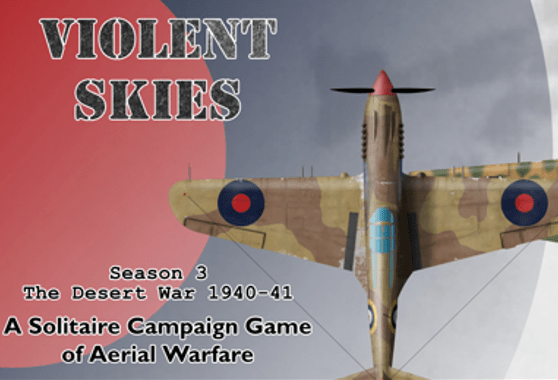
In the category of new and small publisher I knew nothing about, over the past few years I found a new game series called Violent Skies from Pocket Warfare Publishing. These games are print ‘n play games and are available on the Wargame Vault website. We did an interview with the designer Ben Rawlings on the first game in the series called Violent Skies: Season 1 1940 – Dynamo to the Blitz that dealt with aerial combat during WWII and start of World War II. The game has a subtitle of Season 1 and now they are working on the follow-up volumes. The 3rd volume in the series is called Violent Skies – Season 3 The Desert War 1940-41 and looks really good. I reached out to the designer Ben Rawlings and he was more than willing to discuss his design and the future plans for the series.
If you are interested in Violent Skies – The Desert War, you can order a copy for $9.50 from the Wargame Vault website at the following link: https://www.drivethrurpg.com/en/product/512054/violent-skies-1940-41-the-desert-war

Grant: What is your new release for Violent Skies – The Desert War about?
Ben: The Desert War is about the 1940-41 period of the North African Theater aerial fighting during the Second World War. The game puts you in the role of an individual pilot in the main fighter aircraft of the RAF, Luftwaffe and Regia Aeronautica (with a free Vichy French expansion coming).
Grant: Why was this a subject that drew your interest?
Ben: The North African campaign was a constant tug of war until the end of 1942 where both the Axis and the Allies exchanged victories and defeats while constantly battling the extreme desert conditions. That in itself makes for a really engaging period of the Second World War to study, but the air war is a very different beast. Unlike the aerial fighting in Northwestern Europe, the Desert War saw obsolescent types fighting amongst some of the most modern. The first fights between Gladiator Biplanes and the Italian CR.42 soon gave way to Hurricanes, 109’s and Italian monoplanes that lagged behind their RAF and Luftwaffe contemporaries, yet still achieved some impressive results.
Grant: What is your design goal with the expansion?
Ben: The first goal was to continue the Violent Skies Series into its logical next step which was the desert: you can take a pilot you had in the Battle of Britain and start a new campaign with any skills you have gained and start fighting in the desert. The second was to include some lesser known types that don’t often get included in games. The whole stable of Italian fighters are often overlooked. The RAF also used Gloster Gladiators for the final time in the desert and were the last biplane fighters of the RAF. I thought it was a good opportunity to have the Fleet Air Arm Martlet included, better known by their official US name the Wildcat. They saw limited land-based use in the desert in 1941/42.
Grant: What elements from WWII and specifically the period of North Africa are most important to include in the design?
Ben: The lack of radios in the Italian fighter aircraft was the first thing I really wanted to include. Co-ordination between fighters with hand signals was not ideal in the First World War, and by 1939 it was a massive hindrance and was often a factor in the poor outcome for the Italians in a lot of early battles with the RAF. This meant a change to the wingman rules for the Italian aircraft without fitted radios. It also allowed for an Event to restore the standard rule for the few aircraft that did have them. Furthermore, having Events that modelled the constant changing of basing, playing with the aircraft endurance, as well as the chaos of finding aircraft above or below you. These were all factors that came clear from the research that I did that needed to be included. I also had to make sure the biplane fighters had their own feel when playing with them. This is manifested in poorer statistics against faster aircraft, but bonuses against other biplanes and slow bombers.
Grant: What research did you do to get the details correct? What one must read source would you recommend?

Ben: Quite a lot of money has been spent on Osprey Books! A great single source for the RAF would be The Desert Air Force World War II: Air Power in the Western Desert 1940-1942 by Ken Delve. This was insightful in creating the Events and Bandit mix for the RAF aircraft. The Gladiator vs CR.42 Osprey Duel Series is a great read, as was the various Aces of World War 2 Series. Macchi Fighters by Luigino Caliaro was really good for researching the C.200 and the forthcoming C.202. German sources for the desert are plentiful given the larger-than-life pilot accounts from the period. The Luftwaffe in Africa 1941-1943 from Casemate Illustrated is a good timeline with a wonderful set of photos. The ultimate though is A History of The Mediterranean Air War, 1940–1945 by Christopher Shaw. This is a massive multi-volume work that is pretty much the only thing you would need to read to know about the Mediterranean air war, but does require you to set aside a lot of reading time! I also grabbed a series of the Operational Record books of 112 Squadron from the UK’s National Archive. Not only was having a primary source amazingly helpful, it really is an incredible connection with history to have the real record books to draw inspiration from.
Grant: How does the game use a game card that acts as your cockpit?
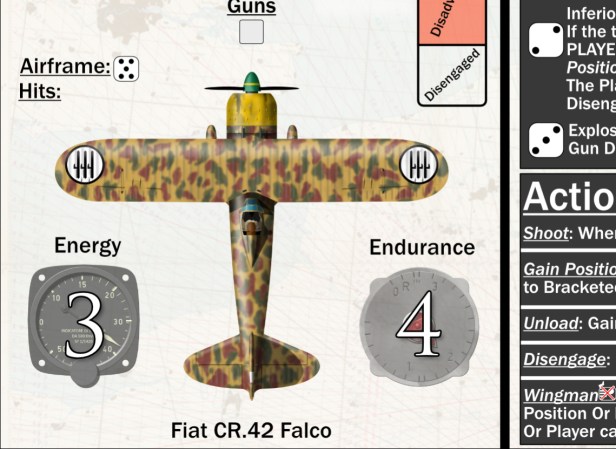
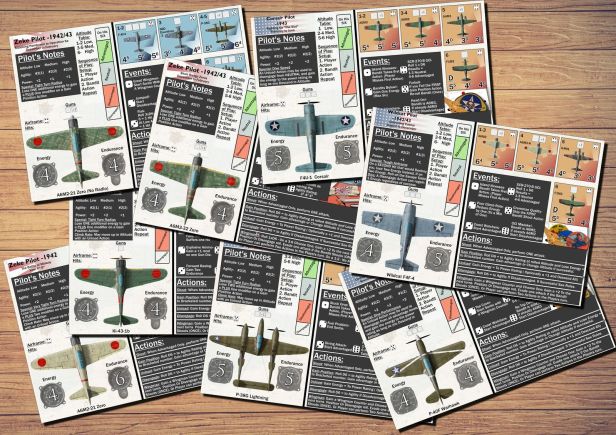
Ben: The main part of the game is played on a card that has a top-down picture of your aircraft and all the information needed to fly it and track that information. You have an Energy and Endurance track, using one D6 for each. Energy is your life. It lets you Gain Position to hopefully shoot down your Bandit. Endurance is the game’s turn marker. When it gets to one, that is your final turn. The Endurance is a reflection of your aircraft’s fuel capacity, fuel burn and basing location. You also have an Altitude track which will affect your performance when performing certain actions. It is through the Endurance, Energy and Altitude tracks that the Player makes their decisions on what action to perform. Much like a real aircraft, you won’t be undertaking any maneuvering while sitting at stall speed!
Grant: What is the layout of the game cards?
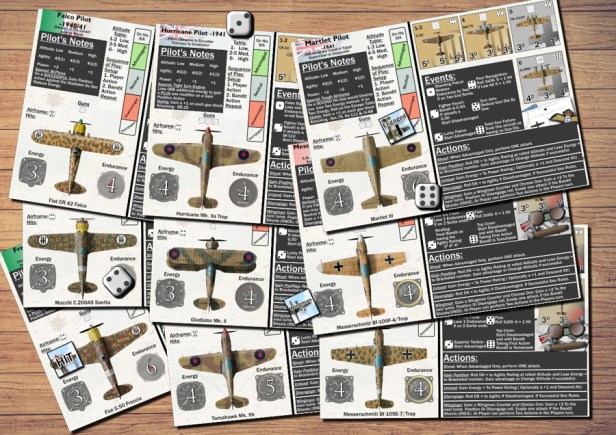
Ben: The game cards are laid out with the left side of the card being the Player’s “Cockpit” with the Energy, Endurance, Altitude and Advantage tracks. The aircraft’s performance, guns and special rules are also on this part of the card. The right side of the card is where you have the non-player controlled elements, such as four Bandits to be randomly selected, and the six Events. There is also a “Checklist” for all the Player actions on this side of the card.
Grant: What different elements of the plane are tracked during a mission?
Ben: The aircraft’s Energy is the most critical thing to be tracked during missions. This is the “currency” which you exchange to Gain Position. If you would have to reduce the energy to below one, you cannot perform the action. The Player will have to balance gaining Energy through other actions, and losing it to maneuver.
Grant: How also does this game card double as a mission generator?
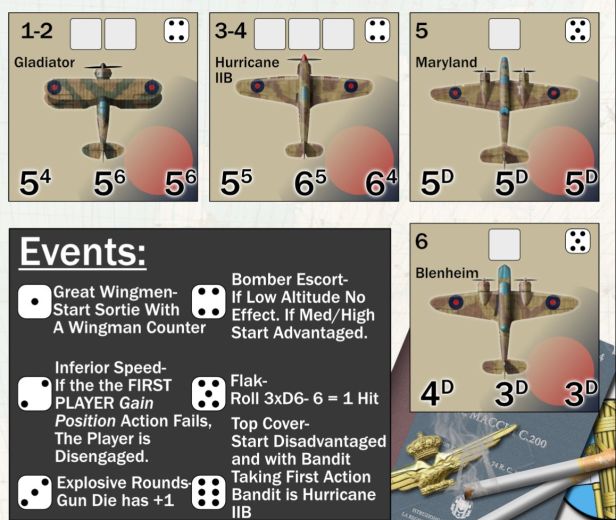
Ben: The Sortie Card also has a selection of four Bandits (enemy aircraft) and six Events. During the setup the Player will roll for Altitude, Bandit and Event. From this a mission is generated. A typical Sortie from these relatively simple systems will allow players to get a rich narrative with plenty of decisions to make to win or lose.
Grant: What different planes are available to fly?
Ben: Gladiator, Hurricane Mk IIa Trop, Tomahawk IIb, Martlet III, MC.200, G.50, CR.42, Bf-109E7/F4 Trop, Bf-110C and an upcoming free update with the D.520 in Vichy Control and the venerable, or perhaps vulnerable Fairey Fulmar.
Grant: How did you differentiate each plane?
Ben: The starting Energy and Endurance of each aircraft is the most obvious change depending on their speed and fuel performance. Then it would be the Agility ratings for each Altitude band. Low, Medium and High all have different Agility and Power ratings to model some of the strengths and weaknesses of WWII designs. Then there is the Special rule which gives the plane a positive or negative change, depending on the aircraft’s characteristics beyond the scope of Agility and Power. Some aircraft get bonuses to Agility, for others their climb rate allows them to disengage at will. Some have defects that negatively affect some things.
Grant: What was this differentiation process like?
Ben: It normally starts in a notebook making a table of the top speed, cruise speed, never exceed speed, climb rate, wing loading and range. From there, comparisons are made with other aircraft and that is how the statistics are done. Anecdotal evidence also may swing a statistic as well.
Grant: What is the general Sequence of Play?
Ben: In a standard campaign game you will first roll for weather. The weather result will then determine the Takeoff and Spotting roll. Once the Spotting roll is done you move onto the Sortie Card. Rolling for Altitude, Bandit type and the Event. The Player then takes the first action and then the Bandit will take theirs. Some Events may let the Bandit take the first action making the Player lose a turn. At the end of the Bandit’s turn, Endurance is reduced by one. When the Endurance reaches one, the Sortie is over, and a Landing roll is made. Recording any success or events of note in the Player Logbook.
Grant: What is the Advantage Track and how does it work?

Ben: The Advantage Track is the heart of the system. A Player or Bandit gains position as the Player can only shoot when advantaged and a Bandit may only shoot when the Player is disadvantaged. This scale represents maneuvering aircraft. A Gain Position action, using the Agility and Power ratings at the current Altitude determines the position on the Advantage Track.
Grant: What different Skills do players have access to choose?
Ben: Skills come in two types. Ace Skills and Pilot Skills. Ace Skills are gained using points earned from shooting Bandits down, while Pilot Skills are gained by number of Sorties flown. The Ace Skills give Players combat bonuses, such as recording two hits a turn rather than one, or giving a bonus on the spotting table. The Pilot Skills give the Player re-rolls on the Takeoff and Landing Tables, chances to begin with higher Endurance or Energy depending on the Player’s flying style and even getting “on his six” which grants a powerful bonus to Players who have survived multiple campaigns.
Grant: What was the greatest challenge in the design you had to overcome?
Ben: With the initial release it was trimming unnecessary detail that added little to the gameplay. With The Desert War, I would say it was getting reliable information on the Italian aircraft, their doctrine and equipment. Books were bought, forums explored and a fair bit of help from a lot of knowledge folk on the internet. From a graphics standpoint the very lovely spotted camos on the Italian and Luftwaffe aircraft took a long while and were done by hand. Getting the shading right on the fabric winged biplanes was also a challenge, a very fun one though!
Grant: What changes have come about through play testing?
Ben: This time around it was mainly just tuning the statistics of some aircraft and removing or re-wording Events. Play-testing also highlighted a few areas where the rulebook needed some more examples with some of the new features of this system. I also have had some post-release questions which I am always very happy to get. These have led to some great conversations which have also directed some upcoming new aircraft for the game and a growing wishlist of future additions.
Grant: What do you feel the game design excels at?
Ben: I said in the interview I did for the Dynamo to the Blitz release that you can get plausible and fun results in a very quick-playing game, while occupying very little space. It also has very little-to-no crafting for a print and play. A pair of scissors for three counters is all you really need, but these can be substituted with a pencil or played on a tablet. I think that is still true, but now players who wish to get more from the system have skills, ranks and awards to explore. All optional of course!
Grant: What new subjects or theaters are you contemplating for this system?
Ben: That is a dangerous question. Currently I am tweaking the Pacific pack which will cover the 1942 carrier battles and the Cactus Air Force into early 1943. That is almost done with only proofing to be done and the ranks and awards for Japan. So F-4Fs, A6Ms, P-400/P-39s, P-38s, the first F-4Us, and the Imperial Japanese army’s Ki-43 which arrived in late 1942. I then have an Eastern Front pack, Desert War 2: 1942-43 and a 4th Fighter Group Story campaign that follow the Debden Eagles from the RAF right through to the P-51D in the USAAF. So lots to be done and I am grateful for everyone who is playing the system. It is great fun to make. I want to make it a player-driven game so feel free to get in touch with anything you would like to see added to the system.
Thanks so much for your time in answering our questions Ben. The game looks great and I am glad that we have been able to share this interesting looking little game with our readers. Hopefully, we will have you back on the blog again for future interviews.
If you are interested in Violent Skies – The Desert War, you can order a copy for $9.50 from the Wargame Vault website at the following link: https://www.drivethrurpg.com/en/product/512054/violent-skies-1940-41-the-desert-war
-Grant
 The Players' Aid